Results by title
4030 books match the query 'Language Arts & Disciplines' and 196 start with m

Metadata for Digital Collections
A How-To-Do-It ManualSteven Jack Miller
American Library Association, 2011
Metadata in Practice
American Library Association, 2004
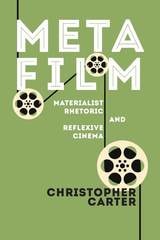
Metafilm
Materialist Rhetoric and Reflexive CinemaChristopher Carter
The Ohio State University Press, 2018
Ultimately, Metafilm reframes materialism as a multimodal composing-in-action, or reflexive materialism, focusing on movies that dramatize their entanglement in economic and historical trauma while provoking forms of resistance during and after viewing. Carter contends that even as we recognize the division of social power in the films, we must also recognize how the concept is subversive and eludes control. In looking at the interplay between the films’ content and their production, circulation, and reception, Carter explores how the films persuade us to identify with onscreen worlds before probing our expectations—validating some, rejecting others, and sometimes proposing new ways of watching altogether.

Metalinguistic Development
Jean Émile Gombert
University of Chicago Press, 1992
language correctly. Later comes the precocious ability to
“reflect” upon and deliberately control its use.
Metalinguistic development, or the emergence of a reflective
attitude to the comprehension and production of oral and
written language, must be distinguished from that of ordinary
verbal communication.
This is the first book to review and analyze what is
known about metacognitive processes in relation to language.
Each of its seven chapters deals systematically with the
relationship between the comprehension and production of the
phonetic, syntactic, semantic, pragmatic, and textual aspects
of language. This material is then related to the
metacognitive principles which govern reflective awareness.
A concluding chapter deals with written language and
metalinguistics.
Jean Émile Gombert's novel description of processes such
as the understanding of metaphor and humor in relation to
pragmatics and his suggestion that metalinguistic knowledge
is intimately connected with literacy contribute to a fuller
understanding of the stages of language acquisition and
mastery. With clarity and insight, Metalinguistic
Development reveals how the capacity for reflection gives
rise to emergent properties of the language system.
“A clear, critical, and interesting book about
an important topic which has not been reviewed properly
before. I particularly like the way that Jean Eacute;mile Gombert
combines a comprehensive account of American work with a very
impressive knowledge of European work.”—Peter Bryant,
University of Oxford
Jean Émile Gombert teaches genetic psychology at the
University of Dijon.
Metaliteracy in Practice
Trudi E. Jacobson
American Library Association, 2015
Metaliteracy
Reinventing Information Literacy to Empower LearnersThomas P. Mackey
American Library Association, 2014
Metaliterate Learning for the Post-Truth World
Thomas P. Mackey
American Library Association, 2018
Metaphor in American Sign Language
Phyllis Perrin Wilcox
Gallaudet University Press, 2001
Only recently have linguists ceased to regard metaphors as mere frills on the periphery of language and begun to recognize them as cornerstones of discourse. Phyllis Wilcox takes this innovation one step further in her fascinating study of metaphors in American Sign Language (ASL).
Such an inquiry has long been obscured by, as Wilcox calls it, “the shroud of iconicity.” ASL’s iconic nature once discouraged people from recognizing it as a language; more recently it has served to confuse linguists examining its metaphors. Wilcox, however, presents methods for distinguishing between icon and metaphor, allowing the former to clarify, not cloud, the latter. “If the iconic influence that surrounds metaphor is set aside, the results will be greater understanding, and interpretations that are less opaque.”
Wilcox concludes her study with a close analysis of the ASL poem, “The Dogs,” by Ella Mae Lentz. In presenting Deaf Americans’, Deaf Germans’, and Deaf Italians’ reactions to the poem, Wilcox manages not only to demonstrate the influence of culture upon metaphors, but also to illuminate the sources of sociopolitical division within the American Deaf community. Metaphor in American Sign Language proves an engrossing read for those interested in linguistics and Deaf culture alike.
Metaphorical World Politics
Francis A. Beer
Michigan State University Press, 2004
Metaphorical World Politics argues that language and metaphor are important parts of international political reality. Metaphors and world politics have appeared together many times in recent history. The blended space that results is metaphorical world politics, a real- world game for political and scientific actors. This collection picks up the challenge to unravel the game, to examine its rules, to clarify the mixture of images and facts that is so real in politics but so exceptional in science. Scholars have studied metaphor mostly from a linguistic or a literary point of view. This work forces those primarily interested in metaphors to think about applications and implications beyond the text. Others concerned mainly with world politics may consider how metaphors may help to energize and structure international political thought and action.
Scholars have most often studied world politics embedded in so-called "facts." Metaphorical World Politics shows that facts are misleading in their compactness, that facts are often meaningless, that metaphors in contrast are energetic processors of meaning, and that facts in world politics are nothing more than weak emulsions of metaphor. This work outlines the general place of metaphor on the map of politics and highlights the location of specific metaphors on the political terrain.
Metaphors Dead and Alive, Sleeping and Waking
A Dynamic ViewCornelia Müller
University of Chicago Press, 2008
To build this model, Müller presents an overview of notions of metaphor from the classical period to the present; studies in detail how metaphors function in speech, text, gesture, and images; and examines the way mixed metaphors sometimes make sense and sometimes do not. This analysis leads her to conclude that metaphors may oscillate between various degrees of sleeping and waking as their status changes depending on context and intention. Bridging the gap between conceptual metaphor theory and more traditional linguistic theories, this book is a major advance for the field and will be vital to novices and initiates alike.
Metaphors We Live By
George Lakoff and Mark Johnson
University of Chicago Press, 1981
In this updated edition of Lakoff and Johnson's influential book, the authors supply an afterword surveying how their theory of metaphor has developed within the cognitive sciences to become central to the contemporary understanding of how we think and how we express our thoughts in language.

Methodological Matters
Narratives for Emerging Researchers in Rhetoric and CompositionErin Kathleen Bahl
Utah State University Press, 2026
Methodological Matters offers a series of investigative reflections from experienced and emerging researchers to provide guidance for researchers who are navigating important complexities early in their careers. Each chapter explores a larger research-related question by narrating how one researcher negotiated a unique methodological challenge while working on a dissertation in the field of rhetoric and composition.
Given the constraints placed on new researchers’ time and resources, one way to navigate research-related precarities is to learn from others who have successfully traversed the same investigative terrain. This volume curates investigative reflections from researchers who, at the time of writing, were in the process of completing (or had just completed) their dissertations. Three parts explore issues of identity, craft, and practice in conducting research as an emerging scholar in rhetoric and composition, and the collection concludes with critical reflections on the role of precarity in conducting research.
Both a curated series of investigative reflections from emerging researchers and a resource guide with tangible tools for use in graduate seminars and fieldwork, Methodological Matters amplifies voices of those who learned how to do research in precarious contexts while simultaneously situated within the sometimes frustrating developmental phase located between “student” and “practitioner.”
Methods and Methodologies for Research in Digital Writing and Rhetoric, Volume 1
Centering Positionality in Computers and Writing ScholarshipCrystal VanKooten
University Press of Colorado, 2023
Methods and Methodologies for Research in Digital Writing and Rhetoric, Volume 2
Centering Positionality in Computers and Writing ScholarshipVictor Del Hierro
University Press of Colorado, 2023
Methods and Methodologies explores how researchers theorize, design, enact, reflect on, and revise digital writing research. The contributors to the two volumes of this edited collection explore how digital technologies can be used to solve problems, challenge the status quo, and address inequities. In some cases, they do so by using familiar digital technologies in novel ways. In other cases, they explain the use of relatively new or less familiar technologies such as digital mapping apps, Twitter bots, audio-visual captions, and computer programming code. By reflecting on the lessons that emerged from their work—and in particular on their own positionality—the authors provide methodological narratives that are personal, professional, and individual yet foundational. By combining attention to human positionality and digital technology, Methods and Methodologies addresses important social issues and questions related to writing and rhetoric.

Methods and Methodology in Composition Research
Gesa Kirsch and Patricia A. Sullivan
Southern Illinois University Press, 1992
In original essays, fourteen nationally known scholars examine the practical, philosophical, and epistemological implications of a variety of research traditions. Included are discussions of historical, theoretical, and feminist scholarship; case-study and ethnographic research; text and conversation analysis; and cognitive, experimental, and descriptive research. Issues that cross methodological boundaries, such as the nature of collaborative research and writing, methodological pluralism, the classification and coding of research data, and the politics of composition research, are also examined. Contributors reflect on their own research practices, and so reflect the current state of composition research itself.
Metrical Stress Theory
Principles and Case StudiesBruce Hayes
University of Chicago Press, 1994
Hayes incorporates the iambic/trochaic opposition into a general theory of word stress assignment, intended to account for all languages in which stress is assigned on phonological as opposed to morphological principles. His theory addresses particularly problematic areas in metrical work, such as ternary stress and unusual weight distinctions, and he proposes new theoretical accounts of them. Attempting to take more seriously the claim of generative grammar to be an account of linguistic universals, Hayes proposes analyses for the stress patterns of over 150 languages.
Hayes compares his own innovative views with alternatives from the literature, allowing students to gain an overview of the field. Metrical Stress Theory should interest all who seek to understand the role of stress in language.
Metro Dailies in the Age of Multimedia Journalism
Mary Lou Nemanic
Temple University Press, 2020
The death of the daily newspaper in the internet age has been predicted for decades. While print newspapers are struggling from drops in advertising and circulation, their survival has been based on original reporting. Instead of a death knell, metro dailies are experiencing an identity crisis—a clash between traditional print journalism’s formality and detail and digital journalism’s informality and brevity.
In Metro Dailies in the Age of Multimedia Journalism, Mary Lou Nemanic provides in-depth case studies of five mid-size city newspapers to show how these publications are adapting to the transition from print-only to multiplatform content delivery—and how newsroom practices are evolving to address this change. She considers the successes when owners allow journalists to manage their newspapers—to ensure production of quality journalism under the protection of newspaper guilds—as well as how layoffs and resource cutbacks have jeopardized quality standards.
Arguing for an integrated approach in which print and online reporting are considered complementary and visual journalism is emphasized across platforms, Nemanic suggests that there is a future for the endangered daily metro newspaper.
Michael Moore and the Rhetoric of Documentary
Edited by Thomas W. Benson and Brian J. Snee
Southern Illinois University Press, 2015
Not afraid to tackle provocative topics in American culture, from gun violence and labor policies to terrorism and health care, Michael Moore has earned both applause and invective in his career as a documentarian. In such polarizing films as Bowling for Columbine, Fahrenheit 9/11, and Sicko, Moore has established a unique voice of radical nostalgia for progressivism, and in doing so has become one of the most recognized documentary filmmakers of all time.
In the first in-depth study of Moore’s feature-length documentary films, editors Thomas W. Benson and Brian J. Snee have gathered leading rhetoric scholars to examine the production, rhetorical appeals, and audience reception of these films. Contributors critique the films primarily as modes of public argument and political art. Each essay is devoted to one of Moore’s films and traces in detail how each film invites specific audience responses.
Michael Moore and the Rhetoric of Documentary reveals not only the art, the argument, and the emotional appeals of Moore’s documentaries but also how these films have revolutionized the genre of documentary filmmaking.

Michael Osborn on Metaphor and Style
Michael Osborn
Michigan State University Press, 2018
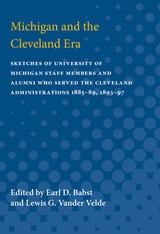
Michigan and the Cleveland Era
Sketches of University of Michigan Staff Members and Alumni Who Served the Cleveland Administrations 1885-89, 1893-97Edited by Earl D. Babst and Lewis G. Vander Velde
University of Michigan Press, 1948

Microhistories of Composition
Bruce Mccomiskey
Utah State University Press, 2016
Writing studies has been dominated throughout its history by grand narratives of the discipline, but in this volume Bruce McComiskey begins to explore microhistory as a way to understand, enrich, and complicate how the field relates to its past. Microhistory investigates the dialectical interaction of social history and cultural history, enabling historians to examine uncommon sites, objects, and agents of historical significance overlooked by social history and restricted to local effects by cultural history. This approach to historical scholarship is ideally suited for exploring the complexities of a discipline like composition.
Through an introduction and eleven chapters, McComiskey and his contributors—including major figures in the historical research of writing studies, such as Louise Wetherbee Phelps, Kelly Ritter, and Neal Lerner—develop focused narratives of particular significant moments or themes in disciplinary history. They introduce microhistorical methodologies and illustrate their application and value for composition historians, contributing to the complexity and adding momentum to the emerging trend within writing studies toward a richer reading of the field’s past and future. Scholars and historians of both composition and rhetoric will appreciate the fresh perspectives on institutional and disciplinary histories and larger issues of rhetorical agency and engagement enacted in writing classrooms that are found in Microhistories of Composition.
Other contributors include Cheryl E. Ball, Suzanne Bordelon, Jacob Craig, Matt Davis, Douglas Eyman, Brian Gogan, David Gold, Christine Martorana, Bruce McComiskey, Josh Mehler, Annie S. Mendenhall, Kendra Mitchell, Antony N. Ricks, David Stock, Kathleen Blake Yancey, Bret Zawilski, and James T. Zebroski.
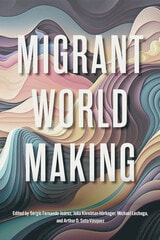
Migrant World Making
Sergio F Juárez
Michigan State University Press, 2023

Milestones in the History of English in America, Volume 76
Allen Walker Read, Richard W. Bailey, editor
Duke University Press, 0

Millions of Suns
On Writing and LifeSharon Fagan McDermott and M. C. Benner Dixon
University of Michigan Press, 2023
With decades of combined teaching experience, McDermott and Benner Dixon share practical craft-of-writing advice with the reader, including over fifty engaging writing prompts to spark the creative process. These prompts guide readers toward the freedom and joy that comes with finding one’s authentic voice. Embracing both the painful and the playful, Millions of Suns is an ideal text for classrooms, professional development, or daily writing practice. Through humor, lyricism, and poignancy, the fundamental message of the book remains the same for newcomers and career authors, whether they write poetry, fiction, non-fiction, or memoir. Let Millions of Suns open a door for you into your creative work, inviting imagination, memory, and inspiration into your writing life.
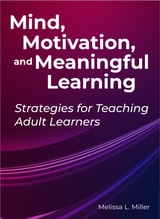
Mind, Motivation, and Meaningful Learning
Melissa L. Miller
Assoc of College & Research Libraries, 2021
Mind, Motivation, and Meaningful Learning: Strategies for Teaching Adult Learners provides a blueprint that academic librarians can apply to their instructional design that facilitates a change in students’ motivation and learning strategies. It provides the tools necessary to teach learners to identify, evaluate, and apply appropriate cognitive, learning, and motivation strategies based on course content and a deeper understanding of the metacognitive component of meaningful learning. Five chapters explore the theories behind adult learning, culminating in a seven-unit curriculum scalable to a variety of learning domains complete with lesson plans, activities, assessments of the learning goals, and student reflections.
Mind, Motivation, and Meaningful Learning can help you identify the components of academic learning that contribute to high achievement; help students learn and practice effective learning and study strategies that lead to improved self-efficacy, self-regulation, and knowledge transfer; and improve instructional design for student, instructor, and academic teaching librarian success.
Mind-Bending Mysteries and Thrillers for Teens
A Programming and Readers' Advisory GuideAmy Alessio
American Library Association, 2014
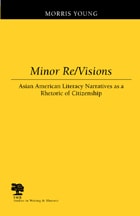
Minor Re/Visions
Asian American Literacy Narratives as a Rhetoric of CitizenshipMorris Young
Southern Illinois University Press, 2004
Through a blend of personal narrative, cultural and literary analysis, and discussions about teaching, Minor Re/Visions: Asian American Literacy Narratives as a Rhetoric of Citizenship shows how people of color use reading and writing to develop and articulate notions of citizenship. Morris Young begins with a narration of his own literacy experiences to illustrate the complicated relationship among literacy, race, and citizenship and to reveal the tensions that exist between competing beliefs and uses of literacy among those who are part of dominant American culture and those who are positioned as minorities.
Influenced by the literacy narratives of other writers of color, Young theorizes an Asian American rhetoric by examining the rhetorical construction of American citizenship in works such as Richard Rodriguez’s Hunger of Memory, Victor Villanueva’s Bootstraps: From an American Academic of Color, Carlos Bulosan’s America Is in the Heart, and Maxine Hong Kingston’s “Song for a Barbarian Reed Pipe” from Woman Warrior. These narratives, Young shows, tell stories of transformation through education, the acquisition of literacy, and cultural assimilation and resistance. They also offer an important revision to the American story by inserting the minor and creating a tension amid dominant discourses about literacy, race, and citizenship. Through a consideration of the literacy narratives of Hawai`i, Young also provides a context for reading literacy narratives as responses to racism, linguistic discrimination, and attempts at “othering” in a particular region.
As we are faced with dominant discourses that construct race and citizenship in problematic ways and as official institutions become even more powerful and prevalent in silencing minor voices, Minor Re/Visions reveals the critical need for revising minority and dominant discourses. Young’s observations and conclusions have important implications for the ways rhetoricians and compositionists read, teach, and assign literacy narratives.
Minor Troubles
Racial Figurations of Youth Sexuality and Childhood's QueernessErin J. Rand
The Ohio State University Press, 2025
In Minor Troubles, Erin J. Rand investigates a series of controversies about youth sexuality and queerness from the early twenty-first century: adult concerns about teen sexting, the bullying and suicides of queer kids, trans youths’ access to gender-segregated bathrooms at school, and sex education. In the public deliberation and mediation of each of these controversies, the imagined qualities of childhood—innocence, vulnerability, nonsexuality, and, crucially, whiteness—are deployed by adults to justify the protection of children. However, these rhetorical figurations of childhood often produce material precarities for actual young people, especially youth of color and queer, trans, and gender-nonconforming youth.
Rand foregrounds the fundamental role of racialization in forming ideas about childhood, arguing that the image of innocent white childhood depends upon the dehumanization of racialized youth. Moreover, the rhetorical process of figuration produces vulnerability and constrains agency for real young people and creates cultural ideas about childhood that come to justify policies, discipline behaviors, regulate identities, control knowledges, and determine interventions that shape children’s lives, bodies, and experiences.
Mis(s) Communication
Stigma and the Miss America OrganizationRebecca J. Meisenbach
Rutgers University Press, 2026
Mis(s) Communication: Stigma and the Miss America Organization explores the one-hundred-year history of the Miss America Organization (MAO) as a site of stigma management. Through five years of ethnographic, archival, and interview-based research, Rebecca J. Meisenbach shows how pageant participation is both valorized and stigmatized—making MAO a key lens for studying stigma as a dynamic, power-laden communication process. The book examines stigma across individual, organizational, and societal levels, focusing on moments like Rule Seven, which once barred nonwhite participants, and the 1968 protest by the New York Radical Women alongside the first Miss Black America pageant. Meisenbach also investigates how contestants navigate stigma tied to intelligence, body image, and the sexualization of women. She analyzes MAO’s 2018 elimination of the swimsuit competition as a stigma management move and its recent shift to a for-profit model under Miss America Opportunity. The book ultimately argues for understanding stigma as communicative and deeply intersectional.
Misinformation Policy in Sub-Saharan Africa
From Laws and Regulations to Media LiteracyPeter Cunliffe-Jones, Assane Diagne, Alan Finlay, Sahite Gaye, Wallace Gichunge, Chido Onumah, Cornia Pretorius and Anya Schiffrin
University of Westminster Press, 2021
Misinformation Policy in Sub-Saharan Africa is a single volume containing two research reports by eight authors examining policy towards misinformation in Sub-Saharan Africa.
The volume first examines the teaching of ‘media literacy’ in state-run schools in seven Sub-Saharan African countries as of mid-2020, as relates to misinformation. It explains the limited elements of media and information literacy (MIL) that are included in the curricula in the seven countries studied and the elements of media literacy related to misinformation taught in schools in one province of South Africa since January 2020. The authors propose six fields of knowledge and skills specific to misinformation that are required in order to reduce students’ susceptibility to false and misleading claims. Identifying obstacles to the introduction and effective teaching of misinformation literacy, the authors make five recommendations for the promotion of misinformation literacy in schools, to reduce the harm misinformation causes.
The second report in the volume examines changes made to laws and regulations related to ‘false information’ in eleven countries across Sub-Saharan Africa 2016-2020 from Ethiopia to South Africa. By examining the terms of such laws against what is known of misinformation types, drivers and effects, it assesses the likely effects of punitive policies and those of more positive approaches that provide accountability in political debate by promoting access to accurate information and corrective speech. In contrast to the effects described for most recent regulations relating to misinformation, the report identifies ways in which legal and regulatory frameworks can be used to promote a healthier information environment.

Mismatch
Form-Function Incongruity and the Architecture of GrammarEdited by Elaine J. Francis and Laura A. Michaelis
CSLI, 2002
Missing Measures
Modern Poetry and the Revolt Against MeterTimothy Steele
University of Arkansas Press, 1990
By the close of the nineteenth century, many poets had abandoned rhyme and meter in favor of “free verse.” Nearly one hundred years later, a growing number of younger poets are reclaiming traditional conventions of prosody by composing rhymed and measured poetry.
Missing Measures is the first full articulation of the aesthetics of this new movement. Timothy Steele, one of the best of those poets who are sometimes called the “New Formalists,” treats his subject against a backdrop of the long history of ideas about poetry, formulated first by the ancients and re-examined and re-interpreted by subsequent writers.
Steele offers a new perspective on the wholesale departure from tradition proclaimed in modernist critical justifications. A rare marriage of clear writing, careful scholarship, and bold thinking, Missing Measures provides a vital new movement with a critical manifesto.

Missing!
Judy Soloway Kay
University of Michigan Press, 2005
The MICHIGAN Reading Plus Readers are original fiction written for students who wish to improve their reading skills. The MICHIGAN Reading Plus Readers support the need for extensive reading on topics of interest to today's students. The Readers offer students books in the genres of mystery, science-fiction, and romance. Activities that practice vocabulary and reading skills are provided on the companion website.
Mister Pulitzer and the Spider
Modern News from Realism to the DigitalKevin G. Barnhurst
University of Illinois Press, 2018
To solve the mystery, Kevin Barnhurst spent thirty years studying news going back to the realism of the 1800s. The usual suspects--technology, business competition, and the pursuit of scoops--are only partly to blame for the fate of news. The main culprit is modernism from the "Mister Pulitzer" era, which transformed news into an ideology called "journalism." News is no longer what audiences or experts imagine. Stories have grown much longer over the past century and now include fewer events, locations, and human beings. Background and context rule instead.
News producers adopted modernism to explain the world without recognizing how modernist ideas influence the knowledge they produce. When webs of networked connectivity sparked a resurgence in realist stories, legacy news stuck to big-picture analysis that can alienate audience members accustomed to digital briefs.
Mixed Categories in the Hierarchical Lexicon
Robert P. Malouf
CSLI, 2000
This book presents a novel analysis of this and similar mixed category constructions in languages including Quechua, Tibetan, Arabic, Fijian, Dagaare, and Jacaltec. Under this analysis, Robert P. Malouf shows that verbal gerunds share the selectional properties of verbs and the distributional properties of nouns. He further shows that since different dimensions of grammatical information can vary independently, the behavior of mixed categories creates no paradox. These dimensions are in principle independent. However, certain types of mixed categories are quite common in the world's languages, while others are rare or nonexistent. The book discusses how cross-linguistic variation can be accounted for by a lexical categorial prototype. By stating these prototypes as default constraints in a hierarchy of lexical information, Malouf argues that one can bring insights from cognitive and functional approaches to linguistics into a formal analysis, thus building on the strengths of both approaches.

Mixed Media
Feminist Presses and Publishing PoliticsSimone Murray
Pluto Press, 2004

Mobile Technology And Academic Libraries
Innovative ServicesRobin Canuel
Assoc of College & Research Libraries, 2017
Mobility Work in Composition
Bruce Horner
Utah State University Press, 2020
Both established and up-and-coming scholars bring a diversity of geographic, institutional, and research-based perspectives to the volume, which includes in-depth investigations of specific forms of mobility work in composition, as well as responses to and reflections on those explorations. Eight chapters present specific cases or issues of this work and twelve shorter response chapters follow, identifying key points of intersection and conflict in the arguments and posing new questions and directions to pursue.
Addressing matters of knowledge transfer and meaning translation, immigrant literacy practices, design pedagogy, academic career changes, student websites, research methodologies, school literacy programs, and archives, Mobility Work in Composition asks what mobility in composition means and how, why, and for whom it might work. It will be of broad interest to students and scholars in rhetoric and composition.
Contributors: Anis Bawarshi, Elizabeth Chamberlain, Patrick Danner, Christiane Donahue, Keri Epps, Eli Goldblatt, Rachel Gramer, Timothy Johnson, Jamila Kareem, Carmen Kynard, Rebecca Lorimer Leonard, Andrea Olinger, John Scenters-Zapico, Khirsten L. Scott, Mary P. Sheridan, Jody Shipka, Ann Shivers-McNair, Scott Wible, Rick Wysocki
Modality in Spanish and Combinations of Modal Meanings
Dana Kratochvílová
Karolinum Press, 2019
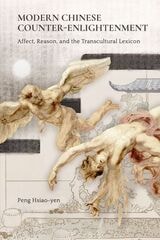
Modern Chinese Counter-Enlightenment
Affect, Reason, and the Transcultural LexiconPeng Hsiao-yen
Hong Kong University Press, 2023
In Modern Chinese Counter-Enlightenment, Peng Hsiao-yen argues that a trend of Counter-Enlightenment had grown from the late Qing to the May Fourth era in the 1910s to the 1920s and continued to the 1940s. She demonstrates how Counter-Enlightenment was manifested with case studies such as Lu Xun’s writings in the late 1900s, the Aesthetic Education movement from the 1910s to 1920s, and the Science and Lifeview debate in the 1920s. During the period, the life philosophy movement, highlighting the epistemic debate on affect and reason, is connected with its counterparts in Germany, France, and Japan. The movement had a widespread and long-term impact on Chinese philosophy and literature. Using the transcultural lexicon as methodology, this book traces how the German term Lebensanschauung (life view), a key concept in Rudolf Eucken’s life philosophy, constituted a global tide of Counter-Enlightenment that influenced the thought of leading Chinese intellectuals in the Republican era. Peng contends that Chinese intellectuals’ transcultural connections with others in the philosophical pursuit of knowledge triggered China’s self-transformation. She successfully reconstructs the missing link in the Chinese theater of the worldwide dialectic of Enlightenment and Counter-Enlightenment.
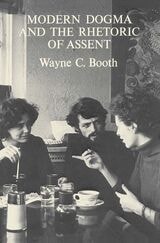
Modern Dogma and the Rhetoric of Assent
Wayne C. Booth
University of Chicago Press, 1974
Booth traces the consequences of modernist assumptions through a wide range of inquiry and action: in politics, art, music, literature, and in personal efforts to find "identity" or a "self." In casting doubt on systematic doubt, the author finds that the dogmas are being questioned in almost every modern discipline. Suggesting that they be replaced with a rhetoric of "systematic assent," Booth discovers a vast, neglected reservoir of "good reasons"—many of them known to classical students of rhetoric, some still to be explored. These "good reasons" are here restored to intellectual respectability, suggesting the possibility of widespread new inquiry, in all fields, into the question, "When should I change my mind?"

Modern Occult Rhetoric
Mass Media and the Drama of Secrecy in the Twentieth CenturyJoshua Gunn
University of Alabama Press, 2005
Uncovering how secrecy, symbolism, and hidden meanings shape modern culture and communication.
The occult has traditionally been understood as the study of secrets of the practice of mysticism or magic. This book broadens our understanding of the occult by treating it as a rhetorical phenomenon tied to language and symbols and more central to American culture than is commonly assumed.
Joshua Gunn approaches the occult as an idiom, examining the ways in which acts of textual criticism and interpretation are occultic in nature, as evident in practices as diverse as academic scholarship, Freemasonry, and television production. Gunn probes, for instance, the ways in which jargon employed by various social and professional groups creates barriers and fosters secrecy. From the theory wars of cultural studies to the Satanic Panic that swept the national mass media in the late 1980s and early 1990s, Gunn shows how the paradox of a hidden, buried, or secret meaning that cannot be expressed in language appears time and time again in Western culture.
These recurrent patterns, Gunn argues, arise from a generalized, popular anxiety about language and its limitations. Ultimately, Modern Occult Rhetoric demonstrates the indissoluble relationship between language, secrecy, and publicity, and the centrality of suspicion in our daily lives.
Modern Pathfinders
Creating B Etter Research GuidesJason Puckett
Assoc of College & Research Libraries, 2015
Modern Pathfinders
Creating Better Research GuidesJason Puckett
Assoc of College & Research Libraries, 2015
Modern Theories of Language
The Empirical ChallengeMortéza Mahmoudian
Duke University Press, 1993
The author begins with the identification of principles which, despite differences in terminology, are held in common by most twentieth-century linguists. He shows the implications, merits, and shortcomings of the major schools of linguistic thought, as well as the techniques one can use in gathering data. Ranging over a wide variety of international linguistic thinking, Mahmoudian takes up the question of what he calls experimentation, or the extent to which the application of certain linguistic theories have validity in constucting models.
Simultaneously a survey of the current state of linguistic theory and a case for the necessity of empirical verification in linguistics, Modern Theories of Language builds a bridge across the gulf between many long-standing conflicts in the theory of language. Accessibly written, this provocative work predicts future theorerical and epistemological developments and will prove essential reading for students and scholars of linguistics, as well as specialists in cognitive psychology and Romance languages.
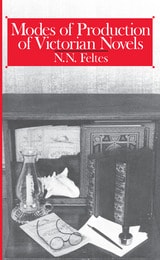
Modes of Production of Victorian Novels
N. N. Feltes
University of Chicago Press, 1986
Feltes focuses on five English novels: Dickens's Pickwick Papers, Thackeray's Henry Esmond, Eliot's Middlemarch, Hardy's Tess of the d'Urbervilles, and Forster's Howards End. Published at approximately twenty year intervals between 1836 and 1920, they each represent a different first-publication format: part-issue, three-volume, bimonthly, magazine-serial, and single-volume. Drawing on publishing, economic, and literary history, Feltes offers a broad, synthetic explanation of the relationship between the production and format of each novel, and the way in which these determine, in the last instance, the ideology of the text.
Modes of Production in Victorian Novels provides a Marxist structuralist analysis of historical events and practices described elsewhere only empirically, and traces their relationship to literary texts which have been analyzed only idealistically, thus setting these familiar works firmly and perhaps permanently into a framework of historic materialism.
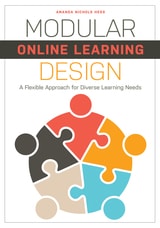
Modular Online Learning Design
A Flexible Approach for Diverse Learning NeedsAmanda Nichols Hess
American Library Association, 2020
Does your online instruction program sometimes feel like a constant scramble to keep pace with requests and deadlines? Modular design is the answer. Approaching projects, whether large and small, with an eye towards future uses will put you on the path to accomplishing broader, organizational goals. And by intentionally building documentation and structure into your process, you will create content that can easily be scaled, modified, adapted, and transformed to meet different learner needs. Hess, experienced in online instruction in both K-12 and academic libraries, shows you how, using project examples of various sizes to illustrate each chapter’s concepts. Her resource guides you through such topics as
- the eight components of modular online learning design;
- key considerations for choosing the design model that best fits your organization and project;
- techniques for connecting your online learning goals with institutional strategy;
- using the IDEA process to align OER content with your instructional needs;
- documenting your planning with checklists, scaffolds, and templates;
- ensuring equity of access with all content formats using the Accessibility Inventory Index;
- principles for scaling up, down, or laterally;
- three models for more meaningful and functional collaboration with internal or external partners; and
- formative testing as a foundation for ongoing evaluation and assessment.
Mood, Aspect, Modality Revisited
New Answers to Old QuestionsEdited by Joanna Blaszczak, Anastasia Giannakidou, Dorota Klimek-Jankowska, and Krzysztof Migdalski
University of Chicago Press, 2016
Current literature assumes a straightforward link between grammatical category and semantic function, and descriptions of well-studied languages have cultivated a sense of predictability in patterns over time. As the editors and contributors of Mood, Aspect, Modality Revisited prove, however, this predictability and stability vanish in the study of lesser-known patterns and languages. The ten provocative essays gathered here present fascinating cutting-edge research demonstrating that the traditional grammatical distinctions are ultimately fluid—and perhaps even illusory. Developing groundbreaking and highly original theories, the contributors in this volume seek to unravel more general, fundamental principles of TAM that can help us better understand the nature of linguistic representations.
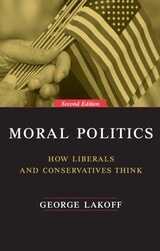
Moral Politics
How Liberals and Conservatives Think, Second EditionGeorge Lakoff
University of Chicago Press, 2002

Morality by Design
Technology's Challenge to Human ValuesWade Rowland
Intellect Books, 2019
In guiding the reader through Enlightenment-era rationalist thought as it pertained to human nature and the foundations of morality, Rowland provides a coherent, intellectually sound, and intuitively appealing alternative to the nihilistic views popularized by contemporary radical relativism. Morality by Design ultimately seeks to convince readers that there is such a thing as moral fact, and that they do indeed have what it takes to make robust and durable moral judgments.