Results by title
1947 books match the query 'Music' and 195 start with m
Music Scenes
Local, Translocal, and VirtualAndy Bennett
Vanderbilt University Press, 2004
Music Talent & Performance
Conservatory Cultural SystemHenry Kingsbury
Temple University Press, 2001
Author Henry Kingbury, a conservatory-trained pianist and music educator turned anthropologist forgoes the traditional ethnomusicologist approach of looking at a non-Western musical culture to focus on the "field" of an American conservatory. The result is a penetrating look at the distinction between teaching music and the nurturing of musicality. Kingsbury offers an innovative anthropological analysis of the western notion of "talent" and its cultural character, noting that many non-western societies have no such concept. Furthermore, he examines various contexts in which music is produced, experienced, and evaluated. His discussion includes the dynamics of orchestra rehearsals in the conservatory, "master class" lessons with a distinguished performer-pedagogue, the ritual characteristics of solo recitals, and an interpretive analysis of stage fright.
Ultimately, Kingsbury argues that music "is highly shifting and indeterminate in meaning," a concept that has important implications for all interpreters of culture and for the artists themselves.
Music Theory and the Exploration of the Past
Edited by Christopher Hatch and David W. Bernstein
University of Chicago Press, 1993
In nineteen essays dealing with musical theories from the twelfth to the twentieth century, two recurring themes emerge. One is the need to understand the historical circumstances of the writing and reception of theory, a humanistic approach that gives theory a place within social and intellectual history. The other is the advantages of applying contemporaneous theory to the music of a given period, thus linking theory to the history of musical styles and structures. The periods given principal attention in these essays are the Renaissance, the years around 1800, and the twentieth century.
Abundantly illustrated with musical examples, Music Theory and the Exploration of the Past offers models of new practical applications of theory to the analysis of music. At the same time, it raises the broader question of how historical knowledge can deepen the understanding of an art and of systematic writings about that art.
Music and Capitalism
A History of the PresentTimothy D. Taylor
University of Chicago Press, 2015
Taylor explores everything from the branding of musicians to the globalization of music to the emergence of digital technologies in music production and consumption. Drawing on interviews with industry insiders, musicians, and indie label workers, he traces both the constricting forces of bottom-line economics and the revolutionary emergence of the affordable home studio, the global internet, and the mp3 that have shaped music in different ways. A sophisticated analysis of how music is made, repurposed, advertised, sold, pirated, and consumed, Music and Capitalism is a must read for anyone who cares about what they are listening to, how, and why.
Music and Conflict
Edited by John Morgan O'Connell and Salwa El-Shawan Castello-Branco
University of Illinois Press, 2010
Music and Cultural Rights
Edited by Andrew N. Weintraub and Bell Yung
University of Illinois Press, 2009
Contributors are Nimrod Baranovitch, Adriana Helbig, Javier F. Leon, Ana María Ochoa, Silvia Ramos, Helen Rees, Felicia Sandler, Amy Ku'uleialoha Stillman, Ricardo D. Trimillos, Andrew N. Weintraub, and Bell Yung.
Music and Culture in Eighteenth-Century Europe
A Source BookEnrico Fubini
University of Chicago Press, 1994
Enrico Fubini offers a sampling of English, French, German, and Italian writings on topics ranging from Enlightenment rationalism and the theories of harmony to German musical culture and the polemics on J. S. Bach. Organized by topic and historical period these selections go beyond writings dealing exclusively with specific musical works to larger issues of theory and the reception of musical ideas in the culture at large. The selections are from books, journals, newspapers, pamphlets, and letters; the contributors include Diderot, Rousseau, Voltaire, Grimm, Alfieri, Rameau, Quantz, Gluck, Tartini, Leopold and W. A. Mozart, and C. P .E. Bach. Many are translated here for the first time.
With general and chapter introductions, restored footnotes, and other valuable annotations, and a biographical appendix, this anthology will interest music scholars, students, and teachers.
Music and Digital Media
A Planetary AnthropologyEdited by Georgina Born
University College London, 2022
Offering a radically new theoretical framework for understanding digital media through music, this volume redresses anthropology’s frequent oversight of music as a topic of study. By positioning music as an expansive subject for digital anthropology, Georgina Born demonstrates how the field can build interdisciplinary links to music and sound studies, digital media studies, and science and technology studies. Music and Digital Media includes five original ethnographies spanning pop, folk, and crossover musical genres throughout Kenya, Argentina, India, Canada, and the UK. A further three chapters engage experimentally with the platforms of music-making and distribution, presenting pioneering ethnographies of an extra-legal peer-to-peer site and the streaming platform Spotify, a series of prominent internet-mediated music genres, and the first ethnography of a global software package, the interactive music platform Max MSP.

Music and Gender
Edited by Pirkko Moisala and Beverley DiamondForeword by Ellen Koskoff
University of Illinois Press, 2000
A cross-section of case studies from the Central African Republic, Finland, and Turkey addresses issues of how performance reflects gender and furthers other social goals, such as negotiating identity and transforming consciousness. Articles on Croatian and Serbian popular music and on the changing circumstances of women musicians in war-torn Ethiopia and post-Soviet Estonia consider the fate of fragile constructions of gender and nationhood in times of war or crisis. Other essays consider the relationship of gender to digital sound technology--in terms of access to the field, interactions among musicians, and aesthetic decisions--and gender issues in writing the musical lives of women composers and performers.
Articulating a theoretical agenda that encompasses perspectives from vastly different musical cultures, this important collection shows how music can help bridge the radical transformations of individuals, groups, and nations.
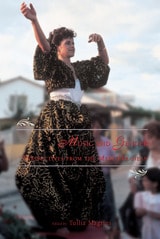
Music and Gender
Perspectives from the MediterraneanEdited by Tullia Magrini
University of Chicago Press, 2003
From Spanish flamenco to Algerian raï, Greek rebetika to Turkish pop music, Sephardi and Berber songs to Egyptian belly dancers, the contributors cover an exceedingly wide range of geographic and musical territories. Individual essays examine musical behavior as representation, assertion, and sometimes transgression of gender identities; compare men's and women's roles in specific musical practices and their historical evolution; and explore how music and gender relate to such issues as ethnicity, nationality, and religion. Anyone studying the musics or cultures of the Mediterranean, or more generally the relations between gender and the arts, will welcome this book.
Contributors:
Caroline Bithell, Joaquina Labajo, Jane C. Sugarman, Carol Silverman, Goffredo Plastino, Gail Holst-Warhaft, Edwin Seroussi, Marie Virolle, Terry Brint Joseph, Deborah Kapchan, Karin van Nieuwkerk, Svanibor Pettan, Martin Stokes, Philip V. Bohlman

Music and Genre
New DirectionsGeorgina Born and David Brackett, editors
Duke University Press, 2027
Music and German National Identity
Celia Applegate and Pamela Potter
University of Chicago Press, 2002
This book explores the questions of how music came to be associated with German identity, when and how Germans came to be regarded as the "people of music," and how music came to be designated as "the most German art." Drawing on the expertise of leading scholars in German history, musicology, and German literature, the essays assembled here examine philosophy, literature, politics, and social currents, as well as the creation and performance of folk music, art music, church music, jazz, and pop to explore the ways in which music has continued to play a central role in the German national imagination and in shaping German identity.
Music and Ideas in the Sixteenth and Seventeenth Centuries
Thomas Mathiesen
University of Illinois Press, 2017

Music and Levels of Narration in Film
Steps across the BorderGuido Heldt
Intellect Books, 2013
A PDF version of this book is available for free in open access via the OAPEN Library platform, www.oapen.org It has been made available under a Creative Commons Attribution 4.0 International Public License and is part of Knowledge Unlatched.

Music and Maestros
The Story of the Minneapolis Symphony OrchestraJohn K. Sherman
University of Minnesota Press, 1952
Music and Maestros was first published in 1952. Minnesota Archive Editions uses digital technology to make long-unavailable books once again accessible, and are published unaltered from the original University of Minnesota Press editions.
Music lovers all over the United States as well as in other countries have heard the music of the Minneapolis Symphony Orchestra under the direction of such noted conductors as Dimitri Mitropoulos and Eugene Ormandy. Now they can enjoy the story behind those concerts, records, and radio broadcasts through this intimate history of the men and music that have made the orchestra famous.
The story begins with the lively musical activities of a frontier town, the antecedents of the symphony orchestra that took shape at the turn of the century. From the early years of the organization under the batons of Emil Oberhoffer and Henri Verbrugghen, the chronicle rises to the period of the great contemporaries, Ormandy, Mitropoulos, and Antal Dorati. There is a wealth of detail on the career of Mitropoulos, the renowned New York Philharmonic conductor who reached his present stature during his leadership of the Minneapolis orchestra.The extensive concert tours that have earned for the Minneapolis symphony the nickname of "orchestra on wheels" are recalled in anecdotes that will evoke many a chuckle and plenty of amazement. Accounts of early recording sessions offer fascinating sidelights on this aspect of musical history. A complete list of the works performed by the orchestra during the past fifty years provides a significant record of changing trends in musical tastes. A roster of al the players who have been members of the orchestra is given, and the reference section also includes a complete list of out-of-town engagements and a list of the orchestra's recordings which are available.
Music and Musical Thought in Early India
Lewis Rowell
University of Chicago Press, 1992
In Indian culture, music forms an integral part of a broad framework of ideas that includes philosophy, cosmology, religion, literature, and science. Rowell works with the known theoretical treatises and the oral tradition in an effort to place the technical details of musical practice in their full cultural context. Many quotations from the original Sanskrit appear here in English translation for the first time, and the necessary technical information is presented in terms accessible to the nonspecialist. These features, combined with Rowell's glossary of Sanskrit terms and extensive bibliography, make Music and Musical Thought in Early India an excellent introduction for the general reader and an indispensable reference for ethnomusicologists, historical musicologists, music theorists, and Indologists.
Music and Mystique in Muscle Shoals
Christopher M. Reali
University of Illinois Press, 2022
The forceful music that rolled out of Muscle Shoals in the 1960s and 1970s shaped hits by everyone from Wilson Pickett and Aretha Franklin to the Rolling Stones and Paul Simon. Christopher M. Reali's in-depth look at the fabled musical hotbed examines the events and factors that gave the Muscle Shoals sound such a potent cultural power. Many artists trekked to FAME Studios and Muscle Shoals Sound in search of the sound of authentic southern Black music—and at times expressed shock at the mostly white studio musicians waiting to play it for them. Others hoped to draw on the hitmaking production process that defined the scene. Reali also chronicles the overlooked history of Muscle Shoals's impact on country music and describes the region's recent transformation into a tourism destination.
Multifaceted and informed, Music and Mystique in Muscle Shoals reveals the people, place, and events behind one of the most legendary recording scenes in American history.
Music and Social Change in South Africa
Maskanda Past and PresentKathryn Olsen
Temple University Press, 2014
Working closely with translated song lyrics and musical notation-and applying musical and socio-political analysis to this music and its cultural context-Olsen argues that maskanda offers insight into how the post-apartheid ideal of social transformation is experienced by those who were marginalized for most of the twentieth century.
Drawing on a decade of research, Olsen strives to demystify the Zulu part of contemporary experience in South Africa and to reveal some of the complexities of the social, economic, and political landscape of contemporary South Africa.
Music and Theater in Minnesota History
John K. Sherman
University of Minnesota Press, 1958
Music and Theater in Minnesota History was first published in 1958. Minnesota Archive Editions uses digital technology to make long-unavailable books once again accessible, and are published unaltered from the original University of Minnesota Press editions.
Music and Trance
A Theory of the Relations Between Music and PossessionGilbert Rouget
University of Chicago Press, 1985
Rouget rigorously examines a worldwide corpus of data from ethnographic literature, but he also draws on the Bible, his own fieldwork in West Africa, and the writings of Plato, Ghazzali, and Rousseau. To organize this immense store of information, he develops a typology of trance based on symbolism and external manifestations. He outlines the fundamental distinctions between trance and ecstasy, shamanism and spirit possession, and communal and emotional trance. Music is analyzed in terms of performers, practices, instruments, and associations with dance. Each kind of trance draws strength from music in different ways at different points in a ritual, Rouget concludes. In possession trance, music induces the adept to identify himself with his deity and allows him to express this identification through dance.
Forcefully rejecting pseudo-science and reductionism, Rouget demystifies the so-called theory of the neurophysiological effects of drumming on trance. He concludes that music's physiological and emotional effects are inseparable from patterns of collective representations and behavior, and that music and trance are linked in as many ways as there are cultural structures.
Music and the Making of Portugal and Spain
Nationalism and Identity Politics in the Iberian PeninsulaEdited by Matthew Machin-Autenrieth, Salwa el-Shawan Castelo-Branco, and Samuel Llano
University of Illinois Press, 2023
What does music in Portugal and Spain reveal about the relationship between national and regional identity building? How do various actors use music to advance nationalism? How have state and international heritage regimes contributed to nationalist and regionalist projects? In this collection, contributors explore these and other essential questions from a range of interdisciplinary vantage points. The essays pay particular attention to the role played by the state in deciding what music represents Portuguese or Spanish identity. Case studies examine many aspects of the issue, including local recording networks, so-called national style in popular music, and music’s role in both political protest and heritage regimes. Topics include the ways the Salazar and Franco regimes adapted music to align with their ideological agendas; the twenty-first-century impact of UNESCO’s Intangible Cultural Heritage program on some of Portugal and Spain's expressive practices; and the tensions that arise between institutions and community in creating and recreating meanings and identity around music.
Contributors: Ricardo Andrade, Vera Marques Alves, Salwa El-Shawan Castelo-Branco, Cristina Sánchez-Carretero, José Hugo Pires Castro, Paulo Ferreira de Castro, Fernán del Val, Héctor Fouce, Diego García-Peinazo, Leonor Losa, Josep Martí, Eva Moreda Rodríguez, Pedro Russo Moreira, Cristina Cruces Roldán, and Igor Contreras Zubillaga
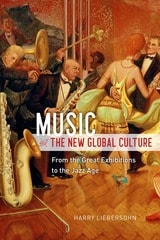
Music and the New Global Culture
From the Great Exhibitions to the Jazz AgeHarry Liebersohn
University of Chicago Press, 2019
Music and the Racial Imagination
Edited by Ronald M. Radano and Philip V. Bohlman
University of Chicago Press, 2001
Each essay follows the lead of the substantial introduction, which reviews the history of race in European and American, non-Western and global musics, placing it within the contexts of the colonial experience and the more recent formation of "world music." Offering a bold, new revisionist agenda for musicology in a postmodern, postcolonial world, this book will appeal to students of culture and race across the humanities and social sciences.
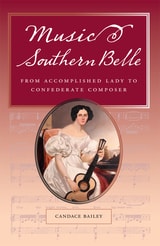
Music and the Southern Belle
From Accomplished Lady to Confederate ComposerCandace Bailey
Southern Illinois University Press, 2010
Candace Bailey’s exploration of the intertwining worlds of music and gender shows how young southern women pushed the boundaries of respectability to leave their unique mark on a patriarchal society. Before 1861, a strictly defined code of behavior allowed a southern woman to identify herself as a “lady” through her accomplishments in music, drawing, and writing, among other factors. Music permeated the lives of southern women, and they learned appropriate participation through instruction at home and at female training institutions. A belle’s primary venue was the parlor, where she could demonstrate her usefulness in the domestic circle by providing comfort and serving to enhance social gatherings through her musical performances, often by playing the piano or singing. The southern lady performed in public only on the rarest of occasions, though she might attend public performances by women. An especially talented lady who composed music for a broader audience would do so anonymously so that her reputation would remain unsullied.
The tumultuous Civil War years provided an opportunity for southern women to envision and attempt new ways to make themselves useful to the broader, public society. While continuing their domestic responsibilities and taking on new ones, young women also tested the boundaries of propriety in a variety of ways. In a broad break with the past, musical ladies began giving public performances to raise money for the war effort, some women published patriotic Confederate music under their own names, supporting their cause and claiming public ownership for their creations. Bailey explores these women’s lives and analyzes their music. Through their move from private to public performance and publication, southern ladies not only expanded concepts of social acceptability but also gained a valued sense of purpose.
Music and the Southern Belle places these remarkable women in their social context, providing compelling insight into southern culture and the intricate ties between a lady’s identity and the world of music. Augmented by incisive analysis of musical compositions and vibrant profiles of composers, this volume is the first of its kind, making it an essential read for devotees of Civil War and southern history, gender studies, and music.
Music and the Staged Veillée in Quebec
Performing TraditionLaura Risk
University of Illinois Press, 2026
Fiddlers, step dancers, storytellers, traditional singers, and folklorists staged Montreal’s first veillée in 1919. All that was missing, announced one of the organizers, was a magic carpet to transport the audience into the countryside and a kiss of forgetfulness to erase the woes of modern life.
Laura Risk tells the story of the veillées and explores how these commercial performances of idealized rural life became part of Quebec’s cultural heritage. Her in-depth examinations of key performances and recordings follow traditional music and dance from the stage onto radio, records and other audio media, and television. Throughout, Risk documents how veillées redefined folklore in twentieth-century Quebec and illuminates how their distinctive framing of traditional musicians and repertoire impacts the performance and reception of the music to the present day.
Astute and evocative, Music and the Staged Veillée in Quebec reveals the music, dancing, call-and-response songs, and extramusical associations winding through century-long conversations about nation, culture, and identity in Quebec.
Music and the Wesleys
Edited by Nicholas Temperley and Stephen Banfield
University of Illinois Press, 2010
Music as Mao's Weapon
Remembering the Cultural RevolutionLei X. Ouyang
University of Illinois Press, 2022
China's Cultural Revolution (1966-1976) produced propaganda music that still stirs unease and, at times, evokes nostalgia. Lei X. Ouyang uses selections from revolutionary songbooks to untangle the complex interactions between memory, trauma, and generational imprinting among those who survived the period of extremes. Interviews combine with ethnographic fieldwork and surveys to explore both the Cultural Revolution's effect on those who lived through it as children and contemporary remembrance of the music created to serve the Maoist regime. As Ouyang shows, the weaponization of music served an ideological revolution but also revolutionized the senses. She examines essential questions raised by this phenomenon, including: What did the revolutionization look, sound, and feel like? What does it take for individuals and groups to engage with such music? And what is the impact of such an experience over time?
Perceptive and provocative, Music as Mao's Weapon is an insightful look at the exploitation and manipulation of the arts under authoritarianism.
Music as Metaphor
The Elements of ExpressionDonald N. Ferguson
University of Minnesota Press, 1960
Music as Metaphor was first published in 1960. Minnesota Archive Editions uses digital technology to make long-unavailable books once again accessible, and are published unaltered from the original University of Minnesota Press editions.
A professor of music for many years, Mr. Ferguson here sets forth his theories on how music conveys meaning to its listeners. He identifies and discusses the elements of musical expression - tonal stress and rhythm - and correlates them with the nervous tensions and motor impulses which characterize human emotion. Through this correlation, he shows how music portrays universally understood emotional states and ideas. He relates these principles to music criticism, proposing a new system for such criticism.
Music as Social Life
The Politics of ParticipationThomas Turino
University of Chicago Press, 2008
Turino begins by developing tools to think about the special properties of music and dance that make them fundamental resources for connecting with our own lives, our communities, and the environment. These concepts are then put into practice as he analyzes various musical examples among indigenous Peruvians, rural and urban Zimbabweans, and American old-time musicians and dancers. To examine the divergent ways that music can fuel social and political movements, Turino looks at its use by the Nazi Party and by the American civil rights movement. Wide-ranging, accessible to anyone with an interest in music’s role in society, and accompanied by a compact disc, Music as Social Life is an illuminating initiation into the power of music.
Music at the Margins of Sense
Jessica A. Holmes
University of Michigan Press, 2026
In Music at the Margins of Sense, Jessica A. Holmes contests prevailing misconceptions associated with deafness and hearing in Western music by turning to the musical experiences of deaf, hard of hearing, and hearing disabled musicians in order to impart a multisensory, multimodal conception of music and musicianship. Through a range of examples drawn from music history, popular music, recent film, and popular science, Holmes reveals that “deafness” is mistakenly understood as a state of total silence and heightened tactile sensation, a stigmatizing trope she calls the “figure of deafness.”
Holmes explores music-making spanning auditory, visual-spatial, vibrotactile, and non-sonorous modalities, including the creative practice of Christine Sun Kim, all-deaf electronic dance music raves, the musical experiences of hearing aid users, and music and musical instruments devised to mitigate tinnitus and hyperacusis. By examining the cultural production of “natural” hearing in the design, branding, and musical programming of digital hearing aids, Holmes offers a reappraisal of hearing that defies naturalized perceptual processes and auditory thresholds, the idealization of sonic fidelity, and biologically driven conceptions of musicality. Music at the Margins of Sense champions an understanding of musicianship that embraces the lived experience of disability as a vital locus of musical creativity and expertise.
Music by Numbers
The Use and Abuse of Statistics in the Music IndustryEdited by Richard Osborne and Dave Laing
Intellect Books, 2021
An edited volume that examines the data and statistics that are key to the music industry.
The music industries are fueled by statistics: sales targets, breakeven points, success ratios, royalty splits, website hits, ticket revenues, listener figures, piracy abuses, and big data. Statistics are of consequence. They influence the music that consumers get to hear, they determine the revenues of music makers, and they shape the policies of governments and legislators. Yet many of these statistics are generated by the music industries themselves, and their accuracy can be questioned. Music by Numbers sets out to explore this shadowy terrain.
This edited collection provides the first in-depth examination of the use and abuse of statistics in the music industry. Written by noted music business scholars and practitioners in the field, the book addresses five key areas in which numbers are employed: sales and awards; music industry policy; live music; music piracy; and digital solutions. The authors address these subjects from a range of perspectives: some of them test the veracity of this data and explore its tactical use by music businesses; others help to generate these numbers by developing surveys and online projects and offering candid observations.
The aim of this collection is to expose the culture and politics of data. Music industry statistics are pervasive, but despite this ubiquity they are underexplored. This book offers a corrective by providing new ways by which to learn music by numbers.

Music from Within
A Biography of the Composer S.C. Eckhardt-GramattéFerdinand Eckhardt
University of Manitoba Press, 1985
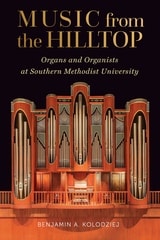
Music from the Hilltop
Organs and Organists at Southern Methodist UniversityBenjamin A. Kolodziej
University of North Texas Press, 2023

Music in American Crime Prevention and Punishment
Lily E. Hirsch
University of Michigan Press, 2014
Although the use of music for extramusical purposes has been a part of American culture for some time, the phenomenon remained largely unknown to the general public until revelations became widespread of startling military practices during the second Iraq War. In Music in American Crime Prevention and Punishment, Lily E. Hirsch explores the related terrain at the intersection of music and law, demonstrating the ways in which music has become a tool of law enforcement and justice through: police and community leaders’ use of classical music in crime deterrence and punishment; the use of rap lyrics as prosecutorial evidence; allegations of music as incitement to violence; and the role of music in U.S. prisons and in detention centers in Guantanamo, Iraq, and Afghanistan.
In the course of her study, Hirsch asks several questions: How does the law treat music? When and why does music participate in the law? How does music influence the legal process? How does the legal process influence music? And how do these appropriations affect the Romantic ideals underlying our view of music?

Music in Black American Life, 1600-1945
A University of Illinois Press AnthologyCompiled by Laurie Matheson. Introduction by Sandra Jean Graham
University of Illinois Press, 2022
Eclectic and essential, Music in Black American Life, 1600–1945 offers specialists and students alike a gateway to the history and impact of Black music in the United States.
Contributors: R. Reid Badger, Rae Linda Brown, Samuel A. Floyd Jr., Sandra Jean Graham, Jeffrey Magee, Robert M. Marovich, Harriet Ottenheimer, Eileen Southern, Katrina Dyonne Thompson, Stephen Wade, and Charles Wolfe

Music in Black American Life, 1945-2020
A University of Illinois Press AnthologyCompiled by Laurie Matheson. Introduction by Tammy L. Kernodle
University of Illinois Press, 2022
Part sourcebook and part survey of historic music scholarship, Music in Black American Life, 1945–2020 collects groundbreaking work that redefines our view of Black music and its place in American music history.
Contributors: Nelson George, Wayne Everett Goins, Claudrena N. Harold, Eileen M. Hayes, Loren Kajikawa, Robin D. G. Kelley, Tammy L. Kernodle, Cheryl L. Keyes, Gwendolyn Pough, Bernice Johnson Reagon, Mark Tucker, and Sherrie Tucker
Music in German Philosophy
An IntroductionEdited by Stefan Lorenz Sorgner and Oliver Fürbeth
University of Chicago Press, 2011
Though many well-known German philosophers have devoted considerable attention to music and its aesthetics, surprisingly few of their writings on the subject have been translated into English. Stefan Lorenz Sorgner, a philosopher, and Oliver Fürbeth, a musicologist, here fill this important gap for musical scholars and students alike with this compelling guide to the musical discourse of ten of the most important German philosophers, from Kant to Adorno.
Music in German Philosophy includes contributions from a renowned group of ten scholars, including some of today’s most prominent German thinkers, all of whom are specialists in the writers they treat. Each chapter consists of a short biographical sketch of the philosopher concerned, a summary of his writings on aesthetics, and finally a detailed exploration of his thoughts on music. The book is prefaced by the editors’ original introduction, presenting music philosophy in Germany before and after Kant, as well as a new introduction and foreword to this English-language addition, which places contemplations on music by these German philosophers within a broader intellectual climate.
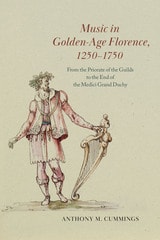
Music in Golden-Age Florence, 1250–1750
From the Priorate of the Guilds to the End of the Medici Grand DuchyAnthony M. Cummings
University of Chicago Press, 2023
Florence is justly celebrated as one of the world’s most important cities. It enjoys mythic status and occupies an enviable place in the historical imagination. But its musico-historical importance is not as well understood as it should be. If Florence was the city of Dante, Michelangelo, and Galileo, it was also the birthplace of the madrigal, opera, and the piano. Music in Golden-Age Florence, 1250–1750 recounts Florence’s principal contributions to music and the history of how music was heard and cultivated in the city, from civic and religious institutions to private patronage and the academies. This book is an invaluable complement to studies of the art, literature, and political thought of the late-medieval and early-modern eras and the quasi-legendary figures in the Florentine cultural pantheon.
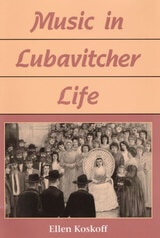
Music in Lubavitcher Life
Ellen Koskoff
University of Illinois Press, 2001
Drawing on twenty years of close study, Ellen Koskoff illuminates the world of the Lubavitcher Hasidim, a community of ultra-orthodox Jews centered in the Crown Heights section of Brooklyn, New York. Her classic ethnography offers an unprecedented look at nigunim, a body of paraliturgical, folk, and popular melodies that Lubavitchers regard as a primary form of spiritual communication with the divine.
Along with vivid descriptions of musical performance in religious contexts and private gatherings, Koskoff details the musical sounds and structures that symbolize Lubavitcher social relations. In particular, she examines the differences between Lubavitcher women's and men's music making and the underlying beliefs and assumptions that give rise to gendered musical behaviors, such as the dictum that prohibits men from hearing a woman sing.
Insightful and distinctive, Music in Lubavitcher Life combines anecdotes with history and musical analysis to reveal music making among the Lubavitchers as a gateway to their ideas about the nature of human spirituality, human social interaction, and God.
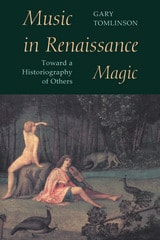
Music in Renaissance Magic
Toward a Historiography of OthersGary Tomlinson
University of Chicago Press, 1994
In Music in Renaissance Magic, Gary Tomlinson describes some of these connections and offers a fresh view of the development of early modern thought in Italy. Raising issues essential to postmodern historiography—issues of cultural distance and our relationship to the others who inhabit our constructions of the past —Tomlinson provides a rich store of ideas for students of early modern culture, for musicologists, and for historians of philosophy, science, and religion.
"A scholarly step toward a goal that many composers have aimed for: to rescue the idea of New Age Music—that music can promote spiritual well-being—from the New Ageists who have reduced it to a level of sonic wallpaper."—Kyle Gann, Village Voice
"An exemplary piece of musical and intellectual history, of interest to all students of the Renaissance as well as musicologists. . . . The author deserves congratulations for introducing this new approach to the study of Renaissance music."—Peter Burke, NOTES
"Gary Tomlinson's Music in Renaissance Magic: Toward a Historiography of Others examines the 'otherness' of magical cosmology. . . . [A] passionate, eloquently melancholy, and important book."—Anne Lake Prescott, Studies in English Literature

Music in the Age of Anxiety
American Music in the FiftiesJames Wierzbicki
University of Illinois Press, 2016
Music historian James Wierzbicki sheds light on how the Fifties' pervasive moods affected its sounds. Moving across genres established--pop, country, opera--and transfigured--experimental, rock, jazz--Wierzbicki delves into the social dynamics that caused forms to emerge or recede, thrive or fade away. Red scares and white flight, sexual politics and racial tensions, technological progress and demographic upheaval--the influence of each rooted the music of this volatile period to its specific place and time. Yet Wierzbicki also reveals the host of underlying connections linking that most apprehensive of times to our own uneasy present.
Music in the Background
Bryce G. Boyer
Bridwell Press, 2026
I’ve been a professional journalist for over 50 years now, a prose writer whose favorite form is the essay. But there are emotions that poetry seems to capture better than prose. Not unique emotions because there are no such things as unique emotions, only the emotions shared by all of us, shared by the whole world. For me, prose seems much more observational, more a reflection of what our senses present and whatever meaning we attach to that reflection. Poetry is more an attempt to understand our feelings by digging down into ourselves like a spelunker explores a cave. The cave is ourselves, and we try to discover—or more probably uncover—what's down there that makes us human. In these few poems I've tried to throw a small flashlight beam on a few of those places down there.
Music in the Castle
Troubadours, Books, and Orators in Italian Courts of the Thirteenth, Fourteenth, and Fifteenth CenturiesF. Alberto Gallo
University of Chicago Press, 1996
In the first of three elegant essays, Gallo examines the troubadours who traveled to northern Italian courts from Provence during the thirteenth century. He discusses their performance practices, the verbal and musical sophistication of their songs, and their role in the daily life of courtiers at Genoa, Ferrara, and Monferrato. The second essay concerns the now dispersed collection of the Visconti library at Pavia. Here, Gallo examines how this collection expressed the tastes of the fourteenth-century court of Giangaleazzo Visconti, how French arts were imported and imitated at Pavia, and the effects this had on music heard at the court. In the final essay, Gallo looks at the fifteenth-century tradition of improvised music, and especially the virtuoso lute player Pietrobono. Mythologized in literary circles of his day, Pietrobono becomes a point of departure for a discussion of the entire vision of music of Italian humanists, from Guarino Veronese to Aurelio Brandolini.
Music in the Culture of the Renaissance and Other Essays
Edward E. Lowinsky
University of Chicago Press, 1989
"Professor Lowinsky's method is the only kind of 'writing about music' that I value."—Igor Stravinsky
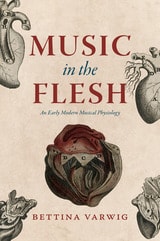
Music in the Flesh
An Early Modern Musical PhysiologyBettina Varwig
University of Chicago Press, 2023
Music in the Flesh reimagines the lived experiences of music-making subjects—composers, performers, listeners—in the long seventeenth century. There are countless historical testimonies of the powerful effects of music upon the early modern body; it is described as moving, ravishing, painful, dangerous, curative, and miraculous while affecting “the circulation of the humors, the purification of the blood, the dilation of the vessels and pores.”
How were these early modern European bodies constituted that music generated such potent bodily-spiritual effects? Bettina Varwig argues that early modern music-making practices challenge our modern understanding of human nature as a mind-body dichotomy. Instead, they persistently affirm a more integrated anthropology, in which body, soul, and spirit remain inextricably entangled. Moving with ease across repertories and regions, sacred and vernacular musics, and domestic and public settings, Varwig sketches a “musical physiology” that is as historically illuminating as it is relevant for present-day performance. This book makes a significant contribution not just to the history of music, but also to the history of the body, the senses, and the emotions, revealing music as a unique access point for reimagining early modern modes of being-in-the-world.
Music in the Old Bones
Jezebel Through the AgesJanet Howe Gaines
Southern Illinois University Press, 1999
An alien, a polytheist from Phoenicia, the biblical Queen Jezebel posed a serious threat to the stability of the Israelites' single male deity. So powerful was this threat that writers through the ages have portrayed her as the incarnation of feminine evil, and her name has become synonymous with the misogynist view of women as seductresses.
Janet Howe Gaines argues that the bride of the Israelite king Ahab became a convenient scapegoat for biblical writers who portrayed her as the primary force behind their nation's apostasy. The biblical account presents the queen as a murderer, as a disruptive force for evil. Despised, the strong-willed Jezebel is still one of the most intriguing women of the Bible.
Music in the Old Bones is a guide to the eternal Jezebel story. The first part of this illustrated study is a detailed analysis that explores the biblical tale from traditional and feminist points of view. Gaines then analyzes the ways authors through the centuries have treated Jezebel. Her unburied bones became misogynist relics for generations of writers who retold her story as a warning about the dangers of rebelling against patriarchal society. From the sermons of John Knox to the novels of Margaret Atwood, from the poetry of Percy Shelley to the ballads of Boyz II Men, from the drama of Racine to the Academy Award-winning film starring Bette Davis, Jezebel has long been the subject of artistic inquiry. Her image as the bad girl of the Bible is still useful to writers. Most exploit her name and evil reputation to enhance their admonitions to women, but a few break away from tradition and openly admire Jezebel's courage and vigor.
Placing the biblical account of Jezebel's doomed reign in the context of its xenophobic writers, Gaines proposes a new and more sympathetic reading of the murdered queen whose body was left to rot in the streets and whose reputation suffered a fate even more egregious. Rather than providing a decent burial for the mangled bones of Jezebel, Gaines seeks to flesh them out and revivify them because, as she demonstrates, "there's music in the old bones yet."
Music in the Present Tense
Rossini’s Italian Operas in Their TimeEmanuele Senici
University of Chicago Press, 2019
Emanuele Senici’s new book provides a fresh look at the motives behind the Rossinian furore and its aftermath by examining the composer’s works in the historical context in which they were conceived, performed, seen, heard, and discussed. Situating the operas firmly within the social practices, cultural formations, ideological currents, and political events of early nineteenth-century Italy, Senici reveals Rossini’s dramaturgy as a radically new and specifically Italian reaction to the epoch-making changes witnessed in Europe at the time. The first book-length study of Rossini’s Italian operas to appear in English, Music in the Present Tense exposes new ways to explore nineteenth-century music and addresses crucial issues in the history of modernity, such as trauma, repetition, and the healing power of theatricality.
Music in the World
Selected EssaysTimothy D. Taylor
University of Chicago Press, 2017
In addition to chapters on music, capitalism, and globalization, Music in the World includes previously unpublished essays on the continuing utility of the concept of culture in the study of music, a historicization of treatments of affect, and an essay on value and music. Taken together, Taylor’s essays chart the changes in different kinds of music in twentieth- and twenty-first-century music and culture from a variety of theoretical perspectives.
Music of Another World
Szymon Laks
Northwestern University Press, 2000
Music of Death and New Creation
Experiences in the World of Balinese Gamelan BeleganjurMichael B. Bakan
University of Chicago Press, 1999
Building from his own experiences as a beleganjur drummer, Bakan also takes us inside a distant musical world and into the lives of musicians connecting across vast cultural divides. Rich with musical examples, photographs, and an accompanying compact disc, Music of Death and New Creation is an unprecedented exploration of how music embodies and shapes life in contemporary Indonesia and beyond.