Results by title
4917 books match the query 'Philosophy' and 215 start with m
Metaphysical Disputation II
On the Essential Concept or Concept of BeingFrancisco Suarez
Catholic University of America Press, 2022
Metaphysical Disputations III and IV
On Being's Passions in General and Its Principles and On Transcendental Unity in GeneralFrancisco Suarez
Catholic University of America Press, 2023
Metaphysical Experiments
Physics and the Invention of the UniverseBjørn Ekeberg
University of Minnesota Press, 2019
An engaging critique of the science and metaphysics behind our understanding of the universe
The James Webb Space Telescope, when launched in 2021, will be the premier orbital observatory, capable of studying every phase of the history of the universe, from the afterglow of the Big Bang to the formation of our solar system. Examining the theoretical basis for key experiments that have made this latest venture in astrophysics possible, Bjørn Ekeberg reveals that scientific cosmology actually operates in a twilight zone between the physical and metaphysical.
Metaphysical Experiments explains how our current framework for understanding the universe, the Big Bang theory, is more determined by a deep faith in mathematical universality than empirical observation. Ekeberg draws on philosophical insights by Spinoza, Bergson, Heidegger, and Arendt; on the critical perspectives of Latour, Stengers, and Serres; and on cutting-edge physics research at the Large Hadron Collider, to show how the universe of modern physics was invented to reconcile a Christian metaphysical premise with a claim to the theoretical unification of nature.
By focusing on the nonmathematical assumptions underlying some of the most significant events in modern science, Metaphysical Experiments offers a critical history of contemporary physics that demystifies such concepts as the universe, particles, singularity, gravity, blackbody radiation, the speed of light, wave/particle duality, natural constants, black holes, dark matter, and dark energy. Ekeberg’s incisive reading of the metaphysical underpinnings of scientific cosmology offers an innovative account of how we understand our place in the universe.
Metaphysical Horror
Leszek Kolakowski
University of Chicago Press, 2001
In a trenchant analysis that serves as an introduction to nearly all of Western philosophy, Kolakowski confronts these dilemmas head on through examinations of several prominent philosophers including Descartes, Spinoza, Husserl, and many of the Neo-Platonists. He finds that philosophy may not provide definitive answers to the fundamental questions, yet the quest itself transforms our lives. It may undermine most of our certainties, yet it still leaves room for our spiritual yearnings and religious beliefs.
The final sentence of the book captures the hopefulness that has survived the horror of nothingness when Kolakowski asks: "Is it not reasonable to suspect that if existence were pointless and the universe devoid of meaning, we would never have achieved not only the ability to imagine otherwise, but even the ability to entertain this very thought—to wit, that existence is pointless and the universe devoid of meaning?" The answer, of course, is clear. Now it is up to readers to take up the challenge of his arguments.
Metaphysical Themes in Thomas Aquinas
John F. Wippel
Catholic University of America Press, 1995
Metaphysical Themes in Thomas Aquinas II
John F. Wippel
Catholic University of America Press, 2007
Metaphysical Themes in Thomas Aquinas III
John F. Wippel
Catholic University of America Press, 2020
Metaphysics
Aristotle
University of Michigan Press, 1952
Metaphysics
Bruce Aune
University of Minnesota Press, 1985
Comprehensive introductory survey of the key concepts and problems in traditional and contemporary metaphysics.
A comprehensive introductory study of the key concepts and problems in traditional and contemporary metaphysics. Aune presents and defends a point of view that is naturalistic, nominalistic and pragmatic-an approach that has the overall advantage of providing a coherent, structured view of the topics he discusses.
Metaphysics as Mediating Dialogue
Olivia Blanchette
Catholic University of America Press, 2023
Metaracial
Hegel, Antiblackness, and Political IdentityRei Terada
University of Chicago Press, 2023
Exploring anxieties raised by Atlantic slavery in radical enlightenment literature concerned about political unfreedom in Europe, Metaracial argues that Hegel's philosophy assuages these anxieties for the left. Interpreting Hegel beside Rousseau, Kant, Mary Shelley, and Marx, Terada traces Hegel's transposition of racial hierarchy into a hierarchy of stances toward reality. By doing so, she argues, Hegel is simultaneously antiracist and antiblack. In dialogue with Black Studies, psychoanalysis, and critical theory, Metaracial offers a genealogy of the limits of antiracism.
Metatheory in Social Science
Pluralisms and SubjectivitiesEdited by Donald W. Fiske and Richard A. Shweder
University of Chicago Press, 1986
While various points of view are expressed in these nineteen essays, they have in common several themes, including the comparison of social and natural science, the role of knowledge in meeting the demands of society and its pressing problems, and the nature and role of subjectivity in science. Some authors hold that subjectivity cannot be studied scientifically; others argue that it can and must be if progress in knowledge is to be made. The essays demonstrate the philosophical pluralism they discuss and give a wide range of alternative positions on the future of the social and behavioral sciences in a postpositivist intellectual world.
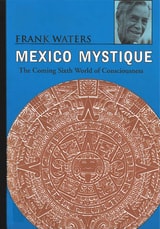
Mexico Mystique
The Coming Sixth World of ConsciousnessFrank Waters
Ohio University Press, 1989
In Mexico Mystique Frank Waters draws us deeply into the ancient but still-living myths of Mexico. To reveal their hidden meanings and their powerful symbolism, he brings to bear his gift for intuitive imagination as well as a broad knowledge of anthropology, Jungian psychology, astrology, and Eastern and esoteric religions. He offers a startling interpretation of the Mayan Great Cycle — our present Fifth World — whose beginning has been projected to 3113 B.C., and whose cataclysmic end has been predicted by 2011 A.D.
Mexico Unveiled
Resisting Colonial Vices and Other ComplaintsCarlos Pereda; Translated by Noell Birondo with Andres Bonilla
Vanderbilt University Press, 2025
In three engaging essays written in a peerless prose style, Pereda considers the persistent influence of European colonialism on Mexican intellectual life, the politics of inclusion, and the changing ideas of what it means to be Mexican. He identifies three “vices”—social habits, customs, and beliefs inherited from European colonialism—that have influenced the development of Mexican national identity: subaltern fervor, craving for novelty, and nationalist zeal. Pereda demonstrates that these three tendencies have led Mexican intellectuals, and Mexican society more generally, to uncritically adopt a politics of exclusion and destructive nationalist attitudes.
Using a strategy he calls “nomadic” thinking—the act of moving beyond our cultural preconceptions and habits of thinking—Pereda guides readers through a number of examples drawn from Mexican philosophy and culture that illustrate these tendencies. At its core, Mexico Unveiled is an accessible and entertaining introduction to the philosophical themes that have long occupied Pereda’s life and work and Mexican philosophy more generally.
Michael Oakeshott on Religion, Aesthetics, and Politics
Elizabeth Campbell Corey
University of Missouri Press, 2006
For much of his career, British political philosopher Michael Oakeshott was identified with Margaret Thatcher’s conservative policies. He has been called by some a guru to the Tories, while others have considered him one of the last proponents of British Idealism. Best known for such books as Experience and Its Modes and Rationalism in Politics, Oakeshott has been the subject of numerous studies, but always with an emphasis on his political thought.
Gnosticism and considers both thinkers’ treatment of Hobbes to delineate their philosophical differences.
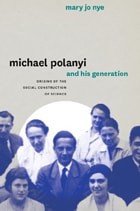
Michael Polanyi and His Generation
Origins of the Social Construction of ScienceMary Jo Nye
University of Chicago Press, 2011
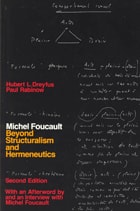
Michel Foucault
Beyond Structuralism and HermeneuticsHubert L. Dreyfus and Paul Rabinow
University of Chicago Press, 1983
To demonstrate the sense in which Foucault's work is beyond structuralism and hermeneutics, the authors unfold a careful, analytical exposition of his oeuvre. They argue that during the of Foucault's work became a sustained and largely successful effort to develop a new method—"interpretative analytics"—capable fo explaining both the logic of structuralism's claim to be an objective science and the apparent validity of the hermeneutical counterclaim that the human sciences can proceed only by understanding the deepest meaning of the subject and his tradition.
"There are many new secondary sources [on Foucault]. None surpass the book by Hubert Dreyfus and Paul Rabinow. . . . The American paperback edition contains Foucault's 'On the Genealogy of Ethics,' a lucid interview that is now our best source for seeing how he construed the whole project of the history of sexuality."—David Hoy, London Review of Books
Michel de Certeau in the Plural, Volume 100
Ian Buchanan, ed.
Duke University Press, 0
With articles that engage directly—as well as theoretically—with de Certeau, this collection corrects a long-standing imbalance in the criticism by covering works from two periods about which little is known in anglophone circles: his early books on religious history and his midlife histories of mysticism and possession. It also includes critiques from queer theory and feminist theory, as well as comparative readings that assess de Certeau alongside his famous contemporary, Michel Foucault. With articles by an international array of scholars who address both the secular and the religious thinker, this special issue is the most definitive study to date of this important twentieth-century thinker.
Contributors. Jeremy Ahearne, Frederick C. Bauerschmidt, Ian Buchanan, Philippe Carrard, Claire Colebrook, Tom Conley, Verena Andermatt Conley, Catherine Driscoll, Carla Freccero, John Frow, Richard Terdiman, Timothy Tomasik, Marie-Claire Vallois, Graham Ward

Micro-Politics
Agency in a Postfeminist EraPatricia S. Mann
University of Minnesota Press, 1994
Micro-Politics was first published in 1994. Minnesota Archive Editions uses digital technology to make long-unavailable books once again accessible, and are published unaltered from the original University of Minnesota Press editions.
Patricia S. Mann explains our current period as a time of social transformation resulting from an "unmooring" of women, men, and children from the nuclear family, gender relations having replaced economic relations as the primary site of social tension and change in our lives. The feminist movement has evolved, according to Mann, into a popularly based postfeminist struggle to reconstruct relationships between women and men within everyday contexts of work, family, education, and politics.
Mann formulates a "postmodern" theory of political agency, utilizing it to explain political events such as the Hill-Thomas Senate hearings and their social aftermath. While liberal and progressive theories have explained political agency in terms of individual or group forms of identity, Mann suggests another alternative. Individuals such as Anita Hill are drawn into socially meaningful struggles in the context of their daily lives-as we all are potentially participating in micro-political forms of activism in a variety of institutional contexts. These dynamic micropolitical situations involve intersecting dimensions of race, class, and sexuality, as well as gender. Within specific conflicts, individuals rearticulate their notions of desire and responsibility, and their expectations for recognition and reward; according to Mann political agency resides in these choices. Addressing some of the most important controversies in political philosophy, Mann weaves together strands of the "participatory politics" of the 1960s and the multicultural politics of the 1990s. In doing so, she offers a new basis for understanding social change.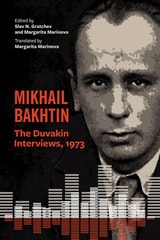
Mikhail Bakhtin
The Duvakin Interviews, 1973Slav N Gratchev
Bucknell University Press, 2019
Published by Bucknell University Press. Distributed worldwide by Rutgers University Press.
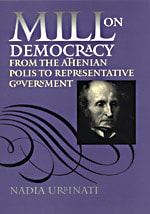
Mill on Democracy
From the Athenian Polis to Representative GovernmentNadia Urbinati
University of Chicago Press, 2002
Redirecting attention to Mill as a political thinker, Nadia Urbinati argues that this claim misrepresents Mill's thinking. Although he did not elaborate a theory of democracy, Mill did devise new avenues of democratic participation in government that could absorb the transformation of politics engendered by the institution of representation. More generally, Urbinati assesses Mill's contribution to modern democratic theory by critiquing the dominant "two liberties" narrative that has shaped Mill scholarship over the last several decades. As Urbinati shows, neither Isaiah Berlin's theory of negative and positive freedom nor Quentin Skinner's theory of liberty as freedom from domination adequately captures Mill's notion of political theory.
Drawing on Mill's often overlooked writings on ancient Greece, Urbinati shows that Mill saw the ideal representative government as a "polis of the moderns," a metamorphosis of the unique features of the Athenian polis: the deliberative character of its institutions and politics; the Socratic ethos; and the cooperative implications of political agonism and dissent. The ancient Greeks, Urbinati shows, and Athenians in particular, are the key to understanding Mill's contribution to modern democratic theory and the theory of political liberty.
Urbinati concludes by demonstrating the importance of Mill's deliberative model of politics to the contemporary debate on liberal and republican views of liberty. Her fresh and persuasive approach not only clarifies Mill's political ideas but also illustrates how they can help enrich our contemporary understanding of democracy.
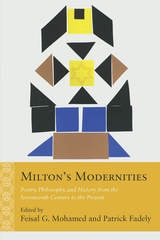
Milton's Modernities
Poetry, Philosophy, and History from the Seventeenth Century to the PresentEdited by Feisal G. Mohamed and Patrick Fadely
Northwestern University Press, 2017
Bristling with insights on Milton’s major works, Milton’s Modernities offers fresh perspectives on the thinkers central to our theorizations of modernity: from Lucretius and Spinoza, Hegel and Kant, to Benjamin and Deleuze. At the volume's core is an embrace of the possibilities unleashed by current trends in philosophy, variously styled as the return to ethics, or metaphysics, or religion. These make all the more visible Milton’s dialogues with later modernity, dialogues that promise to generate much critical discussion in early modern studies and beyond.
Such approaches necessarily challenge many prevailing assumptions that have guided recent Milton criticism—assumptions about context and periodization, for instance. In this way, Milton’s Modernities powerfully broadens the historical archive beyond the materiality of events and things, incorporating as well intellectual currents, hybrids, and insights.

Mimesis, Desire, and the Novel
Rene Girard and Literary CriticismPierpaolo Antonello
Michigan State University Press, 2015
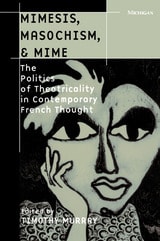
Mimesis, Masochism, and Mime
The Politics of Theatricality in Contemporary French ThoughtTimothy Murray, Editor
University of Michigan Press, 1997
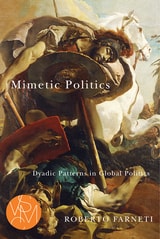
Mimetic Politics
Dyadic Patterns in Global PoliticsRoberto Farneti
Michigan State University Press, 2015
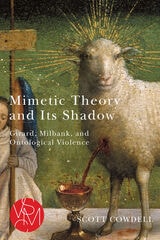
Mimetic Theory and Its Shadow
Girard, Milbank, and Ontological ViolenceScott Cowdell
Michigan State University Press, 2023
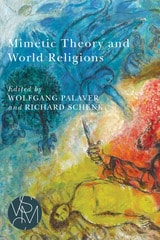
Mimetic Theory and World Religions
Wolfgang Palaver
Michigan State University Press, 2017
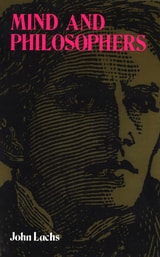
Mind and Philosophers
John Lachs
Vanderbilt University Press, 1987
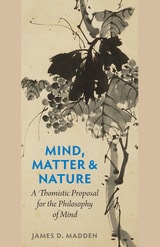
Mind, Matter, and Nature
James D. Madden
Catholic University of America Press, 2013
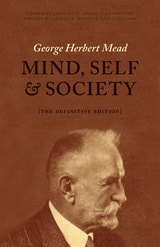
Mind, Self, and Society
The Definitive EditionGeorge Herbert Mead
University of Chicago Press, 2015
This collection gets to the heart of Mead’s meditations on social psychology and social philosophy. Its penetrating, conversational tone transports the reader directly into Mead’s classroom as he teases out the genesis of the self and the nature of the mind. The book captures his wry humor and shrewd reasoning, showing a man comfortable quoting Aristotle alongside Alice in Wonderland.
Included in this edition are an insightful foreword from leading Mead scholar Hans Joas, a revealing set of textual notes by Dan Huebner that detail the text’s origins, and a comprehensive bibliography of Mead’s other published writings. While Mead’s lectures inspired hundreds of students, much of his brilliance has been lost to time. This new edition ensures that Mead’s ideas will carry on, inspiring a new generation of thinkers.
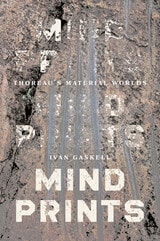
Mindprints
Thoreau's Material WorldsIvan Gaskell
University of Chicago Press, 2024
Though we may associate Henry David Thoreau with ascetic renunciation, he accumulated a variety of tools, art, and natural specimens throughout his life as a homebuilder, surveyor, and collector. In some of these objects, particularly Indigenous artifacts, Thoreau perceived the presence of their original makers, and he called such objects “mindprints.” Thoreau believed that these collections could teach him how his experience, his world, fit into the wider, more diverse (even incoherent) assemblage of other worlds created and re-created by other beings every day. In this book, Ivan Gaskell explores how a profound environmental aesthetics developed from this insight and shaped Thoreau’s broader thought.
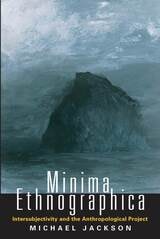
Minima Ethnographica
Intersubjectivity and the Anthropological ProjectMichael Jackson
University of Chicago Press, 1998
Written in the style of Theodor Adorno's Minima Moralia, Jackson's work shows how general ideas are always anchored in particular social events and critical concerns. Emphasizing the intersubjective encounter over objective descriptions of the whole historical and contemporary situation of a given people, he illustrates the power and originality of existential anthropology through a series of vignettes from his fieldwork in Sierra Leone and Australia. An award-winning poet, novelist, and anthropologist, Jackson offers a timely critique of conventions that dull our sense of the links between academic study and lived experience.

Minimal Ethics for the Anthropocene
Joanna Zylinska
Michigan Publishing Services, 2014
Miscellaneous Writings
G.W.F. Hegel
Northwestern University Press, 2000
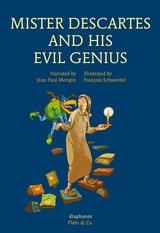
Mister Descartes and His Evil Genius
Jean Paul Mongin
Diaphanes, 2016
On a peaceful winter night while the rest of the town sleeps, Mister Descartes stays up late reading the great books of the world. Suddenly, by the light of the moon, he sees a strange and fearsome shape in the shadow of his pet parrot, Baruch. Is it an illusion, or could it be that his faithful pet is but a figment of his imagination? Could the same be true of his room and all of sleepy Holland? Quite obviously, he cannot rely on his senses, so how can Mister Descartes arrive at any certainty about the world around him? How will he determine what is a clever trick and what is real?
Plato & Co.’s clear approach and charming illustrations make this series the perfect addition to any little library.
Modal Logic for Open Minds
Johan van Benthem
CSLI, 2010
In Modal Logic for Open Minds, Johan van Benthem provides an up-to-date introduction to the field of modal logic, outlining its major ideas and exploring the numerous ways in which various academic fields have adopted it. Van Benthem begins with the basic theories of modal logic, semantics, bisimulation, and axiomatics, and also covers more advanced topics, such as expressive power and computational complexity. The book then moves to a wide range of applications, including new developments in information flow, intelligent agency, and games. Taken together, the chapters show modal logic at the crossroads of philosophy, mathematics, linguistics, computer science, and economics. Most of the chapters are followed by exercises, making this volume ideal for undergraduate and graduate students in philosophy, computer science, symbolic systems, cognitive science, and linguistics.
Model Cases
On Canonical Research Objects and SitesMonika Krause
University of Chicago Press, 2021
In Model Cases, Monika Krause asks about the concrete material research objects behind shared conversations about classes of objects, periods, and regions in the social sciences and humanities. It is well known that biologists focus on particular organisms, such as mice, fruit flies, or particular viruses when they study general questions about life, development, and disease. Krause shows that scholars in the social sciences and humanities also draw on some cases more than others, selecting research objects influenced by a range of ideological but also mundane factors, such as convenience, historicist ideas about development over time, schemas in the general population, and schemas particular to specific scholarly communities.
Some research objects are studied repeatedly and shape our understanding of more general ideas in disproportionate ways: The French Revolution has profoundly influenced our concepts of revolution, of citizenship, and of political modernity, just like studies of doctors have set the agenda for research on the professions. Based on an extensive analysis of the role of model cases in different fields, Krause argues that they can be useful for scholarly communities if they are acknowledged and reflected as particular objects; she also highlights the importance of research strategies based on neglected research objects and neglected combinations of research objects and scholarly concerns.
Moderately Modern
Rémi Brague
St. Augustine's Press, 2017
Modern Chinese Counter-Enlightenment
Affect, Reason, and the Transcultural LexiconPeng Hsiao-yen
Hong Kong University Press, 2023
In Modern Chinese Counter-Enlightenment, Peng Hsiao-yen argues that a trend of Counter-Enlightenment had grown from the late Qing to the May Fourth era in the 1910s to the 1920s and continued to the 1940s. She demonstrates how Counter-Enlightenment was manifested with case studies such as Lu Xun’s writings in the late 1900s, the Aesthetic Education movement from the 1910s to 1920s, and the Science and Lifeview debate in the 1920s. During the period, the life philosophy movement, highlighting the epistemic debate on affect and reason, is connected with its counterparts in Germany, France, and Japan. The movement had a widespread and long-term impact on Chinese philosophy and literature. Using the transcultural lexicon as methodology, this book traces how the German term Lebensanschauung (life view), a key concept in Rudolf Eucken’s life philosophy, constituted a global tide of Counter-Enlightenment that influenced the thought of leading Chinese intellectuals in the Republican era. Peng contends that Chinese intellectuals’ transcultural connections with others in the philosophical pursuit of knowledge triggered China’s self-transformation. She successfully reconstructs the missing link in the Chinese theater of the worldwide dialectic of Enlightenment and Counter-Enlightenment.

Modern Dogma and the Rhetoric of Assent
Wayne C. Booth
University of Chicago Press, 1974
Booth traces the consequences of modernist assumptions through a wide range of inquiry and action: in politics, art, music, literature, and in personal efforts to find "identity" or a "self." In casting doubt on systematic doubt, the author finds that the dogmas are being questioned in almost every modern discipline. Suggesting that they be replaced with a rhetoric of "systematic assent," Booth discovers a vast, neglected reservoir of "good reasons"—many of them known to classical students of rhetoric, some still to be explored. These "good reasons" are here restored to intellectual respectability, suggesting the possibility of widespread new inquiry, in all fields, into the question, "When should I change my mind?"
Modern Enlightenment and the Rule of Reason
John C. McCarthy
Catholic University of America Press, 2018
Modern French Jewish Thought
Writings on Religion and PoliticsEdited by Sarah Hammerschlag
Brandeis University Press, 2018

Modern Jewish Ethics since 1970
Writings on Methods, Sources, and IssuesEdited by Jonathan K. Crane, Emily A. Filler, and Mira Beth Wasserman
Brandeis University Press, 2025
These deliberate juxtapositions are to encourage scholars and students to develop similar meta-ethical analyses on Jewish ethics, broadly construed. Jewish ethics is not just a set of propositions or principles; nor can it be reduced to a single trajectory of thought or abstracted as an elaborate system of ideas. Jewish ethics is the field of study that engages Jewish texts, ideas, history, and experience in conversations about values and virtues, justice and good judgment, human relations and responsibilities. This volume presents some of those conversations to spark many more.

Modern Philosophies of the Will
Reiner Schürmann
Diaphanes, 2020
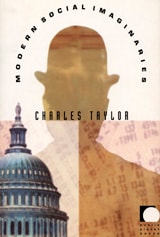
Modern Social Imaginaries
Charles Taylor
Duke University Press, 2004
Retelling the history of Western modernity, Taylor traces the development of a distinct social imaginary. Animated by the idea of a moral order based on the mutual benefit of equal participants, the Western social imaginary is characterized by three key cultural forms—the economy, the public sphere, and self-governance. Taylor’s account of these cultural formations provides a fresh perspective on how to read the specifics of Western modernity: how we came to imagine society primarily as an economy for exchanging goods and services to promote mutual prosperity, how we began to imagine the public sphere as a metaphorical place for deliberation and discussion among strangers on issues of mutual concern, and how we invented the idea of a self-governing people capable of secular “founding” acts without recourse to transcendent principles. Accessible in length and style, Modern Social Imaginaries offers a clear and concise framework for understanding the structure of modern life in the West and the different forms modernity has taken around the world.
Modernism and Hegemony
A Materialist Critique of Aesthetic AgenciesNeil LarsenForeword by Jaime Concha
University of Minnesota Press, 1990
Modernism and Hegemony was first published in 1990. Minnesota Archive Editions uses digital technology to make long-unavailable books once again accessible, and are published unaltered from the original University of Minnesota Press editions.
In Modernism and Hegemony, Neil Larsen exposes the underlying political narratives of modernist aesthetic theory and practice. Unlike earlier Marxist critics, Larsen insists that modernist ideology be approached as a "displaced politics" and not simply as an aesthetic phenomenon. In this view, modernism is broadly ideological project comprising not only the literary-artist canon but also a wide array of theoretical discourses from aesthetics to philosophy, culture, and politics. Larsen gives postmodernism some credit for the apparent breakup of modernism, and for exposing the philosophical and political nature of its aesthetic stance. But he parts company with its ideological and epistemological notions, proposing to change the terms, and thus the framework, of the debate.
For Larsen, modernism is intimately linked to a crisis of representation that affected all aspects of life in the late nineteenth century - a period when capitalism itself was undergoing transformation from its "classical" free market phase into a more abstract, monopolistic and imperialistic stage. Larsen finds the resultant loosening of ties between individuals and society - the breakdown of social and historical agency - behind the growth of modernism. He employs speculative cross-readings of key texts by Marx and Adorno, an examination of Manet's "The Execution of Maximilian," and an analysis of modernism in a Third World setting to explain why modernism made special claims upon the aesthetic, and how it ultimately ascribed historical agency to "works of art."
Modernism, Catastrophe, Utopianism
Hal Foster
Prickly Paradigm Press, 2027
In this collection of essays, Hal Foster reflects on how modernism's utopian frameworks can be reactivated in the face of recent political challenges.
In both contemporary art and politics since COVID-19, the discourses of modernism and modernity have been challenged by unexpected developments. The convergences between left-wing indigeneity and right-wing nativism, and the political right's appropriation of transgression—long a strategy of the left—point to essential challenges of the modernist project. The five essays of Modernism, Catastrophe, Utopia reflects on such developments, seeking to parse the elements of modernist discourse that remain valid or can be repurposed, and those which must be jettisoned. Literary and cultural critic Hal Foster shows how the constructive, even utopian dimension of modernism might be remotivated in the face of ecological catastrophe, potentially liberating us from a melancholic fixation on our traumatic past.
Modernism
An Anthology of Sources and DocumentsEdited by Vassiliki Kolocotroni, Jane Goldman, and Olga Taxidou
University of Chicago Press, 1998
By favoring short extracts over lengthier originals, the editors cover a remarkable range and variety of modernist thinking. Included are not just the familiar high modernist landmarks such as Gustave Flaubert, Ezra Pound, and James Joyce, but also a diverse representation from the sciences, politics, philosophy, and the arts, including Charles Darwin, Thorstein Veblen, W. E. B. Du Bois, Isadora Duncan, John Reed, Adolf Hitler, and Sergei Eisenstein. Another welcome feature is a substantial selection of hard-to-find manifestos from the many modernist movements, among them futurism, cubism, Dada, surrealism, and anarchism.
Modernity At Sea
Melville, Marx, Conrad In CrisisCesare Casarino
University of Minnesota Press, 2002
Analyzes nineteenth-century seafaring narratives and their importance to ideas of modernity
At once a literary-philosophical meditation on the question of modernity and a manifesto for a new form of literary criticism, Modernity at Sea argues that the nineteenth-century sea narrative played a crucial role in the emergence of a theory of modernity as permanent crisis.
In a series of close readings of such works as Herman Melville’s White-Jacket and Moby Dick, Joseph Conrad’s The Nigger of the "Narcissus” and The Secret Sharer, and Karl Marx’s Grundrisse, Cesare Casarino draws upon the thought of twentieth-century figures including Giorgio Agamben, Louis Althusser, Walter Benjamin, Leo Bersani, Gilles Deleuze, Félix Guattari, and Antonio Negri to characterize the nineteenth-century ship narrative as the epitome of Michel Foucault’s "heterotopia"—a special type of space that simultaneously represents, inverts, and contests all other spaces in culture.Elaborating Foucault’s claim that the ship has been the heterotopia par excellence of Western civilization since the Renaissance, Casarino goes on to argue that the nineteenth-century sea narrative froze the world of the ship just before its disappearance—thereby capturing at once its apogee and its end, and producing the ship as the matrix of modernity.
Modernity on Endless Trial
Leszek Kolakowski
University of Chicago Press, 1990
"Exemplary. . . . It should be celebrated." —Arthur C. Danto, New York Times Book Review
"This book . . . express[es] Kolakowski's thought on God, man, reason, history, moral truth and original sin, prompted by observation of the dramatic struggle among Christianity, the Enlightenment and modern totalitarianism. It is a wonderful collection of topics." —Thomas Nagel, Times Literary Supplement
"No better antidote to bumper-sticker thinking exists than this collection of 24 'appeals for moderation in consistency,' and never has such an antidote been needed more than it is now." —Joseph Coates, Chicago Tribune
"Whether learned or humorous, these essays offer gems in prose of diamond hardness, precision, and brilliance." —Thomas D'Evelyn, The Christian Science Monitor
A "Notable Books of the Year 1991" selection, New York Times Book Review—a "Noted with Pleasure" selection, New York Times Book Review—a "Summer Reading 1991" selection, New York Times Book Review—a "Books of the Year" selection, The Times.