Results by title
18284 books match the query 'United States' and 949 start with m
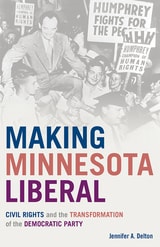
Making Minnesota Liberal
Civil Rights and the Transformation of the Democratic PartyJennifer A. Delton
University of Minnesota Press, 2002
The surprising story of how Minnesota politicians in the 1950s helped redirect American politics—now in paperback
How did a largely white state like Minnesota become a springboard for leadership in civil rights? Why did it produce a generation of liberals—Hubert Humphrey, Walter Mondale, Donald Fraser, Orville Freeman, and Eugene McCarthy—whose ideals transformed the Democratic party?
In Making Minnesota Liberal, Jennifer A. Delton delves into the roots of Minnesota politics for the answer, tracing the change from the regional, third-party, class-oriented politics of the Farmer-Labor party to the national, two-party, pluralistic liberalism of the Democratic-Farmer-Labor party (DFL). While others have examined how anticommunism and the Cold War shaped this transformation, Delton takes a new approach, showing the key roles played by antiracism and the civil rights movement. In telling this story, Delton contributes to our understanding not only of Minnesota’s political history but also of the relationship between antiracism and American politics in the twentieth century.
Making Minnesota Liberal combines political history with a discussion of the symbolic role played by race in political battles between whites. Delton recounts the creation of Minnesota’s Farmer-Labor party, its merger with the Democrats, and the acrimonious battle for control of the DFL just after World War II. She argues that the Humphrey liberals won this battle in part because antiracism activities enabled previously antagonistic groups, divided by ethnicity, religion, and class, to unify around a common cause.
Delton contends that although liberal Minnesotans’s concern for racial justice was genuine, it also provided them with national political relevance and imbued their bid for power with a sense of morality. Ultimately the language of tolerance and diversity that emerged from antiracism prepared Minnesotans for Humphrey’s vision of a pluralistic and state-centered liberalism, which eventually became the model for Democratic politics nationwide. Making Minnesota Liberal is an absorbing and trenchant account of a key moment in American history, one that continues to resonate in our time.
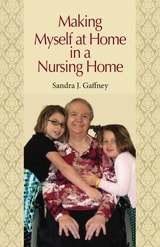
Making Myself at Home in a Nursing Home
Vanderbilt University PressSandra J. Gaffney
Vanderbilt University Press, 2012
She describes her situation in these words: "As a nursing home resident, I require total or maximum care. I have limited use of my hands and arms. With special splints, I am able to turn the pages of my books, use the telephone and TV/VCR/FM radio remote control. When my cup is positioned properly, I can drink independently. I am able to walk with a platform walker and the help of two nursing assistants. My walking is not functional; it is only for exercise. After I moved into my third nursing home, I learned to operate a power wheelchair by using an adaptive switch between my knees. ... All other areas of physical care have to be done for me. My speech is impaired. If people listen carefully, they can understand what I am saying. ... I am able to eat regular food and breathe on my own."
Gaffney became an acute observer and strategist about how to live in a nursing home. Her first-person account, dictated to family members and assistants, covers making the decision to enter a nursing home, choosing the right one, and understanding its culture. She talks about how to furnish your room and about all the issues that arise in a resident's typical day. She has much to say about communication with staff and family about "how to help others help me." Gaffney's daughters, Amy and Bridget, and her friend Ellen Potter provide additional perspectives on the caregiving experience.
Making News at The New York Times
Nikki Usher
University of Michigan Press, 2014
This news ethnography brings to bear the overarching value clashes at play in a digital news world. The book argues that emergent news values are reordering the fundamental processes of news production. Immediacy, interactivity, and participation now play a role unlike any time before, creating clashes between old and new. These values emerge from the social practices, pressures, and norms at play inside the newsroom as journalists attempt to negotiate the new demands of their work. Immediacy forces journalists to work in a constant deadline environment, an ASAP world, but one where the vaunted traditions of yesterday's news still appear in the next day's print paper. Interactivity, inspired by the new user-computer directed capacities online and the immersive Web environment, brings new kinds of specialists into the newsroom, but exacts new demands upon the already taxed workflow of traditional journalists. And at time where social media presents the opportunity for new kinds of engagement between the audience and media, business executives hope for branding opportunities while journalists fail to truly interact with their readers.
Making Of Asian America
Through Political ParticipationPei-te Lien
Temple University Press, 2001
Professor Lien looks at political participation by Asian Americans prior to 1965 and then examines, at both organizational and mass politics levels, how race, ethnicity, and transnationalism help to construct a complex American electorate. She looks not only at rates of participation among Asian Americans as compared with blacks, Latinos, American Indians, and non-Hispanic whites, but also among specific groups of Asian Americans—Chinese, Japanese, Filipinos, Koreans, Asian Indians, and Vietnamese. She also discusses how gender, socioeconomic class, and place of birth affect political participation.
With documentation ranging from historical narrative to opinion survey data, Professor Lien creates a picture of a diverse group of politically active people who are intent on carving out a place for themselves in American political life.
Making Our Neighborhoods, Making Our Selves
George C. Galster
University of Chicago Press, 2019
Urban theorists have tried for decades to define exactly what a neighborhood is. But behind that daunting existential question lies a much murkier problem: never mind how you define them—how do you make neighborhoods productive and fair for their residents? In Making Our Neighborhoods, Making Our Selves, George C. Galster delves deep into the question of whether American neighborhoods are as efficient and equitable as they could be—socially, financially, and emotionally—and, if not, what we can do to change that. Galster aims to redefine the relationship between places and people, promoting specific policies that reduce inequalities in housing markets and beyond.
Making Patriots
Walter Berns
University of Chicago Press, 2001
Although Samuel Johnson once remarked that "patriotism is the last refuge of scoundrels," over the course of the history of the United States we have seen our share of heroes: patriots who have willingly put their lives at risk for this country and, especially, its principles. And this is even more remarkable given that the United States is a country founded on the principles of equality and democracy that encourage individuality and autonomy far more readily than public spiritedness and self-sacrifice.
Walter Berns's Making Patriots is a pithy and provocative essay on precisely this paradox. How is patriotism inculcated in a system that, some argue, is founded on self-interest? Expertly and intelligibly guiding the reader through the history and philosophy of patriotism in a republic, from the ancient Greeks through contemporary life, Berns considers the unique nature of patriotism in the United States and its precarious state. And he argues that while both public education and the influence of religion once helped to foster a public-minded citizenry, the very idea of patriotism is currently under attack.
Berns finds the best answers to his questions in the thought and words of Abraham Lincoln, who understood perhaps better than anyone what the principles of democracy meant and what price adhering to them may exact. The graves at Arlington and Gettysburg and Omaha Beach in Normandy bear witness to the fact that self-interested individuals can become patriots, and Making Patriots is a compelling exploration of how this was done and how it might be again.
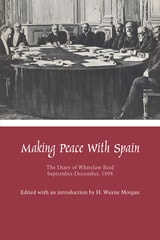
Making Peace with Spain
The Diary of Whitelaw Reid, September-December, 1898By Whitelaw Reid; edited by H. Wayne Morgan
University of Texas Press, 1965
Whitelaw Reid, according to H. Wayne Morgan, was a “leading newspaperman, more than an occasional diplomat, a power in his party’s politics, a supporter of some of the best in his era’s culture . . . Of all his legacy, perhaps the record he left of his part in the Peace of Paris is the most significant and most interesting. It not only reveals the workings of his mind and of the peace conference, but also suggests the complex currents that carried his country into the realities of world power in the twentieth century.”
In editing Reid’s diary, Morgan used much material pertinent to the Paris Peace Conference of 1898, employed here for the first time. This material is a rich assortment of archival matter: the Reid Papers, the John Hay Papers, the John Bassett Moore Papers, and the McKinley Papers, in the Library of Congress; the Peace Commission records, in the National Archives; and unpublished materials in the Central Files of the Department of State.
Whitelaw Reid, as a war correspondent during the Civil War, as clerk of the House Military Affairs Committee, and later as a successor to Horace Greeley on the Tribune, gained access to the leaders of his times and insight into their actions. In 1889 he was appointed U.S. Minister to France by Harrison, and in 1892 he had the dubious honor of being chosen as Harrison’s running mate on the losing presidential ticket. An influential friend and supporter of President McKinley and an occasional advisor to him, Reid was no stranger to politics and to international diplomacy when McKinley appointed him to the Peace Commission that wrote the treaty concluding the Spanish-American War. As a matter of fact, Reid’s opinion reflected the administration’s attitude of expansionism, the policy of Manifest Destiny—or “imperialism,” as it was later called.
Reid’s diary records the details of the sessions of the Joint Peace Commission of Paris from September through a large part of December of 1898. His day-by-day entries reveal the complexity of issues to be considered, the tactics of both the Spanish and the American Commissions in attempting to gain advantage for their respective governments, the interplay of the personalities of the once-proud Spaniards and the brash Americans, the political objectives influencing the points of view of the various members, and the maneuverings that brought about the final resolution of debated issues.
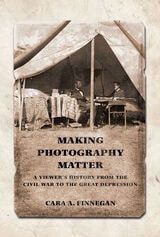
Making Photography Matter
A Viewer's History from the Civil War to the Great DepressionCara Finnegan
University of Illinois Press, 2017
Cara A. Finnegan analyzes a wealth of newspaper and magazine articles, letters to the editor, trial testimony, books, and speeches produced by viewers in response to specific photos they encountered in public. From the portrait of a young Lincoln to images of child laborers and Depression-era hardship, Finnegan treats the photograph as a locus for viewer engagement and constructs a history of photography's viewers that shows how Americans used words about images to participate in the politics of their day. As she shows, encounters with photography helped viewers negotiate the emergent anxieties and crises of U.S. public life through not only persuasion but action, as well.
Making Politics Work
Practical Lessons on Politics for Would-Be Education ReformersPaul T. Hill and Ashley E. Jochim
University of Chicago Press, 2025
The education reform project has always been about making America’s schools more effective for the children who attend them. In Making Politics Work, authors Paul T. Hill and Ashley E. Jochim show that this project cannot succeed without mastering what is the single largest constraint on its success: politics.
Drawing upon more than a decade of work with dozens of school systems, Hill and Jochim show how failures to secure political support or mitigate inevitable opposition dooms the education reform project from the start. But this outcome is not inevitable. By tracing the evolution of the “portfolio strategy” across 27 localities that implemented it, they uncover practical lessons that superintendents, state leaders, and foundation officials can use to increase the likelihood that their ideas for improving public education don’t join the list of once-promising initiatives that could not be sustained in the face of intractable political conflict.
Making Progress
Programmatic and Administrative Approaches for Multimodal Curricular TransformationLogan Bearden
Utah State University Press, 2021
MCT can be achieved at the intersection of program documents and practices. Bearden details ten composition programs that have undergone MCT, offering interview data from the directors who oversaw and/or participated within the processes. He analyzes a corpus of outcomes statements to discover ways we can “make space” for multimodality and gives instructors and programs a broader understanding of the programmatic values for which they should strive if they wish to make space for multimodal composition in curricula. Making Progress also presents how other program documents like syllabi and program websites can bring those outcomes to life and make multimodal composing a meaningful part of first-year composition curricula.
First-year composition programs that do not help their students learn to compose multimodal texts are limiting their rhetorical possibilities. The strategies in Making Progress will assist writing program directors and faculty who are interested in using multimodality to align programs with current trends in disciplinary scholarship and deal with resistance to curricular revision to ultimately help students become more effective communicators in a digital-global age.
Making Race, Making Power
North Carolina's Road to DisfranchisementKent Redding
University of Illinois Press, 2003
Far from being a low-level, localized trend, the struggle for power in North Carolina would be felt across the entire country as race-and class-based organizing challenged the dominant models of making and holding power.
Redding reveals how the ruling class operates with motivations and methods very similar to those of the black voters and Populist farmers they fought against. He tracks how the elites co-opted the innovative mobilizing strategies of the subaltern groups to effectively use their own weapons against them.
At the core of Making Race, Making Power is an insightful dissection of the concrete connections between political strategies of solidarity and exclusion and underlying patterns of race relations.
Making Reform Work
The Case for Transforming American Higher EducationZemsky, Robert
Rutgers University Press, 2009
Robert Zemsky, one of a select group of scholars who participated in Secretary of Education Margaret Spellings' 2005 Commission on the Future of Higher Education, signed off on the commission's report with reluctance. In Making Reform Work he presents the ideas he believes should have come from that group to forge a practical agenda for change. Zemsky argues that improving higher education will require enlisting faculty leadership, on the one hand, and, on the other, a strategy for changing the higher education system writ large.
Directing his attention from what can't be done to what can be done, Zemsky provides numerous suggestions. These include a renewed effort to help students' performance in high schools and a stronger focus on the science of active learning, not just teaching methods. He concludes by suggesting a series of dislodging events, for example, making a three-year baccalaureate the standard undergraduate degree, congressional rethinking of student aid in the wake of the loan scandal, and a change in the rules governing endowments that could break the gridlock that today holds higher education reform captive.
Making Reform Work offers three rules for successful college and university transformation: don't vilify, don't play games, and come to the table with a well-thought-out strategy rather than a sharply worded lamentation.
Making Rights Real
Activists, Bureaucrats, and the Creation of the Legalistic StateCharles R. Epp
University of Chicago Press, 2009
It’s a common complaint: the United States is overrun by rules and procedures that shackle professional judgment, have no valid purpose, and serve only to appease courts and lawyers. Charles R. Epp argues, however, that few Americans would want to return to an era without these legalistic policies, which in the 1970s helped bring recalcitrant bureaucracies into line with a growing national commitment to civil rights and individual dignity.
Focusing on three disparate policy areas—workplace sexual harassment, playground safety, and police brutality in both the United States and the United Kingdom—Epp explains how activists and professionals used legal liability, lawsuit-generated publicity, and innovative managerial ideas to pursue the implementation of new rights. Together, these strategies resulted in frameworks designed to make institutions accountable through intricate rules, employee training, and managerial oversight. Explaining how these practices became ubiquitous across bureaucratic organizations, Epp casts today’s legalistic state in an entirely new light.
Making Room in the Clinic
Nurse Practitioners and the Evolution of Modern Health CareFairman, Julie
Rutgers University Press, 2009
Making Sense of American Liberalism
Edited by Jonathan Bell and Timothy Stanley
University of Illinois Press, 2012
Making Sense of Social Security Reform
Daniel Shaviro
University of Chicago Press, 2000
But what is the average person to make of all this? How many Americans know where the money for Social Security benefits really comes from, or who wins and loses from the system's overall operations? Few people understand the current Social Security system in even its broadest outlines. And yet Social Security reform is ranked among the most important social issues of our time.
With Making Sense of Social Security Reform, Daniel Shaviro makes an important contribution to the public understanding of the issues involved in reforming Social Security. His book clearly and straightforwardly describes the current system and the pressures that have been brought to bear upon it, before dissecting and evaluating the various reform proposals. Accessible to anyone who has an interest in the issue, Shaviro's new work is unique in offering a balanced, nonpartisan account.
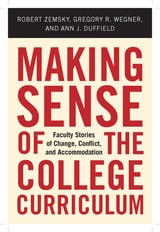
Making Sense of the College Curriculum
Faculty Stories of Change, Conflict, and AccommodationZemsky, Robert
Rutgers University Press, 2018
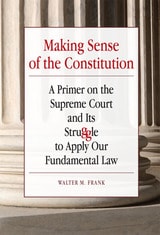
Making Sense of the Constitution
A Primer on the Supreme Court and Its Struggle to Apply Our Fundamental LawWalter M. Frank
Southern Illinois University Press, 2012
In Making Sense of the Constitution: A Primer on the Supreme Court and Its Struggle to Apply Our Fundamental Law, Walter Frank tackles in a comprehensive but lively manner subjects rarely treated in one volume.
Aiming at both the general reader and students of political science, law, or history, Frank begins with a brief discussion of the nature of constitutional law and why the Court divides so closely on many issues. He then proceeds to an analysis of the Constitution and subsequent amendments, placing them in their historical context. Next, Frank shifts to the Supreme Court and its decisions, examining, among other things, doctrinal developments, the Court’s decision making processes, how justices interact with each other, and the debate over how the Constitution should be interpreted.
The work concludes with a close analysis of Court decisions in six major areas of continuing controversy, including abortion, affirmative action, and campaign finance.
Outstanding by the University Press Books for Public and Secondary Schools
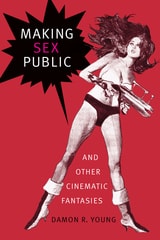
Making Sex Public and Other Cinematic Fantasies
Damon R. Young
Duke University Press, 2018
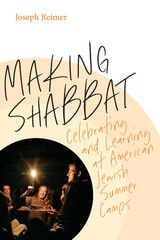
Making Shabbat
Celebrating and Learning at American Jewish Summer CampsJoseph Reimer
Brandeis University Press, 2022
This book tells the story of how Jewish camps have emerged as creators of positive spiritual experiences for Jewish youth in North America. When Jewish camps began at the dawn of the twentieth century, their leaders had little interest in creating Jewish spiritual experiences for their campers. Yet over the course of the past century, Jewish camps have gradually moved into providing primal Jewish experiences that diverse campers can enjoy, parents appreciate, and alumni fondly recall. Making Shabbat Real explores how Shabbat at camp became the focal point for these primal Jewish experiences, providing an interesting perspective on changing approaches to Jewish education and identity in North America.
Making Social Welfare Policy in America
Three Case Studies since 1950Edward D. Berkowitz
University of Chicago Press, 2020
Written in an accessible style and using a minimum of academic jargon, this book illuminates how three of our most important social welfare programs have come into existence and how they have fared over time.
Making Space for Mormon Thought and Culture
The Enduring Influence of Eugene EnglandRobert A. Rees
Signature Books, 2025
This intimate collection brings together a broad array of tributes to Eugene England, a leading Latter-day Saint scholar–teacher of the late twentieth century. It includes the voices of those who knew Gene and his work—family, friends, students, and colleagues—to illuminate the profound impact of one of Mormonism’s most influential thinkers. Through personal narratives and thoughtful reflections, these essays reveal Gene not just as a brilliant theologian and beloved professor, but as a compassionate mentor, faithful questioner, and dedicated disciple.
England’s influence on Latter-day Saint thought, culture, and religion was not only indelible but lasting. His legacy as a founding figure in modern Mormon intellectual life emerges through stories of his classroom teachings, his founding of Dialogue: A Journal of Mormon Thought, and his courageous exploration of difficult questions within a framework of faith. Contributors share how England modeled a life devoted to both unflinching inquiry and deep spiritual commitment—demonstrating that devotion and intellectualism could strengthen rather than threaten one another.
These personal accounts paint a portrait of a man whose theological insights and generous spirit continue to influence Mormon studies and whose example inspires those seeking to harmonize faith with intellectual honesty. For both those who knew England and those discovering him for the first time, this collection offers a window into the heart and mind of a remarkable Mormon thinker and his enduring influence.
Making Space on the Western Frontier
Mormons, Miners, and Southern PaiutesW. Paul Reeve
University of Illinois Press, 2006
Making Steel
Sparrows Point and the Rise and Ruin of American Industrial MightMark Reutter
University of Illinois Press, 1988
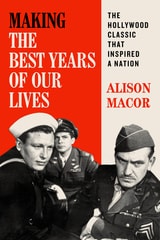
Making The Best Years of Our Lives
The Hollywood Classic That Inspired a NationBy Alison Macor
University of Texas Press, 2022
2023 Wall Award Finalist, Theatre Library Association
How a Hollywood gem transformed the national discourse on post-traumatic stress disorder.
Released in 1946, The Best Years of Our Lives became an immediate success. Life magazine called it “the first big, good movie of the post-war era” to tackle the “veterans problem.” Today we call that problem PTSD, but in the initial aftermath of World War II, the modern language of war trauma did not exist. The film earned the producer Samuel Goldwyn his only Best Picture Academy Award. It offered the injured director, William Wyler, a triumphant postwar return to Hollywood. And for Harold Russell, a double amputee who costarred with Fredric March and Dana Andrews, the film provided a surprising second act.
Award-winning author Alison Macor illuminates the film’s journey from script to screen and describes how this authentic motion picture moved audiences worldwide. General Omar Bradley believed The Best Years of Our Lives would help “the American people to build an even better democracy” following the war, and the movie inspired broad reflection on reintegrating the walking wounded. But the film’s nuanced critique of American ideals also made it a target, and the picture and its creators were swept up in the anti-Communist witch hunts of the late 1940s. In this authoritative history, Macor chronicles the making and meaning of a film that changed America.
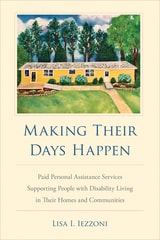
Making Their Days Happen
Paid Personal Assistance Services Supporting People with Disability Living in Their Homes and CommunitiesLisa I. Iezzoni
Temple University Press, 2022
Most Americans—even those with significant disability—want to live in their homes and communities. Unpaid family members or friends often work as “informal” caregivers, helping those who need assistance— and many feel they have no option but to serve. In contrast, paid personal assistance services workers (PAS) provide a lifeline to those consumers with complex needs and limited social networks. However, there is a crisis looming in the increasing needs for paid PAS and the limited available PAS workforce.
Making Their Days Happen explores disability, health, and civil rights, along with relevant federal and state labor policies related to personal assistance services. Lisa Iezzoni addresses the legal context of paid PAS as well as financing mechanisms for obtaining home-based personal assistance. She also draws upon interviews she conducted with paid PAS consumers and PAS workers to explore PAS experiences and their perspectives about their work.
Offering recommendations for improving future experiences of PAS consumers and providers, Iezzoni emphasizes that people with disabilities want to be a part of society, and PAS workers who do this low-wage work find satisfaction in helping them achieve their goals.

Making Their Own Way
Southern Blacks' Migration to Pittsburgh, 1916-30Peter Gottlieb
University of Illinois Press, 1987
on that momentous movement historians know as the Great Migration. Peter
Gottlieb shatters the received portrait of southern migrants as bewildered,
premodern folk, 'utterly unprepared' for the complexities of urban life.
African Americans in his account emerge as complex, creative agents, exploiting
old solidarities and building new ones, transforming the urban landscape
even as it transformed them." -- James Campbell, Northwestern University
"Engagingly written and well organized. . . . A major addition to
the fields of Afro-American, urban, and working-class history." --
Howard N. Rabinowitz, Georgia Historical Quarterly
"Gottlieb uses oral histories, corporate records, and primary and
secondary scholarship to present a useful picture of an important part
of the Great Migration that followed World War I." -- George Lipsitz,
Choice
"Sensitive and yet also incisive. . . . clear and often compelling.
An outstanding study." -- James R. Barrett, Journal of American
Ethnic History
Publication of this work was supported in part by a grant from the
Andrew W. Mellon Foundation.
Making Things Perfectly Queer
Interpreting Mass CultureAlexander Doty
University of Minnesota Press, 1993
Doty argues that films, television, and other forms of mass culture consistently elicit a wide range of queer (sexually liminal) responses, and suggests an interpretive framework for understanding mass culture that stands as a corrective to many standard cultural approaches.
Making Up Our Mind
What School Choice Is Really AboutSigal R. Ben-Porath and Michael C. Johanek
University of Chicago Press, 2019
Those are not only the wrong questions—they’re the wrong premises, argue philosopher Sigal R. Ben-Porath and historian Michael C. Johanek in Making Up Our Mind. Market-driven school choices aren’t new. They predate the republic, and for generations parents have chosen to educate their children through an evolving mix of publicly supported, private, charitable, and entrepreneurial enterprises. The question is not whether to have school choice. It is how we will regulate who has which choices in our mixed market for schooling—and what we, as a nation, hope to accomplish with that mix of choices. Looking beyond the simplistic divide between those who oppose government intervention and those who support public education, the authors make the case for a structured landscape of choice in schooling, one that protects the interests of children and of society, while also identifying key shared values on which a broadly acceptable policy could rest.
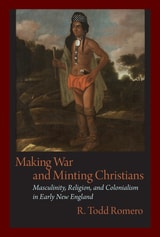
Making War and Minting Christians
Masculinity, Religion, and Colonialism in Early New EnglandR. Todd Romero
University of Massachusetts Press, 2011
In this book, R. Todd Romero traces the interaction of notions of gender, the practice of religion, and the conduct of warfare in colonial America. He shows how Native and Anglo-American ideas of manhood developed in counterpoint, in the context of Christian evangelization, colonial expansion, and recurrent armed conflict.
For the English, the cultivation of manliness became an important aspect of missionary efforts. Conversion demanded that the English “make men” of the Indians before they could “make them Christians,” a process that involved reshaping Native masculinity according to English patriarchal ideals that the colonists themselves rarely matched. For their part, Native Americans held on to older ways of understanding the divine and defining gender even as they entered English “praying towns” and negotiated the steep demands of the missionaries.
Evolving ideas of masculinity resonated with religious significance and shaped the meaning of warfare for Natives and colonists alike. Just as the English believed that their territorial expansion was divinely sanctioned, Indians attributed a string of victories in King Philip's War to “the Great God” and the perception that their enemies “were like women.” Trusting that war and manliness were necessarily linked, both groups engaged in ritual preparations for battle, believed deeply in the efficacy of the supernatural to affect the outcome of combat, and comprehended the meaning of war in distinctly religious ways.
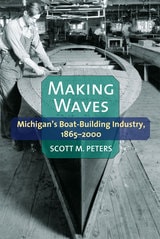
Making Waves
Michigan’s Boat-Building Industry, 1865-2000Scott M. Peters
University of Michigan Press, 2015
Making Whole What Has Been Smashed
On Reparations PoliticsTorpey, John
Rutgers University Press, 2017
Viewing the search for “coming to terms with the past” as a form of politics, John Torpey argues that there are major differences between reparations for the living victims of past wrongdoing and reparations for the descendants of such victims. More fundamentally, he argues that claims for reparations comprise a relatively novel kind of politics that involves a quest for symbolic recognition and material compensation for those seeking them—through the idiom of the past rather than the present. This reissue is the first paperback edition and contains a new preface by the author.
Making Work Pay
Bruce D. Meyer
Russell Sage Foundation, 2001
Making World Literature
Actors, Institutions, and Networks in the United States since 1890Anna Muenchrath
University of Massachusetts Press, 2024
From universities to governments, the Big Five publishers to Amazon, the influence of institutions abounds in US publishing. A diverse array of books from around the globe have been made into world literature in the US, selected by editors, publishers, and bureaucrats, produced by non-profits and for-profit presses of all sizes, and distributed through schools, publishing programs, and bookstores. The resulting world literary canon is the product of complex negotiations between individual preferences and institutional mandates, as well as economic, cultural, and pedagogical logics. While book publishing has fallen increasingly under the sway of global capitalism, yet the literary world remains made up of a series of individuals making choices about whom to fund, teach, translate, edit, and publish. The “world” of world literature, Anna Muenchrath argues, is a heterogeneous network of people whose circulation of literature is necessarily imbricated in the market economy, but whose selections might resist that economy and open new literary futures. Through archival research and close readings, this book considers what those participating are trying to do in circulating a text, and what communities they are helping to form or strengthen.
Making World Literature posits that network theory can effectively model the agency of actors and institutions in the literary field, making visible both the long-term accrual of power, as well as the choices of authors, translators, editors, and readers who do not simply replicate the values of a global literary marketplace, but divert, question, and undermine them. Muenchrath closely examines the paratexts and archival documents surrounding moments of global circulation in and through institutions like US world literature anthologies, the Council of Books in Wartime, the Iowa Writer’s Workshop, Oprah’s Book Club, and Amazon’s translation imprint. The granularity of these case studies reveals the increasingly limited agency of the individual in the global literary field, demonstrating how such players are important actors, and how their choices open up further options for later actors seeking to take texts down new paths toward or after publication.
Making a Better World
Public Housing, the Red Scare, and the Direction of Modern Los AngelesDon Parson
University of Minnesota Press, 2005
Making a Green Machine
The Infrastructure of Beverage Container RecyclingJørgensen, Finn Arne
Rutgers University Press, 2011
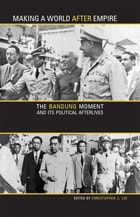
Making a World after Empire
The Bandung Moment and Its Political AfterlivesChristopher J. Lee
Ohio University Press, 2010
In April 1955, twenty-nine countries from Africa, Asia, and the Middle East came together for a diplomatic conference in Bandung, Indonesia, intending to define the direction of the postcolonial world. Representing approximately two-thirds of the world’s population, the Bandung conference occurred during a key moment of transition in the mid-twentieth century—amid the global wave of decolonization that took place after the Second World War and the nascent establishment of a new cold war world order in its wake. Participants such as Jawaharlal Nehru of India, Gamal Abdel Nasser of Egypt, Zhou Enlai of China, and Ahmed Sukarno of Indonesia seized this occasion to attempt the creation of a political alternative to the dual threats of Western neocolonialism and the cold war interventionism of the United States and the Soviet Union.
The essays in this volume explore the diverse repercussions of this event, tracing the diplomatic, intellectual, and sociocultural histories that have emanated from it. Making a World after Empire consequently addresses the complex intersection of postcolonial history and cold war history and speaks to contemporary discussions of Afro-Asianism, empire, and decolonization, thus reestablishing the conference’s importance in twentieth-century global history.
Contributors: Michael Adas, Laura Bier, James R. Brennan, G. Thomas Burgess, Antoinette Burton, Dipesh Chakrabarty, Julian Go, Christopher J. Lee, Jamie Monson, Jeremy Prestholdt, Denis M. Tull
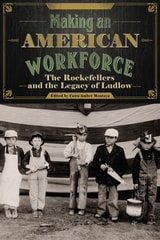
Making an American Workforce
The Rockefellers and the Legacy of LudlowFawn-Amber Montoya
University Press of Colorado, 2014
Focusing on the workers themselves—men, women, and children representative of a variety of immigrant and ethnic groups—contributors trace the emergence of the Employee Representation Plan, the work of the company's Sociology Department, and CF&I's interactions with the YMCA in the early twentieth century. They examine CF&I's early commitment to Americanize its immigrant employees and shape worker behavior, the development of policies that constructed the workforce it envisioned while simultaneously laying the groundwork for the strike that eventually led to the Ludlow Massacre, and the impact of the massacre on the employees, the company, and beyond.
Making an American Workforce provides greater insight into the repercussions of the Industrial Representation Plan and the Ludlow Massacre, revealing the long-term consequences of Colorado Fuel and Iron Company policies on the American worker, the state of Colorado, and the creation of corporate culture. Making an American Workforce will be of interest to Western, labor, and business historians.
Making an Antislavery Nation
Lincoln, Douglas, and the Battle over FreedomGraham A. Peck
University of Illinois Press, 2020
This sweeping narrative presents an original and compelling explanation for the triumph of the antislavery movement in the United States prior to the Civil War. Abraham Lincoln's election as the first antislavery president was hardly preordained. From the country's inception, Americans had struggled to define slavery's relationship to freedom. Most Northerners supported abolition in the North but condoned slavery in the South, while most Southerners denounced abolition and asserted slavery's compatibility with whites' freedom. On this massive political fault line hinged the fate of the nation.
Graham A. Peck meticulously traces the conflict over slavery in Illinois from the Northwest Ordinance in 1787 to Lincoln's defeat of his archrival Stephen A. Douglas in the 1860 election. Douglas's attempt in 1854 to persuade Northerners that slavery and freedom had equal national standing stirred a political earthquake that brought Lincoln to the White House. Yet Lincoln's framing of the antislavery movement as a conservative return to the country's founding principles masked what was in fact a radical and unprecedented antislavery nationalism. It justified slavery's destruction but triggered the Civil War.
Presenting pathbreaking interpretations of Lincoln, Douglas, and the Civil War's origins, Making an Antislavery Nation shows how battles over slavery paved the way for freedom's triumph in America.
Making an Issue of Child Abuse
Political Agenda Setting for Social ProblemsBarbara J. Nelson
University of Chicago Press, 1986
Making and Unmaking Intellectual Property
Creative Production in Legal and Cultural PerspectiveEdited by Mario Biagioli, Peter Jaszi, and Martha Woodmansee
University of Chicago Press, 2011
Rules regulating access to knowledge are no longer the exclusive province of lawyers and policymakers and instead command the attention of anthropologists, economists, literary theorists, political scientists, artists, historians, and cultural critics. This burgeoning interdisciplinary interest in “intellectual property” has also expanded beyond the conventional categories of patent, copyright, and trademark to encompass a diverse array of topics ranging from traditional knowledge to international trade. Though recognition of the central role played by “knowledge economies” has increased, there is a special urgency associated with present-day inquiries into where rights to information come from, how they are justified, and the ways in which they are deployed.
Making and Unmaking Intellectual Property, edited by Mario Biagioli, Peter Jaszi, and Martha Woodmansee, presents a range of diverse—and even conflicting—contemporary perspectives on intellectual property rights and the contested sources of authority associated with them. Examining fundamental concepts and challenging conventional narratives—including those centered around authorship, invention, and the public domain—this book provides a rich introduction to an important intersection of law, culture, and material production.
Making in School and Public Libraries
Edited by Kristin Fontichiaro, Caroline Wack, Tori Culler, and Nicole Sype
Michigan Publishing Services, 2020
Readers will gain practical insights about how to
- Define goals and target audiences
- Customize programs to meet community needs
- Equip a makerspace
- Document activities
- Assess achievements and areas for growth
- Engage makers in a variety of technology and hands-on activities, including robots, 3D printing, sewing, cardboard challenges, knitting and crochet, design thinking, and zines
The authors’ experiences include co-creating one of the nation’s first school library makerspaces; establishing after-school maker programs with elementary and middle school learners; co-designing one-off and ongoing maker events for community-building in diverse public libraries; engaging with senior citizens in a low-income Senior Summer Camp pilot; and state, national, and international workshops for teachers, librarians, and youth mentors.

Making of Legends
More True Stories of Frontier AmericaMark Dugan
Ohio University Press, 1997
Mark Dugan brings reality to the forefront in The Making of Legends. Some of the characters in his accounts are practically unknown but deserve more recognition than the bandits whose names are mythic. Exhaustive archival research enables him to recreate such colorful lives as North Carolina’s Malina Blaylock, who, disguised as a man, joined her outlaw husband in the Confederate army; slippery escape artist David Lewis, the Robin Hood of the Cumberland, who finally stopped two bullets in a chaotic Pennsylvania shoot-out; Wyatt Earp, in his mysterious post-OK Corral year, amidst the Coeur d’Alene gold rush; and grim “Laughing Sam” Hartman, of South Dakota.
Dugan sets the stage by explaining how newspapers and dime novels fanned the flames of public fascination with outlaws. He unmasks the real Billy the Kid, traces the paths of Butch Cassidy and the Sundance Kid to their historic shoot-out in South America, and masterfully summarizes the Civil War grudges, bloodshed, and wanton destruction along the Kansas-Missouri border that spawned Jesse and Frank James and the Younger brothers gang.
In researching the lawless era of the American frontier, Dugan discovered much information that has never been published — material that will expand readers' views of frontier history and people, both good and bad. The Making of Legends proves that the actual stories of notorious legends can be more exciting, moving, and intriguing than anything dreamed up in a dime novel or a Hollywood fantasy.
With The Making of Legends Mark Dugan’s pursuit of outlaws takes him to Pennsylvania, North Carolina, Texas, California, South Dakota, Idaho, Oregon, Nebraska, Indiana, Wyoming, and Montana.
Making the American Home
Middle-Class Women and Domestic Material Culture, 1840–1940Marilyn F. Motz
University of Wisconsin Press, 1988
Making the American Mouth
Dentists and Public Health in the Twentieth CenturyPicard, Alyssa
Rutgers University Press, 2009
Making the American Mouth is at once a history of United States dentistry and a study of a billion-dollar industry. Alyssa Picard chronicles the forces that limited Americans' access to dental care in the early twentieth century and the ways dentists worked to expand that access--and improve the public image of their profession. Comprehensive in scope, this work describes how dentists' early public health commitments withered under the strain of fights over fluoride, mid-century social movements for racial and gender equity, and pressure to insure dental costs. It explains how dentists came to promote cosmetic services, and why Americans were so eager to purchase them. As we move into the twentyfirst century, dentists' success in shaping their industry means that for many, the perfect American smile will remain a distant--though tantalizing--dream.
Making the American Team
Sport, Culture, and the Olympic ExperienceMark Dyreson
University of Illinois Press, 1998
Sport dominates television and the mass media. Politics and business are a-bustle with sports metaphors. Endorsements by athletes sell us products. "Home run," "slam dunk," and the rest of the vocabulary of sport color daily conversation. Even in times of crisis and emergency, the media reports the scores and highlights.
Marky Dyreson delves into how our obsession with sport came into being with a close look at coverage of the Olympic Games between 1896 and 1912. How people reported and consumed information on the Olympics offers insight into how sport entered the heart of American culture as part of an impetus for social reform. Political leaders came to believe in the power of sport to revitalize the "republican experiment." Sport could instill a new sense of national identity that would forge a new sense of community and a healthy political order while at the same time linking America's intellectual and power elite with the experiences of the masses.

Making the Carry
The Lives of John and Tchi-Ki-Wis LinklaterTimothy Cochrane
University of Minnesota Press, 2023
An extraordinary illustrated biography of a Métis man and Anishinaabe woman navigating great changes in their homeland along the U.S.–Canada border in the early twentieth century
John Linklater, of Anishinaabeg, Cree, and Scottish ancestry, and his wife, Tchi-Ki-Wis, of the Lac La Croix First Nation, lived in the canoe and border country of Ontario and Minnesota from the 1870s until the 1930s. During that time, the couple experienced radical upheavals in the Quetico–Superior region, including the cutting of white and red pine forests, the creation of Indian reserves/reservations and conservation areas, and the rise of towns, tourism, and mining. With broad geographical sweep, historical significance, and biographical depth, Making the Carry tells their story, overlooked for far too long.
John Linklater, a renowned game warden and skilled woodsman, was also the bearer of traditional ecological knowledge and Indigenous heritage, both of which he was deeply committed to teaching others. He was sought by professors, newspaper reporters, museum personnel, and conservationists—among them Sigurd Olson, who considered Linklater a mentor. Tchi-Ki-Wis, an extraordinary craftswoman, made a sweeping array of necessary yet beautiful objects, from sled dog harnesses to moose calls to birch bark canoes. She was an expert weaver of large Anishinaabeg cedar bark mats with complicated geometric designs, a virtually lost art.
Making the Carry traces the routes by which the couple came to live on Basswood Lake on the international border. John’s Métis ancestors with deep Hudson’s Bay Company roots originally came from Orkney Islands, Scotland, by way of Hudson Bay and Red River, or what is now Winnipeg. His family lived in Manitoba, northwest Ontario, northern Minnesota, and, in the case ofJohn and Tchi-Ki-Wis, on Isle Royale. A journey through little-known Canadian history, the book provides an intimate portrait of Métis people.
Complete with rarely seen photographs of activities from dog mushing to guiding to lumbering, as well as of many objects made by Tchi-Ki-Wis, such as canoes, moccasins, and cedar mats, Making the Carry is a window on a traditional way of life and a restoration of two fascinating Indigenous people to their rightful place in our collective past.
Making the Case
Advocacy and Judgment in Public ArgumentKathryn M. Olson
Michigan State University Press, 2012
In an era when the value of the humanities and qualitative inquiry has been questioned in academia and beyond, Making the Case is an engaging and timely collection that brings together a veritable who’s who of public address scholars to illustrate the power of case-based scholarly argument and to demonstrate how critical inquiry into a specific moment speaks to general contexts and theories. Providing both a theoretical framework and a wealth of historically situated texts, Making the Case spans from Homeric Greece to twenty-first-century America. The authors examine the dynamic interplay of texts and their concomitant rhetorical situations by drawing on a number of case studies, including controversial constitutional arguments put forward by activists and presidents in the nineteenth century, inventive economic pivots by Franklin Roosevelt and Alan Greenspan, and the rhetorical trajectory and method of Barack Obama.
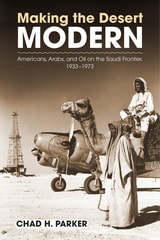
Making the Desert Modern
Americans, Arabs, and Oil on the Saudi Frontier, 1933–1973Chad Parker
University of Massachusetts Press, 2015
In 1933 American oilmen representing what later became the Arabian American Oil Company (Aramco) signed a concession agreement with the Saudi Arabian king granting the company sole proprietorship over the oil reserves in the country's largest province. As drilling commenced and wells proliferated, Aramco soon became a major presence in the region. In this book Chad H. Parker tells Aramco's story, showing how an American company seeking resources and profits not only contributed to Saudi “nation building” but helped define U.S. foreign policy during the early Cold War.
In the years following World War II, as Aramco expanded its role in Saudi Arabia, the idea of “modernization” emerged as a central component of American foreign policy toward newly independent states. Although the company engaged in practices supportive of U.S. goals, its own modernizing efforts tended to be pragmatic rather than policy-driven, more consistent with furthering its business interests than with validating abstract theories. Aramco built the infrastructure necessary to extract oil and also carved an American suburb out of the Arabian desert, with all the air-conditioned comforts of Western modern life. At the same time, executives cultivated powerful relationships with Saudi government officials and, to the annoyance of U.S. officials, even served the monarchy in diplomatic disputes. Before long the company became the principal American diplomatic, political, and cultural agent in the country, a role it would continue to play until 1973, when the Saudi government took over its operation.
Making the Forever War
Marilyn B. Young on the Culture and Politics of American MilitarismMary L. Dudziak
University of Massachusetts Press, 2021
Making the Forever War brings Young's articles and essays on American war together for the first time, including never before published works. Moving from the first years of the Cold War to Korea, Vietnam, and more recent "forever" wars in Iraq and Afghanistan, Young reveals the ways in which war became ever-present, yet more covert and abstract, particularly as aerial bombings and faceless drone strikes have attained greater strategic value. For Young, U.S. empire persisted because of, not despite, the inattention of most Americans. The collection concludes with an afterword by prominent military historian Andrew Bacevich.