Results by title
2285 books match the query 'Women' and 107 start with m
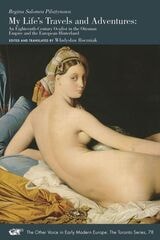
My Life's Travels and Adventures
An Eighteenth-Century Oculist in the Ottoman Empire and the European HinterlandRegina Salomea Pilsztynowa
Iter Press, 2020
This edition brings the entirety of this personal and idiosyncratic memoir to English for the first time.
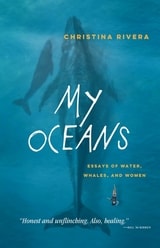
My Oceans
Essays of Water, Whales, and WomenChristina Rivera
Northwestern University Press, 2025
In a swell of sea-linked essays, Christina Rivera explores the kinship between marine animals, humans, and Earth’s blue womb. Rivera’s investigative questions begin with the toxic burden of her body and spiral out—to a grieving orca, a hunted manta ray, a pregnant sea turtle, a spawning salmon, an “endling” porpoise, and the “mother culture” of sperm whales—as she redefines what it means to mother and defend a collective future.
Braiding memoir with embodied climate science, Rivera challenges that it’s not anthropomorphism to feel deep connection to nonhuman species and proposes that gathering in collective grief is essential amid the sixth mass extinction. For ecofeminists, fans of Rachel Carson and Terry Tempest Williams—and for anyone who feels themself disintegrate in the presence of the sea—My Oceans offers a timely and wondrous descent into the deep waters of interconnection in which we swim.
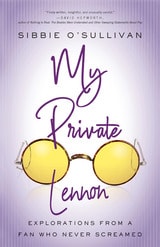
My Private Lennon
Explorations from a Fan Who Never ScreamedSibbie O'Sullivan
The Ohio State University Press, 2020
My Private Lennon charts the author’s realization that the Beatles, especially John Lennon, were a crucial force in her development. A radical departure from other books written by Beatles fans, My Private Lennon invites its readers to consider subjects not usually found in works about Lennon and the band, such as the constraints of memory, the male body, grief, the female breast, race, cultural issues, and the importance of privacy in our over-mediated world. In pieces that engage cultural issues and historical contexts, My Private Lennon creates a witty and provocative intimacy with readers who value the power of art to change one’s life and who love John Lennon and the Beatles.
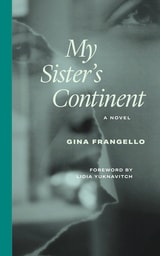
My Sister's Continent
A NovelGina Frangello, Lidia Yuknavitch
Northwestern University Press, 2026
Kirby is a young woman attempting to come to terms with a failed bout of therapy and the truth about her identical twin, Kendra. Since girlhood, Kirby both idolized and envied Kendra, a fearless and charismatic ballet dancer who commanded the attention of everyone in their orbit. In the aftermath of tragedy, Kirby is sent a case study by a former psychiatrist intent on publishing a distorted version of her family’s secrets. She responds by using Kendra’s private and revealing journals to reconstruct their final months together, as well as her own “disastrous” time in therapy, to voice her own truth.
Freud’s “Dora,” a young woman whose mysterious symptoms he contentiously chalked up to “hysteria,” appears at turns in the faces of each twin as they navigate a world of sexuality, familial dysfunction, and possibly-psychosomatic ailments. Reissued with a new foreword by Lidia Yuknavitch, Frangello’s groundbreaking early novel brings “Dora” into a new era.
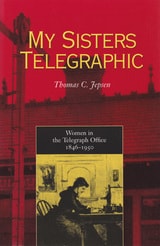
My Sisters Telegraphic
Women in the Telegraph Office, 1846–1950Thomas C. Jepsen
Ohio University Press, 2000
The role of the telegraph operator in the mid-nineteenth century was like that of today’s software programmer/analyst, according to independent scholar Tom Jepsen, who notes that in the “cyberspace” of long ago, male operators were often surprised to learn that the “first-class man” on the other end of the wire was a woman.
Like the computer, the telegraph caused a technological revolution. The telegraph soon worked synergistically with the era’s other mass-scale technology, the railroad, to share facilities as well as provide communications to help trains run on time.
The strategic nature of the telegraph in the Civil War opened opportunities for women, but tension arose as men began to return from military service. However, women telegraphers did not affect male employment or wage levels. Women kept their jobs after the war with support from industry—Western Union in particular—and because they defended and justified their role.
“Although women were predominantly employed in lower-paying positions and in rural offices, women who persisted and made a career of the profession could work up to managerial or senior technical positions that, except for wage discrimination, were identical to those of their male counterparts,” writes Jepsen. “Telegraphy as an occupation became gendered, in the sense that we understand today, only after the introduction of the teletype and the creation of a separate role for women teletype operators.”
My Sisters Telegraphic is a fresh introduction to this pivotal communications technology and its unsung women workers, long neglected by labor and social historians.

My Song is My Own
100 Women's SongsKathy Henderson
Pluto Press, 1979
With full sheet music for every song, and accompanying lyrics, this is perfect for singers as well as readers. Each section is introduced with a a brief thematic history, showing how the music has developed over time.
From ballads to industrial songs written for the mine and factory, from folk revivals to children's songs for the street and playground, this book reveals the hidden culture and history of women for us today.
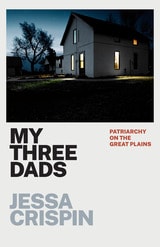
My Three Dads
Patriarchy on the Great PlainsJessa Crispin
University of Chicago Press, 2022
For many Americans, Kansas represents a vision of Midwestern life that is good and wholesome and evokes the American ideals of god, home, and country. But for those like Jessa Crispin who have grown up in Kansas, the realities are much harsher. She argues that the Midwestern values we cling to cover up a long history of oppression and control over Native Americans, women, and the economically disadvantaged.
Blending personal narrative with social commentary, Crispin meditates on why the American Midwest still enjoys an esteemed position in our country's mythic self-image. Ranging from The Wizard of Oz to race, from chastity to rape, from radical militias and recent terrorist plots to Utopian communities, My Three Dads opens on a comic scene in a Kansas rent house the author shares with a (masculine) ghost. This prompts Crispin to think about her intellectual fathers, her spiritual fathers, and her literal fathers. She is curious to understand what she has learned from them and what she needs to unlearn about how a person should be in a family, as a citizen, and as a child of god—ideals, Crispin argues, that have been established and reproduced in service to hierarchy, oppression, and wealth.
Written in Crispin’s well-honed voice—smart, assured, comfortable with darkness—My Three Dads offers a kind of bleak redemption, the insight that no matter where you go, no matter how far from home you roam, the place you came from is always with you, “like it or not.”