Results by title
3576 books match the query 'American' and 179 start with m
More Poems about Money
Daniel Wolff
Four Way Books, 2022
More Than Meat and Raiment
PoemsAngela Jackson
Northwestern University Press, 2022
The speakers of these poems reflect on memory and saga, history and legend. Voices recall evenings spent catching fireflies with a younger sister, the aroma of homemade rolls, the father who squeezes papers into his wallet alongside bills in order to appear wealthy (“a flock of green birds rustling inside / to get out for some extravagance”). A Black girl watches TV and dreams of the perfect partner. A citizen contends with the unrelenting devastation of police violence in a work reminiscent of Gwendolyn Brooks’s “verse journalism.” A mother loses her daughter only to witness her rebirth: “Praise be / the human being / that is being.”
In “For Our People,” an homage to Margaret Walker, Jackson summons the resilience and imagination of African Americans, celebrating “each of us injured or exalted, betrayer or betrayed, muted / and declamatory, all one, each of us all of us, each a private star beloved in the universe.” Lauded as one of American poetry’s most vivid voices, Jackson continues her reign among the country’s foremost wordsmiths. This sublime collection delves deep into the porch stories and folktales that have carried the Black voice through all its histories.
Morocco Bound
Disorienting America's Maghreb, from Casablanca to the Marrakech ExpressBrian T. Edwards
Duke University Press, 2005
Edwards reads a broad range of texts to recuperate the disorienting possibilities for rethinking American empire. Examining work by William Burroughs, Jane Bowles, Ernie Pyle, A. J. Liebling, Jane Kramer, Alfred Hitchcock, Clifford Geertz, James Michener, Ornette Coleman, General George S. Patton, and others, he puts American texts in conversation with an archive of Maghrebi responses. Whether considering Warner Brothers’ marketing of the movie Casablanca in 1942, journalistic representations of Tangier as a city of excess and queerness, Paul Bowles’s collaboration with the Moroccan artist Mohammed Mrabet, the hippie communities in and around Marrakech in the 1960s and early 1970s, or the writings of young American anthropologists working nearby at the same time, Edwards illuminates the circulation of American texts, their relationship to Maghrebi history, and the ways they might be read so as to reimagine the role of American culture in the world.
Mother in Summer
Susan Hahn
Northwestern University Press, 2002
Motion
American Sports PoemsNoah Blaustein
University of Iowa Press, 2001
Sports have long served as inspiration for poetry-the ancient Greeks wrote odes in praise of their athletes-so it is little surprise that in a culture as obsessed with athletes as our own sports would exert an influence on contemporary poets. Motion: American Sports Poems rescues sports from our society's focus on superstars, multimillion-dollar contracts, and gold medals to capture champions and losers, competitors and spectators in moments that are anything but fleeting.
As Noah Blaustein points out in his preface, among the many parallels made between sports and poetry is the idea of transcendence. Forged from the most basic elements of sport-energy, movement, and rhythm-the poems in this anthology reflect something universal: sport as metaphor, sport as struggle, sport as the battleground for mythic figures and local heroes.
The often celebrated sports-baseball, boxing, football, and basketball-are here along with unexpected pastimes like surfing, skateboarding, tennis, soccer, karate, rock climbing, bowling, and curling. Young and old, black and white, male and female, the poets in this anthology celebrate everyone who has come together in the shimmy and shake and sweat of sport.

Mountain Dialogues
Frank Waters
Ohio University Press, 1999
“Mysticism is peculiar to the mountainbred,” Frank Waters once told an interviewer for Psychology Today. And in Mountain Dialogues, available for the first time in paperback, the mountainbred Waters proves it true. Ranging over such diverse subjects as silence, spirits, time, change, and the sacred mountains of the world, Waters sounds again and again the radiant, mystic theme of man’s inherent wholeness and his oneness with the cosmos.
Writing in Western American Literature, Charles L. Adams said, “In Mountain Dialogues, we see Frank Waters acknowledging his sources—major influences on a great American thinker and writer. Waters weaves together threads of these influences, adds his own thought, and presents us with a truly cosmic overview. This overview is thoroughly that of an American ‘Westerner’; it also is one that merits international consideration.”
And as the Bloomsbury Review wrote: “Mountain Dialogues is more than just a collection of personal essays. It is an ‘evolutionist’s handbook’ for the sons and daughters of the new West, a guide for those who would transcend the limitations of Western civilization.”
Moving Encounters
Sympathy and the Indian Question in Antebellum LiteratureLaura L. Mielke
University of Massachusetts Press, 2008
An old Indian woman comforts two young white children she finds lost in the woods and lovingly carries them back to their eager parents. A frontiersman sheds tears over the grave of a Mohican youth, holding hands with the mourning father. According to Laura L. Mielke, such emotionally charged scenes between whites and Indians paradoxically flourished in American literature from 1820 to 1850, a time when the United States government developed and applied a policy of Indian removal.
Although these “moving encounters,” as Mielke terms them, often promoted the possibility of mutual sympathy between Native Americans and Euro-Americans, they also suggested that these emotional links were inherently unstable, potentially dangerous, and ultimately doomed. At the same time, the emphasis on Indian-white sympathy provided an opportunity for Indians and non-Native activists to voice an alternative to removal and acculturation, turning the language of a sentimental U.S. culture against its own imperial impulse. Mielke details not only how such writers as James Fenimore Cooper and Henry Rowe Schoolcraft forecast the inevitable demise of Indian-white sympathy, but also how authors like Lydia Maria Child and William Apess insisted that a language of feeling could be used to create shared community or defend American Indian sovereignty. In this way, Moving Encounters sheds new light on a wide range of texts concerning the “Indian Question” by emphasizing their engagement with popular sentimental forms and by challenging the commonly held belief that all Euro-American expressions of sympathy for American Indians in this period were fundamentally insincere. While portraits of Indian-white sympathy often prompted cynical rejoinders from parodists, many never lost faith in the power of emotion to overcome the greed and prejudice fueling the dispossession of American Indians.

Mr. Dooley in Peace and in War
Finley Peter Dunne
University of Illinois Press, 1988
As Charlie McCarthy is to Edgar Bergen, so is Martin T. Dooley to newspaper humorist Finley Peter Dunne. Mr. Dooley in Peace and in War, originally published in 1898, collects brief, humorous pieces Dunne wrote for the Chicago Evening Post and the Chicago Journal. In an Irish-American dialect as thick as the foam on a pint of stout, Mr. Dooley and his friends discuss the military "sthrateejy" for American action in Cuba, "iliction" day shenanigans, Queen Victoria's jubilee, the "new woman," and the strange American sport of football, in which a player puts "a pair iv matthresses on his legs, a pillow behind, [and] a mask over his nose" and tries to kill his fellow men. Through his tall tales and speculations, Mr. Dooley reveals the pleasure and pain of being Irish in Chicago at the turn of the twentieth century.
Clothed in the charming hyperbole and mislocution of the unflappable Mr. Dooley, Dunne's incisive social criticism flies unerringly to the target, exposing prejudice, hypocrisy, insensitivity, and plain old-fashioned humbug.
Mr. Stevens' Secretary
PoemsFrances Schenkkan
University of Arkansas Press, 2017
Finalist, 2017 Miller Williams Poetry Prize, edited by Billy Collins
“Forces an eye-opening change in perspective.”
—Billy Collins
In Mr. Stevens’ Secretary, a fictional assistant to Wallace Stevens juggles her roles as a mother, a wife, a believer, and a working woman. Privy at times to the famous poet’s personal life, the secretary must balance her curiosity about Stevens with her commitment to her husband, her faith, and the life she desires.
This vivid and compelling character struggles with fears of mental illness and the challenges of working for a prominent, reserved man, all while adjusting to new environs. She leaves her home, and her job, as she contemplates whether her marriage is worth saving and if she can reconcile the Baptist faith of her upbringing with the questions raised by her new place in the world. Throughout, we are witness to her complex relationship with the famous modernist poet, and with writing itself.
Mrs. Dumpty
Chana Bloch
University of Wisconsin Press, 1998
The poems in Mrs. Dumpty are about “a great fall,” the dissolution of a long and loving marriage, but they are not simply documentary or elegiac. What interests Chana Bloch is the inner life: how we are formed by our losses and our parents’ losses, how we learn what we need to know through our intuitions and confusions, how we deny and delay and finally discover who we are.
Mrs. Ramsay's Knee
Idris Anderson
Utah State University Press, 2008
Mrs. Sigourney of Hartford
Poems and Prose on the Early American Deaf CommunityEdna Edith Sayers
Gallaudet University Press, 2013
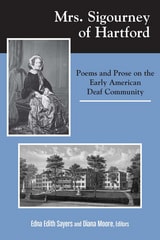
Lydia Huntley was born in 1791 in Norwich, CT, the only child of a poor Revolutionary war veteran. But her father’s employer, a wealthy widow, gave young Lydia the run of her library and later sent her for visits to Hartford, CT. After teaching at her own school for several years in Norwich, Lydia returned to Hartford to head a class of 15 girls from the best families. Among her students was Alice Cogswell, a deaf girl soon to be famous as a student of Thomas Hopkins Gallaudet and Laurent Clerc.
Lydia’s inspiration came from a deep commitment to the education of girls and also for African American, American Indian, and deaf children. She left teaching to marry Charles Sigourney, then turned to writing to support her family, publishing 56 books, 2,000 magazine articles, and popular poetry. Lydia Sigourney never abandoned her passion for deaf education, remaining a supporter of Gallaudet’s school for the deaf until her death. Yet, her contributions to deaf education and her writing have been forgotten until now.
All of Lydia Sigourney’s of Lydia Sigourney’s work on the nascent Deaf community is presented in this new volume. Her writing intertwines her mastery of the sentimentalism form popular in her day with her sharp insights on the best ways to educate deaf children. In the process, Mrs. Sigourney of Hartford reestablishes her rightful place in history.
Mud Woman
Poems from the ClayNora Naranjo-Morse
University of Arizona Press, 1992

Murder on the Reservation
American Indian Crime FictionRay B. Browne
University of Wisconsin Press, 2004
Murdered by His Wife
Deborah Navas
University of Massachusetts Press, 1999
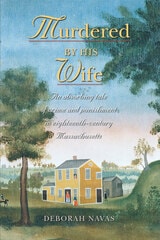
In March 1778, Joshua Spooner, a wealthy gentleman farmer in Brookfield, Massachusetts, was beaten to death and his body stuffed down a well. Four people were hanged for the crime: two British soldiers, a young Continental soldier, and Spooner's wife, Bathsheba, who was charged with instigating the murder. She was thirty-two years old and five months pregnant when executed. Newspapers described the case as “the most extraordinary crime ever perpetrated in New England.”
Murdered by His Wife provides a vivid reconstruction of this dramatic but little-known episode. Beautiful, intelligent, high-spirited, and witty, Bathsheba was the mother of three young children and in her own words felt “an utter aversion” for her husband, who was known to be an abusive drunk.
A year before the murder, she took in and nursed a sixteen-year-old Continental soldier who was returning from a year's enlistment under George Washington. The two became lovers and conceived a child. Divorces were all but impossible for women at that time and adulteresses were stripped to the waist and publicly whipped. Bathsheba's pregnancy occasioned a series of desperate plots to murder her husband, finally brought to fruition with the aid of two British deserters from General Burgoyne's defeated army.
The plots, the crime, the trial, and the aftermath are presented against a backdrop of revolutionary turmoil in Massachusetts. As the daughter of the state's most prominent and despised Loyalist, Bathsheba bore the brunt of the political, cultural, and gender prejudices of her day. When she sought a stay of execution to deliver her baby, the Massachusetts Council rejected her petition and she was promptly hanged before a crowd of 5,000 spectators.
Muriel Rukeyser's the Book of the Dead
Tim Dayton
University of Missouri Press, 2003
Muse
Susan Aizenberg
Southern Illinois University Press, 2002
Muse, the first full-length collection from poet Susan Aizenberg, brings together poems of personal history, elegy, and the complex lives of artists, writers, and “ordinary” people, in an exploration of the relationship between art and life, esthetics and ethics. She is sharp-eyed in purpose, trying to understand “what love is” in a continual shifting between loss and knowledge. While “there is no other world than this one” for Aizenberg, nevertheless she finds a world of affirmation. Aizenberg sings elegant blues, keeps a perfect balance between elaboration and restraint with formal skill that is both impressive and consoling, reminding us that poetry is a form of intelligence in which music creates a world full of mystery and depth.
Muse Found in a Colonized Body
Yesenia Montilla
Four Way Books, 2022
In the book's eponymous poem, Yesenia Montilla writes, “How do you not love yourself when you / constantly survive your undoing just by being precious?" Muse Found in a Colonized Body answers this rhetorical question by populating itself with poems that range far and wide in content — observing pop culture, interrogating history, resisting contemporary injustice — but that share the spinal cord of unflinching love. As Rachel Eliza Griffiths notes, Montilla’s “powers orbit and intuit the lives of Philando Castile, Captain America, Christian Cooper, Karl Marx, Ahmaud Arbery, Eartha Kitt, and many more while stitching our wounded identities, memories, and histories in defiant poems of revision and joyous reclamation.” The vertebral odes of this collection at turns uplift desire, affirm life, celebrate protest, and condemn the violent greed of imperial usurpation that has produced the U.S. as we know it. Both in its criticism and its admiration, Muse Found in a Colonized Body calls upon its readers to rise to the occasion of these lyrics’ profound care.
Museum of the Soon to Depart
Andy Young
Carnegie Mellon University Press, 2024
In Museum of the Soon to Depart, poet Andy Young searches for her place in history as it unfolds around her through revolution, plague, and natural disaster. As curator of her museum, she navigates her own and others’ suffering through intense observation, from the inner mechanisms of grief and illness to the solace of distance provided by photography. The material of the poet’s own life and events on the world stage intertwine, resulting in poems with a staggering range, inhabiting language in ways that ultimately point to its limits.
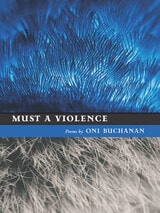
Must a Violence
Oni Buchanan
University of Iowa Press, 2012
In sounding out the problem of how to respond to violence and to the betrayal and domestication of that which is wild, this book counters with aesthetic violence and disruption of its own, opening the self to the unexpected powers of the senses and to encounters between "wildness" and "domestication" within the self. Though never easy, this openness creates the possibility for an all-enveloping love that touches and joins all animals, both nonhuman and human.
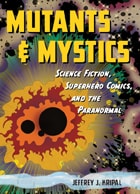
Mutants and Mystics
Science Fiction, Superhero Comics, and the ParanormalJeffrey J. Kripal
University of Chicago Press, 2011
But that's just scratching the surface, says Jeffrey Kripal. In Mutants and Mystics, Kripal offers a brilliantly insightful account of how comic book heroes have helped their creators and fans alike explore and express a wealth of paranormal experiences ignored by mainstream science. Delving deeply into the work of major figures in the field—from Jack Kirby’s cosmic superhero sagas and Philip K. Dick’s futuristic head-trips to Alan Moore’s sex magic and Whitley Strieber’s communion with visitors—Kripal shows how creators turned to science fiction to convey the reality of the inexplicable and the paranormal they experienced in their lives. Expanded consciousness found its language in the metaphors of sci-fi—incredible powers, unprecedented mutations, time-loops and vast intergalactic intelligences—and the deeper influences of mythology and religion that these in turn drew from; the wildly creative work that followed caught the imaginations of millions. Moving deftly from Cold War science and Fredric Wertham's anticomics crusade to gnostic revelation and alien abduction, Kripal spins out a hidden history of American culture, rich with mythical themes and shot through with an awareness that there are other realities far beyond our everyday understanding.
A bravura performance, beautifully illustrated in full color throughout and brimming over with incredible personal stories, Mutants and Mystics is that rarest of things: a book that is guaranteed to broaden—and maybe even blow—your mind.
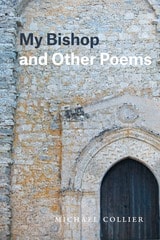
My Bishop and Other Poems
Michael Collier
University of Chicago Press, 2018
The poems of this collection explore such everyday dualities—how the human need for attachment is as much a source of pain as of vitality and how our longing for transcendence often leads to sinister complicities. The title poem tells the conflicted and devastating story of the poet’s friendship with the now-disgraced Bishop of Phoenix, Arizona, interweaving fragments of his parents’ funerals, which the Bishop concelebrated, with memories of his childhood spiritual leanings and how they were disrupted by a pedophilic priest the Bishop failed to protect him from.
This meditation on spiritual life, physical death, and betrayal is joined by an array of poised, short lyrics and expansive prose poems exploring how the terror and unpredictability of our era intrudes on our most intimate moments. Whether Michael Collier is writing about an airline disaster, Huey Newton’s trial, Thomas Jefferson’s bees, a piano in the woods, or his own fraught friendship with the disgraced Catholic Bishop, his syntactic verve, scrupulously observed detail, and flawless ear bring the felt—and sometimes frightening—dimensions of the mundane to life. Throughout, this collection pursues a quiet but ferocious need to get to the bottom of things.
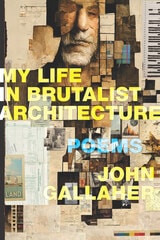
My Life in Brutalist Architecture
John Gallaher
Four Way Books, 2024
My Mother Was a Computer
Digital Subjects and Literary TextsN. Katherine Hayles
University of Chicago Press, 2005
My Mother Was a Computer explores how the impact of code on everyday life has become comparable to that of speech and writing: language and code have grown more entangled, the lines that once separated humans from machines, analog from digital, and old technologies from new ones have become blurred. My Mother Was a Computer gives us the tools necessary to make sense of these complex relationships. Hayles argues that we live in an age of intermediation that challenges our ideas about language, subjectivity, literary objects, and textuality. This process of intermediation takes place where digital media interact with cultural practices associated with older media, and here Hayles sharply portrays such interactions: how code differs from speech; how electronic text differs from print; the effects of digital media on the idea of the self; the effects of digitality on printed books; our conceptions of computers as living beings; the possibility that human consciousness itself might be computational; and the subjective cosmology wherein humans see the universe through the lens of their own digital age.
We are the children of computers in more than one sense, and no critic has done more than N. Katherine Hayles to explain how these technologies define us and our culture. Heady and provocative, My Mother Was a Computer will be judged as her best work yet.
My Prisoner and Other Stories
Tyler McAndrew
The Ohio State University Press, 2025
Set largely in the Rust Belt of the 1990s and early 2000s, My Prisoner and Other Stories gives us protagonists who repeatedly confront helplessness in the face of others’ suffering. A teenage girl tries to help an elderly woman who has locked herself out of her house only to be shaken by the trauma and loneliness that the woman—a Holocaust survivor and recent widow—eventually shares with her. A schoolteacher writes letters to his cousin, who has schizophrenia and is serving a life sentence for the murder of three of their relatives. A middle school student makes a complicated gesture of charity after befriending the poor kid at his lunch table. Siblings seed the ground for an eccentric treasure hunter only to find that their prank leads them into unexpected emotional peril. The structural forces that stain life in late-capitalist America—the prison system, economic desperation—lurk throughout these muscular and empathetic tales, but in the face of endemic adversity, shrewd and loving characters strive for and sometimes achieve hope and tenderness. Tyler McAndrew shows us an unadorned America that can still tap its capacity for human kindness.
My Sense of Silence
Memoirs of a Childhood with DeafnessLennard J. Davis
University of Illinois Press, 1999
Selected as an "Editors Choice" by the Chicago Tribune
Lennard J. Davis grew up as the hearing child of deaf parents. In this candid, affecting, and often funny memoir, he recalls the joys and confusions of this special world, especially his complex and sometimes difficult relationships with his working-class Jewish immigrant parents. Gracefully slipping through memory, regret, longing, and redemption, My Sense of Silence is an eloquent remembrance of human ties and human failings.
My Soviet Union
Michael Dumanis
University of Massachusetts Press, 2007
The speaker of the simultaneously funny and devastating poems in this remarkable first collection comes from a country that, like the Soviet Union, no longer exists, a place he treats with a mixture of nostalgia, disdain, and bewilderment as he strives to achieve a sense of order in his current disordered environment, a post-apocalyptic landscape with striking similarities to our own. He takes the reader through haunting and disjunctive childhood memories, on visits to Azerbaijan and West Des Moines, through the ravages of physical and spiritual illness, into and out of wars and ill-fated romantic escapades, as he carefully pieces together a complex narrative of self. This is a book of location and dis-location, intent and inaction, struggle and failure, restraint and mania, love and anger, savagery and healing, grief and merriment, elegy and ode. Technically, the poems-often litanies-are marked by syntactical variation, recurring imagery, paradoxical statement, cultural idioms, shifts between high and low diction, a carnivalesque sense of humor, and an elliptical approach to exposition. The speaker also takes on the identities of various personae in the book, including Joseph Cornell, Vladimir Mayakovsky, Pol Pot, a vaudevillian, a movie extra, minor dictators, vagrants, ambigendered lovers, and a lighthouse keeper on an uninhabited island.
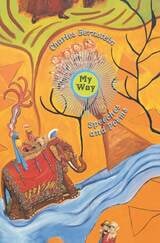
My Way
Speeches and PoemsCharles Bernstein
University of Chicago Press, 1998
In My Way, (in)famous language poet and critic Charles Bernstein deploys a wide variety of interlinked forms—speeches and poems, interviews and essays—to explore the place of poetry in American culture and in the university. Sometimes comic, sometimes dark, Bernstein's writing is irreverent but always relevant, "not structurally challenged, but structurally challenging."
Addressing many interrelated issues, Bernstein moves from the role of the public intellectual to the poetics of scholarly prose, from vernacular modernism to idiosyncratic postmodernism, from identity politics to the resurgence of the aesthetic, from cultural studies to poetry as a performance art, from the small press movement to the Web. Along the way he provides "close listening" to such poets as Charles Reznikoff, Laura Riding, Susan Howe, Ezra Pound, Allen Ginsberg, and Gertrude Stein, as well as a fresh perspective on L=A=N=G=U=A=G=E, the magazine he coedited that became a fulcrum for a new wave of North American writing.
In his passionate defense of an activist, innovative poetry, Bernstein never departs from the culturally engaged, linguistically complex, yet often very funny writing that has characterized his unique approach to poetry for over twenty years. Offering some of his most daring work yet—essays in poetic lines, prose with poetic motifs, interviews miming speech, speeches veering into song—Charles Bernstein's My Way illuminates the newest developments in contemporary poetry with its own contributions to them.
"The result of [Bernstein's] provocative groping is more stimulating than many books of either poetry or criticism have been in recent years."—Molly McQuade, Washington Post Book World
"This book, for all of its centrifugal activity, is a singular yet globally relevant perspective on the literary arts and their institutions, offered in good faith, yet cranky and poignant enough to not be easily ignored."—Publishers Weekly
"Bernstein has emerged as postmodern poetry's sous-chef of insouciance. My Way is another of his rich concoctions, fortified with intellect and seasoned with laughter."—Timothy Gray, American Literature
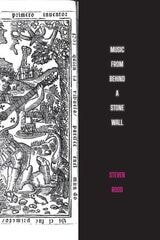
music from behind a stone wall
Steven Rood
Omnidawn, 2024
The poems in Steven Rood’s newest collection take on a musical sensibility as they flow from the poet’s sixty years as a classical guitarist who remains preoccupied with the tonalities of daily life. Each poem in music from behind a stone wall comes together to build a multi-layered symphony that reveals the delights and travails of family life and moments of intimate connection with animals and plants. At the core of the book are poems considering the overwhelming task of trying to communicate the essence of musical experience via the written word. This is a book of grief and joy sung with lyric acuity, vivid images, and formal variation.