Results by title
8642 books match the query '20th Century' and 493 start with m
Mine Towns
Buildings for Workers in Michigan’s Copper CountryAlison K. Hoagland
University of Minnesota Press, 2010

Mineral Point
A HistoryGeorge Fiedler
Wisconsin Historical Society Press, 1973

Minor China
Method, Materialisms, and the AestheticHentyle Yapp
Duke University Press, 2021
Minor Salvage
The Korean War and Korean American Life WritingsStephen Hong Sohn
University of Michigan Press, 2022
Miracle of '48
Edited by Steve Neal. Foreword by Robert V. Remini
Southern Illinois University Press, 2003
Miracle of ’48: Harry Truman’s Major Campaign Speeches and Selected Whistle-stopsis the first published collection of the public addresses Harry Truman made as he crisscrossed the United States from New York City to Los Angeles to Independence, Missouri in 1948. Edited by veteran political journalist Steve Neal, and complemented by a foreword from presidential historian Robert V. Remini, this volume captures the infectious spirit and determination of Truman’s message to the American people.
In an era when policy issues were paramount and televised debates were a thing of the future, Truman boldly stated his case directly to the American people, and they responded. “Senator Barkley and I will win this election and make these Republicans like it,” he declared in his acceptance speech at the Democratic National Convention in Philadelphia. “Don’t you forget that. We will do that because they are wrong and we are right.”
From the start of his “non-political” western tour in Crestline, Ohio, through his victory celebration in his hometown of Independence, the plainspoken Truman waged the good fight against all odds, never mixing his words or apologizing for his aggressively honest tactics. In blaming the GOP for a decline in farm prices, he alleged that the 80th Congress had “stuck a pitchfork in the farmer’s backs.” Truman is now regarded as among our greatest presidents and the populist message of his ’48 campaign is still as compelling and relevant today as it was over half a century ago.
“The political history of the United States reveals many unusual developments,” General Dwight D. Eisenhower wrote Truman after the 1948 election, “but certainly at no point does it record a greater accomplishment than yours, that can be traced so clearly to the stark courage and fighting heart of one man.”

Mirages
The Unexpurgated Diary of Anaïs Nin, 1939–1947Anaïs Nin
Ohio University Press, 2013
Mirages collects, for the first time, the story that was cut from all of Nin’s other published diaries, particularly volumes 3 and 4 of The Diary of Anaïs Nin, which cover the same time period. It is the long-awaited successor to the previous unexpurgated diaries Henry and June, Incest, Fire, and Nearer the Moon. Mirages answers the questions Nin readers have been asking for decades: What led to the demise of Nin’s love affair with Henry Miller? Just how troubled was her marriage to Hugh Guiler? What is the story behind Nin’s “children,” the effeminate young men she seemed to collect at will? Mirages is a deeply personal story of heartbreak, despair, desperation, carnage, and deep mourning, but it is also one of courage, persistence, evolution, and redemption that reaches beyond the personal to the universal.
Mirror Affect
Seeing Self, Observing Others in Contemporary ArtCristina Albu
University of Minnesota Press, 2016
For decades, contemporary artworks with reflective properties have stimulated public forms of spectatorship. According to Cristina Albu, these artworks, which can include elements such as mirrors, live video feedback, or sensors, draw attention to affective interdependence and mechanisms of social control.
In Mirror Affect, Albu provides a historical account of mirroring processes in contemporary art and offers insight into the phenomenological and sociopolitical concerns that have inspired artists to stage processes of affective, perceptual, and behavioral mirroring between art viewers. Beginning with the 1960s, Albu charts the rise of interpersonal modes of art spectatorship. She reveals contemporary artists’ strategic use of reflective and responsive interfaces to instill doubt in visual representation and appeal to active scrutiny of the changing social dynamics. She suggests that the mirroring processes envisioned by contemporary artists such as Joan Jonas, Dan Graham, Lynn Hershman Leeson, Olafur Eliasson, and Rafael Lozano-Hemmer trigger visual disjunctions to upset narcissistic inclinations. They invite viewers to see themselves in relation to others and to ponder their role within complex social systems.
From sculpture and performance to art and technology projects, video art, and installation art, Mirror Affect analyzes forms of interpersonal spectatorship, revising and expanding current historiographies of participatory art.
Mirror to the Cage
Three Contemporary Hungarian PlaysClara Györgyey
University of Arkansas Press, 1993
Mirrors of Our Playing
Paradigms and Presences in Modern DramaThomas R. Whitaker
University of Michigan Press, 1999
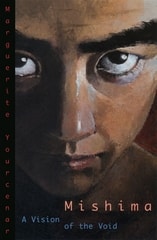
Mishima
A Vision of the VoidMaguerite Yourcenar
University of Chicago Press, 2001
Miss Cutler and the Case of the Resurrected Horse
Social Work and the Story of Poverty in America, Australia, and BritainMark Peel
University of Chicago Press, 2011
Social workers produced thousands of case files about the poor during the interwar years. Analyzing almost two thousand such case files and traveling from Boston, Minneapolis, and Portland to London and Melbourne, Miss Cutler and the Case of the Resurrected Horse is a pioneering comparative study that examines how these stories of poverty were narrated and reshaped by ethnic diversity, economic crisis, and war.
Miss Stephen's Apprenticeship
How Virginia Stephen Became Virginia WoolfRosalind Brackenbury
University of Iowa Press, 2018
During the years leading up to her marriage with Leonard Woolf in 1912, the year in which she finished The Voyage Out and sent it to be published by her cousin at Duckworth’s, the future Virginia Woolf was teaching herself how to be a writer. While her brothers were sent first to private schools, then to Cambridge to be educated, Virginia Stephen and her sister Vanessa were informally educated at home. With this background, how did she know she was a writer? What were her struggles? How did she teach herself? What made Miss Stephen into the author Virginia Woolf?
Miss Stephen’s Apprenticeship explores these questions, delving into Virginia Woolf ’s letters and diaries, seeking to understand how she covered the distance from the wistful “I only wish I could write,” to the almost casual statement, “the novels are finished.” These days, the trajectory of a writer very often starts with studying for an MFA. In Woolf ’s case, however, it’s instructive to ask: How did a great writer, who had no formal education, invent for herself the framework she needed for a writing life? How did she know what she had to learn? How did she make her own way?
Novelist Rosalind Brackenbury explores these questions and others, and in the process reveals what Virginia Woolf can give to young writers today.
Missing Millie Benson
The Secret Case of the Nancy Drew Ghostwriter and JournalistJulie K. Rubini
Ohio University Press, 2015
Growing up in Ladora, Iowa, Mildred “Millie” Benson had ample time to develop her imagination and sense of adventure. While still a journalism graduate student at the University of Iowa, Millie began writing for the Stratemeyer Syndicate, which published the phenomenally popular Hardy Boys series, among others. Soon, Millie was tapped for a new series starring amateur sleuth Nancy Drew, a young, independent woman not unlike Millie herself. Under the pen name Carolyn Keene, Millie wrote the first book, The Secret of the Old Clock, and twenty-two other Nancy Drew Mystery Stories. In all, Millie wrote more than a hundred novels for young people.
Millie was also a journalist for the Toledo Times and the Toledo Blade. At sixty-two, she obtained her pilot’s license. Follow the clues throughout Missing Millie to discover the story of this ghostwriter, journalist, and adventurer.
Missing
A MemoirCornelia Maude Spelman
Northwestern University Press, 2010
Acclaimed children’s book author Cornelia Maude Spelman’s memoir of her family springs from a meeting and subsequent friendship with the late, legendary New Yorker editor William MaxwellIn the 1920s, he and her parents had been friends as undergraduates at the University of Illinois at Urbana-Champaign. When Spelman hints at what she thinks of as the failure of her parents’ lives, he counters that “in a good novel one doesn’t look for a success story, but for a story that moves one with its human drama and richness of experience.”
At their final meeting, Maxwell encourages her to tell her mother’s story. Missing is Spelman’s response to Maxwell’s wisdom. With the pacing of the mystery novels her mother loved, and using everything from letters and interviews to the family’s quotidian paper trail—medical records, telegrams, and other oft-overlooked clues to a family’s history—Spelman reconstructs her mother’s life and untimely death. Along the way, she unravels mysteries of her family, including the fate of her long lost older brother.
Spelman skillfully draws the reader into the elation and sorrow that accompany the discovery of a family’s past. A profoundly loving yet honest elegy, Missing is, like the woman it memorializes, complex and beautiful.

Mission Underway
The History of the Popular Culture Association/American Culture Association and the Popular Culture Movement 1967–2001Edited, Revised, and Updated by Ray B. Browne
University of Wisconsin Press, 2002
Mixed Blood
Intermarriage & Ethnic: Intermarriage And Ethnic Identity In Twentieth Century AmericaPaul R. Spickard
University of Wisconsin Press, 1991
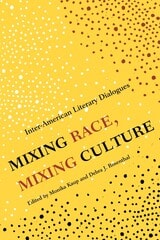
Mixing Race, Mixing Culture
Inter-American Literary DialoguesEdited by Monika Kaup and Debra Rosenthal
University of Texas Press, 2002
Over the last five centuries, the story of the Americas has been a story of the mixing of races and cultures. Not surprisingly, the issue of miscegenation, with its attendant fears and hopes, has been a pervasive theme in New World literature, as writers from Canada to Argentina confront the legacy of cultural hybridization and fusion.
This book takes up the challenge of transforming American literary and cultural studies into a comparative discipline by examining the dynamics of racial and cultural mixture and its opposite tendency, racial and cultural disjunction, in the literatures of the Americas. Editors Kaup and Rosenthal have brought together a distinguished set of scholars who compare the treatment of racial and cultural mixtures in literature from North America, the Caribbean, and Latin America. From various angles, they remap the Americas as a multicultural and multiracial hemisphere, with a common history of colonialism, slavery, racism, and racial and cultural hybridity.
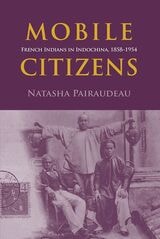
Mobile Citizens
French Indians in Indochina, 1858-1955Natasha Pairaudeau
National University of Singapore Press, 2016
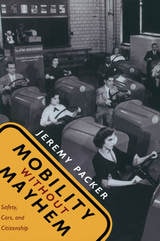
Mobility without Mayhem
Safety, Cars, and CitizenshipJeremy Packer
Duke University Press, 2007
Packer focuses on cultural figures that have been singled out as particularly dangerous. Women drivers, hot-rodders, bikers, hitchhikers, truckers, those who “drive while black,” and road ragers have all been targets of fear. As Packer debunks claims about the dangers posed by each figure, he exposes biases against marginalized populations, anxieties about social change, and commercial and political desires to profit by fomenting fear. Certain populations have been labeled as dangerous or deviant, he argues, to legitimize monitoring and regulation and, ultimately, to curtail access to automotive mobility. Packer reveals how the boundary between personal freedom and social constraint is continually renegotiated in discussions about safe, proper driving.
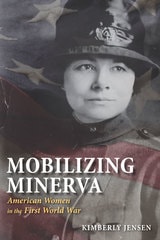
Mobilizing Minerva
American Women in the First World WarKimberly Jensen
University of Illinois Press, 2007
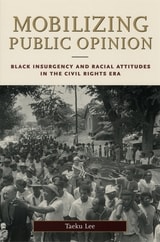
Mobilizing Public Opinion
Black Insurgency and Racial Attitudes in the Civil Rights EraTaeku Lee
University of Chicago Press, 2002
Ultimately, Mobilizing Public Opinion is a timely, cautionary tale about how we view public opinion and a compelling testament to the potential power of ordinary citizens.
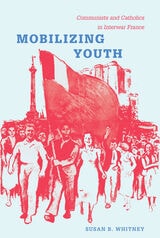
Mobilizing Youth
Communists and Catholics in Interwar FranceSusan B. Whitney
Duke University Press, 2009
Moving back and forth between the constantly shifting tactics devised to mobilize young people and the circumstances of their lives, Whitney gives special consideration to the context in which the youth movements operated and in which young people made choices. She traces the impact of the First World War on the young and on the formulation of generation-based political and religious identities, the role of work and leisure in young people’s lives and political mobilization, the impact of the Depression, the importance of Soviet ideas and intervention in French Communist youth politics, and the state’s attention to youth after the victory of France’s Popular Front government in 1936. Mobilizing Youth concludes by inserting the era’s youth activists and movements into the complicated events of the Second World War.
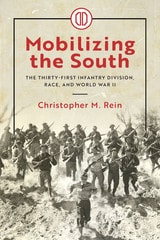
Mobilizing the South
The Thirty-First Infantry Division, Race, and World War IIChristopher M. Rein
University of Alabama Press, 2022
A richly researched account of the social, racial, and political history of a major Deep South infantry division at home and in the Pacific
Chris Rein’s study of the Thirty-First Infantry Division, known officially as the “Dixie Division,” illuminates the complexities in mobilizing American reserve units to meet the global emergency during World War II. Citizen soldiers from Alabama, Florida, Louisiana, and Mississippi formed the core of one of the ninety infantry divisions the Army successfully activated, trained, equipped, and deployed to defeat fascism in Europe and race-based imperialism in the Pacific. But the Army mobilized ideas along with manpower, and soldiers from across the Jim Crow South brought their racial ideas and views with them into the ranks and then exported these across the South Pacific. If the American victory in World War II represents a “double victory” over racism abroad and at home, the division’s service is a cogent reminder that the same powerful force could pull in opposite directions.
While focused on the division’s operational service during the war years, Mobilizing the South: The Thirty-First Infantry Division, Race, and World War II spans the division’s entire service from 1917 to 1967, from an interwar period highlighted by responses to natural disasters and facing down lynch mobs through a postwar service that included protecting activists in the most important struggles of the civil rights era. But the division’s extended service as a training establishment highlights lingering resentments and tensions within the American military system between the active and reserve components. Despite this, the division performed well in General Douglas MacArthur’s island-hopping campaign across the South Pacific. Using official records as well as details drawn from correspondence and oral histories, Rein captures how individual soldiers framed their exposure to a larger world, and how service alongside African American, New Guinean, and Filipino units both reinforced and modified views on race and postwar American society.
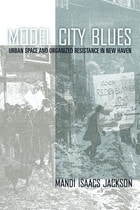
Model City Blues
Urban Space and Organized Resistance in New HavenMandi Isaacs Jackson
Temple University Press, 2008
Model City Blues tells the story of how regular people, facing a changing city landscape, fought for their own model of the “ideal city” by creating grassroots plans for urban renewal. Filled with vivid descriptions of significant moments in a protracted struggle, it offers a street-level account of organized resistance to institutional plans to transform New Haven, Connecticut in the 1960s. Anchored in the physical spaces and political struggles of the city, it brings back to center stage the individuals and groups who demanded that their voices be heard.
By reexamining the converging class- and race-based movements of 1960s New Haven, Mandi Jackson helps to explain the city's present-day economic and political struggles. More broadly, by closely analyzing particular sites of resistance in New Haven, Model City Blues employs multiple academic disciplines to redefine and reimagine the roles of everyday city spaces in building social movements and creating urban landscapes.
Model Immigrants and Undesirable Aliens
The Cost of Immigration Reform in the 1990sChristina Gerken
University of Minnesota Press, 2013
During 1995 and 1996, President Bill Clinton signed into law three bills that altered the rights and responsibilities of immigrants: the Antiterrorism and Effective Death Penalty Act, the Personal Responsibility Act, and the Illegal Immigration Reform and Immigrant Responsibility Act. Model Immigrants and Undesirable Aliens examines the changing debates around immigration that preceded and followed the passage of landmark legislation by the U.S. Congress in the mid-1990s, arguing that it represented a new, neoliberal way of thinking and talking about immigration.
Christina Gerken explores the content and the social implications of the deliberations that surrounded the development and passage of immigration reform, analyzing a wide array of writings from congressional debates and committee reports to articles and human-interest stories in mainstream newspapers. The process, she shows, disguised its underlying racism by creating discursive strategies that shaped and upheld an image of “desirable” immigrants—those who could demonstrate “personal responsibility” and an ability to contribute to the U.S. economy. Gerken finds that politicians linked immigration to complex issues: poverty, welfare reform, so-called family values, measures designed to combat terrorism, and the spiraling costs of social welfare programs.
Although immigrants were often at the center of congressional debates, politicians constructed an elaborate, abstract terminology that appeared to be unrelated to race or gender. Instead, politicians promoted neoliberal policies as the avenue to a postracist, postsexist world of opportunity for every rational consumer with an entrepreneurial spirit. Still, Gerken concludes that the passage of pathbreaking legislation was characterized by a useful tension between neoliberal assumptions and hidden anxieties about race, class, gender, and sexuality.
Moderate Modernity
The Newspaper Tempo and the Transformation of Weimar DemocracyJochen Hung
University of Michigan Press, 2023
The newspaper’s idea of a modern, democratic Germany was undermined by the political and economic crises that hit Germany at the beginning of the 1930s. The way the newspaper described German democracy changed under these pressures. Flappers, American fridges, and modern music—the things that Tempo had once marshalled as representatives of a German future—were now rejected by the newspaper as emblems of a bygone age. The changes in Tempo’s vision of Germany’s future show that descriptions of Weimar politics as a standoff between upright democrats and rabid extremists do not do justice to the historical complexity of the period. Rather, we need to accept the Nazis as a lethal product of a German democracy itself. The history of Tempo teaches us how liberal democracies can create and nurture their own worst enemies.
Modern American Grotesque
Literature and PhotographyJames Goodwin
The Ohio State University Press, 2009
Modern American Poetry, 1865-1950
Alan Shucard
University of Massachusetts Press, 1990
Modern American Queer History
Allida Black
Temple University Press, 2001
Whether the subject is an individual life story, a community study, or an aspect of public policy, these essays illuminate the ways in which individuals in various locales understood the nature of their desires and the possibilities of resisting dominant views of normality and deviance. Theoretically informed, but accessible, the essays shed light too on the difficulties of writing history when documentary evidence is sparse or "coded." Taken together these essays suggest that while some individuals and social networks might never emerge from the shadows, the persistent exploration of the past for their traces is an integral part of the on-going struggle for queer rights.
Modern American Religion, Volume 1
The Irony of It All, 1893-1919Martin E. Marty
University of Chicago Press, 1986
"Marty writes with the highest standards of scholarship and with his customary stylistic grace. No series of books is likely to tell us as much about the religious condition of our own time as "Modern American Religion."—Robert L. Spaeth, Minneapolis Star Tribune
"The wealth of material and depth of insight are beyond reproach. This book will clearly stand as an important meteorological guide to the storm front of modernity as it swept Americans into the twentieth century."—Belden C. Lane, Review of Religions
"Whatever one thinks about Marty's theological or philosophical position as a historian, the charm of his friendly circumspective approach to American religious history is irresistible."—John E. Wilson, Theological Studies
"Marty attempts to impose historical order on the divergent ways a century of Americans have themselves tried to find order in their worlds. . . . [He] meets the challenge deftly. . . . It is a book relevant to our time. . . . Engages the heart and mind jointly."—Andy Solomon, Houston Post
Modern American Religion, Volume 2
The Noise of Conflict, 1919-1941Martin E. Marty
University of Chicago Press, 1991
"He tells the story [of the 1920s and 1930s] with a verve seldom equaled and manages to condense in one volume the results of dozens of specialized monographs. . . . [It] bears the usual hallmarks of a Marty book: a smoothly flowing narrative, passages studded with suggestive insight inviting further research, and apt quotations that capture the gist of complicated issues. . . . [A] splendid book. . . . Deserves a wide readership and undoubtedly will receive it." —James H. Moorhead, Chicago Sunday Tribune
"There is simply no better source, certainly none so engaging, for the interactions of religion and the larger culture in the interwar period." —Robert Booth Fowler, Journal of American History
"[This book is] not merely a history of American religion, but what might better be called a religious history" —David M. Kennedy, New York Times Book Review
Modern American Religion, Volume 3
Under God, Indivisible, 1941-1960Martin E. Marty
University of Chicago Press, 1996
Under God, Indivisible, 1941-1960 is the first book to systematically address religion and the roles it played in shaping the social and political life of mid-century America. A work of exceptional clarity and historical depth, it will interest general readers as well as historians of American and church history.
"The series will become a standard account of the nation's variegated religious culture during the current century. The four volumes, the fruition of decades of research, may rank as much honored Marty's most significant contribution to U.S. studies."—Richard N. Ostling, Time
"When America needs some advice or commentary on the state of modern theology, the person it turns to is Martin Marty."—Publishers Weekly
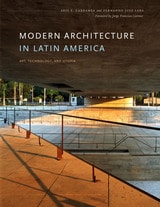
Modern Architecture in Latin America
Art, Technology, and UtopiaBy Luis E. Carranza and Fernando Luiz Lara; foreword by Jorge Francisco Liernur
University of Texas Press, 2015
Designed as a survey and focused on key examples and movements arranged chronologically from 1903 to 2003, this is the first comprehensive history of modern architecture in Latin America in any language.
Runner-up, University Co-op Robert W. Hamilton Book Award, 2015
Modern Architecture in Latin America: Art, Technology, and Utopia is an introductory text on the issues, polemics, and works that represent the complex processes of political, economic, and cultural modernization in the twentieth century. The number and types of projects varied greatly from country to country, but, as a whole, the region produced a significant body of architecture that has never before been presented in a single volume in any language. Modern Architecture in Latin America is the first comprehensive history of this important production.
Designed as a survey and focused on key examples/paradigms arranged chronologically from 1903 to 2003, this volume covers a myriad of countries; historical, social, and political conditions; and projects/developments that range from small houses to urban plans to architectural movements. The book is structured so that it can be read in a variety of ways—as a historically developed narrative of modern architecture in Latin America, as a country-specific chronology, or as a treatment of traditions centered on issues of art, technology, or utopia. This structure allows readers to see the development of multiple and parallel branches/historical strands of architecture and, at times, their interconnections across countries. The authors provide a critical evaluation of the movements presented in relationship to their overall goals and architectural transformations.
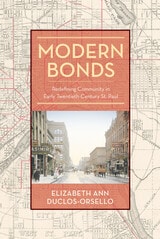
Modern Bonds
Redefining Community in Early Twentieth-Century St. PaulElizabeth Ann Duclos-Orsello
University of Massachusetts Press, 2018
What does community mean, exactly? In this interdisciplinary study, Elizabeth Ann Duclos-Orsello takes seriously the concept of community as an object of historical analysis.
Focusing on St. Paul, Minnesota, from 1900 to 1920, Modern Bonds explores the diverse ways that its people renegotiated private and public affiliations during a period of modernization. The book examines a wide range of subjects and materials, including photographs from an African American family, fictional depictions of middle-class women, built environments that created enclaves of immigrants, and public festivals designed to unite all citizens. As Duclos-Orsello demonstrates, it was in this period that a complex set of activities, policies, and practices led to new understandings of community that continue to shape life today.
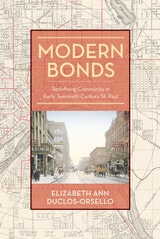
Modern Bonds
Redefining Community in Early Twentieth-Century St. PaulElizabeth Ann Duclos-Orsello
University of Massachusetts Press, 2018
What does community mean, exactly? In this interdisciplinary study, Elizabeth Ann Duclos-Orsello takes seriously the concept of community as an object of historical analysis.
Focusing on St. Paul, Minnesota, from 1900 to 1920, Modern Bonds explores the diverse ways that its people renegotiated private and public affiliations during a period of modernization. The book examines a wide range of subjects and materials, including photographs from an African American family, fictional depictions of middle-class women, built environments that created enclaves of immigrants, and public festivals designed to unite all citizens. As Duclos-Orsello demonstrates, it was in this period that a complex set of activities, policies, and practices led to new understandings of community that continue to shape life today.
Modern China, 1840–1972
An Introduction to Sources and Research AidsAndrew J. Nathan
University of Michigan Press, 1973
Modern Chinese Literary and Cultural Studies in the Age of Theory
Reimagining a FieldRey Chow, ed.
Duke University Press, 2000
One of the volume’s provocative suggestions is that the old model of area studies—an offshoot of U.S. Cold War strategy that found its anchorage in higher education—is no longer feasible for the diverse and multifaceted experiences that are articulated under the rubric of “Chineseness.” As Rey Chow argues in her introduction, the notion of a monolithic Chineseness bound ultimately to mainland China is, in itself, highly problematic because it recognizes neither the material realities of ethnic minorities within China nor those of populations in places such as Tibet, Taiwan, and post–British Hong Kong. Above all, this book demonstrates that, as the terms of a chauvinistic sinocentrism become obsolete, the critical use of theory—particularly by younger China scholars whose enthusiasm for critical theory coincides with changes in China’s political economy in recent years—will enable the emergence of fresh connections and insights that may have been at odds with previous interpretive convention.
Originally published as a special issue of the journal boundary 2, this collection includes two new essays and an afterword by Paul Bové that places its arguments in the context of contemporary cultural politics. It will have far-reaching implications for the study of modern China and will be of interest to scholars of theory and culture in general.
Contributors. Stanley K. Abe, Ien Ang, Chris Berry, Paul Bové, Sung-cheng Yvonne Chang, Rey Chow, Dorothy Ko, Charles Laughlin, Leung Ping-kwan, Kwai-cheung Lo, Christopher Lupke, David Der-wei Wang, Michelle Yeh
Modern French Jewish Thought
Writings on Religion and PoliticsEdited by Sarah Hammerschlag
Brandeis University Press, 2018
Modern Housing for America
Policy Struggles in the New Deal EraGail Radford
University of Chicago Press, 1996
Modern Middle Eastern Jewish Thought
Writings on Identity, Politics, and Culture, 1893–1958Edited by Moshe Behar and Zvi Ben-Dor Benite
Brandeis University Press, 2013
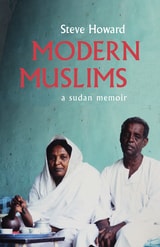
Modern Muslims
A Sudan MemoirSteve Howard
Ohio University Press, 2016

Modern Nature
The Rise of the Biological Perspective in GermanyLynn K. Nyhart
University of Chicago Press, 2009
In Modern Nature,Lynn K. Nyhart traces the emergence of a “biological perspective” in late nineteenth-century Germany that emphasized the dynamic relationships among organisms, and between organisms and their environment. Examining this approach to nature in light of Germany’s fraught urbanization and industrialization, as well the opportunities presented by new and reforming institutions, she argues that rapid social change drew attention to the role of social relationships and physical environments in rendering a society—and nature—whole, functional, and healthy.
This quintessentially modern view of nature, Nyhart shows, stood in stark contrast to the standard naturalist’s orientation toward classification. While this new biological perspective would eventually grow into the academic discipline of ecology, Modern Nature locates its roots outside the universities, in a vibrant realm of populist natural history inhabited by taxidermists and zookeepers, schoolteachers and museum reformers, amateur enthusiasts and nature protectionists.
Probing the populist beginnings of animal ecology in Germany, Nyhart unites the history of popular natural history with that of elite science in a new way. In doing so, she brings to light a major orientation in late nineteenth-century biology that has long been eclipsed by Darwinism.
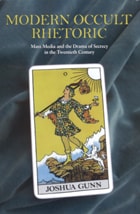
Modern Occult Rhetoric
Mass Media and the Drama of Secrecy in the Twentieth CenturyJoshua Gunn
University of Alabama Press, 2005
Uncovering how secrecy, symbolism, and hidden meanings shape modern culture and communication.
The occult has traditionally been understood as the study of secrets of the practice of mysticism or magic. This book broadens our understanding of the occult by treating it as a rhetorical phenomenon tied to language and symbols and more central to American culture than is commonly assumed.
Joshua Gunn approaches the occult as an idiom, examining the ways in which acts of textual criticism and interpretation are occultic in nature, as evident in practices as diverse as academic scholarship, Freemasonry, and television production. Gunn probes, for instance, the ways in which jargon employed by various social and professional groups creates barriers and fosters secrecy. From the theory wars of cultural studies to the Satanic Panic that swept the national mass media in the late 1980s and early 1990s, Gunn shows how the paradox of a hidden, buried, or secret meaning that cannot be expressed in language appears time and time again in Western culture.
These recurrent patterns, Gunn argues, arise from a generalized, popular anxiety about language and its limitations. Ultimately, Modern Occult Rhetoric demonstrates the indissoluble relationship between language, secrecy, and publicity, and the centrality of suspicion in our daily lives.

Modern Odysseys
Cavafy, Woolf, Césaire, and a Poetics of IndirectionMichelle Zerba
The Ohio State University Press, 2021
Modern Spanish Women as Agents of Change
Essays in Honor of Maryellen BiederSmith, Jennifer
Bucknell University Press, 2019
Published by Bucknell University Press. Distributed worldwide by Rutgers University Press.

Modern Swedish Prose in Translation
Karl Erik Lagerlof, Editor
University of Minnesota Press, 1979
Modern Swedish Prose in Translation was first published in 1979. Minnesota Archive Editions uses digital technology to make long-unavailable books once again accessible, and are published unaltered from the original University of Minnesota Press editions.
These excerpts from Swedish prose works - mostly novels - reflect major shifts in mood and style in the 25 years since 1950. Editor Karl Erik Lagerlof traces cultural and political developments in Sweden from the post-World War II era, when writers felt themselves in a world devoid of political meaning and rejected realism as a literary mode, down to the intensely political years of the Vietnam era. The selections in this anthology range from the anti-ideological works of the postwar years to recent documentary methods influenced by Marxism, structuralism, and a renewed political consciousness.
Modern Tibetan Literature and Social Change
Lauran R. Hartley and Patricia Schiaffini-Vedani, eds.
Duke University Press, 2008
The contributors explore the circumstances that led to the development of modern Tibetan literature, its continuities and breaks with classical Tibetan literary forms, and the ways that writers use forms such as magical realism, satire, and humor to negotiate literary freedom within the People’s Republic of China. They provide crucial information about Tibetan writers’ lives in China and abroad, the social and political contexts in which they write, and the literary merits of their oeuvre. Along with deep social, cultural, and political analysis, this wealth of information clarifies the complex circumstances that Tibetan writers face in the PRC and the diaspora. The contributors consider not only poetry, short stories, and novels but also other forms of cultural production—such as literary magazines, films, and Web sites—that provide a public forum in the Tibetan areas of the PRC, where censorship and restrictions on public gatherings remain the norm. Modern Tibetan Literature and Social Change includes a previously unavailable list of modern Tibetan works translated into Western languages and a comprehensive English-language index of names, subjects, and terms.
Contributors: Pema Bhum, Howard Y. F. Choy, Yangdon Dhondup, Lauran R. Hartley, Hortsang Jigme, Matthew T. Kapstein, Nancy G. Lin, Lara Maconi, Françoise Robin, Patricia Schiaffini-Vedani, Ronald D. Schwartz, Tsering Shakya, Sangye Gyatso (aka Gangzhün), Steven J. Venturino,
Riika Virtanen
Modern Utopian Fictions from H. G. Wells to Iris Murdoch
Peter Edgerly Firchow
Catholic University of America Press, 2007
Modernism - Dada - Postmodernism
Richard Sheppard
Northwestern University Press, 1999
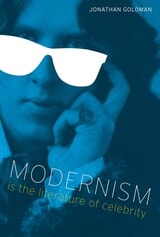
Modernism Is the Literature of Celebrity
By Jonathan Goldman
University of Texas Press, 2011
The phenomenon of celebrity burst upon the world scene about a century ago, as movies and modern media brought exceptional, larger-than-life personalities before the masses. During the same era, modernist authors were creating works that defined high culture in our society and set aesthetics apart from the middle- and low-brow culture in which celebrity supposedly resides. To challenge this ingrained dichotomy between modernism and celebrity, Jonathan Goldman offers a provocative new reading of early twentieth-century culture and the formal experiments that constitute modernist literature's unmistakable legacy. He argues that the literary innovations of the modernists are indeed best understood as a participant in the popular phenomenon of celebrity.
Presenting a persuasive argument as well as a chronicle of modernism's and celebrity's shared history, Modernism Is the Literature of Celebrity begins by unraveling the uncanny syncretism between Oscar Wilde's writings and his public life. Goldman explains that Wilde, in shaping his instantly identifiable public image, provided a model for both literary and celebrity cultures in the decades that followed. In subsequent chapters, Goldman traces this lineage through two luminaries of the modernist canon, James Joyce and Gertrude Stein, before turning to the cinema of mega-star Charlie Chaplin. He investigates how celebrity and modernism intertwine in the work of two less obvious modernist subjects, Jean Rhys and John Dos Passos. Turning previous criticism on its head, Goldman demonstrates that the authorial self-fashioning particular to modernism and generated by modernist technique helps create celebrity as we now know it.