Results by title
5159 books match the query 'Biography' and 312 start with m
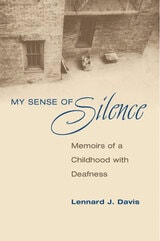
My Sense of Silence
Memoirs of a Childhood with DeafnessLennard J. Davis
University of Illinois Press, 1999
Selected as an "Editors Choice" by the Chicago Tribune
Lennard J. Davis grew up as the hearing child of deaf parents. In this candid, affecting, and often funny memoir, he recalls the joys and confusions of this special world, especially his complex and sometimes difficult relationships with his working-class Jewish immigrant parents. Gracefully slipping through memory, regret, longing, and redemption, My Sense of Silence is an eloquent remembrance of human ties and human failings.
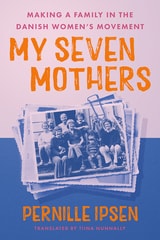
My Seven Mothers
Making a Family in the Danish Women's MovementPernille Ipsen
University of Minnesota Press, 2025
Seven women raise a child together while redefining their place in society at the beginning of the Women’s Movement in Denmark in the 1970s
On New Year’s Eve in Copenhagen in 1972, seven women had a child together: one gave birth and six others attended. They had met a year earlier at a feminist women’s camp on a small island and now, with about twenty other women’s liberationists, they occupied three dilapidated apartment buildings in the center of Copenhagen. One became the country’s first Women’s House, the nerve center of the Women’s Movement in Denmark, and the other two were women-only communal living spaces that were Pernille Ipsen’s first home. In this intimate portrait of life during the exhilarating early days of women’s liberation in Scandinavia and dramatic social change around the globe, she tells the stories of these seven women, her seven mothers.
Recounting her mothers’ history—from the passions and beliefs they shared to the political divisions over sexual identity that ultimately split them apart—Ipsen captures the individuality of each of her mothers as well as the common experiences that drew them together. As she deftly reflects the practical and emotional realities of her mothers’ women-centered life, Ipsen presents an engrossing picture of intersecting lives that, half a century ago, raised questions we still grapple with today: What is a family? Who is a woman? And who gets to decide?
A chronicle of gender, sexuality, and feminism as it was constructed, contested, and lived, My Seven Mothers is an eye-opening account of the challenges and possibilities connected with liberation and radical social change during the 1970s. In this time of fierce struggles over family, sexuality, and child-rearing, it reminds us that new worlds are always possible.

My Sister's Mother
A Memoir of War, Exile, and Stalin’s SiberiaDonna Solecka Urbikas
University of Wisconsin Press, 2019
In 1940, Janina Ślarzynska and her five-year-old daughter Mira were taken by Soviet secret police (NKVD) from their small family farm in eastern Poland and sent to Siberia with hundreds of thousands of others. So began their odyssey of hunger, disease, cunning survival, desperate escape across a continent, and new love amidst terrible circumstances.
But in the 1950s, baby boomer Donna yearns for a “normal” American family while Janina and Mira are haunted by the past. In this unforgettable memoir, Donna recounts her family history and her own survivor’s story, finally understanding the damaged mother who had saved her sister.
Finalist, Best Traditional Non-Fiction Book, Chicago Writers Association
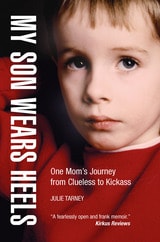
My Son Wears Heels
One Mom's Journey from Clueless to KickassJulie Tarney, Foreword by Diane Ehrensaft
University of Wisconsin Press, 2016
Julie had no idea what that meant. She felt disoriented. Wasn’t it her role to encourage and support her child? Surely she had to set some limits to his self-expression—or did she? Would he be bullied? Could she do the right thing? What was the right thing?
The internet was no help, because there was no internet. And there were zero books for a mom scrambling to understand a toddler who had definite ideas about his gender, regardless of how Nature had endowed him. Terms such as transgender, gender nonconforming, and gender creative were rare or nonexistent.
There were, however, mainstream experts who theorized that a “sissy” boy was the result of a domineering mother. Julie couldn’t believe it. She didn’t want to care what her neighbors thought, but she did care. “Domineering mother” meant controlling mother. It meant bad mother. It meant her mother.
Lacking a positive role model of her own, and fearful of being judged as a mom who was making her son “too feminine,” Julie embarked on an unexpected parenting path. Despite some missteps, and with no map to guide her, she learned to rely on her instincts. She listened carefully, kept an open mind, and as long as Harry was happy, she let him lead the way. Julie eventually realized that Harry knew who he was all along. Her job was simply to love and support him unconditionally, allowing him to be his authentic self. This story of a mother embracing her child’s uniqueness and her own will resonate with all families.
Winner, inaugural BeOUT Award for LGBTQ Visibility, awarded by Milwaukee Pride
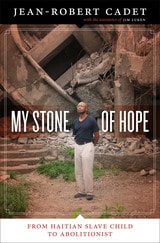
My Stone of Hope
From Haitian Slave Child to AbolitionistBy Jean-Robert Cadet
University of Texas Press, 2011
There are 27 million slaves living in the world today—more than at any time in history. Three hundred thousand of them are impoverished children in Haiti, who "stay with" families as unpaid and uneducated domestic workers, subject to physical, emotional, and sexual abuse. This practice, known locally as restavek ("staying with"), is so widespread that one in ten Haitian children is caught up in this form of slavery.
Jean-Robert Cadet was a restavek in Haiti from the late 1950s until the early 1970s. He told the harrowing story of his youth in Restavec: From Haitian Slave Child to Middle-Class American—a landmark book that exposed ongoing child slavery in Haiti. Now in My Stone of Hope, Cadet continues his story from his early attempts to adjust to freedom in American society to his current life mission of eliminating child slavery through advocacy and education. As he recounts his own struggles to surmount the psychological wounds of slavery, Cadet puts a human face on the suffering that hundreds of thousands of Haitians still endure daily. He also builds a convincing case that child slavery is not just one among many problems that Haiti faces as the Western Hemisphere's poorest nation. Rather, he argues that the systematic abuse of so many of its children is Haiti's fundamental problem, because it creates damaged adults who seem incapable of governing the country justly or managing its economy productively.
For everyone concerned about the fate of Haiti, the welfare of children, and the freedom of people around the globe, My Stone of Hope sounds an irresistible call to action.
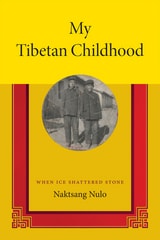
My Tibetan Childhood
When Ice Shattered StoneNatksang Nulo
Duke University Press, 2014
The real significance of this episodic narrative is the way it shows, through the eyes of a child, the suppressed histories of China's invasion of Tibet. The author's matter-of-fact accounts cast the atrocities that he relays in stark relief. Remarkably, Naktsang lived to tell his tale. His book was published in 2007 in China, where it was a bestseller before the Chinese government banned it in 2010. It is the most reprinted modern Tibetan literary work. This translation makes a fascinating if painful period of modern Tibetan history accessible in English.

My Version of the Facts
Carla Pekelis, translated from the Italian by George Hochfield
Northwestern University Press, 2005
My Victorians
Lost in the Nineteenth CenturyRobert Clark
University of Iowa Press, 2019
As Clark delves deeper into the Victorian world, he wonders: What can its artists offer a twenty-first century writer by way of insight into his own life and work? His obsession with Victoriana bleeds into all aspects of his life, even the seemingly incongruous world of online dating. My Victorians is in the spirit of Geoff Dyer’s Out of Sheer Rage and Rebecca Mead’s My Life in Middlemarch. This book considers what happens when heartbreak, eros, faith, and doubt drive us to take refuge in the past.

My War against the Nazis
A Jewish Soldier with the Red ArmyAdam Broner, with a foreword by Antony Polonsky
University of Alabama Press, 2007
A poignant account of the perils and fortunes of an indomitable survivor of violence in Eastern Europe during World War II.
In 1939, to escape Nazi occupation, 14-year-old Adam Broner and his older brother Sam left their home and family in Lodz, Poland, and made their way to the Soviet Union. Adam enlisted in the Red Army to join the fight against the Nazis but was sent to work in a Siberian coal mine instead when his nationality was discovered. After a bold and daring escape from Siberia, Broner reached the Soviet Polish Kosciuszko Army, joined the struggle against the Nazis, participated in the liberation of Poland, and rode victorious into Berlin in 1945. He later learned that his parents, siblings (except Sam), and all other close relatives had perished during the war.
Broner rebuilt his life, established a family, returned to Moscow for a degree in economics, and then went back to Poland, where he accepted a job in the Polish central planning agency. Eventually fed up with the growing anti-Semitism of the Communist government there, the author emigrated to the United States in 1969. He earned a doctorate from Princeton University and served as an economic adviser to New Jersey governors and the state legislature. In retirement, Broner learned portrait painting and reproduced the likenesses of his parents and siblings from memory, which are presented along with their biographies in this book.
In recounting his struggle for survival during some of the most dramatic upheavals of the 20th century— the Great Depression, Nazism, World War II, and the spread of Communism in Central Europe— Broner reveals a life dedicated to the ultimate goal of freedom, which he achieved through a combination of arduous effort and fortunate circumstance.
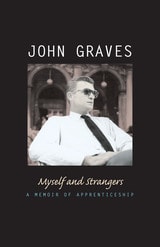
Myself and Strangers
A Memoir of ApprenticeshipBy John Graves
University of Texas Press, 2005
In Myself and Strangers, John Graves, the highly regarded author of Goodbye to a River and other classic works, recalls the decade-long apprenticeship in which he found his voice as a writer. He recounts his wanderings from Texas to Mexico, New York, and Spain, where, like Hemingway, he hoped to find the material with which to write books that mattered. With characteristic honesty, Graves admits the false starts and dead ends that dogged much of his writing, along with the exhilaration he felt when the words finally flowed. He frankly describes both the pleasures and the restlessness of expatriate life in Europe after World War II—as well as his surprising discovery, when family obligations eventually called him home to Texas, that the years away had prepared him to embrace his native land as the fit subject matter for his writing. For anyone seeking the springs that fed John Graves' best-loved books, this memoir of apprenticeship will be genuinely rewarding.

Myth of Iron
Shaka in HistoryDan Wylie
Ohio University Press, 2008
Meanwhile the public image, sometimes monstrous, sometimes heroic, juggernauts on—truly a “myth of iron” that is so intriguing, so dramatic, so archetypal, and sometimes so politically useful that few have subjected it to proper scrutiny.
Myth of Iron: Shaka in History is the first book-length scholarly study of Shaka to be published. It lays out, as far as possible, all the available evidence—mainly hitherto underutilized Zulu oral testimonies, supported by other documentary sources—and decides, item by item, legend by legend, what exactly is known about Shaka’s reign. The picture that emerges in this meticulously researched and absorbing antibiography is very different from the popular narrative.
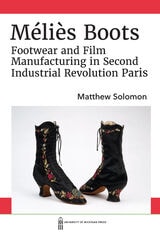
Méliès Boots
Footwear and Film Manufacturing in Second Industrial Revolution ParisMatthew Solomon
University of Michigan Press, 2022
Winner of the 2024 Society for Cinema and Media Studies Katherine Singer Kovacs Book Award
Before he became an influential cinematic innovator, Georges Méliès (1861–1938) was a maker of deluxe French footwear, an illusionist, and a caricaturist. Proceeding from these beginnings, Méliès Boots traces how the full trajectory of Georges Méliès’ career during the late-nineteenth and early-twentieth centuries, along with the larger cultural and historical contexts in which Méliès operated, shaped his cinematic oeuvre. Solomon examines Méliès’ unpublished drawings and published caricatures, the role of laughter in his magic theater productions, and the constituent elements of what Méliès called "the new profession of the cinéaste." The book also reveals Méliès' connections to the Incohérents, a group of ephemeral artists from the 1880s, demonstrating the group’s relevance for Méliès, early cinema, and modernity. By positioning Méliès in relation to the material culture of his time, Solomon demonstrates that Méliès’ work was expressive of a distinctly modern, and modernist, sensibility that appeared in France during the 1880s in the wake of the Second Industrial Revolution.