Results by title
3745 books match the query 'Europe' and 307 start with m
Muslim Spain
Its History and CultureAnwar G. Chejne
University of Minnesota Press, 1974
Muslim Spain was first published in 1974. Minnesota Archive Editions uses digital technology to make long-unavailable books once again accessible, and are published unaltered from the original University of Minnesota Press editions.
This comprehensive history of Muslim Spain in the centuries from 711 to 1492 provides a panoramic view of the whole field of Hispano-Arabic culture, including science, philosophy, and the arts. As the account makes clear, Muslim Spain was always an integral part of the main literary and intellectual stream of the East and as such was as Islamic as Syria or Egypt. Thus the history is important for an understanding of Islamic culture as a whole and of the interaction of people and ideas. The author shows that the interdependence and continuity of Muslim culture through its long history was nurtured by the unhampered travel of students and scholars and the circulation of publications throughout the width and breadth of the Islamic Empire, notwithstanding the political division that separated Muslim Spain from the center of Islam.
The first five chapter of the book describe, dynasty by dynasty, the Muslims' conquest and rule. The remaining chapters discuss in detail all aspects of Hispano-Arabic culture. Among the subjects are the social structure, the sciences and education, Arabic and linguistic studies, prose and belles lettres, poetry, history, geography, and travel, courtly love, religion, philosophy and mysticism, the natural sciences, and architecture, the minor arts, and music.
The book is illustrated with photographs, drawings, and maps, and there is an extensive bibliography.
Muslims in Spain, 1500 to 1614
L. P. Harvey
University of Chicago Press, 2005
Picking up at the end of his earlier classic study, Islamic Spain, 1250 to 1500— which described the courageous efforts of the followers of Islam to preserve their secular, as well as sacred, culture in late medieval Spain—L. P. Harvey chronicles here the struggles of the Moriscos. These forced converts to Christianity lived clandestinely in the sixteenth century as Muslims, communicating in aljamiado— Spanish written in Arabic characters. More broadly, Muslims in Spain, 1500 to 1614, tells the story of an early modern nation struggling to deal with diversity and multiculturalism while torn by the fanaticism of the Counter-Reformation on one side and the threat of Ottoman expansion on the other. Harvey recounts how a century of tolerance degenerated into a vicious cycle of repression and rebellion until the final expulsion in 1614 of all Muslims from the Iberian Peninsula.
Retold in all its complexity and poignancy, this tale of religious intolerance, political maneuvering, and ethnic cleansing resonates with many modern concerns. Eagerly awaited by Islamist and Hispanist scholars since Harvey's first volume appeared in 1990, Muslims in Spain, 1500 to 1614, will be compulsory reading for student and specialist alike.
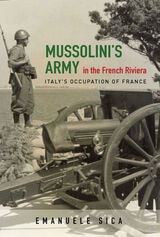
Mussolini's Army in the French Riviera
Italy's Occupation of FranceEmanuele Sica
University of Illinois Press, 2016
Employing a multi-tiered approach, Emanuele Sica examines the simultaneously conflicting and symbiotic relationship between the French population and Italian soldiers. At the grassroots level, Sica asserts that the cultural proximity between the soldiers and the local population, one-quarter of which was Italian, smoothed the sharp angles of miscommunication and cultural faux-pas at a time of great uncertainty. At the same time, it encouraged a laxness in discipline that manifested as fraternization and black marketeering. Sica's examination of political tensions highlights how French prefects and mayors fought to keep the tatters of sovereignty in the face of military occupation. In addition, he reveals the tense relationship between Fascist civilian authorities eager to fulfil imperial dreams of annexation and army leaders desperate to prevent any action that might provoke French insurrection. Finally, he completes the tableau with detailed accounts of how food shortages and French Resistance attacks brought sterner Italian methods, why the Fascists' attempted "Italianization" of the French border city of Menton failed, and the ways the occupation zone became an unlikely haven for Jews.
My Amputations
Clarence Major
University of Alabama Press, 1986
Originally published in 1986, this new edition returns to print a classic, influential work of American fiction
The author of the acclaimed novel Reflex and Bone Structure returns here in My Amputations to the question of identity, the double, adventure, detection, and mystery, but with more hypnotic power and range. In My Amputations he has his protagonist, Mason Ellis (who may just be “a desperate ex-con” or a wronged American novelist out to right the wrong done to him), jump through flaming loops like a trained dog, so to speak. In other words, there seems to be no end to the troubles Mason Ellis faces.
His story takes him from the South Side of Chicago, to New York, with a stint in Attica prison, across America and Europe and into the primal depths of Africa. Mason, all the while, tries to convince the reader that he is the important American writer he says he is. Upon his release from prison he sets out to prove his claim. After an audacious bank-robbery and a couple of burglaries that are hilarious, he goes into hiding to escape the malice of one of his cohorts, and eventually flees to Europe. The irony is that he is now as much the runner as the seeker. After encounters with a Zuni ex-folksinger, kidnappers, the New York underworld, literary groupies, an Italian swordsman, a violent German secret society, and an anti-bellum cotillion in rural Greece, he finds himself face to face (behind a mask) with his own destiny.
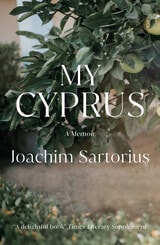
My Cyprus
A MemoirJoachim Sartorius
Haus Publishing, 2021
The island of Cyprus has been a site of global history and conquest, and its strategic position means it has been coveted by one foreign power after another. The Phoenicians, Greeks, Romans, Byzantines, Venetians, Genoese, Ottomans, and British have all left their mark. Along with the Roman and Byzantine ruins of Salamis, the island holds impressive monuments dating from the Frankish and Venetian times: the Abbey of Bellapais, the fortified harbor of Kyrenia, and the magnificent cathedrals of Nicosia and Famagusta, the setting for Shakespeare’s Othello.
Having lived in Cyprus for three years, Joachim Sartorius returns to the island’s cultures and legends and brings to life the colors and lights of the Levant area of the Middle East. He sifts through the sediments of the island’s history, including its division after the Turkish invasion of 1974 and the difficulties that followed. Rather than focusing solely on historical or political factors, this book is the work of a poet, who, with the help of both Greek and Turkish Cypriot friends, tries to understand this unique place.

My Life as a Spy
Investigations in a Secret Police FileKatherine Verdery
Duke University Press, 2018
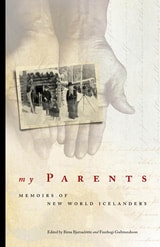
My Parents
Memoirs of New World IcelandersBirna Bjarnadottir
University of Manitoba Press, 2007