Results by title
5448 books match the query 'History and criticism' and 307 start with m
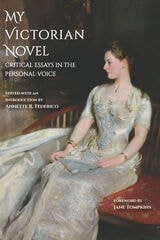
My Victorian Novel
Critical Essays in the Personal VoiceAnnette R. Federico
University of Missouri Press, 2020
These are essays in the original sense of the word, attempts: individual and experiential approaches to literary works that have subjective meanings beyond social facts. By reflecting on their own histories with novels taught, studied, researched, and re-experienced in different contexts over many years, the contributors reveal how an aesthetic object comes to inhabit our critical, pedagogical, and personal lives.
By inviting scholars to share their experiences with a favorite novel without the pressure of an analytical agenda, the sociable essays in My Victorian Novel seek to restore some vitality to the act of literary criticism, and encourage other scholars to talk about the importance of reading in their lives and the stories that have enchanted and transformed them.
The novels in this collection include:
Jane Eyre by Charlotte Brontë
The Duke’s Children by Anthony Trollope
The Adventures of Sherlock Holmes by Arthur Conan Doyle
The Newcomes by William Makepeace Thackeray
Middlemarch by George Eliot
Daniel Deronda by George Eliot
The Return of the Native by Thomas Hardy
Vanity Fair by William Makepeace Thackeray
North and South by Elizabeth Gaskell
Bleak House by Charles Dickens
David Copperfield by Charles Dickens
New Grub Street by George Gissing
The Pickwick Papers by Charles Dickens
Dracula by Bram Stoker
Wuthering Heights by Emily Brontë
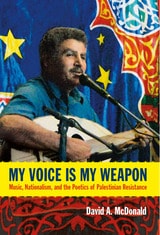
My Voice Is My Weapon
Music, Nationalism, and the Poetics of Palestinian ResistanceDavid A. McDonald
Duke University Press, 2013

Mysteries of Africa
Eugene Schleh
University of Wisconsin Press, 1991
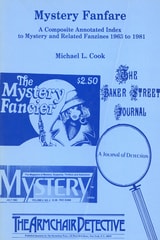
Mystery Fanfare
A Composite Annotated Index to Mystery and Related Fanzines 1963–1981Michael L. Cook
University of Wisconsin Press, 1983
This work is a composite index of the complete runs of all mystery and detective fan magazines that have been published, through 1981. Added to it are indexes of many magazines of related nature. This includes magazines that are primarily oriented to boys' book collecting, the paperbacks, and the pulp magazine hero characters, since these all have a place in the mystery and detective genre.
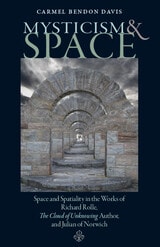
Mysticism and Space
Space and Spatiality in the Works of Richard Rolle, The Cloud of Unknowing Author, and Julian of NorwichCarmel Bendon Davis
Catholic University of America Press, 2008

Myth and Archive
A Theory of Latin American NarrativeRoberto González-Echevarría
Duke University Press, 1998
Providing ways to link literary and nonliterary narratives, González Echevarría examines a variety of archival writings—from the chronicles of the discovery and conquest of the New World to scientific travel narratives and records of criminal confessions—and explores the relationship of these writings to novels by authors such as García Márquez, Borges, Barnet, Sarmiento, Carpentier, and Garcilaso de la Vega. Moving beyond demonstrating that early forms of creative narrative had their geneses in the sixteenth-century authoritative discourse of the Spanish Empire, González Echevarría shows how this same originating process has been repeated in other key moments in the history of the Latin American narrative. He shows how the discourse of scientific discovery was the model for much nineteenth-century literature, as well as how anthropological writings on the nature of language and myth have come to shape the ideology and form of literature in the twentieth century. This most recent form of Latin American narrative creates its own mythic form through an atavistic return to its legal origins—the archive.
This acclaimed book—originally published in 1990—will be of continuing interest to historians, anthropologists, literary theorists, and students of Latin American culture.
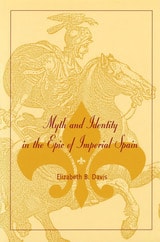
Myth and Identity in the Epic of Imperial Spain
Elizabeth B. Davis
University of Missouri Press, 2026
The first in-depth analysis of some of the most important epic poems of the Spanish Golden Age, Myth and Identity in the Epic of Imperial Spain breathes new life into five of these long- neglected texts. Elizabeth Davis demonstrates that the epic must not be overlooked, for doing so creates a significant gap in one's ability to appraise not only the cultural practice of the imperial age, but also the purest expression of its ideology.
Davis's study focuses on heroic poetry written from 1569 to 1611, including Alonso de Ercilla's La Araucana, undeniably the most significant epic poem of its time. Also included are Diego de Hojeda's La Christiada, Juan Rufo's La Austriada,. Lope de Vega's Jerusalén Conquistada, and Cristóbal de Virués's Historia del Monserrate.
Examining these epics as the major site for the construction of cultural identities and Renaissance nationalist myths, Davis analyzes the means by which the epic constructs a Spanish sense of self. Because this sense of identity is not easily susceptible to direct representation, it is often derived in opposition to an "other," which serves to reaffirm Spanish cultural superiority. The Spanish Christian caballeros are almost always pitted against Amerindians, Muslims, Jews, or other adversaries portrayed as backward or heathen for their cultural and ethnic differences.
The pro-Castilian elite of sixteenth-century Spain faced the daunting task of constructing unity at home in the process of expansion and conquest abroad, yet ethnic and regional differences in the Iberian Peninsula made the creation of an imperial identity particularly difficult. The epic, as Davis shows, strains to convey the overriding image of a Spain that appears more unified than the Spanish empire ever truly was.
An important reexamination of the Golden Age canon, Myth and Identity in the Epic of Imperial Spain brings a new twist to the study of canon formation. While Davis does not ignore more traditional approaches to the literary text, she does apply recent theories, such as deconstruction and feminist criticism, to these poems, resulting in an innovative examination of the material.
Confronting such issues as canonicity, gender, the relationship between literature and Golden Age culture, and that between art and power, this publication offers scholars a new perspective for assessing Golden Age and Transatlantic studies.