Results by title
313 books match the query 'Administration' and 10 start with n
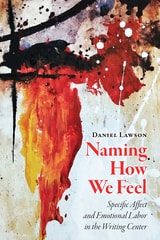
Naming How We Feel
Specific Affect and Emotional Labor In the Writing CenterDaniel Lawson
Utah State University Press, 2026
Writing centers are the locus for a wide range of emotional labor on campus, often serving students beyond the typical educational purpose. Naming How We Feel grapples with the question of how writing center administrators account for, train for, and theorize emotion and affect in the writing center to facilitate better and more ethical practices and considers how writing center administrators might ameliorate the costs of such emotional labor to faculty, tutors, and students.
Beginning with a discussion of how writing center scholars might identify and understand emotional labor, the book then expands to examine richly varied case studies and anecdotes to showcase how tutors tend to experience such labor and consider its relationship and association with emotional intelligence and burnout. Lawson considers how the field might better prepare and train tutors for affect and emotional labor, ultimately advocating for more equitable conditions for emotional labor within writing centers.
Naming How We Feel examines the critical role feelings play in writing and writing center work, offering advice on training tutors for emotional labor and literacy and suggestions for how administrators might engage institutional stakeholders to create and support more equitable conditions for emotional labor within their writing centers.

Nationally Competitive Scholarships
Serving Students and the Public GoodSuzanne McCray
University of Arkansas Press, 2007

Navigating Space On and Beyond Campus
Eric Detweiler
Utah State University Press, 2026
Offering practical applications of scholarship in spatial theory and rhetorics of space and place, Navigating Space On and Beyond Campus profiles how writing and rhetoric programs across the United States have responded to the spatial challenges and possibilities facing higher education. Exploring how instructors creatively and critically navigate actual, virtual, and inaccessible spaces in the pursuit of effective, ethically informed rhetoric and writing education, this book also reveals how the use of space contributes to the creation and/or denial of equity among students, faculty, and programs.
Contributors document how they have secured and repurposed campus real estate, literally and metaphorically navigated relationships with other campus resources, and responded to austerity measures that have threatened the spaces they have historically called their own. Individual sections focus on the historical pressures that have shaped programs’ locations and resources, developments in the work and design of writing centers, the creation of new labs and centers, and the relationship between writing programs and the broader places and communities with which they are intertwined.
How spaces are allocated, structured, and regulated is a key determinant of access and equity in higher education. Navigating Space On and Beyond Campus offers timely strategies for and reflections on the place of rhetoric and writing on college and university campuses.
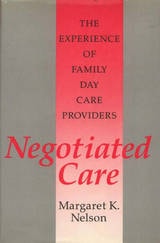
Negotiated Care
The Experience of Family Day Care ProvidersMargaret K. Nelson
Temple University Press, 1991
Weaving together numerous richly detailed interviews and surveys with recent feminist literature on the role of caregiving in women’s lives and investigations of women’s involvement in home-based work, this book explores the daily lives of family day care providers. Margaret K. Nelson uncovers the dilemmas providers face in their relationships with parents who bring children to them, with the children themselves, with the providers’ family members, and with representatives of the state’s regulatory system. She links these dilemmas to the contradiction between an increasing demand for personalized, cheap, informal child care services and a public policy that subjects child care providers to public scrutiny while giving them limited material and ideological support.
Nelson’s discussions with day care providers reveal considerable tensions that emerge over issues of control and intimacy. The dual motivation of business and family gives rise to problems, such as how to maintain enough distance from the parents to set limits on hours while providing personal service in a family setting. Family day care providers often enter this occupation as a way to engage in paid work and meet their own child care responsibilities. This book looks at how they manage to negotiate a setting that simultaneously involves money, trust, and caring.
Family day care represents one of the most prevalent sources of child care for working parents. It is an especially common form of care for very young children, yet it remains little studied. In the popular press, stereotypes—many of them negative—prevail. This book substitutes a thorough, detailed examination of this child care setting from a perspective that has generally been ignored-that of the caregiver. While providing useful insights into the role of caregiving in women’s lives and the phenomenon of home-based work, it contributes to the ongoing policy debates about child care.
In the series Women in the Political Economy, edited by Ronnie J. Steinberg.

Negotiation within Domination
New Spain's Indian Pueblos Confront the Spanish StateEthelia Ruiz Medrano
University Press of Colorado, 2016
Bringing together work by Mexican and North American historians, this collection is a crucially important and rare contribution to the field. Negotiation within Domination is a valuable resource for native peoples as they seek to redefine and revitalize their identities and assert their rights relating to language and religion, ownership of lands and natural resources, rights of self-determination and self-government, and protection of cultural and intellectual property. It will be of interest primarily to specialists in the field of colonial studies and historians and ethnohistorians of New Spain.
Contributors: R. Jovita Baber, José Manuel A. Chávez-Gómez, Susan Kellogg, Edward W. Osowski, María de los Ángeles Romero Frizzi, Ethelia Ruiz Medrano, Cuauhtémoc Velasco Ávila, Yanna P. Yannakakis

New Routes to Library Success
100+ Ideas from Outside the StacksElisabeth Doucett
American Library Association, 2015

Newer Dimensions of Patient Care
The Use of the Physical and Social Environment for Therapeutic PurposesEsther Lucille Brown
Russell Sage Foundation, 1961

No Equal In The World
An Interpretation Of The Academic PresidencyJoseph N. Crowley
University of Nevada Press, 1994

Norton on Archives
Thornton W. Mitchell
Society of American Archivists, 2003

Now You're a Manager
Quick and Practical Strategies for New Mid-Level Managers in Academic LibrariesLeslie Madden
Assoc of College & Research Libraries, 2017