Results by title
187 books match the query 'African American women' and 3 start with n
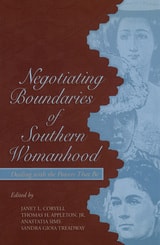
Negotiating Boundaries of Southern Womanhood
Dealing with the Powers That BeEdited & Intro by Janet L. Coryell, Thomas Appleton, Anastatia Sims, & Sandra Treadway
University of Missouri Press, 2000
In a time when most Americans never questioned the premise that women should be subordinate to men, and in a place where only white men enjoyed fully the rights and privileges of citizenship, many women learned how to negotiate societal boundaries and to claim a share of power for themselves in a male-dominated world.
Covering the early nineteenth through the early twentieth centuries, Negotiating Boundaries of Southern Womanhood describes the ways southern women found to advance their development and independence and establish their own identities in the context of a society that restricted their opportunities and personal freedom.
They confronted, cooperated with, and sometimes were co-opted by existing powers: the white and African American elite whose status was determined by wealth, family name, gender, race, skin color, or combinations thereof. Some women took action against established powers and, in so doing, strengthened their own communities; some bowed to the powers and went along to get along; some became the powers, using status to ensure their prosperity as well as their survival. All chose their actions based on the time and place in which they lived.
In these thought-provoking essays, the authors illustrate the complex intersections of race, class, and gender as they examine the ways in which southern women dealt with "the powers that be" and, in some instances, became those powers. Elitism, status, and class were always filtered through a prism of race and gender in the South, and women of both races played an important role in maintaining as well as challenging the hierarchies that existed.
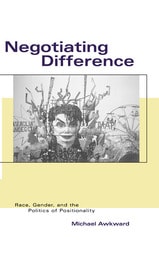
Negotiating Difference
Race, Gender, and the Politics of PositionalityMichael Awkward
University of Chicago Press, 1995
From Spike Lee's She's Gotta Have It to Michael Jackson's physical transmutations, from Toni Morrison's Song of Solomon to August Wilson's Fences, from male scholars' investments in feminism to white scholars' in black texts—Awkward explores cultural moments that challenge the exclusive critical authority of race and gender. In each instance he confronts the question: What do artists, scholars, and others concerned with representations of Afro-American life make of the view that gender, race, and sexuality circumscribe their own and others' lives and narratives? Throughout he demonstrates the perils and merits of the sort of "boundary crossing" this book ultimately makes: a black male feminism.
In pursuing a black male feminist criticism, Awkward's study acknowledges the complexities of interpretation in an age when a variety of powerful discourses have proliferated on the subject of racial, gendered, and sexual difference; at the same time, it identifies this proliferation as an opportunity to negotiate seemingly fixed cultural and critical positions.
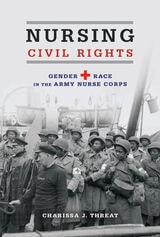
Nursing Civil Rights
Gender and Race in the Army Nurse CorpsCharissa J. Threat
University of Illinois Press, 2015
As Threat reveals, both groups viewed their circumstances with the Army Nurse Corps as a civil rights matter. Each conducted separate integration campaigns to end the discrimination they suffered. Yet their stories defy the narrative that civil rights struggles inevitably arced toward social justice. Threat tells how progressive elements in the campaigns did indeed break down barriers in both military and civilian nursing. At the same time, she follows conservative threads to portray how some of the women who succeeded as agents of change became defenders of exclusionary practices when men sought military nursing careers. The ironic result was a struggle that simultaneously confronted and reaffirmed the social hierarchies that nurtured discrimination.