Results by title
435 books match the query 'Asian American & Pacific Islander Studies' and 9 start with n

National Abjection
The Asian American Body OnstageKaren Shimakawa
Duke University Press, 2002
Shimakawa looks at the origins of Asian American theater, particularly through the memories of some of its pioneers. Her examination of the emergence of Asian American theater companies illuminates their strategies for countering the stereotypes of Asian Americans and the lack of visibility of Asian American performers within the theater world. She shows how some plays—Wakako Yamauchi’s 12-1-A, Frank Chin’s Chickencoop Chinaman, and The Year of the Dragon—have both directly and indirectly addressed the displacement of Asian Americans. She analyzes works attempting to negate the process of abjection—such as the 1988 Broadway production of M. Butterfly as well as Miss Saigon, a mainstream production that enacted the process of cultural displacement both onstage and off. Finally, Shimakawa considers Asian Americanness in the context of globalization by meditating on the work of Ping Chong, particularly his East-West Quartet.
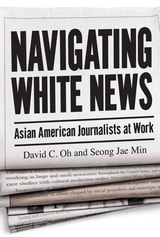
Navigating White News
Asian American Journalists at WorkDavid C Oh
Rutgers University Press, 2023
Combining critical race studies with cultural production studies, Navigating White News: Asian American Journalists at Work is the only academic book to examine the ways that racial identification and activation matters in their understanding of news. This adds to the existing literature on race and the sociology of news by examining intra-racial differences in the ways they navigate and understand White newsrooms. Employing in-depth interviews with twenty Asian American journalists who are actively working in large and small newsrooms across the United States, Navigating White News: Asian American Journalists at Work argues that Asian American reporters for whom racial identities are important questioned what counted as news, questioned the implicitly White perspective of objectivity, and actively worked toward providing more complex, substantive coverage of Asian American communities. For Asian American reporters for whom racial identity was not meaningful, they were more invested in existing professional norms. Regardless, all journalists understood that news is a predominantly and culturally White institution.
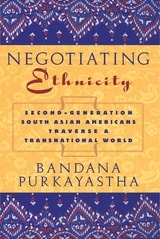
Negotiating Ethnicity
Second-Generation South Asians Traverse a Transnational WorldPurkayastha, Bandana
Rutgers University Press, 2005
In the continuing debates on the topic of racial and ethnic identity in the United States, there are some that argue that ethnicity is an ascribed reality. To the contrary, others claim that individuals are becoming increasingly active in choosing and constructing their ethnic identities.Focusing on second-generation South Asian Americans, Bandana Purkayastha offers fresh insights into the subjective experience of race, ethnicity, and social class in an increasingly diverse America. The young people of Indian, Pakistani, Bangladeshi, and Nepalese origin that are the subjects of the study grew up in mostly white middle class suburbs, and their linguistic skills, education, and occupation profiles are indistinguishable from their white peers. By many standards, their lifestyles mark them as members of mainstream American culture. But, as Purkayastha shows, their ethnic experiences are shaped by their racial status as neither “white” nor “wholly Asian,” their continuing ties with family members across the world, and a global consumer industry, which targets them as ethnic consumers.”
Drawing on information gathered from forty-eight in-depth interviews and years of research, this book illustrates how ethnic identity is negotiated by this group through choice—the adoption of ethnic labels, the invention of “traditions,” the consumption of ethnic products, and participation in voluntary societies. The pan-ethnic identities that result demonstrate both a resilient attachment to heritage and a celebration of reinvention.
Lucidly written and enriched with vivid personal accounts, Negotiating Ethnicity is an important contribution to the literature on ethnicity and racialization in contemporary American culture.
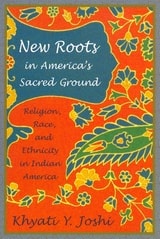
New Roots in America's Sacred Ground
Religion, Race, and Ethnicity in Indian AmericaJoshi, Khyati Y
Rutgers University Press, 2006
In this compelling look at second-generation Indian Americans, Khyati Y. Joshi draws on case studies and interviews with forty-one second-generation Indian Americans, analyzing their experiences involving religion, race, and ethnicity from elementary school to adulthood. As she maps the crossroads they encounter as they navigate between their homes and the wider American milieu, Joshi shows how their identities have developed differently from their parents’ and their non-Indian peers’ and how religion often exerted a dramatic effect.
The experiences of Joshi’s research participants reveal how race and religion interact, intersect, and affect each other in a society where Christianity and whiteness are the norm. Joshi shows how religion is racialized for Indian Americans and offers important insights in the wake of 9/11 and the backlash against Americans who look Middle Eastern and South Asian.
Through her candid insights into the internal conflicts contemporary Indian Americans face and the religious and racial discrimination they encounter, Joshi provides a timely window into the ways that race, religion, and ethnicity interact in day-to-day life.

Nikkei Baseball
Japanese American Players from Immigration and Internment to the Major LeaguesSamuel Ragalado
University of Illinois Press, 2013

Nimrods
a fake-punk self-hurt anti-memoirKawika Guillermo
Duke University Press, 2023

Nisei Sansei
Jere Takahashi
Temple University Press, 1998

No Safe Spaces
Re-casting Race, Ethnicity, and Nationality in American TheaterAngela C. Pao
University of Michigan Press, 2010
"No Safe Spaces opens up a conversation beyond narrow polemics . . . Although cross-racial casting has been the topic of heated discussion, little sustained scholarship addresses both the historical precedents and theoretical dimensions. Pao illustrates the tensions and contradictions inherent not only in stage representations, but also in the performance of race in everyday life. A wonderful book whose potential readership goes well beyond theater and performance scholars."
---Josephine Lee, University of Minnesota
"Non-traditional casting, increasingly practiced in American theater, is both deeply connected to our country's racial self-image(s) and woefully under-theorized. Pao takes on the practice in its entirety to disentangle the various strands of this vitally important issue."
---Karen Shimakawa, New York University
No Safe Spaces looks at one of the most radical and enduring changes introduced during the Civil Rights era---multiracial and cross-racial casting practices in American theater. The move to cast Latino/a, African American, and Asian American actors in classic stage works by and about white Europeans and Americans is viewed as both social and political gesture and artistic innovation. Nontraditionally cast productions are shown to have participated in the national dialogue about race relations and ethnic identity and served as a source of renewed creativity for the staging of the canonical repertory.
Multiracial casting is explored first through its history, then through its artistic, political, and pragmatic dimensions. Next, the book focuses on case studies from the dominant genres of contemporary American theater: classical tragedy and comedy, modern domestic drama, antirealist drama, and the Broadway musical, using a broad array of archival source materials to enhance and illuminate its arguments.
Angela C. Pao is Associate Professor of Comparative Literature at Indiana University.
A volume in the series Theater: Theory/Text/Performance

No Sword To Bury
Japanese Americans In HawaiiFranklin S. Odo
Temple University Press, 2004