Results by title
92 books match the query 'Boundaries' and 5 start with n

New Borders
Migration, Hotspots and the European SuperstateAntonis Vradis, Evie Papada, Joe Painter, and Anna Papoutsi
Pluto Press, 2018
As borders across Europe have come to symbolize the European Union, this book provides answers to questions of European policy, the securitization of national boundaries, and how legislation determines who is free to belong to a place.

News and Frontier Consciousness in the Late Roman Empire
Mark W. Graham
University of Michigan Press, 2006
Approaching Roman frontiers with the aid of media studies as well as anthropological and sociological methodologies, Mark W. Graham chronicles and documents this significant transition in ancient thought, which coincided with, but was not necessarily dependent on, the Christianization of the Roman world.
Mark W. Graham is Assistant Professor of History at Grove City College.
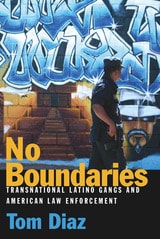
No Boundaries
Transnational Latino Gangs and American Law EnforcementTom Diaz
University of Michigan Press, 2011
"Tom Diaz has worn out some shoe leather, much like a good detective, in gathering facts, not myths or urban legends. As a result he has produced an accurate and comprehensive look at a grave and present danger to our society."
---From the foreword by Chris Swecker, former Assistant Director of the FBI and former head of the FBI's Criminal Investigative Division
No Boundaries is a disturbing account of what many consider the "next Mafia"---Latino crime gangs. Like the Mafia, these gangs operate an international network, consider violence a routine matter, and defy U.S. law enforcement at every level. Also, the gangs spawn kingpins such as the notorious Nelson Martinez Varela Comandari, who nearly became the first "Latin godfather" in the United States.
Focusing on the Los Angeles–based Mara Salvatrucha (MS-13) and the 18th Street Gang, and the Chicago-based Latin Kings, Tom Diaz describes how neighborhood gangs evolved into extremely brutal, sophisticated criminal enterprises and how local and federal authorities have struggled to suppress them. As he makes clear, the problem of transnational Latino gangs involves complex national and international issues, such as racial tensions, immigration policy, conflict in Latin America, and world economic pressures.
Tom Diaz is a lawyer, author, and public speaker who conducts research on gun policy and violence for the Violence Policy Center, a Washington, D.C.–based think tank. He has covered national security affairs for the Washington Times and served as counsel to the U.S. House Subcommittee on Crime and Criminal Justice from 1993 to 1997.
Cover photograph: Tegucigalpa, Honduras: A policeman passes by a graffiti of the Mara Salvatrucha "MS-13" (juvenile gang) at the entrance of the unit where members of the gang are kept imprisoned in the National Penitentiary in Tamara, 30 km north of Tegucigalpa, February 1, 2006. © Elmer Martinez/AFP/Getty Images
North American Borders in Comparative Perspective
Edited by Guadalupe Correa-Cabrera and Victor Konrad; Foreword by Alan Artibise
University of Arizona Press, 2020
The northern and southern borders and borderlands of the United States should have much in common; instead they offer mirror articulations of the complex relationships and engagements between the United States, Mexico, and Canada. In North American Borders in Comparative Perspectiveleading experts provide a contemporary analysis of how globalization and security imperatives have redefined the shared border regions of these three nations.
This volume offers a comparative perspective on North American borders and reveals the distinctive nature first of the overportrayed Mexico-U.S. border and then of the largely overlooked Canada-U.S. border. The perspectives on either border are rarely compared. Essays in this volume bring North American borders into comparative focus; the contributors advance the understanding of borders in a variety of theoretical and empirical contexts pertaining to North America with an intense sharing of knowledge, ideas, and perspectives.
Adding to the regional analysis of North American borders and borderlands, this book cuts across disciplinary and topical areas to provide a balanced, comparative view of borders. Scholars, policy makers, and practitioners convey perspectives on current research and understanding of the United States’ borders with its immediate neighbors. Developing current border theories, the authors address timely and practical border issues that are significant to our understanding and management of North American borderlands.
The future of borders demands a deep understanding of borderlands and borders. This volume is a major step in that direction.
Contributors
Bruce Agnew
Donald K. Alper
Alan D. Bersin
Christopher Brown
Emmanuel Brunet-Jailly
Irasema Coronado
Guadalupe Correa-Cabrera
Michelle Keck
Victor Konrad
Francisco Lara-Valencia
Tony Payan
Kathleen Staudt
Rick Van Schoik
Christopher Wilson

Not Quite White
White Trash and the Boundaries of WhitenessMatt Wray
Duke University Press, 2006
Of crucial importance are the ideas about poor whites that circulated through early-twentieth-century public health campaigns, such as hookworm eradication and eugenic reforms. In these crusades, impoverished whites, particularly but not exclusively in the American South, were targeted for interventions by sanitarians who viewed them as “filthy, lazy crackers” in need of racial uplift and by eugenicists who viewed them as a “feebleminded menace” to the white race, threats that needed to be confined and involuntarily sterilized.
Part historical inquiry and part sociological investigation, Not Quite White demonstrates the power of social categories and boundaries to shape social relationships and institutions, to invent groups where none exist, and to influence policies and legislation that end up harming the very people they aim to help. It illuminates not only the cultural significance and consequences of poor white stereotypes but also how dominant whites exploited and expanded these stereotypes to bolster and defend their own fragile claims to whiteness.