Results by title
343 books match the query 'Capitalism' and 6 start with n

Nature for Sale
The Commons versus CommoditiesGiovanna Ricoveri
Pluto Press, 2013
Nature for Sale uncovers the rich heritage of common ownership which existed before the dominance of capitalist property relations. Giovanna Ricoveri argues that the subsistence commons of the past can be reinvented today to provide an alternative to the current destructive economic order.
Ricoveri outlines the distinct features of common ownership as it has existed in history: cooperation, sustainable use of natural resources and decision-making through direct democracy. In doing so, she shows how it is possible to provide goods and services which are not commodities exchanged on the capitalistic market, something still demonstrated today in village communities across the global South.
Tracing the erosion of the commons from the European enclosures at the dawn of the Industrial Revolution to the new enclosures of modern capitalism, the book concludes by arguing that a new commons is needed today. It will be essential reading for activists as well as students and academics in history, politics, economics and development studies.

Neoliberalism and Unlawful Governance
The Crisis of Democratic RightsGuillermina Seri
University of Michigan Press, 2026
In looking at the ways in which people resist, the book honors the perspective of the excluded and the voices of those most immediately affected by neoliberal austerity—from activists defending land and rights to communities subjected to various forms of exploitation, extractivism, and displacement. Bringing in these voices and theoretical perspectives, including from beyond the English-speaking world, this book highlights alternative ways of thinking about democracy and rights, drawing from the tradition of the commons. Through its deep analysis of history, theory, and world events, Neoliberalism and Unlawful Governance offers fresh insights into how various forms of emergency measures, policing, and security are used to privilege markets over people and the planet, while also emphasizing the crucial role of popular movements in defending and expanding democratic rights and to rebuilding commons.
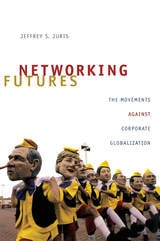
Networking Futures
The Movements against Corporate GlobalizationJeffrey S. Juris
Duke University Press, 2008
In an account full of activist voices and on-the-ground detail, Juris provides a history of anti–corporate globalization movements, an examination of their connections to local dynamics in Barcelona, and an analysis of movement-related politics, organizational forms, and decision-making. Depicting spectacular direct action protests in Barcelona and other cities, he describes how far-flung activist networks are embodied and how networking politics are performed. He further explores how activists have used e-mail lists, Web pages, and free software to organize actions, share information, coordinate at a distance, and stage “electronic civil disobedience.” Based on a powerful cultural logic, anti–corporate globalization networks have become models of and for emerging forms of radical, directly democratic politics. Activists are not only responding to growing poverty, inequality, and environmental devastation; they are also building social laboratories for the production of alternative values, discourses, and practices.
New Countries
Capitalism, Revolutions, and Nations in the Americas, 1750–1870John Tutino, editor
Duke University Press, 2016
Contributors. Alfredo Ávila, Roberto Breña, Sarah C. Chambers, Jordana Dym, Carolyn Fick, Erick Langer, Adam Rothman, David Sartorius, Kirsten Schultz, John Tutino
No Peer Rivals
American Grand Strategy in the Era of Great Power CompetitionIonut Popescu
University of Michigan Press, 2025
No Peer Rivals takes a major staple of International Relations scholarship—the offensive realist paradigm—and develops a comprehensive and practical grand strategy for the United States in this new era of Great Power Competition. The No Peer Rival framework is grounded in a realistic assessment of the most likely courses of action adopted by China, Russia, and other important regional powers. It prioritizes great power rivalry over other strategic goals, and identifies China as the biggest threat to America’s unique position in the international system. This grand strategic approach carefully aligns the domestic sources of national power (economic strength, energy security, and technological prowess) to America’s foreign policy and national security objectives. In addition to recommending necessary changes to America’s military and diplomatic strategies, No Peer Rivals also demonstrates that a realistic approach to industrial policy, international trade, energy production, and technological superiority offers the best chance for developing the sinews of power needed to outcompete Beijing in the long run.

Not Yet a Placeless Land
Tracking an Evolving American GeographyWilbur Zelinsky
University of Massachusetts Press, 2011
In this book, cultural geographer Wilbur Zelinsky challenges that nearly universal view and reaches a paradoxical conclusion: that American land and society are becoming more uniform and more diverse at the same time. After recounting the many ways in which modern technologies, an advanced capitalist market system, and a potent central political establishment have standardized the built landscape of the country's vast territory and its burgeoning population over the past two hundred and fifty years, he also considers the vigor of countervailing forces. In a carefully balanced assessment, he documents steady increases in the role of the unpredictable, in the number and variety of arbitrarily located places and activities, and the persistence of basic cultural diversities. Contrary to popular perceptions, place-to-place differences in spoken language, religion, and political behavior have not diminished or disappeared. In fact, Zelinsky shows, novel cultural regions and specialized cities have been emerging even as a latter-day version of regionalism and examples of neo-localism are taking root in many parts of the United States.