264 books match the query 'Chicago (Ill.)' and 7 start with n
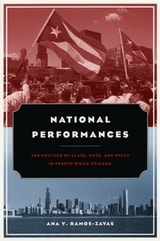
cover of National Performances: The Politics of Class, Race, and Space in Puerto Rican Chicago

National Performances

The Politics of Class, Race, and Space in Puerto Rican Chicago

Ana Y. Ramos-Zayas

University of Chicago Press, 2003

In this book, Ana Y. Ramos-Zayas explores how Puerto Ricans in Chicago construct and perform nationalism. Contrary to characterizations of nationalism as a primarily unifying force, Ramos-Zayas finds that it actually provides the vocabulary to highlight distinctions along class, gender, racial, and generational lines among Puerto Ricans, as well as between Puerto Ricans and other Latino, black, and white populations.

Drawing on extensive ethnographic research, Ramos-Zayas shows how the performance of Puerto Rican nationalism in Chicago serves as a critique of social inequality, colonialism, and imperialism, allowing barrio residents and others to challenge the notion that upward social mobility is equally available to all Americans—or all Puerto Ricans. Paradoxically, however, these activists' efforts also promote upward social mobility, overturning previous notions that resentment and marginalization are the main results of nationalist strategies.

Ramos-Zayas's groundbreaking work allows her here to offer one of the most original and complex analyses of contemporary nationalism and Latino identity in the United States.
[more]
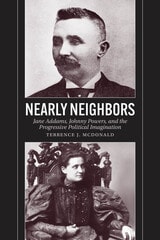
cover of Nearly Neighbors: Jane Addams, Johnny Powers, and the Progressive Political Imagination

Nearly Neighbors

Jane Addams, Johnny Powers, and the Progressive Political Imagination

Terrence J. McDonald

University of Chicago Press, 2026

An engaging look at the encounter between Jane Addams, Hull House settlement co-founder and Progressive reformer, and Alderman Johnny Powers.
 
Jane Addams was full of courage and goodwill when she opened Hull House in Chicago’s Nineteenth Ward in 1889. However, she failed to understand that her immigrant neighbors had been well-organized around mostly Catholic churches and schools for decades before her arrival. Her ultimate political rival, Johnny Powers, grew up in this culture but was no ethnic hero or deep political thinker. Nearly Neighbors is the first book to provide a contextualized history of their encounter, embedding it in the social and political culture and structures of Chicago and the Nineteenth Ward in the 1890s.

Terrence J. McDonald provides a crucial analysis of two pivotal figures in Chicago’s political history, in part by providing the first detailed assessment of Powers’s life and practices, but also by demonstrating Addams’s misconception of him and her neighbors—and why it matters for understanding her Progressive work overall. In both her political work and writings, Addams saw her ethnic neighbors as bundles of economic need, rather than bearers of ethnic culture. At the same time, she was recruited by elite allies into causes that appeared to be opposed by her neighbors. These views and practices permitted Powers to win in their climactic political battle in 1898 simply by claiming to be the neighborhood defender against Addams and her “downtown” allies. Nearly Neighbors offers a new way of understanding Addams and the complicated legacy of her famous political work and writings. 
 
[more]
cover of Negotiating Latinidad: Intralatina/o Lives in Chicago

Negotiating Latinidad

Intralatina/o Lives in Chicago

Frances R. Aparicio

University of Illinois Press, 2019
Longstanding Mexican and Puerto Rican populations have helped make people of mixed nationalities—MexiGuatamalans, CubanRicans, and others—an important part of Chicago's Latina/o scene. Intermarriage between Guatemalans, Colombians, and Cubans have further diversified this community-within-a-community. Yet we seldom consider the lives and works of these Intralatino/as when we discuss Latino/as in the United States.In Negotiating Latinidad, a cross-section of Chicago's second-generation Intralatino/as offer their experiences of negotiating between and among the national communities embedded in their families. Frances R. Aparicio's rich interviews reveal Intralatino/as proud of their multiplicity and particularly skilled at understanding difference and boundaries. Their narratives explore both the ongoing complexities of family life and the challenges of fitting into our larger society, in particular the struggle to claim a space—and a sense of belonging—in a Latina/o America that remains highly segmented in scholarship. The result is an emotionally powerful, theoretically rigorous exploration of culture, hybridity, and transnationalism that points the way forward for future scholarship on Intralatino/a identity.
[more]
cover of Neoliberal Chicago

Neoliberal Chicago

Edited by Larry Bennett, Roberta Garner, and Euan Hague

University of Illinois Press, 2017
The neoliberal philosophy of fiscal austerity aligned with reduced regulation has transformed Chicago. As pursued by mayor Rahm Emanuel and his predecessor Richard M. Daley, neoliberalism led officials to privatize everything from parking meters to schools, gut regulations and social services, and promote gentrification wherever possible. The essayists in Neoliberal Chicago explore an essential question: how does neoliberalism work on the ground in today's Chicago? Contextual chapters explore race relations, physical development, and why Chicago embraced neoliberalism. Other contributors delve into aspects of the neoliberal vision, neoliberalism's impact on three iconic city spaces, and how events like the 2008 foreclosure crisis and the bid to attract the Olympic Games reveal the workings of neoliberalism. Contributors: Stephen Alexander, Larry Bennett, Michael Bennett, Carrie Breitbach, Sean Dinces, Kenneth Fidel, Roberta Garner, Euan Hague, Black Hawk Hancock, Christopher Lamberti, Michael J. Lorr, Martha Martinez, Brendan McQuade, Alex G. Papadopoulos, Rajiv Shah, Costas Spirou, Carolina Sternberg, and Yue Zhang.
[more]
cover of Never a City So Real: A Walk in Chicago

Never a City So Real

A Walk in Chicago

Alex Kotlowitz

University of Chicago Press, 2019

“Chicago is a tale of two cities,” headlines declare. This narrative has been gaining steam alongside reports of growing economic divisions and diverging outlooks on the future of the city. Yet to keen observers of the Second City, this is nothing new. Those who truly know Chicago know that for decades—even centuries—the city has been defined by duality, possibly since the Great Fire scorched a visible line between the rubble and the saved. For writers like Alex Kotlowitz, the contradictions are what make Chicago. And it is these contradictions that form the heart of Never a City So Real.

The book is a tour of the people of Chicago, those who have been Kotlowitz’s guide into this city’s – and by inference, this country’s – heart.  Chicago, after all, is America’s city. Kotlowitz introduces us to the owner of a West Side soul food restaurant who believes in second chances,  a steelworker turned history teacher, the “Diego Rivera of the projects,” and the lawyers and defendants who populate Chicago’s Criminal Courts Building.  These empathic, intimate stories chronicle the city’s soul, its lifeblood.

This new edition features a new afterword from the author, which examines the state of the city today as seen from the double-paned windows of a pawnshop. Ultimately, Never a City So Real is a love letter to Chicago, a place that Kotlowitz describes as “a place that can tie me up in knots but a place that has been my muse, my friend, my joy.”
[more]
cover of New York, Chicago, Los Angeles: America’s Global Cities

New York, Chicago, Los Angeles

America’s Global Cities

Janet Abu-Lughod

University of Minnesota Press, 2001
A renowned scholar compares America's three global cities. "Abu-Lughod nicely characterizes the distinctive feel and experience of the three cities. She works her way through the history, the statistics, and the economic forces, but she ends up on the sidewalk, marveling at the complexity that has been created by an extraordinary history, and enamored of it. What is most urgent about her book is not so much her analysis of the urban condition as her devotion to cities. The city has been under attack by theorists and sprawlers for a long time now, but this fine book provides necessary examples of how the city may be intelligently loved." --Nathan Glazer in The New Republic "In a pathbreaking analysis, Abu-Lughod demonstrates the historical roots of what is usually described as a contemporary phenomenon." --MultiCultural Review "Substantial, in-depth comparison of more than one large city by a single urban scholar, while not unprecedented, is a difficult project to execute competently. Abu-Lughod has done a commendable job. One can only hope that others will follow her pioneering work and provide comparative and historical analyses of other global cities." --Urban Geography "For those of us who are interested in historical-geographical approaches to comparative urbanization, Janet Abu-Lughod's new work, New York, Chicago, Los Angeles: America's Global Cities, comes as a welcome relief. This impressive volume provides a comprehensive, readable, and lively interpretation of the three leading U.S. metropolitan areas. Although Abu-Lughod is a trained urban sociologist, she has a keen sensitivity to historical, spatial, economic, political, and cultural considerationsits real strengths lie in an exhaustive review of empirical evidence from the three metropolises and a rich illustration of points with abundant maps, tables, and figures. Abu-Lughod excels in profiling the trajectories of America's three largest city-regions. I find the book to be a tour de force, the worthwhile result of many years of study and observation. Happily, the book presents the material in a straightforward way and is remarkably free of the jargon that sometimes plagues global-city studies. I hope the book receives wide circulation. Abu-Lughod, after a long scholarly career in urban studies, may have achieved her magnum opus in this ambitious study of America's three preeminent global cities." --Geographical Review "Janet Abu-Lughod's book is both a fascinating history of New York, Chicago, and Los Angeles and a history of the United States from a new perspective. The stories of the three cities are beautifully overlapped but consistent in themselves, related to one another but self-sufficient. This is a very American book-despite the author's wealth of experience abroad. Her forte is the new narrative she weaves from existing research. The book provides a remarkably systematic and organized narrative of urbanization in the 19th and 20th centuries. It is also replete with a collection of individual anecdotal evidence and an impressive multitude of single conceptual and metaphorical observations that are often hidden in the empirical material presented throughout the book. This book represents an outstanding achievement. It will be-and deserves to be-an instant classic. Abu-Lughod's major opus is expressive of a life's work among the great American urbanists and planners of the 20th century. Abu-Lughod is a living example of what the best of urbanism can produce in a largely suburban America. In this sense, the book gives planners a giant source of inspiration: the big picture in long waves. The city lives despite itself." --Roger Keil, Journal of the American Planning Association "Janet L. Abu-Lughod's book is the first to compare these cities in an ambitious in-depth study that takes into account each city's unique history, following their development from their earliest days to their current status as players on the global state." --Bulletin of Science, Technology & Society New York, Chicago, and Los Angeles--for all their differences, they are quintessentially American cities. They are also among the handful of cities in the world that can truly be called "global." Janet L. Abu-Lughod's book is the first to compare them in an ambitious in-depth study that takes into account each city's unique history, following their development from their earliest days to their current status as players on the global stage. Unlike most other global cities, New York, Chicago, and Los Angeles all quickly grew from the nearly blank slate of the American landscape to become important beyond the nation's borders early in their histories. As a result, Abu-Lughod is able to show the effect of globalization on each city's development from its beginnings. While all three are critical to global economics and the spread of American culture to the farthest reaches of an increasingly interlinked world, their influence reflects their individual histories and personalities. In a masterful synthesis of historical and economic information, Abu-Lughod clarifies how each city's global role is--and will be--affected by geography, ethnicity of population, political institutions, and tradition of governance. New York, Chicago, and Los Angeles are more than global players: they are also home to forty million people. Abu-Lughod closes the book with a set of vignettes that captures the cities' differences as perceived by one who has lived in them. Bringing together the local and the global in thoroughly unexpected and enlightening ways, this important volume offers fascinating insight into these vital urban centers. "Comparative urbanism has few practitioners as distinguished as Janet L. Abu-Lughod. In this monumental study, Professor Abu-Lughod rescues Los Angeles from eccentricity by placing it in comparative context alongside the two most accepted urban paradigms of the United States: New York and Chicago. In doing so, she has added a new city--the City of Angels--to the front ranks of American cities and has significantly enhanced our understanding of New York and Chicago as well." --Kevin Starr, State Librarian of California "This breathtaking tour through the history of the three largest cities of the United States synthesizes the essentials of their varied history in a readable, lively form. New York, Chicago, Los Angeles is the first book I have seen by a single author who has lived in and become intimately knowledgeable about each of the cities, has plumbed their history, examined statistics, and pulled together a comparison that places the data and accounts in the context of personal experience. Abu-Lughod concludes the book with a set of human vignettes that captures differences and similarities among the cities, in the lived experience of a user and employer of each of the cities." --Peter Marcuse, Columbia University "A masterful comparative history of the three cities. Abu-Lughod's scholarship is impeccable and her book extremely well written." --John Friedmann, Professor Emeritus, UCLA, author of Endangered Dreams: The Great Depression and California and The Dream Endures: California Enters the 1940s. Janet L. Abu-Lughod, professor emerita of sociology of Northwestern University and the Graduate Faculty of the New School for Social Research, has been writing about and studying cities for more than fifty years. Her books include From Urban Village to East Village: The Battle for New York's Lower East Side; Changing Cities: Urban Sociology; Before European Hegemony: The World System A.D. 1250-1350; Rabat: Urban Apartheid in Morocco; and Cairo: 1001 Years of the City Victorious, among many other publications. In 1999 she received the Robert and Helen Lynd Award (American Sociological Association, Section on Community and Urban Sociology) for distinguished lifetime contributions to the study of cities.
[more]
cover of No One Was Killed: The Democratic National Convention, August 1968

No One Was Killed

The Democratic National Convention, August 1968

John Schultz

University of Chicago Press, 2009

While other writers contemplated the events of the 1968 Chicago riots from the safety of their hotel rooms, John Schultz was in the city streets, being threatened by police, choking on tear gas, and listening to all the rage, fear, and confusion around him. The result, No One Was Killed, is his account of the contradictions and chaos of convention week, the adrenalin, the sense of drama and history, and how the mainstream press was getting it all wrong.

"A more valuable factual record of events than the city’s white paper, the Walker Report, and Theodore B. White’s Making of a President combined."—Book Week

"As a reporter making distinctions between Yippie, hippie, New Leftist, McCarthyite, police, and National Guard, Schultz is perceptive; he excels in describing such diverse personalities as Julian Bond and Eugene McCarthy."—Library Journal

"High on my short list of true, lasting, inspired evocations of those whacked-out days when the country was fighting a phantasmagorical war (with real corpses), and police under orders were beating up demonstrators who looked at them funny."—Todd Gitlin, from the foreword

[more]