Results by title
134 books match the query 'Chinese' and 2 start with n

Negative Exposures
Knowing What Not to Know in Contemporary ChinaMargaret Hillenbrand
Duke University Press, 2020
When nations decide to disown their troubled pasts, how does this strategic disavowal harden into social fact? In Negative Exposures, Margaret Hillenbrand investigates the erasure of key aspects of such momentous events as the Nanjing Massacre, the Cultural Revolution, and the Tiananmen Square protests from the Chinese historical consciousness, not due to amnesia or censorship but through the operations of public secrecy. Knowing what not to know, she argues, has many stakeholders, willing and otherwise, who keep quiet to protect themselves or their families out of shame, pragmatism, or the palliative effects of silence. Hillenbrand shows how secrecy works as a powerful structuring force in Chinese society, one hiding in plain sight, and identifies aesthetic artifacts that serve as modes of reckoning against this phenomenon. She analyses the proliferation of photo-forms—remediations of well-known photographs of troubling historical events rendered in such media as paint, celluloid, fabric, digital imagery, and tattoos—as imaginative spaces in which the shadows of secrecy are provocatively outlined.
[more]
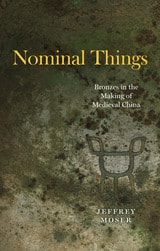
Nominal Things
Bronzes in the Making of Medieval ChinaJeffrey Moser
University of Chicago Press, 2023
How the medieval study of ancient bronzes influenced the production of knowledge and the making of things in East Asia.
This book opens in eleventh-century China, where scholars were the first in world history to systematically illustrate and document ancient artifacts. As Jeffrey Moser argues, the visual, technical, and conceptual mechanisms they developed to record these objects laid the foundations for methods of visualizing knowledge that scholars throughout early modern East Asia would use to make sense of the world around them.
Of the artifacts these scholars studied, the most celebrated were bronze ritual vessels that had been cast nearly two thousand years earlier. While working to make sense of the relationship between the bronzes’ complex shapes and their inscribed glyphs, they came to realize that the objects were “nominal things”—objects inscribed with names that identified their own categories and uses. Eleventh-century scholars knew the meaning of these glyphs from hallowed Confucian writings that had been passed down through centuries, but they found shocking disconnects between the names and the bronzes on which they were inscribed. Nominal Things traces the process by which a distinctive system of empiricism was nurtured by discrepancies between the complex materiality of the bronzes and their inscriptions. By revealing the connections between the new empiricism and older ways of knowing, the book explains how scholars refashioned the words of the Confucian classics into material reality.
[more]