153 books match the query 'Cities and towns' and 8 start with n
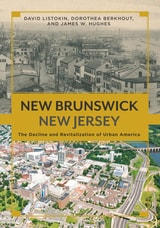
cover of New Brunswick, New Jersey: The Decline and Revitalization of Urban America

New Brunswick, New Jersey

The Decline and Revitalization of Urban America

Listokin, David

Rutgers University Press, 2016
While many older American cities struggle to remain vibrant, New Brunswick has transformed itself, adapting to new forms of commerce and a changing population, and enjoying a renaissance that has led many experts to cite this New Jersey city as a model for urban redevelopment. Featuring more than 100 remarkable photographs and many maps, New Brunswick, New Jersey explores the history of the city since the seventeenth century, with an emphasis on the dramatic changes of the past few decades.
 
Using oral histories, archival materials, census data, and surveys, authors David Listokin, Dorothea Berkhout, and James W. Hughes illuminate the decision-making and planning process that led to New Brunswick’s dramatic revitalization, describing the major redevelopment projects that demonstrate the city’s success in capitalizing on funding opportunities. These projects include the momentous decision of Johnson & Johnson to build its world headquarters in the city, the growth of a theater district, the expansion of Rutgers University into the downtown area, and the destruction and rebuilding of public housing. But while the authors highlight the positive effects of the transformation, they also explore the often heated controversies about demolishing older neighborhoods and ask whether new building benefits residents. Shining a light on both the successes and failures in downtown revitalization, they underscore the lessons to be learned for national urban policy, highlighting the value of partnerships, unwavering commitment, and local leadership. 
 
Today, New Brunswick’s skyline has been dramatically altered by new office buildings, residential towers, medical complexes, and popular cultural centers. This engaging volume explores the challenges facing urban America, while also providing a specific case study of a city’s quest to raise its economic fortunes and retool its economy to changing needs.
 
[more]
cover of New Urban Development: Looking Back to See Forward

New Urban Development

Looking Back to See Forward

Gruen, Claude

Rutgers University Press, 2010

The recent recession is one result of how local planning laws and practices have stifled competition, discouraged innovation, and artificially pushed up prices in America's most economically vibrant regions. Economist and consultant Claude Gruen unravels the story behind how these unintended consequences have resulted from the evolution of local zoning, growth controls, and laws intended to increase housing affordability.

New Urban Development traces how locally induced housing cost increases led federal policy-makers to toss out the safeguards against lending excesses that had been put in place during the 1930s. But the story begins much earlier, during the colonial era, continuing up through the mortgage collapse that ushered in the recession of 2008. In his sweeping history of these issues, Gruen considers gentrification, environmentalism, sprawl, anti-sprawl movements, and more. His clarification of how urban development change occurs backs up his recommendations for increasing the production of housing and replacing obsolete commercial and industrial spaces with development that serves the twenty-first-century economy. New Urban Development specifies thirteen changes to policies at the federal, state, and local levels to provide better and less expensive urban housing, desirable neighborhoods, and thriving workplaces across the country.
[more]
cover of New York Recentered: Building the Metropolis from the Shore

New York Recentered

Building the Metropolis from the Shore

Kara Murphy Schlichting

University of Chicago Press, 2019

The history of New York City’s urban development often centers on titanic municipal figures like Robert Moses and on prominent inner Manhattan sites like Central Park. New York Recentered boldly shifts the focus to the city’s geographic edges—the coastlines and waterways—and to the small-time unelected locals who quietly shaped the modern city. Kara Murphy Schlichting details how the vernacular planning done by small businessmen and real estate operators, performed independently of large scale governmental efforts, refigured marginal locales like Flushing Meadows and the shores of Long Island Sound and the East River in the late nineteenth and early twentieth centuries. The result is a synthesis of planning history, environmental history, and urban history that recasts the story of New York as we know it.
[more]
cover of New York, Chicago, Los Angeles: America’s Global Cities

New York, Chicago, Los Angeles

America’s Global Cities

Janet Abu-Lughod

University of Minnesota Press, 2001
A renowned scholar compares America's three global cities. "Abu-Lughod nicely characterizes the distinctive feel and experience of the three cities. She works her way through the history, the statistics, and the economic forces, but she ends up on the sidewalk, marveling at the complexity that has been created by an extraordinary history, and enamored of it. What is most urgent about her book is not so much her analysis of the urban condition as her devotion to cities. The city has been under attack by theorists and sprawlers for a long time now, but this fine book provides necessary examples of how the city may be intelligently loved." --Nathan Glazer in The New Republic "In a pathbreaking analysis, Abu-Lughod demonstrates the historical roots of what is usually described as a contemporary phenomenon." --MultiCultural Review "Substantial, in-depth comparison of more than one large city by a single urban scholar, while not unprecedented, is a difficult project to execute competently. Abu-Lughod has done a commendable job. One can only hope that others will follow her pioneering work and provide comparative and historical analyses of other global cities." --Urban Geography "For those of us who are interested in historical-geographical approaches to comparative urbanization, Janet Abu-Lughod's new work, New York, Chicago, Los Angeles: America's Global Cities, comes as a welcome relief. This impressive volume provides a comprehensive, readable, and lively interpretation of the three leading U.S. metropolitan areas. Although Abu-Lughod is a trained urban sociologist, she has a keen sensitivity to historical, spatial, economic, political, and cultural considerationsits real strengths lie in an exhaustive review of empirical evidence from the three metropolises and a rich illustration of points with abundant maps, tables, and figures. Abu-Lughod excels in profiling the trajectories of America's three largest city-regions. I find the book to be a tour de force, the worthwhile result of many years of study and observation. Happily, the book presents the material in a straightforward way and is remarkably free of the jargon that sometimes plagues global-city studies. I hope the book receives wide circulation. Abu-Lughod, after a long scholarly career in urban studies, may have achieved her magnum opus in this ambitious study of America's three preeminent global cities." --Geographical Review "Janet Abu-Lughod's book is both a fascinating history of New York, Chicago, and Los Angeles and a history of the United States from a new perspective. The stories of the three cities are beautifully overlapped but consistent in themselves, related to one another but self-sufficient. This is a very American book-despite the author's wealth of experience abroad. Her forte is the new narrative she weaves from existing research. The book provides a remarkably systematic and organized narrative of urbanization in the 19th and 20th centuries. It is also replete with a collection of individual anecdotal evidence and an impressive multitude of single conceptual and metaphorical observations that are often hidden in the empirical material presented throughout the book. This book represents an outstanding achievement. It will be-and deserves to be-an instant classic. Abu-Lughod's major opus is expressive of a life's work among the great American urbanists and planners of the 20th century. Abu-Lughod is a living example of what the best of urbanism can produce in a largely suburban America. In this sense, the book gives planners a giant source of inspiration: the big picture in long waves. The city lives despite itself." --Roger Keil, Journal of the American Planning Association "Janet L. Abu-Lughod's book is the first to compare these cities in an ambitious in-depth study that takes into account each city's unique history, following their development from their earliest days to their current status as players on the global state." --Bulletin of Science, Technology & Society New York, Chicago, and Los Angeles--for all their differences, they are quintessentially American cities. They are also among the handful of cities in the world that can truly be called "global." Janet L. Abu-Lughod's book is the first to compare them in an ambitious in-depth study that takes into account each city's unique history, following their development from their earliest days to their current status as players on the global stage. Unlike most other global cities, New York, Chicago, and Los Angeles all quickly grew from the nearly blank slate of the American landscape to become important beyond the nation's borders early in their histories. As a result, Abu-Lughod is able to show the effect of globalization on each city's development from its beginnings. While all three are critical to global economics and the spread of American culture to the farthest reaches of an increasingly interlinked world, their influence reflects their individual histories and personalities. In a masterful synthesis of historical and economic information, Abu-Lughod clarifies how each city's global role is--and will be--affected by geography, ethnicity of population, political institutions, and tradition of governance. New York, Chicago, and Los Angeles are more than global players: they are also home to forty million people. Abu-Lughod closes the book with a set of vignettes that captures the cities' differences as perceived by one who has lived in them. Bringing together the local and the global in thoroughly unexpected and enlightening ways, this important volume offers fascinating insight into these vital urban centers. "Comparative urbanism has few practitioners as distinguished as Janet L. Abu-Lughod. In this monumental study, Professor Abu-Lughod rescues Los Angeles from eccentricity by placing it in comparative context alongside the two most accepted urban paradigms of the United States: New York and Chicago. In doing so, she has added a new city--the City of Angels--to the front ranks of American cities and has significantly enhanced our understanding of New York and Chicago as well." --Kevin Starr, State Librarian of California "This breathtaking tour through the history of the three largest cities of the United States synthesizes the essentials of their varied history in a readable, lively form. New York, Chicago, Los Angeles is the first book I have seen by a single author who has lived in and become intimately knowledgeable about each of the cities, has plumbed their history, examined statistics, and pulled together a comparison that places the data and accounts in the context of personal experience. Abu-Lughod concludes the book with a set of human vignettes that captures differences and similarities among the cities, in the lived experience of a user and employer of each of the cities." --Peter Marcuse, Columbia University "A masterful comparative history of the three cities. Abu-Lughod's scholarship is impeccable and her book extremely well written." --John Friedmann, Professor Emeritus, UCLA, author of Endangered Dreams: The Great Depression and California and The Dream Endures: California Enters the 1940s. Janet L. Abu-Lughod, professor emerita of sociology of Northwestern University and the Graduate Faculty of the New School for Social Research, has been writing about and studying cities for more than fifty years. Her books include From Urban Village to East Village: The Battle for New York's Lower East Side; Changing Cities: Urban Sociology; Before European Hegemony: The World System A.D. 1250-1350; Rabat: Urban Apartheid in Morocco; and Cairo: 1001 Years of the City Victorious, among many other publications. In 1999 she received the Robert and Helen Lynd Award (American Sociological Association, Section on Community and Urban Sociology) for distinguished lifetime contributions to the study of cities.
[more]
cover of Newcomers: Gentrification and Its Discontents

Newcomers

Gentrification and Its Discontents

Matthew L. Schuerman

University of Chicago Press, 2019

Gentrification is transforming cities, small and large, across the country. Though it’s easy to bemoan the diminished social diversity and transformation of commercial strips that often signify a gentrifying neighborhood, determining who actually benefits and who suffers from this nebulous process can be much harder. The full story of gentrification is rooted in large-scale social and economic forces as well as in extremely local specifics—in short, it’s far more complicated than both its supporters and detractors allow.

In Newcomers, journalist Matthew L. Schuerman explains how a phenomenon that began with good intentions has turned into one of the most vexing social problems of our time. He builds a national story using focused histories of northwest Brooklyn, San Francisco’s Mission District, and the onetime site of Chicago’s Cabrini-Green housing project, revealing both the commonalities among all three and the place-specific drivers of change. Schuerman argues that gentrification has become a too-easy flashpoint for all kinds of quasi-populist rage and pro-growth boosterism. In Newcomers, he doesn’t condemn gentrifiers as a whole, but rather articulates what it is they actually do, showing not only how community development can turn foul, but also instances when a “better” neighborhood truly results from changes that are good. Schuerman draws no easy conclusions, using his keen reportorial eye to create sharp, but fair, portraits of the people caught up in gentrification, the people who cause it, and its effects on the lives of everyone who calls a city home.
[more]
cover of Newsprint Metropolis: City Papers and the Making of Modern Americans

Newsprint Metropolis

City Papers and the Making of Modern Americans

Julia Guarneri

University of Chicago Press, 2017

At the turn of the twentieth century, ambitious publishers like Joseph Pulitzer, William Randolph Hearst, and Robert McCormick produced the most spectacular newspapers Americans had ever read.  Alongside current events and classified ads, publishers began running comic strips, sports sections, women’s pages, and Sunday magazines. Newspapers’ lavish illustrations, colorful dialogue, and sensational stories seemed to reproduce city life on the page. 

Yet as Julia Guarneri reveals, newspapers did not simply report on cities; they also helped to build them.  Metropolitan sections and civic campaigns crafted cohesive identities for sprawling metropolises.  Real estate sections boosted the suburbs, expanding metropolitan areas while maintaining cities’ roles as economic and information hubs.  Advice columns and advertisements helped assimilate migrants and immigrants to a class-conscious, consumerist, and cosmopolitan urban culture.

Newsprint Metropolis offers a tour of American newspapers in their most creative and vital decades.  It traces newspapers’ evolution into highly commercial, mass-produced media, and assesses what was gained and lost as national syndicates began providing more of Americans’ news.  Case studies of Philadelphia, New York, Chicago, and Milwaukee illuminate the intertwined histories of newspapers and the cities they served.  In an era when the American press is under attack, Newsprint Metropolis reminds us how papers once hosted public conversations and nurtured collective identities in cities across America. 
[more]
cover of No Communication with the Sea: Searching for an Urban Future in the Great Basin

No Communication with the Sea

Searching for an Urban Future in the Great Basin

Tim Sullivan

University of Arizona Press, 2010

Few other places in the United States are as high, dry, sparsely inhabited—and urbanized—as the Great Basin of Utah and Nevada. The great majority of the population of this rapidly growing region lives in the two metropolitan areas at its edges, Salt Lake City and the Wasatch Front, and Reno and the Truckee Meadows. These cities embody the allure and the challenge of the contemporary American West, deemed by some “The New American Heartland.”

No Communication with the Sea is a journey through this urbanizing Great Basin landscape. Here, the land fosters illusions of limitless space and resources, but its space and resources are severely limited; its people live clustered in cities but are often reluctant to embrace urbanity. These tensions led journalist and urban planner Tim Sullivan to explore the developing centers and edges of the Great Basin cities and the ways some are trying to build livable and sustainable urban environments.

In this highly readable book of creative nonfiction, Sullivan employs a variety of methods—including interviews, research, travelogues, and narrative—to survey the harsh landscape for clues to the ways cities can adapt to their geography, topography, ecology, hydrography, history, and culture. No Communication with the Sea embarks on a quest for a livable future for the heart of the interior West. In the process, it both unearths the past and ponders the present and future Great Basin cities.
[more]
cover of No Way Out: Precarious Living in the Shadow of Poverty and Drug Dealing

No Way Out

Precarious Living in the Shadow of Poverty and Drug Dealing

Waverly Duck

University of Chicago Press, 2015

In 2005 Waverly Duck was called to a town he calls Bristol Hill to serve as an expert witness in the sentencing of drug dealer Jonathan Wilson. Convicted as an accessory to the murder of a federal witness and that of a fellow drug dealer, Jonathan faced the death penalty, and Duck was there to provide evidence that the environment in which Jonathan had grown up mitigated the seriousness of his alleged crimes. Duck’s exploration led him to Jonathan’s church, his elementary, middle, and high schools, the juvenile facility where he had previously been incarcerated, his family and friends, other drug dealers, and residents who knew him or knew of him. After extensive ethnographic observations, Duck found himself seriously troubled and uncertain: Are Jonathan and others like him a danger to society? Or is it the converse—is society a danger to them?

Duck’s short stay in Bristol Hill quickly transformed into a long-term study—one that forms the core of No Way Out. This landmark book challenges the common misconception of urban ghettoes as chaotic places where drug dealing, street crime, and random violence make daily life dangerous for their residents. Through close observations of daily life in these neighborhoods, Duck shows how the prevailing social order ensures that residents can go about their lives in relative safety, despite the risks that are embedded in living amid the drug trade. In a neighborhood plagued by failing schools, chronic unemployment, punitive law enforcement, and high rates of incarceration, residents are knit together by long-term ties of kinship and friendship, and they base their actions on a profound sense of community fairness and accountability. Duck presents powerful case studies of individuals whose difficulties flow not from their values, or a lack thereof, but rather from the multiple obstacles they encounter on a daily basis.

No Way Out explores how ordinary people make sense of their lives within severe constraints and how they choose among unrewarding prospects, rather than freely acting upon their own values. What emerges is an important and revelatory new perspective on the culture of the urban poor.
[more]