Results by title
206 books match the query 'City Planning & Urban Development' and 7 start with n
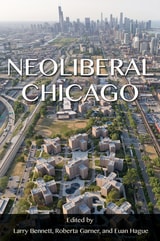
Neoliberal Chicago
Edited by Larry Bennett, Roberta Garner, and Euan Hague
University of Illinois Press, 2017
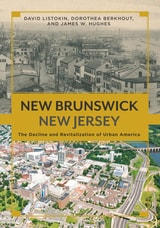
New Brunswick, New Jersey
The Decline and Revitalization of Urban AmericaListokin, David
Rutgers University Press, 2016
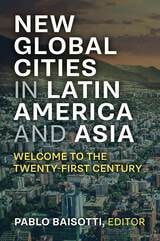
New Global Cities in Latin America and Asia
Welcome to the Twenty-First CenturyPablo Baisotti, Editor
University of Michigan Press, 2022
New Global Cities in Latin America and Asia: Welcome to the Twenty-First Century proposes new visions of global cities and regions historically considered “secondary” in the international context. The arguments are not only based on material progress made by these metropolises, but also on the growing social difficulties experienced (e.g., organized crime, drug trafficking, slums, economic inequalities). The book illustrates the growth of cities according to these problems arising from the modernity of the new century, comparing Latin American and Asian cities.
This book analyzes the complex relationships within cities through an interdisciplinary approach, complementing other research and challenging orthodox views on global cities. At the same time, the book provides new theoretical and methodological tools to understand the progress of “Third World” cities and the way of understanding “globality” in the 21st century by confronting the traditional views with which global cities were appreciated since the 1980s. Pablo Baisotti brings together researchers from various fields who provide new interpretative keys to certain cities in Latin America and Asia.
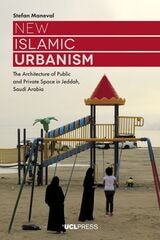
New Islamic Urbanism
The Architecture of Public and Private Space in Jeddah, Saudi ArabiaStefan Maneval
University College London, 2019
Combining Michael Warner’s concepts of publics and counterpublics with theories of space and sociological approaches to architecture, Stefan Maneval explores the concept of New Islamic Urbanism in Saudi Arabia, arguing that this architectural trend, which is characterized by an emphasis on privacy protection through high enclosures, gates, blinds, and tinted windows, constitutes for some an important element of piety. At the same time, it enables different conceptions of privacy, banned social practices, as well as the formation of publics and counterpublics.
Based on rich ethnographic data collected by the author, New Islamic Urbanism challenges normative assumptions on gender segregation in Muslim societies and provides a nuanced account of the meaning of publicness and privacy in Muslim contexts in general. It will be of particular interest to an academic readership in Middle East and Islamic studies, as well as in architecture, urban planning and anthropology.
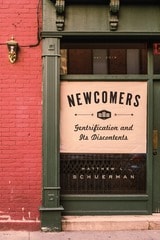
Newcomers
Gentrification and Its DiscontentsMatthew L. Schuerman
University of Chicago Press, 2019
In Newcomers, journalist Matthew L. Schuerman explains how a phenomenon that began with good intentions has turned into one of the most vexing social problems of our time. He builds a national story using focused histories of northwest Brooklyn, San Francisco’s Mission District, and the onetime site of Chicago’s Cabrini-Green housing project, revealing both the commonalities among all three and the place-specific drivers of change. Schuerman argues that gentrification has become a too-easy flashpoint for all kinds of quasi-populist rage and pro-growth boosterism. In Newcomers, he doesn’t condemn gentrifiers as a whole, but rather articulates what it is they actually do, showing not only how community development can turn foul, but also instances when a “better” neighborhood truly results from changes that are good. Schuerman draws no easy conclusions, using his keen reportorial eye to create sharp, but fair, portraits of the people caught up in gentrification, the people who cause it, and its effects on the lives of everyone who calls a city home.
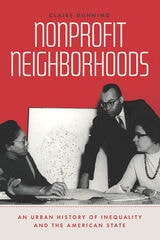
Nonprofit Neighborhoods
An Urban History of Inequality and the American StateClaire Dunning
University of Chicago Press, 2022
Nonprofits serving a range of municipal and cultural needs are now so ubiquitous in US cities, it can be difficult to envision a time when they were more limited in number, size, and influence. Turning back the clock, however, uncovers both an illuminating story of how the nonprofit sector became such a dominant force in American society, as well as a troubling one of why this growth occurred alongside persistent poverty and widening inequality. Claire Dunning’s book connects these two stories in histories of race, democracy, and capitalism, revealing how the federal government funded and deputized nonprofits to help individuals in need, and in so doing avoided addressing the structural inequities that necessitated such action in the first place.
Nonprofit Neighborhoods begins after World War II, when suburbanization, segregation, and deindustrialization inaugurated an era of urban policymaking that applied private solutions to public problems. Dunning introduces readers to the activists, corporate executives, and politicians who advocated addressing poverty and racial exclusion through local organizations, while also raising provocative questions about the politics and possibilities of social change. The lessons of Nonprofit Neighborhoods exceed the bounds of Boston, where the story unfolds, providing a timely history of the shift from urban crisis to urban renaissance for anyone concerned about American inequality—past, present, or future.
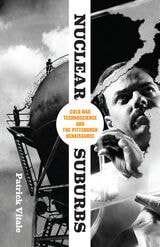
Nuclear Suburbs
Cold War Technoscience and the Pittsburgh RenaissancePatrick Vitale
University of Minnesota Press, 2021
From submarines to the suburbs—the remaking of Pittsburgh during the Cold War
During the early Cold War, research facilities became ubiquitous features of suburbs across the United States. Pittsburgh’s eastern and southern suburbs hosted a constellation of such facilities that became the world’s leading center for the development of nuclear reactors for naval vessels and power plants. The segregated communities that surrounded these laboratories housed one of the largest concentrations of nuclear engineers and scientists on earth. In Nuclear Suburbs, Patrick Vitale uncovers how the suburbs shaped the everyday lives of these technology workers.
Using oral histories, Vitale follows nuclear engineers and scientists throughout and beyond the Pittsburgh region to understand how the politics of technoscience and the Cold War were embedded in daily life. At the same time that research facilities moved to Pittsburgh’s suburbs, a coalition of business and political elites began an aggressive effort, called the Pittsburgh Renaissance, to renew the region. For Pittsburgh’s elite, laboratories and researchers became important symbols of the new Pittsburgh and its postindustrial economy. Nuclear Suburbs exposes how this coalition enrolled technology workers as allies in their remaking of the city.
Offering lessons for the present day, Nuclear Suburbs shows how race, class, gender, and the production of urban and suburban space are fundamental to technoscientific networks, and explains how the “renewal” of industrial regions into centers of the tech economy is rooted in violence and injustice.