Results by title
104 books match the query 'Colombia' and 2 start with n
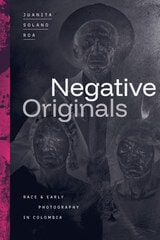
Negative Originals
Race and Early Photography in ColombiaJuanita Solano Roa
Duke University Press, 2025
In Negative Originals, Juanita Solano Roa explores race and identity through photographic practices in late nineteenth-century Medellín, Colombia. Focusing on the photographic studios of Fotografía Rodríguez and Benjamín de la Calle, Solano Roa examines the visual construction and dissemination of racial ideologies and the linkage of race to progress. She studies both positive and negative prints to highlight the juxtaposition of traditional portraiture, which reinforced prevailing racial ideologies, and subversive depictions of often excluded individuals such as cross-dressers, peasants, the poor, and Afro-Colombians. In redefining photography’s role, Solano Roa shifts the critic’s eye from traditional positive prints to negatives, exposing the form’s material, symbolic, and spatial significance. In doing so, she simultaneously uncovers new perspectives on the medium and challenges hegemonic histories. Engaging one of Latin America’s most important photographic archives, Solano Roa addresses urgent gaps in the history of Colombian and Latin American photography, particularly at the intersection of race, gender, and the construction of whiteness.
[more]

No Limits to Their Sway
Cartagena's Privateers and the Masterless Caribbean in the Age of RevolutionsEdgardo Pérez Morales
Vanderbilt University Press, 2018
Following the 1808 French invasion of the Iberian Peninsula, an unprecedented political crisis threw the Spanish Monarchy into turmoil. On the Caribbean coast of modern-day Colombia, the important port town of Cartagena rejected Spanish authority, finally declaring independence in 1811. With new leadership that included free people of color, Cartagena welcomed merchants, revolutionaries, and adventurers from Venezuela, the Antilles, the United States, and Europe. Most importantly, independent Cartagena opened its doors to privateers of color from the French Caribbean. Hired mercenaries of the sea, privateers defended Cartagena's claim to sovereignty, attacking Spanish ships and seizing Spanish property, especially near Cuba, and establishing vibrant maritime connections with Haiti.
Most of Cartagena's privateers were people of color and descendants of slaves who benefited from the relative freedom and flexibility of life at sea, but also faced kidnapping, enslavement, and brutality. Many came from Haiti and Guadeloupe; some had been directly involved in the Haitian Revolution. While their manpower proved crucial in the early Anti-Spanish struggles, Afro-Caribbean privateers were also perceived as a threat, suspected of holding questionable loyalties, disorderly tendencies, and too strong a commitment to political and social privileges for people of color. Based on handwritten and printed sources in Spanish, English, and French, this book tells the story of Cartagena's multinational and multicultural seafarers, revealing the Trans-Atlantic and maritime dimensions of South American independence.
Most of Cartagena's privateers were people of color and descendants of slaves who benefited from the relative freedom and flexibility of life at sea, but also faced kidnapping, enslavement, and brutality. Many came from Haiti and Guadeloupe; some had been directly involved in the Haitian Revolution. While their manpower proved crucial in the early Anti-Spanish struggles, Afro-Caribbean privateers were also perceived as a threat, suspected of holding questionable loyalties, disorderly tendencies, and too strong a commitment to political and social privileges for people of color. Based on handwritten and printed sources in Spanish, English, and French, this book tells the story of Cartagena's multinational and multicultural seafarers, revealing the Trans-Atlantic and maritime dimensions of South American independence.
[more]