355 books match the query 'Communism, Post-Communism & Socialism' and 5 start with n
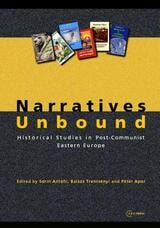
cover of Narratives Unbound: Historical studies in post-communist Eastern Europe

Narratives Unbound

Historical studies in post-communist Eastern Europe

Péter Apor

Central European University Press, 2007
The first work that covers the post-Communist development of historical studies in six Eastern European countries: Bulgaria, Czech Republic, Hungary, Poland, Romania, and Slovakia. A uniquely critical and qualitative analysis from a comparative and critical perspective, written by scholars from the region itself. Focusing on the first post-Communist decade, 1989–1999, the book offers a longer-term perspective that includes the immediate 'prehistory' of that momentous decade as well as its 'posthistoire'. The authors capture the spirit of 1989, that heady mix of elation, surprise, determination, and hope: l'ivresse du possible. This was the paradoxical beginning of Eastern European post-Communism: ushered in by 'anti-Utopian' revolutions, and slowly finding its course towards a bureaucratic, imitative, challenging, and anachronistic restoration of a capitalism that had changed almost beyond recognition when it had mutated into the negative double of Communism. Each individual chapter has numerous and detailed notes and references.
[more]
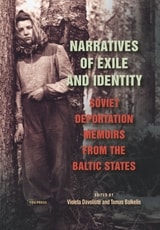
cover of Narratives of Exile and Identity: Soviet Deportation Memoirs from the Baltic States

Narratives of Exile and Identity

Soviet Deportation Memoirs from the Baltic States

Tomas Balkelis

Central European University Press, 2018
In an innovative effort to situate Baltic testimonies to the Gulag in the broader international context of research on displacement and memory, scholars from the Baltic States, Western Europe, Canada, and the United States seek answers to the following questions: Do different groups of deportees experience deportation differently? How do the accounts of women, children and men differ in their representation? Do various ethnic groups remember the past differently: how do they use historical and cultural paradigms to structure their experience in unique ways? The scholars researched the archives, read testimonies, interviewed former deportees, and examined artifacts of memory produced since the late 1980s, applying crossdisciplinary approaches used at the study of the Holocaust testimonies; the testimonies of women have received a particular emphasis. The essays in the book also examine the issues of transmittance, commemoration and public uses of the memory of deportations in contemporary social, cultural and political contexts of Baltic societies, including the reflection of Gulag legacy in literature, the cinema and museums.
[more]
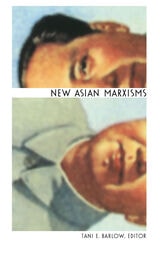
cover of New Asian Marxisms

New Asian Marxisms

Tani E. Barlow, ed.

Duke University Press, 2002

Displaying the particular vitality of the global traditions of Marxism and neomarxism at the beginning of the twenty-first century, New AsianMarxisms collects essays by a diverse group of scholars—historians, political scientists, literary scholars, and sociologists—who offer a range of studies of the Marxist heritage focusing on Korea, Japan, India, and China.

While some of these essays take up key thinkers in Marxist history or draw attention to outstanding problematics, others focus on national literature and discourse in North and South Korea, the "Mao Zedong Fever" of the 1990s, the implications of Li Dazhao's poetry, and the Indian Naxalite movement.  Illustrating the importance of central analytical categories like exploitation, alienation, and violence to studies on the politics of knowledge, contributors confront prevailing global consumerist fantasies
with accounts of political struggle, cultural displacement, and theoretical strategies.

Contributors. Tani E. Barlow, Dai Jinhua, Michael Dutton, D. R. Howland, Marshall Johnson, Liu Kang, You-me Park, William Pietz, Claudia Pozzana, Alessandro Russo, Sanjay Seth, Gi-Wook Shin, Sugiyama Mitsunobu, Jing Wang
[more]
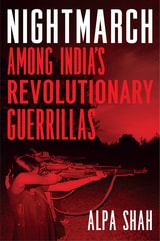
cover of Nightmarch: Among India’s Revolutionary Guerrillas

Nightmarch

Among India’s Revolutionary Guerrillas

Alpa Shah

University of Chicago Press, 2019

Winner of the 2020 Association for Political and Legal Anthropology Book Prize

Shortlisted for the Orwell Prize


Shortlisted for the New India Foundation Book Prize
 
Anthropologist Alpa Shah found herself in an active platoon of Naxalites—one of the longest-running guerrilla insurgencies in the world. The only woman, and the only person without a weapon, she walked alongside the militants for seven nights across 150 miles of dense, hilly forests in eastern India. Nightmarch is the riveting story of Shah's journey, grounded in her years of living with India’s tribal people, an eye-opening exploration of the movement’s history and future and a powerful contemplation of how disadvantaged people fight back against unjust systems in today’s world.
 
The Naxalites have fought for a communist society for the past fifty years, caught in a conflict that has so far claimed at least forty thousand lives. Yet surprisingly little is known about these fighters in the West. Framed by the Indian state as a deadly terrorist group, the movement is actually made up of Marxist ideologues and lower-caste and tribal combatants, all of whom seek to overthrow a system that has abused them for decades. In Nightmarch, Shah shares some of their gritty untold stories: here we meet a high-caste leader who spent almost thirty years underground, a young Adivasi foot soldier, and an Adivasi youth who defected. Speaking with them and living for years with villagers in guerrilla strongholds, Shah has sought to understand why some of India’s poor have shunned the world’s largest democracy and taken up arms to fight for a fairer society—and asks whether they might be undermining their own aims.
 
By shining a light on this largely ignored corner of the world, Shah raises important questions about the uncaring advance of capitalism and offers a compelling reflection on dispossession and conflict at the heart of contemporary India.
[more]
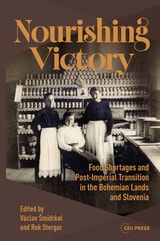
cover of Nourishing Victory: Food Shortages and Post-Imperial Transition in the Bohemian Lands and Slovenia

Nourishing Victory

Food Shortages and Post-Imperial Transition in the Bohemian Lands and Slovenia

Rok Stergar

Central European University Press, 2026

The aggravating food shortage was the central internal crisis in Habsburg Austria during the First World War and posed a major challenge to the consolidation of the successor states. Nourishing Victory offers a fresh comparative perspective on food and the collapse and rebuilding of political legitimacy from the regional vantage point of the Bohemian Lands and Slovenia before and after 1918. Zooming in on multiple levels of society, the book explores how politicians, local officials, and grassroots protagonists navigated collapsing supply systems, relied on black markets, and sought to make sense of the chaos around them. Since this was a crisis of international proportions, the book also examines foreign food aid and the contradictions it entailed. At the same time, to emphasize the local dynamics of food supply and political legitimacy, it explores how food became a political weapon in struggles over contested borderlands such as Teschen Silesia and Prekmurje.
[more]