Results by title
1882 books match the query 'Criticism and interpretation' and 46 start with n
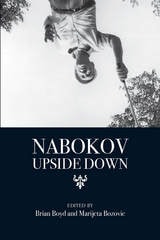
Nabokov Upside Down
Edited by Brian Boyd and Marijeta Bozovic
Northwestern University Press, 2017
Nabokov Upside Down brings together essays that explicitly diverge from conventional topics and points of reference when interpreting a writer whose influence on contemporary literature is unrivaled. Scholars from around the world here read Nabokov in terms of bodies rather than minds, belly-laughs rather than erudite wit, servants rather than master-artists, or Asian rather than Western perspectives. The first part of the volume is dedicated to surveys of Nabokov’s oeuvre that transform some long-held assumptions concerning the nature of and significance of his work.
Often thought of as among the most cerebral of artists, Nabokov comes across in these essays as profoundly aware of the physical world, as evidenced by his masterly representation of physical movement, his bawdy humor, and his attention to gustatory pleasure, among other aspects of his writing. The volume’s second half focuses on individual works or phases in Nabokov’s career, noting connections among them as well as to other fields of inquiry beyond literature. Engaged in conversation with each other and, in his editorial comments, with Brian Boyd, the essays in this volume show Nabokov scholarship continuing to renew itself.
Nabokov and Indeterminacy
The Case of The Real Life of Sebastian KnightPriscilla Meyer
Northwestern University Press, 2018
In Nabokov and Indeterminacy, Priscilla Meyer shows how Vladimir Nabokov’s early novel The Real Life of Sebastian Knight illuminates his later work. Meyer first focuses on Sebastian Knight, exploring how Nabokov associates his characters with systems of subtextual references to Russian, British, and American literary and philosophical works. She then turns to Lolita and Pale Fire, applying these insights to show that these later novels clearly differentiate the characters through subtextual references, and that Sebastian Knight’s construction models that of Pale Fire.
Meyer argues that the dialogue Nabokov constructs among subtexts explores his central concern: the continued existence of the spirit beyond bodily death. She suggests that because Nabokov’s art was a quest for an unattainable knowledge of the otherworldly, knowledge which can never be conclusive, Nabokov’s novels are never closed in plot, theme, or resolution—they take as their hidden theme the unfinalizability that Bakhtin says characterizes all novels.
The conclusions of Nabokov's novels demand a rereading, and each rereading yields a different novel. The reader can never get back to the same beginning, never attain a conclusion, and instead becomes an adept of Nabokov’s quest. Meyer emphasizes that, unlike much postmodern fiction, the contradictions created by Nabokov’s multiple paths do not imply that existence is constructed arbitrarily of pre-existing fragments, but rather that these fragments lead to an ever-deepening approach to the unknowable.
Nabokov's Canon
From "Onegin" to "Ada"Marijeta Bozovic
Northwestern University Press, 2016
Nabokov's Fifth Arc
Nabokov and Others on His Life's WorkEdited by J. E. Rivers and Charles Nicol
University of Texas Press, 1982
In his autobiography Speak, Memory, Vladimir Nabokov compared his life to a spiral, in which “twirl follows twirl, and every synthesis is the thesis of the next series.” The first four arcs of the spiral of Nabokov’s life—his youth in Russia, voluntary exile in Europe, two decades spent in the United States, and the final years of his life in Switzerland—are now followed by a fifth arc, his continuing life in literary history, which this volume both explores and symbolizes.
This is the first collection of essays to examine all five arcs of Nabokov’s creative life through close analyses of representative works. The essays cast new light on works both famous and neglected and place these works against the backgrounds of Nabokov’s career as a whole and modern literature in general. Nabokov analyzes his own artistry in his “Postscript to the Russian Edition of Lolita,” presented here in its first English translation, and in his little-known “Notes to Ada by Vivian Darkbloom,” published now for the first time in America and keyed to the standard U.S. editions of the novel. In addition to a defense of his father’s work by Dmitri Nabokov and a portrait-interview by Alfred Appel, Jr., the volume presents a vast spectrum of critical analyses covering all Nabokov’s major novels and several important short stories. The highly original structure of the book and the fresh and often startling revelations of the essays dramatize as never before the unity and richness of Nabokov’s unique literary achievement.
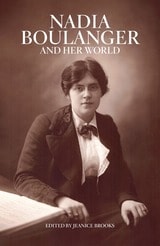
Nadia Boulanger and Her World
Edited by Jeanice Brooks
University of Chicago Press, 2020
Composer, performer, conductor, impresario, and charismatic and inspirational teacher, Boulanger engaged in a vast array of activities in a variety of media, from private composition lessons and lecture-recitals to radio broadcasts, recordings, and public performances. But how to define and account for Boulanger’s impact on the music world is still unclear. Nadia Boulanger and Her World takes us from a time in the late nineteenth century, when many careers in music were almost entirely closed to women, to the moment in the late twentieth century when those careers were becoming a reality. Contributors consider Boulanger’s work in the worlds of composition, musical analysis, and pedagogy and explore the geographies of transatlantic and international exchange and disruption within which her career unfolded. Ultimately, this volume takes its title as a topic for exploration—asking what worlds Boulanger belonged to, and in what sense we can consider any of them to be “hers.”
Nakagami, Japan
Buraku and the Writing of EthnicityAnne McKnight
University of Minnesota Press, 2010
In Nakagami, Japan, Anne McKnight shows how the writer’s exploration of buraku led to a unique blend of fiction and ethnography—which amounted to nothing less than a reimagining of modern Japanese literature. McKnight develops a parallax view of Nakagami’s achievement, allowing us to see him much as he saw himself, as a writer whose accomplishments traversed both buraku literary arts and high literary culture in Japan.
As she considers the ways in which Nakagami and other twentieth-century writers used ethnography to shape Japanese literature, McKnight reveals how ideas about language also imagined a transfigured relation to mainstream culture and politics. Her analysis of the resulting “rhetorical activism” lays bare Nakagami’s unique blending of literature and ethnography within the context of twentieth-century ideas about race, ethnicity, and citizenship—in Japan, but also on an international scale.
Narrating Trauma
Victorian Novels and Modern Stress DisordersGretchen Braun
The Ohio State University Press, 2022
Narratives Unsettled
Digression in Robert Walser, Thomas Bernhard, and Adalbert StifterSamuel Frederick
Northwestern University Press, 2012
Frederick's readings of the narrative experiments, utopian moments, and obsessions with the trivial in works by Walser, Bernhard, and Stifter point to new ways of approaching the ostensibly antinarrative as a productive element of narrativity. As a work that explores the often neglected crossroads of German studies and postclassical narratology, Narratives Unsettled will be of great interest to scholars in both of these fields, as well as to those working on literature and theory in general.
Narratives, Nerdfighters, and New Media
Jennifer Burek Pierce
University of Iowa Press, 2020
For decades, we’ve been warned that video killed the radio star, and, more recently, that social media has replaced reading. Nerdfighteria, a first-of-its-kind online literary community with nearly three million members, challenges these assumptions. It is the brainchild of brothers Hank and John Green, who provide literary themed programming on their website and YouTube channel, including video clips from John, a best-selling author most famous for his young adult book, The Fault in Our Stars. These clips not only give fans personal insights into his works and the writing process writ large, they also provide unique access to the author, inspiring fans to create their own fan art and make connections with one another.
In the twenty-first century, reading and watching videos are related activities that allow people to engage with authors and other readers. Whether they turn to The Fault in Our Stars or titles by lesser-known authors, Nerdfighters are readers. Incorporating thousands of testimonials about what they read and why, Jennifer Burek Pierce not only sheds light on this particular online community, she also reveals what it tells us about the changing nature of reading in the digital age. In Nerdfighteria, we find a community who shows us that being online doesn’t mean disinterest in books.
Nathaniel Mackey, Destination Out
Essays on His WorkJeanne Heuving
University of Iowa Press, 2021
This collection is organized through broad topics in order to provide entrances into his challenging work: myth, literature, and seriality; music, performance, and collaboration; syncretism, synopsis, and what-saying. It engages Mackey’s spiritual and esoteric disposition along with his attention to what Amiri Baraka called the “enraged sociologies” of Black music. In his manifesto “Destination Out,” Mackey describes his work as “wanting to bid all givens goodbye” and as “centrifugal.” It is also centripetal, manifesting a reflexive interiority that creates itself through recurring forms.
Contributors: Maria Damon, Joseph Donahue, Rachel Blau DuPlessis, Norman Finkelstein, Luke Harley, Paul Jaussen, Adalaide Morris, Fred Moten, Peter O’Leary, Anthony Reed
Nationalism, Colonialism, and Literature
Terry Eagleton
University of Minnesota Press, 1990
The three essays constituting this volume were originally published as individual pamphlets by the Field Day Theatre Company, in Derry, Northern Ireland. Each deals with the question of nationalism and the role of cultural production as a force in understanding and analyzing the aftermath of colonization. The authors’ diverse perspectives are demonstrated by the essays’ respective titles: Eagleton, Nationalism: Irony and Commitment; Jameson, Modernism and Imperialism; and Said, Yeats and Decolonization. The essays have implication beyond their immediate topics, bearing upon questions of feminism, decolonization, and modernism to illuminate problems that belong to other groups and regions.
Native Intelligence
Aesthetics, Politics, and Postcolonial LiteratureDeepika Bahri
University of Minnesota Press, 2003
A compelling reclamation of the place of aesthetics in postcolonial literature
Literature though it may be, postcolonial literature is studied and understood largely—and often solely—in social and political terms. In neglecting its aesthetic dimension, as this book forcefully demonstrates, we are overlooking not only an essential aspect of this literature but even a critical perspective on its sociopolitical function and value. In Native Intelligence, Deepika Bahri focuses on postcolonial literature’s formal and aesthetic negotiations with sociopolitical concerns.
How, Bahri asks, do aesthetic considerations contest the social function of postcolonial literature? In answering, her book takes on two tasks: First, it identifies the burden of representation borne by postcolonial literature through its progressive politicization. Second, it draws on Frankfurt School critical theory to reclaim a place for aesthetics in literary representation by closely engaging works of Rohinton Mistry, Salman Rushdie, and Arundhati Roy. Throughout, Bahri shows how attention to the aesthetic innovations and utopian impulses of postcolonial works uncovers their complex and uneven relationship to ideology, reanimating their potential to make novel contributions to the larger project of social liberation.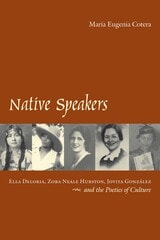
Native Speakers
Ella Deloria, Zora Neale Hurston, Jovita Gonzalez, and the Poetics of CultureBy María Eugenia Cotera
University of Texas Press, 2008
Gloria Anzaldua Book Prize, National Women's Studies Association, 2009
In the early twentieth century, three women of color helped shape a new world of ethnographic discovery. Ella Cara Deloria, a Sioux woman from South Dakota, Zora Neale Hurston, an African American woman from Florida, and Jovita González, a Mexican American woman from the Texas borderlands, achieved renown in the fields of folklore studies, anthropology, and ethnolinguistics during the 1920s and 1930s. While all three collaborated with leading male intellectuals in these disciplines to produce innovative ethnographic accounts of their own communities, they also turned away from ethnographic meaning making at key points in their careers and explored the realm of storytelling through vivid mixed-genre novels centered on the lives of women.
In this book, Cotera offers an intellectual history situated in the "borderlands" between conventional accounts of anthropology, women's history, and African American, Mexican American and Native American intellectual genealogies. At its core is also a meditation on what it means to draw three women—from disparate though nevertheless interconnected histories of marginalization—into conversation with one another. Can such a conversation reveal a shared history that has been erased due to institutional racism, sexism, and simple neglect? Is there a mode of comparative reading that can explore their points of connection even as it remains attentive to their differences? These are the questions at the core of this book, which offers not only a corrective history centered on the lives of women of color intellectuals, but also a methodology for comparative analysis shaped by their visions of the world.

Navigating the African Diaspora
The Anthropology of InvisibilityDonald Martin Carter
University of Minnesota Press, 2010
Ne me quitte pas
A Song by Jacques Brel and Interpreted by Nina Simone and OthersMaya Angela Smith
Duke University Press, 2025
Negative, Nonsensical, and Non-Conformist
The Films of Suzuki SeijunPeter A. Yacavone
University of Michigan Press, 2023
Neil Jordan
Maria T. Pramaggiore
University of Illinois Press, 2007
Despite the striking diversity of Jordan's films, the director consistently returns to gothic themes of loss, violence, and madness. In her sophisticated examination of Mona Lisa,Michael Collins, and The Good Thief, Pramaggiore shows how Jordan presents these dark narratives with a uniquely Irish and postmodern sense of irony. This illuminating analysis of one of the cinema's most important artists will be of keen interest to movie enthusiasts as well as students and scholars of contemporary film.
Neither God nor Master
Robert Bresson and Radical PoliticsBrian Price
University of Minnesota Press, 2010
Situating Bresson in radical and aesthetic political contexts, from surrealism to situationism, Neither God nor Master shows how his early style was a model for social resistance. We then see how, after May 1968, his films were in fact a series of reflections on the failure of revolution in France—especially as “failure” is understood in relation to Bresson’s chosen literary precursors, Dostoyevsky and Tolstoy, and Russian revolutionary culture of the nineteenth century.
Restoring Bresson to the radical political culture from which he emerged—and to which he remained faithful—Price offers a major revision of the reputation of one of the most celebrated figures in the history of French film. In doing so, he raises larger philosophical questions about the efficacy of revolutionary practices and questions about interpretation and metaphysical tendencies of film historical research that have, until now, gone largely untested.
Never Say I
Sexuality and the First Person in Colette, Gide, and ProustMichael Lucey
Duke University Press, 2006
Considering novels along with journalism, theatrical performances, correspondences, and face-to-face encounters, Lucey focuses on the interlocking social and formal dimensions of using the first person. He argues for understanding the first person not just as a grammatical category but also as a collectively produced social artifact, demonstrating that Proust’s, Gide’s, and Colette’s use of the first person involved a social process of assuming the authority to speak about certain issues, or on behalf of certain people. Lucey reveals these three writers as both practitioners and theorists of the first person; he traces how, when they figured themselves or other first persons in certain statements regarding same-sex identity, they self-consciously called attention to the creative effort involved in doing so.
New Critical Approaches to the Short Stories of Ernest Hemingway
Jackson J. Benson, ed.
Duke University Press, 1990
New Critical Approaches to the Short Stories of Ernest Hemingway is an all-new sequel to Benson’s highly acclaimed 1975 book, which provided the first comprehensive anthology of criticism of Ernest Hemingway’s masterful short stories. Since that time the availability of Hemingway’s papers, coupled with new critical and theoretical approaches, has enlivened and enlarged the field of American literary studies. This companion volume reflects current scholarship and draws together essays that were either published during the past decade or written for this collection.
The contributors interpret a variety of individual stories from a number of different critical points of view—from a Lacanian reading of Hemingway’s “After the Storm” to a semiotic analysis of “A Very Short Story” to an historical-biographical analysis of “Old Man at the Bridge.” In identifying the short story as one of Hemingway’s principal thematic and technical tools, this volume reaffirms a focus on the short story as Hemingway’s best work. An overview essay covers Hemingway criticism published since the last volume, and the bibliographical checklist to Hemingway short fiction criticism, which covers 1975 to mid-1989, has doubled in size.
Contributors. Debra A. Moddelmog, Ben Stotzfus, Robert Scholes, Hubert Zapf, Susan F. Beegel, Nina Baym, William Braasch Watson, Kenneth Lynn, Gerry Brenner, Steven K. Hoffman, E. R. Hagemann, Robert W. Lewis, Wayne Kvam, George Monteiro, Scott Donaldson, Bernard Oldsey, Warren Bennett, Kenneth G. Johnston, Richard McCann, Robert P. Weeks, Amberys R. Whittle, Pamela Smiley, Jeffrey Meyers, Robert E. Fleming, David R. Johnson, Howard L. Hannum, Larry Edgerton, William Adair, Alice Hall Petry, Lawrence H. Martin Jr., Paul Smith
New Essays on Clint Eastwood
Leonard Engel
University of Utah Press, 2012
A common thread throughout the volume is the respect for Eastwood’s commitment to cinematic storytelling. Indi-vidually and collectively, the essays highlight the variety and complexity of Eastwood’s themes and his accomplish-ments throughout a lifetime of endeavors. Examining his Westerns and detective films illustrates how Eastwood left his iconic stamp on those genres, while discussion of his more recent films expounds on his use of family, history, and myth to transcend generic conventions and to project a hard-won vision of a united humanity beyond the separation of ethnic, racial, and national conflicts. Cumulatively, the essays remind us of his lifelong devotion to perfecting his artistry and his powers as a storyteller.
New World Maker
Radical Poetics, Black Internationalism, and the Translations of Langston HughesRyan James Kernan, foreword by Robin D. G. Kelley
Northwestern University Press, 2022
Through original research and close readings alert to the foreign prosody underlying Hughes’s work, New World Maker recuperates his political writing, which had been widely maligned by Cold War detractors and adherents of New Criticism, and affirms his place as a progenitor of African diasporic literature and within the pantheon of US modernists. Demonstrating the integral part translation played in Hughes’s creative process, this book challenges a number of common assumptions about this canonical thinker and offers important insights for scholars of African diasporic literature, comparative literature, and American, Caribbean, and translation studies.
New York-Paris
Whitman, Baudelaire, and the Hybrid CityLaure Katsaros
University of Michigan Press, 2012
As New York and Paris began to modernize, new modes of entertainment, such as panoramas, dioramas, and photography, seemed poised to take the place of the more complex forms of literary expression. Dioramas and photography were invented in Paris but soon spread to America, forming part of an increasingly universal idiom of the spectacle. This brave new world of technologically advanced but crudely mimetic spectacles haunts both Whitman's vision of New York and Baudelaire's view of Paris. In New York-Paris, Katsaros explores the images of the mid-nineteenth-century city in the poetry of both Whitman and Baudelaire and seeks to demonstrate that, by projecting an image of the other's city onto his own, each poet tried to resist the apparently irresistible forward momentum of modernity rather than create a paradigmatically happy mixture of "high" and "low" culture.
Next to the Color Line
Gender, Sexuality, and W. E. B. Du BoisSusan Gillman
University of Minnesota Press, 2007
Nicholas of Cusa's <i>On Learned Ignorance</i>
A Commentary on <i>De docta ignorantia</i>Karsten Harries
Catholic University of America Press, 2024
Nietzsche and Dostoevsky
Philosophy, Morality, TragedyEdited by Jeff Love and Jeffrey Metzger
Northwestern University Press, 2016
Nietzsche and Music
Georges Liébert
University of Chicago Press, 2003
In his youth, Friedrich Nietzsche yearned to become a great composer and wrote many pieces of music. He later claimed to be "the most musical of all philosophers." Yet most books on Nietzsche fail to explore the importance of music for his thought.
Nietzsche and Music provides the first in-depth examination of the fundamental significance of music for Nietzsche's life and work. Nietzsche's views on music are essential for understanding his philosophy as a whole. Part biography and part critical examination, Georges Liébert brilliantly demonstrates that despite failed attempts at a professional career as composer, Nietzsche never fully removed himself from the world of music, but instead, became a composer of philosophy, utilizing the musical form as a template for his own writings and creative thought. Liébert's study surveys Nietzsche's opinions about particular composers and compositions, as well as his more theoretical writings on music and its relation to the other arts. He also explores Nietzsche's listening habits, his playing and style of composition, and his many contacts in the musical world, including his controversial and contentious relationship with Richard Wagner. For Nietzsche, music gave access to a realm of wisdom that transcended thought. Music was Nietzsche's great solace; in his last years, it was his refuge from madness.
A virtuoso exploration of this little-known but crucial aspect of Nietzsche's life and work, this volume will be of enormous value to scholars of philosophy, music, aesthetics, and literature.
Nietzsche's Legacy
"Ecce Homo" and "The Antichrist," Two Books on Nature and PoliticsHeinrich Meier
University of Chicago Press, 2024
A reappraisal of Ecce Homo and The Antichrist within Nietzsche’s oeuvre.
Nietzsche's Legacy takes on the most challenging and misunderstood works in Nietzsche’s oeuvre to illuminate his view of what a philosopher is and what constitutes a philosophic life. Interpreting Ecce Homo and The Antichrist as twin books meant to replace the abandoned Will to Power project, Heinrich Meier recovers them from the stigma of Nietzsche’s late mental collapse, showing that these works are, above all, a lucid self-assessment. The carefully written pair contains both the highest affirmation—the Yes of the “revaluation of all values”—and the most resolute negation—the No to Christianity. How the Yes and the No go together, how the relation between nature and politics is to be determined, how Nietzsche’s intention is governing the political-philosophical double-face: this is the subject of Nietzsche’s Legacy, which opens up a new understanding of Nietzsche’s philosophy as a whole.
Nietzsche's Posthumanism
Edgar Landgraf
University of Minnesota Press, 2023
A timely and trenchant commentary on the centrality of Nietzsche’s thought for our time
While many posthumanists claim Nietzsche as one of their own, rarely do they engage his philosophy in any real depth. Nietzsche’s Posthumanism addresses this need by exploring the continuities and disagreements between Nietzsche’s philosophy and contemporary posthumanism. Focusing specifically on Nietzsche’s reception of the life sciences of his day and his reflections on technology—research areas as central to Nietzsche’s work as they are to posthumanism—Edgar Landgraf provides fresh readings of Nietzsche and a critique of post- and transhumanist philosophies.
Through Landgraf’s inquiry, lesser-known aspects of Nietzsche’s writings emerge, including the neurophysiological basis of his epistemology (which anticipates contemporary debates on embodiment), his concerns with insects and the emergent social properties they exhibit, and his reflections on the hominization and cultivation effects of technology. In the process, Landgraf challenges major commonplaces about Nietzsche’s philosophy, including the idea that his social theory asserts the rights of “the strong” over “the weak.” The ethos of critical posthumanism also offers a new perspective on key ethical and political contentions of Nietzsche’s writings.
Nietzsche’s Posthumanism presents a uniquely framed introduction to tenets of Nietzsche’s thought and major trends in posthumanism, making it an essential exploration for anyone invested in Nietzsche and his contemporary relevance, and in posthumanism and its genealogy.
Retail e-book files for this title are screen-reader friendly.
Nietzsche, Psychology, and First Philosophy
Robert B. Pippin
University of Chicago Press, 2010
Friedrich Nietzsche is one of the most elusive thinkers in the philosophical tradition. His highly unusual style and insistence on what remains hidden or unsaid in his writing make pinning him to a particular position tricky. Nonetheless, certain readings of his work have become standard and influential. In this major new interpretation of Nietzsche’s work, Robert B. Pippin challenges various traditional views of Nietzsche, taking him at his word when he says that his writing can best be understood as a kind of psychology.
Pippin traces this idea of Nietzsche as a psychologist to his admiration for the French moralists: La Rochefoucauld, Pascal, Stendhal, and especially Montaigne. In distinction from philosophers, Pippin shows, these writers avoided grand metaphysical theories in favor of reflections on life as lived and experienced. Aligning himself with this project, Nietzsche sought to make psychology “the queen of the sciences” and the “path to the fundamental problems.” Pippin contends that Nietzsche’s singular prose was an essential part of this goal, and so he organizes the book around four of Nietzsche’s most important images and metaphors: that truth could be a woman, that a science could be gay, that God could have died, and that an agent is as much one with his act as lightning is with its flash.
Expanded from a series of lectures Pippin delivered at the Collège de France, Nietzsche, Psychology, and First Philosophy offers a brilliant, novel, and accessible reading of this seminal thinker.
Nikolai Evreinov & Others
»The Storming of the Winter Palace«Edited by Inke Arns, Sylvia Sasse, and Igor Chubarov
Diaphanes, 2017
Nikolaj Evreinov: “The Storming of the Winter Palace” tells the fascinating story of this production. Taking readers through the relevant history, the authors describe the role of The Storming of the Winter Palace in commemorating Soviet power. With a wealth of illustrations, they also show how photographs of Evreinov’s theatrical storming eventually became historical documents of the October Revolution themselves.
Nikolai Klyuev
Time and Text, Place and PoetMichael Makin
Northwestern University Press, 2009
Nikolai Klyuev is the first book in English to examine the life and work of this enigmatic poet. Klyuev (1884–1937) rose to prominence in the early twentieth century as the first of the so-called "new peasant poets" but later fell victim to Stalinist hostility to both his cultural ideology and his homosexuality. He was arrested and exiled in 1933, then shot in 1937.
Klyuev’s work incorporates rich elements of folklore, mysticism, politics, and religion, and he sometimes invokes arcane Russian syntax and vocabulary. Makin’s feat is particularly notable because Klyuev was often elusive in his own accounts of his life, and Makin successfully brings into focus the poet’s deliberate strategies of self-mythologization. Nikolai Klyuev is an indispensable guide to the life and the work of an important poet winning wider recognition outside of Russia.
Nimble Believing
Dickinson and the UnknownJames McIntosh
University of Michigan Press, 2004
--Harold Bloom, Genius
" . . . a truly literary study in the largest, most humane, sense. Instead of subjecting poems to the distortions of theory, it brings biography, theology, psychology, and cultural history to bear on the intricacies of language, where all the issues of the poet's life and work converge, contend, and seek resolution."
--Albert Gelpi, American Literature
" . . . insightful readings of many of Dickinson's difficult poems and . . . a significant contribution to Dickinson studies."
---Choice
"McIntosh shows the power of Dickinson's religious quest in word, in verse, and in truth. He shows that she was much more than an ever-adolescent angry rebel trying to subvert the religious oppression of benighted Amherst neighbors."
---Emily Dickinson Journal
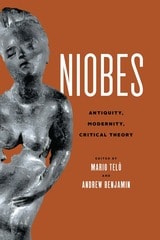
Niobes
Antiquity, Modernity, Critical TheoryEdited by Mario Telò and Andrew Benjamin
The Ohio State University Press, 2024
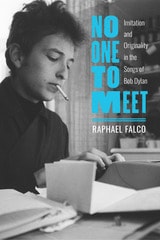
No One to Meet
Imitation and Originality in the Songs of Bob DylanRaphael Falco
University of Alabama Press, 2022
WINNER OF THE ELIZABETH AGEE PRIZE IN AMERICAN LITERATURE
A groundbreaking appreciation of Dylan as a literary practitioner.
The literary establishment tends to regard Bob Dylan as an intriguing, if baffling, outsider. That changed overnight when Dylan was awarded the 2016 Nobel Prize in Literature, challenging us to think of him as an integral part of our national and international literary heritage. No One to Meet: Imitation and Originality in the Songs of Bob Dylan places Dylan the artist within a long tradition of literary production and offers an innovative way to understand his unique and often controversial methods of composition.
Dylan expert Raphael Falco traces the similarities between the way Dylan borrows, digests, and transforms traditional songs and what Renaissance writers called imitatio. Although Dylan’s lyrical postures may suggest an avant-garde consciousness, No One to Meet shows that Dylan’s creative process creatively expands methods used by classical and Renaissance authors.
Drawing on numerous examples, including Dylan’s previously unseen manuscript excerpts and archival materials, Raphael Falco illuminates how the ancient process of poetic imitation, handed down from Greco-Roman antiquity, allows us to make sense of Dylan’s musical and lyrical technique. By placing Dylan firmly in the context of an age-old poetic practice, No One to Meet deepens our appreciation of Dylan’s songs and allows us to celebrate him as what he truly is: a great writer.
No One's Witness
A Monstrous PoeticsSyd Zolf
Duke University Press, 2021
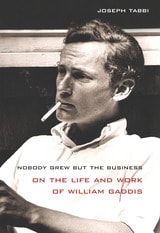
Nobody Grew but the Business
On the Life and Work of William GaddisJoseph Tabbi
Northwestern University Press, 2015
Finalist, 2016 Society for Midland Authors Award for Biography & Memoir
During his lifetime, William Gaddis (1922–1998) evaded biographical questions, never read from his work publicly, and didn’t allow his photograph to appear on his books. Before his novel J R (1975) won Gaddis the National Book Award and some measure of renown, he had given up the bohemian world of 1950s Greenwich Village for a series of corporate jobs that both paid the bills and provided an inside view of the encroachment of market values into every corner of American culture.
By illustrating the interconnectedness of Gaddis’s life and work, Tabbi, among his foremost interpreters, demystifies the “difficult author” and shows a writer who was as attuned as any to the way Americans talk, and who sensitively chronicled the gradual commodification of artistic endeavor. Illuminating, heartbreaking, and masterful, Tabbi’s book gives us the most subtly drawn portrait to date of one of the twentieth century’s seminal novelists.
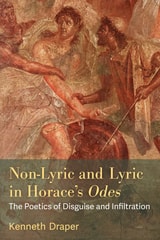
Non-Lyric and Lyric in Horace's Odes
The Poetics of Disguise and InfiltrationKenneth Draper
University of Michigan Press, 2026
Kenneth Draper’s new volume investigates genre, gender, and self-presentation in Horace’s first collection of Odes. It examines how Horace uses non-lyric genres—elegy, epic, invective, and philosophical discourse—to define his lyric project, responding to the rhetorical challenge of writing in the wake of civil war. It shows how Horace employs a “poetics of disguise and infiltration” in his engagement with these other genres. At times, he assimilates his lyric persona to an elegiac one, claiming to share elegy’s effeminacy and disinterest in politics. Similarly, he draws on philosophical discourse to present himself as too modest for heavy political themes. In both cases, he turns to clothing metaphors to identify the slight persona as a disguise that he may assume or discard as needed. Through this disingenuous self-presentation, he disavows interest in the masculine modes of epic and invective. Read as reflections on Horace’s own infiltration of epic territory, the examined scenes give clues about his motivations: focusing on the characters’ self-preservation amid dangers, he reminds readers of the risks and audacity of his project.
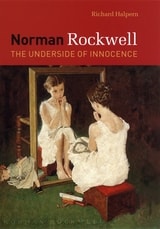
Norman Rockwell
The Underside of InnocenceRichard Halpern
University of Chicago Press, 2006
Norman Rockwell’s scenes of everyday small-town life are among the most indelible images in all of twentieth-century art. While opinions of Rockwell vary from uncritical admiration to sneering contempt, those who love him and those who dismiss him do agree on one thing: his art embodies a distinctively American style of innocence.
In this sure-to-be controversial book, Richard Halpern argues that this sense of innocence arises from our reluctance—and also Rockwell’s—to acknowledge the often disturbing dimensions of his works. Rockwell’s paintings frequently teem with perverse acts of voyeurism and desire but contrive to keep these acts invisible—or rather, hidden in plain sight, available for unacknowledged pleasure but easily denied by the viewer.
Rockwell emerges in this book, then, as a deviously brilliant artist, a remorseless diagnostician of the innocence in which we bathe ourselves, and a continuing, unexpected influence on contemporary artists. Far from a banal painter of the ordinary, Halpern argues, Rockwell is someone we have not yet dared to see for the complex creature he is: a wholesome pervert, a knowing innocent, and a kitschy genius.
Provocative but judicious, witty but deeply informed, Norman Rockwell is a book rich in suggestive propositions and eye-opening details—one that will change forever the way we think about this American icon and his works.
Not without Madness
Perspectives on OperaFabrizio Della Seta
University of Chicago Press, 2012
Notes to Make the Sound Come Right
Four Innovators of Jazz PoetryT.J. Anderson III
University of Arkansas Press, 2004
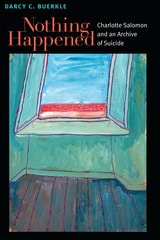
Nothing Happened
Charlotte Salomon and an Archive of SuicideDarcy C. Buerkle
University of Michigan Press, 2013
Charlotte Salomon's (1917-43) fantastical autobiography, Life? or Theater?, consists of 769 sequenced gouache paintings, through which the artist imagined the circumstances of the eight suicides in her family, all but one of them women. But Salomon's focus on suicide was not merely a familial idiosyncrasy. Nothing Happened argues that the social history of early-twentieth-century Germany has elided an important cultural and social phenomenon by not including the story of German Jewish women and suicide. This absence in social history mirrors an even larger gap in the intellectual history of deeply gendered suicide studies that have reproduced the notion of women's suicide as a rarity in history. Nothing Happened is a historiographic intervention that operates in conversation and in tension with contemporary theory about trauma and the reconstruction of emotion in history.
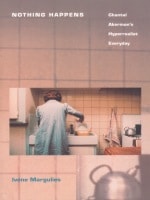
Nothing Happens
Chantal Akerman’s Hyperrealist EverydayIvone Margulies
Duke University Press, 1996
Margulies grounds her critical analysis in detailed discussions of Akerman’s work—from Saute ma ville, a 13-minute black-and-white film made in 1968, through Jeanne Dielman and Je tu il elle to the present. Focusing on the real-time representation of a woman’s everyday experience in Jeanne Dielman, Margulies brings the history of social and progressive realism and the filmmaker’s work into perspective. Pursuing two different but related lines of inquiry, she investigates an interest in the everyday that stretches from postwar neorealist cinema to the feminist rewriting of women’s history in the seventies. She then shows how Akerman’s “corporeal cinema” is informed by both American experiments with performance and duration and the layerings present in works by European modernists Bresson, Rohmer, and Dreyer. This analysis revises the tired opposition between realism and modernism in the cinema, defines Akerman’s minimal-hyperrealist aesthetics in contrast to Godard’s anti-illusionism, and reveals the inadequacies of popular characterizations of Akerman’s films as either simply modernist or feminist.
An essential book for students of Chantal Akerman’s work, Nothing Happens will also interest international film critics and scholars, filmmakers, art historians, and all readers concerned with feminist film theory.

Novalis, Spinoza, and the Limits of Romantic Materialism
Siarhei Biareishyk
Northwestern University Press, 2026
Offering an innovative and illuminating new reading of Spinoza and Novalis
This rigorously researched study reframes our understanding of the intellectual currents in Germany around 1800 through a careful reinterpretation of its key thinker, Novalis, in conversation with Spinoza’s philosophy. Siarhei Biareishyk presents an alternative to the standard narrative that resolutely links emergent modernity and secularization to philosophical “idealism” by showing how Spinozan materialism informs the scientific experiments, metaphysical inquiries, and political debates of Novalis and his contemporaries. Shifting our focus away from the historical interpretation of Novalis as a mystic and theorist of subjectivity, Biareishyk elaborates on the Spinozan materialist strain in Novalis in three key domains: ontology and the conception of nature, theories of singularity and individuation, and the concept of the political. He brings current romanticist scholarship into conversation with contemporary discussions of Spinoza in continental philosophy, in the Marxist tradition particularly, demonstrating that the Spinoza–Novalis encounter provides a viable alternative—in its articulation of causality, dialectics, and the political—to the dominant conceptual apparatuses of both Kant and Hegel.

Novas
Selected WritingsHaroldo de Campos
Northwestern University Press, 2007
A generous introduction to one of the key literary figures to emerge from Brazil in the second half of the twentieth century, this book offers English-speaking readers an ample selection of this prodigious writer's celebrated poetry and widely influential critical work. As a poet and as a cofounder of the renowned group Noigandres, Haroldo de Campos has made a unique and substantial contribution to the theory and practice of experimental writing, particularly the form known as concrete poetry, and to the Latin American avant-garde as a whole. These contributions, acclaimed worldwide by figures such as Umberto Eco, Jacques Derrida, Octavio Paz, and Guillermo Cabrera Infante, can be observed unfolding here, first in poetry selections ranging from de Campos' early work before concretism through his most recent production; then in theoretical texts that trace his evolution as a critic from an early interest in baroque and modernist writers to his development of an innovative model for reading, translating, and writing. This second, critical section of the book includes de Campos' encounters with the tasks of translating and reading some of the most important texts of Eastern and Western culture-from Ecclesiastes to the No play Hagoromo, from Dante to Paz-thus charting a genealogy of modern literature.
Together, these poems and critical writings afford English-speaking readers their first sustained exposure to a unique personality within the international avant-garde, a writer described by Brazilian poet João Cabral de Melo Neto as "that wonderful thing: / a poet and a translator who came to literature armed with an enviable / knowledge of the literary phenomenon."
Novel and Film
Essays in Two GenresBruce Morrissette
University of Chicago Press, 1985
The influential essays collected in Novel and Film display a wide range of critical and analytic approaches to the narrative aspects of the two genres. For all the variety of their subjects, from constructional forms such as interior duplication and game play to intertextual parallels with mathematics and topology, these essays together define a unified critical perspective, one that has brought fresh precision to the analysis of narrative techniques and that continues to raise questions of prime importance to contemporary fiction. Included is a complete bibliography of Morrissette's scholarly works.