158 books match the query 'Cultural assimilation' and 3 start with n
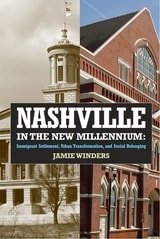
cover of Nashville in the New Millennium: Immigrant Settlement, Urban Transformation, and Social Belonging

Nashville in the New Millennium

Immigrant Settlement, Urban Transformation, and Social Belonging

Jamie Winders

Russell Sage Foundation, 2013
Beginning in the 1990s, the geography of Latino migration to and within the United States started to shift. Immigrants from Central and South America increasingly bypassed the traditional gateway cities to settle in small cities, towns, and rural areas throughout the nation, particularly in the South. One popular new destination—Nashville, Tennessee—saw its Hispanic population increase by over 400 percent between 1990 and 2000. Nashville, like many other such new immigrant destinations, had little to no history of incorporating immigrants into local life. How did Nashville, as a city and society, respond to immigrant settlement? How did Latino immigrants come to understand their place in Nashville in the midst of this remarkable demographic change? In Nashville in the New Millennium, geographer Jamie Winders offers one of the first extended studies of the cultural, racial, and institutional politics of immigrant incorporation in a new urban destination. Moving from schools to neighborhoods to Nashville’s wider civic institutions, Nashville in the New Millennium details how Nashville’s long-term residents and its new immigrants experienced daily life as it transformed into a multicultural city with a new cosmopolitanism. Using an impressive array of methods, including archival work, interviews, and participant observation, Winders offers a fine-grained analysis of the importance of historical context, collective memories and shared social spaces in the process of immigrant incorporation. Lacking a shared memory of immigrant settlement, Nashville’s long-term residents turned to local history to explain and interpret a new Latino presence. A site where Latino day laborers gathered, for example, became a flashpoint in Nashville’s politics of immigration in part because the area had once been a popular gathering place for area teenagers in the 1960s and 1970s. Teachers also drew from local historical memories, particularly the busing era, to make sense of their newly multicultural student body. They struggled, however, to help immigrant students relate to the region’s complicated racial past, especially during history lessons on the Jim Crow era and the Civil Rights movement. When Winders turns to life in Nashville’s neighborhoods, she finds that many Latino immigrants opted to be quiet in public, partly in response to negative stereotypes of Hispanics across Nashville. Long-term residents, however, viewed this silence as evidence of a failure to adapt to local norms of being neighborly. Filled with voices from both long-term residents and Latino immigrants, Nashville in the New Millennium offers an intimate portrait of the changing geography of immigrant settlement in America. It provides a comprehensive picture of Latino migration’s impact on race relations in the country and is an especially valuable contribution to the study of race and ethnicity in the South.
[more]
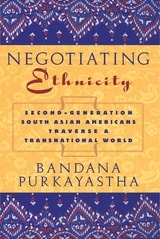
cover of Negotiating Ethnicity: Second-Generation South Asians Traverse a Transnational World

Negotiating Ethnicity

Second-Generation South Asians Traverse a Transnational World

Purkayastha, Bandana

Rutgers University Press, 2005

In the continuing debates on the topic of racial and ethnic identity in the United States, there are some that argue that ethnicity is an ascribed reality. To the contrary, others claim that individuals are becoming increasingly active in choosing and constructing their ethnic identities.Focusing on second-generation South Asian Americans, Bandana Purkayastha offers fresh insights into the subjective experience of race, ethnicity, and social class in an increasingly diverse America. The young people of Indian, Pakistani, Bangladeshi, and Nepalese origin that are the subjects of the study grew up in mostly white middle class suburbs, and their linguistic skills, education, and occupation profiles are indistinguishable from their white peers. By many standards, their lifestyles mark them as members of mainstream American culture. But, as Purkayastha shows, their ethnic experiences are shaped by their racial status as neither “white” nor “wholly Asian,” their continuing ties with family members across the world, and a global consumer industry, which targets them as ethnic consumers.”

Drawing on information gathered from forty-eight in-depth interviews and years of research, this book illustrates how ethnic identity is negotiated by this group through choice—the adoption of ethnic labels, the invention of “traditions,” the consumption of ethnic products, and participation in voluntary societies. The pan-ethnic identities that result demonstrate both a resilient attachment to heritage and a celebration of reinvention.

Lucidly written and enriched with vivid personal accounts, Negotiating Ethnicity is an important contribution to the literature on ethnicity and racialization in contemporary American culture.
[more]
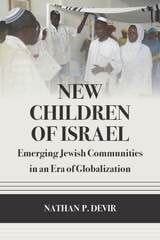
cover of New Children of Israel: Emerging Jewish Communities in an Era of Globalization

New Children of Israel

Emerging Jewish Communities in an Era of Globalization

Nathan P. Devir

University of Utah Press, 2017

In the last century, the tragic events of the Holocaust and the subsequent founding of the state of Israel brought about tremendous changes for Jewish communities all over the world. This book explores what may be the next watershed moment for the Jews: the inclusion of millions of people from developing nations who self-define as Jewish but who have no historical ties with established centers of Jewish life. These emerging groups are expanding notions of what it means to be Jewish.

This comparative ethnographic study, the first of its kind, presents in-depth analyses of the backgrounds, motivations, and sociohistorical contexts of emerging Jewish communities in Cameroon, Ghana, India, and other postcolonial locales. It investigates the ramifications of these new movements for the larger Judeo-Christian world, particularly with regard to issues of multiculturalism, immigration, race relations, and messianic expectations concerning the prophecy of Isaiah 11:12, according to which God will “assemble the dispersed of Israel, and gather together the scattered of Judah from the four corners of the earth.” 
[more]