429 books match the query 'Development' and 7 start with n

cover of NGOs and Transnational Networks: Wild Cards in World Politics

NGOs and Transnational Networks

Wild Cards in World Politics

William E. DeMars

Pluto Press, 2005

[more]
cover of Nature in the Global South: Environmental Projects in South and Southeast Asia

Nature in the Global South

Environmental Projects in South and Southeast Asia

Paul Greenough and Anna Lowenhaupt Tsing, eds.

Duke University Press, 2003

A nuanced look at how nature has been culturally constructed in South and Southeast Asia, Nature in the Global South is a major contribution to understandings of the politics and ideologies of environmentalism and development in a postcolonial epoch. Among the many significant paradigms for understanding both the preservation and use of nature in these regions are biological classification, state forest management, tropical ecology, imperial water control, public health, and community-based conservation. Focusing on these and other ways that nature has been shaped and defined, this pathbreaking collection of essays describes projects of exploitation, administration, science, and community protest.

With contributors based in anthropology, ecology, sociology, history, and environmental and policy studies, Nature in the Global South features some of the most innovative and influential work being done in the social studies of nature. While some of the essays look at how social and natural landscapes are created, maintained, and transformed by scientists, officials, monks, and farmers, others analyze specific campaigns to eradicate smallpox and save forests, waterways, and animal habitats. In case studies centered in the Philippines, India, Pakistan, Thailand, Indonesia, and South and Southeast Asia as a whole, contributors examine how the tropics, the jungle, tribes, and peasants are understood and transformed; how shifts in colonial ideas about the landscape led to extremely deleterious changes in rural well-being; and how uneasy environmental compromises are forged in the present among rural, urban, and global allies.

Contributors:
Warwick Anderson
Amita Baviskar
Peter Brosius
Susan Darlington
Michael R. Dove
Ann Grodzins Gold
Paul Greenough
Roger Jeffery
Nancy Peluso
K. Sivaramakrishnan
Nandini Sundar
Anna Lowenhaupt Tsing
Charles Zerner
[more]
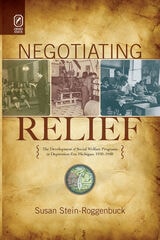
cover of Negotiating Relief: The Development of Social Welfare Programs in Depression-Era Michigan, 1930–1940

Negotiating Relief

The Development of Social Welfare Programs in Depression-Era Michigan, 1930–1940

Susan Stein-Roggenbuck

The Ohio State University Press, 2008

In Negotiating Relief, Susan Stein-Roggenbuck examines Michigan’s implementation of the New Deal relief programs and the state’s reorganization of welfare in 1939. Local officials, social workers, and recipients were key players in the Michigan debates over how best to administer relief. The book sheds important light on the profession of social work and public welfare, and the development of nonfederal relief at the state and local levels after 1935.
 
Guided by fiscal localism and a firm belief in home rule, local officials fought to retain control of relief. Stein-Roggenbuck argues that while significant changes occurred in welfare policy as a result of the New Deal, many continuities remained. Among those was the responsibility of families to provide financial support. Often forgotten were those on general relief—individuals who did not fit the federal programs such as Aid to Dependent Children (ADC) and Old Age Assistance (OAA). General relief became a third track of welfare.

Drawing on newspaper records, county and city board minutes, social welfare agency records, federal records, and case file records, Negotiating Relief gives voice to the numerous groups involved in welfare debates, particularly the recipients of relief. This book adds to our understanding of the local implementation of welfare policy in both rural and urban areas.

 
[more]
cover of New Jersey's Postsuburban Economy

New Jersey's Postsuburban Economy

James W. Hughes and Joseph J. Seneca

Rutgers University Press, 2015

New Jersey has a long history of adapting to a changing economic climate. From its colonial origins to the present day, New Jersey's economy has continuously and successfully confronted the challenges and uncertainties of technological and demographic change, placing the state at the forefront of each national and global economic era. Based on James W. Hughes and Joseph J. Seneca’s nearly three-decade-long Rutgers Regional Report series, New Jersey’s Postsuburban Economy presents the issues confronting the state and brings to the forefront ideas for meeting these challenges.

From the rural agricultural and natural resource based economy and lifestyle of the seventeenth century to today’s postindustrial, suburban-dominated, automobile-dependent economy, the economic drivers which were considered to be an asset are now viewed by many to be the state’s greatest disadvantage. On the brink of yet another transformation, this one driven by a new technology and an internet based global economy, New Jersey will have to adapt itself yet again—this time to a postsuburban digital economy. 

Hughes and Seneca describe the forces that are now propelling the state into yet another economic era. They do this in the context of historical economic transformations of New Jersey, setting out the technological, demographic, and transportation shifts that defined and drove them.
[more]
cover of Newman, Canon Law and Development: Quarrying Granite Rocks with Razors

Newman, Canon Law and Development

Quarrying Granite Rocks with Razors

David P. Long

Catholic University of America Press, 2024
John Henry Newman is well-known as a theologian, philosopher, historian, writer, University rector, and poet, but can he also be associated with the field of canon law? When Newman first proposed the possibility of doctrinal development as proof that the Catholic faith was free from corruption and error, he claimed “the Church is declared to be the great and special support of the Truth, her various functionaries are said to be means towards the settlement of diversities and of uncertainty of doctrine, and securing unity of faith.” For Newman, these various functionaries included not only apostles, prophets, evangelists, and pastors, but also theologians and, as is argued in this work, canon lawyers. While Newman and doctrinal development have become well-explored topics in the field of theology, there has been little scholarship on how Newman’s thoughts on doctrinal development can influence current canon law and Church governance. David Long addresses that lacuna by offering a systematic analysis of Newman’s concept of development within current canonical practice. It starts by tracing Newman’s notions of personal judgment, public discussion, and episcopal moderation, followed by a presentation of the current canonical understanding of the theologian, and finally an application of the connection between Newman’s theory on development and present canonical legislation as it involves the role of the theologian. By undertaking such an application, and by creating a model for discussion that preserves both development and Tradition, this work humbly proposes a valuable model for understanding the theologian’s contribution within the life of the contemporary Church in ways not previously explored.
[more]
cover of Not Only the Market

Not Only the Market

Martin Potucek

Central European University Press, 1999
Successful transition for any post-communist country is reliant upon market, government and the civil sector. Potucek's pioneering study of the Czech Republic highlights the early transitional mistakes made during the Klaus era with respect to the role of these sectors. Not Only the Market examines the balance between where the sectors are or should be and makes useful comparisons with other post-communist countries. Focusing on developmental issues, the book looks at a number of public concerns including social and health care reform, privatization and the emerging patterns of corporatism and examines problems such as insufficient legislation, excessive lenience and the incompetence of public administration which has created an unreasonably large space for socio-pathological forces - corruption, Mafia activity and the siphoning of public funds into private hands. The causes and consequences of these forces are considered and Potucek provides a blueprint of reform which emphasizes the necessity of a conscious public policy to optimize both freedom and inequality.
[more]
cover of Nuer Conquest: The Structure and Development of an Expansionist System

Nuer Conquest

The Structure and Development of an Expansionist System

Raymond C. Kelly

University of Michigan Press, 1985

The Nuer conquest entailed a fourfold increase in territorial domain achieved during the short span of seventy years (ca. 1820—90). This represents one of the most prominent and widely discussed instances of tribal imperialism contained in the ethnographic record. Professor Kelly’s comprehensive examination of the causes and means of Nuer expansion caps nearly a half century of scholarly inquiry that encompasses a capsule history of anthropological approaches to a central theoretical issue: the interrelationship between social and material causes in historical and developmental processes. This book will be of interest to anthropologists concerned with social theory, economic anthropology, ecological anthropology, social organization, and warfare.
[more]