Results by title
300 books match the query 'Economic Development' and 6 start with n

NGOs and Transnational Networks
Wild Cards in World PoliticsWilliam E. DeMars
Pluto Press, 2005
[more]
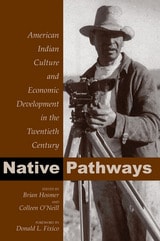
Native Pathways
American Indian Culture and Economic Development in the Twentieth CenturyBrian Hosmer
University Press of Colorado, 2004
How has American Indians' participation in the broader market - as managers of casinos, negotiators of oil leases, or commercial fishermen - challenged the U.S. paradigm of economic development? Have American Indians paid a cultural price for the chance at a paycheck? How have gender and race shaped their experiences in the marketplace? Contributors to Native Pathways ponder these and other questions, highlighting how indigenous peoples have simultaneously adopted capitalist strategies and altered them to suit their own distinct cultural beliefs and practices. Including contributions from historians, anthropologists, and sociologists, Native Pathways offers fresh viewpoints on economic change and cultural identity in twentieth-century Native American communities. Foreword by Donald L. Fixico.
[more]
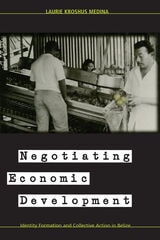
Negotiating Economic Development
Identity Formation and Collective Action in BelizeLaurie Kroshus Medina
University of Arizona Press, 2004
The citrus industry in Belize could be said to exist primarily to satisfy the needs of people in other countries. A business that is highly dependent on global markets and the geopolitics of international trade, it comprises some 500 farmers, many hundreds of wage laborers, and two processing companies that produce frozen juice concentrate for export. This new study examines how those farmers, laborers, and companies define and pursue shared interests, and how they respond differently to the impact of national development strategies and global economic and political forces. Laurie Kroshus Medina analyzes the development of the citrus industry in Belize over fifteen years to explore the relationship between the production of collective identities and the negotiation of development policies at the interface of global and local processes. She shows how citrus farmers and workers, processing companies, and politicians compete to construct shared identities, how they mobilize collective actors, and how their collective action shapes the goals, policies, and practices associated with development. Taking an ethnographic approach, Medina describes how the Belizean citrus industry responds to cycles of boom and bust, and the implications of such cycles for workers and growers. She offers a close look at the major actors—workers, union members, small and large growers, and politicians—as they respond to global changes in the citrus industry. Her analysis is made more compelling through an account of two open struggles in the industry over the formation of a rival union and the attempt to buy the processing company, owned by the multinational corporation Nestlé. She also includes a discussion of the impact of NAFTA on the industry. Medina's research demonstrates how collective agency in Belize has pushed the citrus industry's development in directions that simultaneously conform to and diverge from the trajectories laid out by foreign agencies. Negotiating Economic Development provides a bridge from old to new studies of Latin American social movements as it offers key insights into competing forms of identity for a wide range of social scientists concerned with the human and social aspects of development issues and globalization.
[more]
New Developments in Productivity Analysis
Edited by Charles R. Hulten, Edwin R. Dean, and Michael J. Harper
University of Chicago Press, 2001
The productivity slowdown of the 1970s and 1980s and the resumption of productivity growth in the 1990s have provoked controversy among policymakers and researchers. Economists have been forced to reexamine fundamental questions of measurement technique. Some researchers argue that econometric approaches to productivity measurement usefully address shortcomings of the dominant index number techniques while others maintain that current productivity statistics underreport damage to the environment. In this book, the contributors propose innovative approaches to these issues. The result is a state-of-the-art exposition of contemporary productivity analysis.
Charles R. Hulten is professor of economics at the University of Maryland. He has been a senior research associate at the Urban Institute and is chair of the Conference on Research in Income and Wealth of the National Bureau of Economic Research. Michael Harper is chief of the Division of Productivity Research at the Bureau of Labor Statistics. Edwin R. Dean, formerly associate commissioner for Productivity and Technology at the Bureau of Labor Statistics, is adjunct professor of economics at The George Washington University.
Charles R. Hulten is professor of economics at the University of Maryland. He has been a senior research associate at the Urban Institute and is chair of the Conference on Research in Income and Wealth of the National Bureau of Economic Research. Michael Harper is chief of the Division of Productivity Research at the Bureau of Labor Statistics. Edwin R. Dean, formerly associate commissioner for Productivity and Technology at the Bureau of Labor Statistics, is adjunct professor of economics at The George Washington University.
[more]

New Jersey's Postsuburban Economy
James W. Hughes and Joseph J. Seneca
Rutgers University Press, 2015
New Jersey has a long history of adapting to a changing economic climate. From its colonial origins to the present day, New Jersey's economy has continuously and successfully confronted the challenges and uncertainties of technological and demographic change, placing the state at the forefront of each national and global economic era. Based on James W. Hughes and Joseph J. Seneca’s nearly three-decade-long Rutgers Regional Report series, New Jersey’s Postsuburban Economy presents the issues confronting the state and brings to the forefront ideas for meeting these challenges.
From the rural agricultural and natural resource based economy and lifestyle of the seventeenth century to today’s postindustrial, suburban-dominated, automobile-dependent economy, the economic drivers which were considered to be an asset are now viewed by many to be the state’s greatest disadvantage. On the brink of yet another transformation, this one driven by a new technology and an internet based global economy, New Jersey will have to adapt itself yet again—this time to a postsuburban digital economy.
Hughes and Seneca describe the forces that are now propelling the state into yet another economic era. They do this in the context of historical economic transformations of New Jersey, setting out the technological, demographic, and transportation shifts that defined and drove them.
[more]
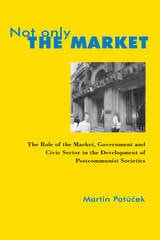
Not Only the Market
Martin Potucek
Central European University Press, 1999
Successful transition for any post-communist country is reliant upon market, government and the civil sector. Potucek's pioneering study of the Czech Republic highlights the early transitional mistakes made during the Klaus era with respect to the role of these sectors. Not Only the Market examines the balance between where the sectors are or should be and makes useful comparisons with other post-communist countries. Focusing on developmental issues, the book looks at a number of public concerns including social and health care reform, privatization and the emerging patterns of corporatism and examines problems such as insufficient legislation, excessive lenience and the incompetence of public administration which has created an unreasonably large space for socio-pathological forces - corruption, Mafia activity and the siphoning of public funds into private hands. The causes and consequences of these forces are considered and Potucek provides a blueprint of reform which emphasizes the necessity of a conscious public policy to optimize both freedom and inequality.
[more]