Results by title
453 books match the query 'Economic policy' and 15 start with n
NBER Macroeconomics Annual, 2025
Volume 40Edited by John Leahy and Valerie Ramey
University of Chicago Press Journals, 2026
Provides a forum for leading economists to participate in important debates in macroeconomics and to report on major developments in macroeconomic analysis and policy.
This fortieth volume of the NBER Macroeconomics Annual includes four new papers on contemporary macroeconomic challenges and methodologies. Christopher Clayton, Matteo Maggiori, and Jesse Schreger examine how hegemonic powers use economic policies as tools of influence on target countries and show how the effectiveness of these policies depends on the target’s available alternatives and whether it can take advantage of those alternatives. José Luis Montiel Olea, Mikkel Plagborg-Møller, Eric Qian, and Christian Wolf provide essential guidance for practitioners choosing between vector autoregressions and local projections for estimating impulse response functions. Kristin Forbes, Jongrim Ha, and M. Ayhan Kose analyze inflation-output tradeoffs across rate cycles from the 1970s to the post-pandemic period using a new cross-country database that reveals how delayed but aggressive monetary responses can generate low-cost disinflation. Satyajit Chatterjee, Dean Corbae, Kyle Dempsey, and José-Victor Ríos-Rull explore the bidirectional relationship between credit scores and inequality over the life cycle, demonstrating through a dynamic general equilibrium model how full information credit scoring systems can improve welfare outcomes. In a keynote address commemorating the conference anniversary, Olivier Blanchard assesses the evolution of macroeconomic research over four decades, and finds substantial methodological convergence.
Narrowing the Channel
The Politics of Regulatory Protection in International TradeRobert Gulotty
University of Chicago Press, 2020
Narrowing the Channel demonstrates that globalization and globalized firms can paradoxically hinder rather than foster economic cooperation as larger firms seek to protect their markets through often unnecessarily strict product regulations. To illustrate the problem of regulatory protectionism, Robert Gulotty offers an in-depth analysis of contemporary rulemaking in the United States and the European Union in the areas of health, safety, and environmental standards. He shows how large firms seek regulatory schemes that disproportionately disadvantage small firms. When multinationals are embedded in the local economy, governments too have an incentive to use these regulations to shift profits back home. Today, the key challenge to governing global trade is not how much trade occurs but who is allowed to participate, and this book shows that new rules will be needed to allow governments to widen the benefits of global commerce and avoid further inequality and market concentration.
National Saving and Economic Performance
Edited by B. Douglas Bernheim and John B. Shoven
University of Chicago Press, 1991
In National Saving and Economic Performance, edited by B. Douglas Bernheim and John B. Shoven, that task is addressed by offering the results of new research, with recommendations for policies aimed to improve saving. Leading experts in diverse fields of economics debate the need for more accurate measurement of official saving data; examine how corporate decisions to retain or distribute earnings affect household-level consumption and saving; and investigate the effects of taxation on saving behavior, correlations between national saving and international investment over time, and the influence of economic growth on saving.
Presenting the most comprehensive and up-to-date research on saving, this volume will benefit both academic and government economists.
Native Pathways
American Indian Culture and Economic Development in the Twentieth CenturyBrian Hosmer
University Press of Colorado, 2004
Natural Resource Policymaking in Developing Countries
Environment, Economic Growth, and Income DistributionWilliam L. Ascher and Robert Healy
Duke University Press, 1990
This book is about the links that tie resource use, environmental quality, and economic development, and the way in which those links are affected by the distribution of income and resource ownership. The links may be relatively simple, as in the case of peasant farmers too poor to conserve resources for the future and with nothing to gain from sound environmental practices. Or they may be very complex—as the authors find when they demonstrate how achievement of higher incomes by the rich can increase environmentally destructive behavior by the poor. Many of the links in some way involve rural land use, whether for agriculture or forestry. Natural Resource Policymaking in Developing Countries argues that the policies that matter are not merely those dealing with resources and the environment, but a much broader set that includes income distribution and asset ownership.
Negotiated Reform
The Multilevel Governance of Financial RegulationEdited by Renate Mayntz
Campus Verlag, 2016

Neoliberal Chicago
Edited by Larry Bennett, Roberta Garner, and Euan Hague
University of Illinois Press, 2017
Neoliberalism and Commodity Production in Mexico
Thomas Weaver
University Press of Colorado, 2012
Detailed ethnographic fieldwork shows how foreign investment, privatization, deregulation, and elimination of welfare benefits have devastated national industries and natural resources and threatened agriculture, driving the campesinos and working class deeper into poverty. Focusing on specific commodity chains and the changes to production and marketing under neoliberalism, the contributors highlight the detrimental impacts of policies by telling the stories of those most affected by these changes. They detail the complex interplay of local and global forces, from the politically mediated systems of demand found at the local level to the increasingly powerful municipal and state governments and the global trade and banking institutions.
Sharing a common theoretical perspective and method throughout the chapters, Neoliberalism and Commodity Production in Mexico is a multi-sited ethnography that makes a significant contribution to studies of neoliberal ideology in practice.
Networked
Business and Politics in Decentralizing Indonesia, 1998-2004Wahyu Prasetyawan
National University of Singapore Press, 2018
Networked Business and Politics in Decentralizing Indonesia evaluates three cases of deep-seated political conflict and intrigue including central government, local governments, and multinational companies. It looks at how the structure of the national political economy has changed as the result of local politicians becoming involved in disputes with the national government over control of natural resources. It also analyzes how these changes will affect the distribution of wealth in the country as well as Indonesia’s evolving democratic politics and modes of governance.
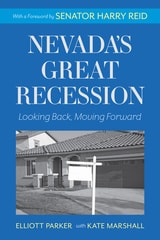
Nevada's Great Recession
Looking Back, Moving ForwardElliott Parker
University of Nevada Press, 2017
This is a different kind of economics book. Parker uses his expertise from doing research on the East Asian fiscal crisis to give profound insights into what happened and how to avoid future catastrophes. Marshall personalizes it by providing vignettes of what it was actually like to be in the trenches and fighting the inevitable political battles that came up, and counteracting some of the falsehoods that certain politicians were spreading about the recession.
Parker and Marshall’s book should be required reading for not only every single elected official in Nevada, but for any private citizen who cares about the public good.
New Jersey's Multiple Municipal Madness
Karcher, Alan
Rutgers University Press, 1998
Alan Karcher looks at the history and high cost of New Jersey's multiple municipalities. He investigates the economic considerations, political pressures, and personal agendas that created the bizarre configurations dividing the Garden State, while analyzing the public policies that allowed and even encouraged the formation of new municipalities. Karcher also examines the political dynamics that thwarted every effort of New Jersey metropolises to join the front ranks of major American cities.
Karcher identifies the major motivations behind the unparalleled experience of New Jersey's municipal multiplication. He delves deeply into the primary causes of new lines being drawn, such as road appropriations, the location of a railroad station, control of a local school district, the regulation of alcohol sales, and the preservation of exclusivity prior to the acceptance of zoning. He also assesses the present situation and what has happened in the past 60 years since the municipal multiplication madness ceased, calling on elected officials to confront reality and correct yesterday's excesses.
The genesis of the present political map of the state is a story that while interesting is not always charming, while fascinating is far from edifying. Little in the history can be called quaint. Rather it is a story of separation and exclusion, of division and greed, of preservation of prerogatives and prejudices. It is a story that supports the conclusion that these lines are rarely the product of chance, rather they were drawn by politicians with very human foibles and frailties, and with very narrow agendas-agendas that have proven to be egregiously expensive for today's taxpayers.
Alan Karcher, the former Speaker of the New Jersey Assembly during the activist 1980s, currently practices municipal law in Middlesex County. He represents the third generation of his family to serve as a member of the New Jersey State Legislature.

New Jersey's Postsuburban Economy
James W. Hughes and Joseph J. Seneca
Rutgers University Press, 2015
From the rural agricultural and natural resource based economy and lifestyle of the seventeenth century to today’s postindustrial, suburban-dominated, automobile-dependent economy, the economic drivers which were considered to be an asset are now viewed by many to be the state’s greatest disadvantage. On the brink of yet another transformation, this one driven by a new technology and an internet based global economy, New Jersey will have to adapt itself yet again—this time to a postsuburban digital economy.
Hughes and Seneca describe the forces that are now propelling the state into yet another economic era. They do this in the context of historical economic transformations of New Jersey, setting out the technological, demographic, and transportation shifts that defined and drove them.
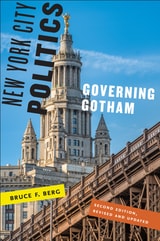
New York City Politics
Governing GothamBerg, Bruce F
Rutgers University Press, 2018
New York City Politics focuses on the impact of these three forces on the governance of New York City’s political system including the need to promote democratic accountability, service delivery equity, as well as the maintenance of civil harmony. This second edition updates the discussion with examples from the Bloomberg and de Blasio administrations as well as current public policy issues including infrastructure, housing and homelessness, land use regulations, and education.
New York City Politics
Governing GothamBerg, Bruce F
Rutgers University Press, 2007
New York City Politics focuses on the impact of these three forces on the governance of New York City’s political system including the need to promote democratic accountability, service delivery equity, as well as the maintenance of civil harmony. This second edition updates the discussion with examples from the Bloomberg and de Blasio administrations as well as current public policy issues including infrastructure, housing and homelessness, land use regulations, and education.
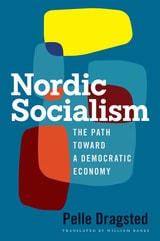
Nordic Socialism
The Path Toward a Democratic EconomyPelle Dragsted, Translated by William Banks
University of Wisconsin Press, 2025
In Dragsted’s analysis, Denmark and the rest of the Nordic countries are already socialist, but only in part. The dangers come (and here many conservative Americans will disagree) from the unhealthy encroachment of capitalism. His provocative argument is that capitalism and socialism are not in fact mutually exclusive, and already Nordic economies are hybrids, a mix of decommodified, democratically governed sectors and undemocratic, privately controlled enterprises. The relevant question is the degree to which one dominates the other. Currently, undemocratic forces are ascendant, but it need not be so. Dragsted offers both his diagnosis and his proposed solution, a comprehensive plan for a gradual (re)democratization of the economy and a move to fully and firmly embrace, and redefine, “Nordic socialism.”