Results by title
425 books match the query 'Ethics' and 5 start with n

Near Human
Border Zones of Species, Life, and BelongingMette N. Svendsen
Rutgers University Press, 2022
Near Human takes us into the borders of human and animal life. In the animal facility, fragile piglets substitute for humans who cannot be experimented on. In the neonatal intensive care unit, extremely premature infants prompt questions about whether they are too fragile to save or, if they survive, whether they will face a life of severe disability. Drawing on ethnographic fieldwork carried out on farms, in animal-based experimental science labs, and in hospitals, Mette N. Svendsen shows that practices of substitution redirect the question of "what it means" to be human to "what it takes" to be human. The near humanness of preterm infants and research piglets becomes an avenue to unravel how neonatal life is imagined, how societal belonging is evaluated, and how the Danish welfare state is forged. This courageous multi-sited and multi-species approach cracks open the complex ethical field of valuating life and making different kinds of pigs and different kinds of humans belong in Denmark.
[more]
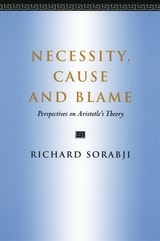
Necessity, Cause and Blame
Perspectives on Aristotle's TheoryRichard Sorabji
University of Chicago Press, 2006
A discussion of Aristotle’s thought on determinism and culpability, Necessity, Cause, and Blame also reveals Richard Sorabji’s own philosophical commitments. He makes the original argument here that Aristotle separates the notions of necessity and cause, rejecting both the idea that all events are necessarily determined as well as the idea that a non-necessitated event must also be non-caused. In support of this argument, Sorabji engages in a wide-ranging discussion of explanation, time, free will, essence, and purpose in nature. He also provides historical perspective, arguing that these problems remain intimately bound up with modern controversies.
“Necessity, Cause and Blame would be counted by all as one of Sorabji’s finest. The book is essential for philosophers—both specialists on the Greeks and modern thinkers about free will—and also compelling for non-specialists.”—Martha Nussbaum
“Original and important . . . The book relates Aristotle’s discussions to both the contemporary debates on determinism and causation and the ancient ones. It is especially detailed on Stoic arguments about necessity . . . and on the social and legal background to Aristotle’s thought.”—Choice
“It is difficult to convey the extraordinary richness of this book. . . . A Greekless philosopher could read it with pleasure . . . At the same time, its learning and scholarship are enormous.”—G. E. M. Anscombe, Times Literary Supplement
[more]
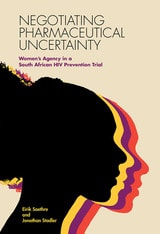
Negotiating Pharmaceutical Uncertainty
Women's Agency in a South African HIV Prevention TrialEirik Saethre
Vanderbilt University Press, 2017
Telling the story of a clinical trial testing an innovative gel designed to prevent women from contracting HIV, Negotiating Pharmaceutical Uncertainty provides new insight into the complex and contradictory relationship between medical researchers and their subjects. Although clinical trials attempt to control and monitor participants' bodies, Saethre and Stadler argue that the inherent uncertainty of medical testing can create unanticipated opportunities for women to exercise control over their health, sexuality, and social relationships. Combining a critical analysis of the social production of biomedical knowledge and technologies with a detailed ethnography of the lives of female South African trial participants, this book brings to light issues of economic exclusion, racial disparity, and spiritual insecurity in Johannesburg's townships. Built on a series of tales ranging from strategy sessions at the National Institutes of Health to witchcraft accusations against the trial, Negotiating Pharmaceutical Uncertainty illuminates the everyday social lives of clinical trials.
As embedded anthropologists, Saethre and Stadler provide a unique and nuanced perspective of the reality of a clinical trial that is often hidden from view.
As embedded anthropologists, Saethre and Stadler provide a unique and nuanced perspective of the reality of a clinical trial that is often hidden from view.
[more]

Nietzsche's Enlightenment
The Free-Spirit Trilogy of the Middle PeriodPaul Franco
University of Chicago Press, 2011
While much attention has been lavished on Friedrich Nietzsche’s earlier and later works, those of his so-called middle period have been generally neglected, perhaps because of their aphoristic style or perhaps because they are perceived to be inconsistent with the rest of his thought. With Nietzsche’s Enlightenment, Paul Franco gives this crucial section of Nietzsche’s oeuvre its due, offering a thoughtful analysis of the three works that make up the philosopher’s middle period: Human, All too Human; Daybreak; and The Gay Science.
It is Nietzsche himself who suggests that these works are connected, saying that their “common goal is to erect a new image and ideal of the free spirit.” Franco argues that in their more favorable attitude toward reason, science, and the Enlightenment, these works mark a sharp departure from Nietzsche’s earlier, more romantic writings and differ in important ways from his later, more prophetic writings, beginning with Thus Spoke Zarathustra. The Nietzsche these works reveal is radically different from the popular image of him and even from the Nietzsche depicted in much of the secondary literature; they reveal a rational Nietzsche, one who preaches moderation instead of passionate excess and Dionysian frenzy. Franco concludes with a wide-ranging examination of Nietzsche’s later works, tracking not only how his outlook changes from the middle period to the later but also how his commitment to reason and intellectual honesty in his middle works continues to inform his final writings.
[more]

Notebooks for an Ethics
Jean-Paul Sartre
University of Chicago Press, 1992
A major event in the history of twentieth-century thought, Notebooks for a Ethics is Jean-Paul Sartre's attempt to develop an ethics consistent with the profound individualism of his existential philosophy.
In the famous conclusion to Being and Nothingness, Sartre announced that he would devote his next philosophical work to moral problems. Although he worked on this project in the late 1940s, Sartre never completed it to his satisfaction, and it remained unpublished until after his death in 1980. Presented here for the first time in English, the Notebooks reveal Sartre at his most productive, crafting a masterpiece of philosophical reflection that can easily stand alongside his other great works.
Sartre grapples anew here with such central issues as "authenticity" and the relation of alienation and freedom to moral values. Exploring fundamental modes of relating to the Other—among them violence, entreaty, demand, appeal, refusal, and revolt—he articulates the necessary transition from individualism to historical consciousness. This work thus forms an important bridge between the early existentialist Sartre and the later Marxist social thinker of the Critique of Dialectical Reason. The Notebooks themselves are complemented here by two additional essays, one on "the good and subjectivity," the other on the oppression of blacks in the United States.
With publication of David Pellauer's lucid translation, English-speaking readers will be able to appreciate this important contribution to moral philosophy and the history of ethics.
Jean-Paul Sartre (1906-1980) was offered, but declined, the Nobel Prize for literature in 1964. His many works of fiction, drama, and philosophy include the monumental study of Flaubert, The Family Idiot, and The Freud Scenario, both published in translation by the University of Chicago Press.
[more]