Results by title
3745 books match the query 'Europe' and 64 start with n
NEW WOMAN AND THE EMPIRE
Iveta Jusová
The Ohio State University Press, 2005

Nails in the Wall
Catholic Nuns in Reformation GermanyAmy Leonard
University of Chicago Press, 2005
Focusing primarily on a group of Dominican nuns in Strasbourg, Germany, Amy Leonard's Nails in the Wall outlines the century-long battle between these nuns and the Protestant city council. With savvy strategies that employed charm, wealth, and political and social connections, the nuns were able to sustain their Catholic practices. Leonard's in-depth archival research uncovers letters about and records of the nuns' struggle to maintain their religious beliefs and way of life in the face of Protestant reforms. She tells the story of how they worked privately to keep Catholicism alive-continuing to pray in Latin, smuggling in priests to celebrate Mass, and secretly professing scores of novices to ensure the continued survival of their convents. This fascinating and heartening study shows that, far from passively allowing the Protestants to dismantle their belief system, the women of the Strasbourg convents were active participants in the battle over their vocation and independence.

Napoleonic Friendship
Military Fraternity, Intimacy, and Sexuality in Nineteenth-Century FranceBrian Joseph Martin
University of New Hampshire Press, 2011
Winner of the Laurence Wylie Prize in French Cultural Studies
One of the first books on “Gays in the Military” published following the historic repeal of “Don't Ask Don't Tell” in 2011, Napoleonic Friendship examines the history of male intimacy in the French military, from Napoleon to the First World War. Echoing the historical record of gay soldiers in the United States, Napoleonic Friendship is the first book-length study on the origin of queer soldiers in modern France. Based on extensive archival research in France, the book traces the development of affectionate friendships in the French Army from 1789 to 1916.
Following the French Revolution, radical military reforms created conditions for new physical and emotional intimacy between soldiers, establishing a model of fraternal affection during the Revolutionary and Napoleonic Wars that would persist amid the ravages of the Franco-Prussian War and World War I. Through readings of Napoleonic military memoirs (and other non-fiction archival material) and French military fiction (from Hugo and Balzac to Zola and Proust), Martin examines a broad range of emotional and erotic relationships, from combat buddies to soldier lovers. He argues that the French Revolution's emphasis on military fraternity evolved into an unprecedented sense of camaraderie in the armies of Napoleon. For many soldiers, the hardships of combat led to intimate friendships. For some, the homosociality of military life inspired mutual affection, lifelong commitment, and homoerotic desire.
Narratives Unbound
Historical studies in post-communist Eastern EuropePéter Apor
Central European University Press, 2007
Narratives of Low Countries History and Culture
Reframing the PastEdited by Jane Fenoulhet and Lesley Gilbert
University College London, 2016
Natalija
Life in the Balkan Powder Keg, 1880-1956Natalija Matic-Zrnic
Central European University Press, 2009
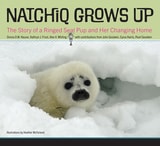
Natchiq Grows Up
The Story of an Alaska Ringed Seal Pup and Her Changing HomeDonna D.W. Hauser
University of Alaska Press, 2023
Beginning in the 1980s, scientists started traveling to northwest Alaska to research the lives of ringed seals, bringing Labrador retrievers who could sniff out seals and their snow cave homes (called lairs) on the sea ice. Decades later, scientists partnered with the Iñupiaq people of
Qikiktaġruk (Kotzebue) to learn more about ringed seals. They relied on a combination of Indigenous Knowledge and scientific techniques to capture and apply tags to understand the movements and behavior of ringed seals.
But the Arctic homes of ringed seals are changing, and the long history of ringed seal science in the Kotzebue Sound proved to be just the beginning of long and cooperative relationships melding science and Indigenous knowledge. During 2018 and 2019, with unprecedented sea ice conditions, Qikiktagrumiut Elders and scientists returned to the ice to measure changes in the habitat available for ringed seal pups in the region.
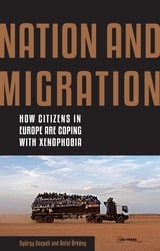
Nation and Migration
How Citizens in Europe Are Coping with XenophobiaGyörgy Csepeli
Central European University Press, 2021
Nation and Migration provides a way to understand recent migration events in Europe that have attracted the world's attention. The emergence of the nations in the West promised homogenization, but instead the imagined national communities have everywhere become places of heterogeneity, and modern nation states have been haunted by the specter of minorities. This study analyses experiences relating to migration in 23 European countries. It is based on data from the International Social Survey Programme, a global cross-national collaborative exercise, with surveys made in 1995, 2003, and 2013. In the authors' view, a critical test for Europe will be its ability to find adequate responses to the challenges of globalization.
The book provides a detailed overview of how citizens in Europe are coping with a xenophobia fueled by their own sense of insecurity. The authors reconstruct the competing sociological reactions to migration in the forms of integration, assimilation and segregation. Hungary receives special attention: the data show that people living there are far less closed and xenophobic than they might seem through the prism of a media-instigated moral panic.

National Conversations
Public Service Media and Cultural Diversity in EuropeEdited by Gavan Titley, Karina Horsti, and Gunilla Hultén
Intellect Books, 2014
National History and the World of Nations
Capital, State, and the Rhetoric of History in Japan, France, and the United StatesChristopher L. Hill
Duke University Press, 2008
Delving into narrative histories, prose fiction, and social philosophy, Hill analyzes the rhetoric, narrative form, and intellectual genealogy of late-nineteenth-century texts that contributed to the creation of national history in each of the three countries. He discusses the global political economy of the era, the positions of the three countries in it, and the reasons that arguments about history loomed large in debates on political, economic, and social problems. Examining how the writing of national histories in the three countries addressed political transformations and the place of the nation in the world, Hill illuminates the ideological labor national history performed. Its production not only naturalized the division of the world by systems of states and markets, but also asserted the inevitability of the nationalization of human community; displaced dissent to pre-modern, pre-national pasts; and presented the subject’s acceptance of a national identity as an unavoidable part of the passage from youth to adulthood.

National Holidays in Czechoslovakia Between the World Wars
Celebrate the RepublicDagmar Hájková
Central European University Press, 2027
National Identity of Romanians in Transylvania
Sorin Mitu
Central European University Press, 2001
This meticulously researched and elegantly written book is the most authoritative study of the emergence of modern Romanian identity in Transylvania during the eighteenth and nineteenth centuries. Based upon a plethora of contemporary published sources, Mitu approaches national identity from a variety of perspectives - from within the Romanian community itself and their reaction to the image others had of them.
The author sheds new light on the problems of self-evaluation using a method he describes as "functional analysis" to examine a complex set of ideologies and propaganda. This approach helps the reader to understand the intricate web of contemporary Romanian nationalism.
National Identity of Romanians in Transylvania appeals to scholars of modern Romanian history, those focusing on the Habsburg Monarchy and the study of modern nationalism. The book is an important contribution to the expanding debate on nationalism and national identity from an East European perspective.
National Megalomania and Imagination of the Ancient World
Jie-Hyun Lim
Central European University Press, 2027
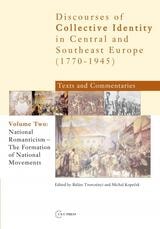
National Romanticism
The Formation of National MovementsMiroslav Hroch
Central European University Press, 2007
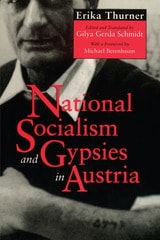
National Socialism and Gypsies in Austria
Erika Thurner
University of Alabama Press, 1998
In this first English translation of Erika Thurner's National Socialism and Gypsies in Austria, Gilya Gerda Schmidt makes available Thurner’s investigation of Camps Salzburg and Lackenbach, the two central areas of Gypsy persecution in Austria. Two factors made Thurner’s research especially difficult: the Roma and Sinti have more an oral tradition than a written one, and scholarship on the plight of the Gypsies is sparse. Through painstaking research, Thurner has been able to piece together fragments from Nazi documents, recollections of victims, accounts of bystanders and other eyewitnesses, and formal records to present her account. The result is a volume that truly enhances our understanding of the Gypsies’ experiences during this period.
The volume also focuses on broader aspects of the Gypsies’ ordeals: the ideological foundations and legal ordinances regarding Gypsies, the discrimination and persecution in Burgenland as a whole, the transports from Austria to Lodz and Chelmo, and the medical experimentation. The book has also been expanded, with a new study of Camp Salzburg, an updated bibliography, and numerous photographs, which were not included in the German edition.
The recent upsurge of anti-Gypsy violence in Austria illustrates both the horror of the treatment of Gypsy tribes and the timeliness of the subject of this volume.
Nationalism and Sexuality
Middle-Class Morality and Sexual Norms in Modern EuropeGeorge L. Mosse, With a critical introduction by Mary Louise Roberts
University of Wisconsin Press, 2020

Nationalizing Empires
Stefan Berger
Central European University Press, 2015

Nationalizing a Borderland
War, Ethnicity, and Anti-Jewish Violence in East Galicia, 1914–1920Alexander Victor Prusin
University of Alabama Press, 2005
Nationalizing a Borderland enriches understanding of ethnic conflict by examining the factors in the Austro-Hungarian province of Galicia between 1914 and 1920 that led to the rise of xenophobic nationalism and to the ethnocide of World War II. From Russian, Polish, Ukrainian, and Austrian archival sources, Prusin argues that while the violence inflicted upon Jews during that period may at first seem irrational and indiscriminate, a closer examination reveals that it was generated by traditional antisemitism and by the security concerns of the Russian and Polish militaries in the front zone. This violence, Prusin contends, served as a means of reshaping the socio-economic and political space of the province by diminishing Jewish cultural and economic influence.
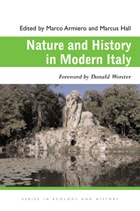
Nature and History in Modern Italy
Marco Armiero
Ohio University Press, 2010
Is Italy il bel paese—the beautiful country—where tourists spend their vacations looking for art, history, and scenery? Or is it a land whose beauty has been cursed by humanity’s greed and nature’s cruelty? The answer is largely a matter of narrative and the narrator’s vision of Italy. The fifteen essays in Nature and History in Modern Italy investigate that nation’s long experience in managing domesxadtixadcated rather than wild natures and offer insight into these conflicting visions. Italians shaped their land in the most literal sense, producing the landscape, sculpting its heritage, embedding memory in nature, and rendering the two different visions inseparxadable. The interplay of Italy’s rich human history and its dramatic natural diversity is a subject with broad appeal to a wide range of readers.
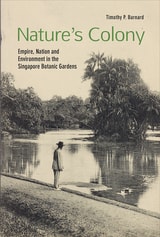
Nature's Colony
Empire, Nation and Environment in the Singapore Botanic GardensTimothy P. Barnard
National University of Singapore Press, 2017
Initially conceived to exploit nature for the benefit of empire, the Gardens were part of a symbolic struggle by administrators, scientists, and gardeners to assert dominance within Southeast Asia’s tropical landscape, reflecting shifting understandings of power, science, and nature among local administrators and distant mentors in Britain. Consequently, as an outpost of imperial science, the Gardens were instrumental in the development of plantation crops, such as rubber and oil palm, which went on to shape landscapes across the globe. Since the independence of Singapore, the Gardens have played a role in the “greening” of the country and have been named as Singapore’s first World Heritage Site. Setting the Gardens alongside the Royal Botanic Gardens, Kew, and botanic gardens in India, Ceylon, Mauritius, and the West Indies, Nature’s Colony provide the first in-depth look at the history of this influential institution.
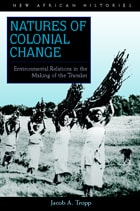
Natures of Colonial Change
Environmental Relations in the Making of the TranskeiJacob A. Tropp
Ohio University Press, 2006
In this groundbreaking study, Jacob A. Tropp explores the interconnections between negotiations over the environment and an emerging colonial relationship in a particular South African context—the Transkei—subsequently the largest of the notorious “homelands” under apartheid.
In the late nineteenth century, South Africa’s Cape Colony completed its incorporation of the area beyond the Kei River, known as the Transkei, and began transforming the region into a labor reserve. It simultaneously restructured popular access to local forests, reserving those resources for the benefit of the white settler economy. This placed new constraints on local Africans in accessing resources for agriculture, livestock management, hunting, building materials, fuel, medicine, and ritual practices.
Drawing from a diverse array of oral and written sources, Tropp reveals how bargaining over resources—between and among colonial officials, chiefs and headmen, and local African men and women—was interwoven with major changes in local political authority, gendered economic relations, and cultural practices as well as with intense struggles over the very meaning and scope of colonial rule itself.
Natures of Colonial Change sheds new light on the colonial era in the Transkei by looking at significant yet neglected dimensions of this history: how both “colonizing” and “colonized” groups negotiated environmental access and how such negotiations helped shape the broader making and meaning of life in the new colonial order.
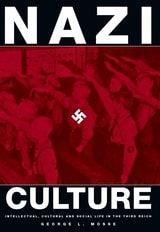
Nazi Culture
Intellectual, Cultural, and Social Life in the Third ReichGeorge L. Mosse
University of Wisconsin Press, 2003
What was life like under the Third Reich? What went on between parents and children? What were the prevailing attitudes about sex, morality, religion? How did workers perceive the effects of the New Order in the workplace? What were the cultural currents—in art, music, science, education, drama, and on the radio?
Professor Mosse’s extensive analysis of Nazi culture—groundbreaking upon its original publication in 1966—is now offered to readers of a new generation. Selections from newspapers, novellas, plays, and diaries as well as the public pronouncements of Nazi leaders, churchmen, and professors describe National Socialism in practice and explore what it meant for the average German.
By recapturing the texture of culture and thought under the Third Reich, Mosse’s work still resonates today—as a document of everyday life in one of history’s darkest eras and as a living memory that reminds us never to forget.
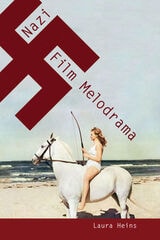
Nazi Film Melodrama
Laura Heins
University of Illinois Press, 2013

Nazi Ideology before 1933
A DocumentationIntroduced and translated by Barbara Miller Lane and Leila J. Rupp
University of Texas Press, 1978
This volume brings together a hitherto scattered and inaccessible body of material crucial to the understanding of the evolution of Nazi political thought. Before the publication of this volume, scholars had virtually ignored the extensive writings and programs published by leading Nazi ideologues before 1933. Barbara Miller Lane and Leila J. Rupp have collected the political writings of Nazi theorists—Dietrich Eckart, Alfred Rosenberg, Gottfried Feder, Joseph Goebbels, Gregor and Otto Strasser, Heinrich Himmler, and Richard Walther Darré—during the period before the National Socialists came to power. The Strassers are given considerable space because of their great intellectual importance within the party before 1933. In commentary by the editors, the significance of each Nazi theorist is weighed and evaluated at each stage of the history of the party.
Lane and Rupp conclude that Nazi ideology, before 1933 at least, was not a consistent whole but a doctrine in the process of rapid development to which new ideas were continually introduced. By the time the Nazis came to power, however, a group of interrelated assertions and official promises had been made to party followers and to the public. Hitler and the Third Reich had to accommodate this ideology, even when not implementing it. Hitler’s role in the development of Nazi ideology, interpreted here as a very permissive one, is thoroughly assessed. His own writings, however, have been omitted since they are readily available elsewhere.
The twenty-eight documents included in this book illustrate themes and phases in Nazi ideology which are discussed in the introduction and the detailed prefatory notes. Long selections, as often as possible full-length, are provided to allow the reader to follow the arguments. Each selection is accompanied by an introductory note and annotations which clarify its relationship to other works of the author and other writings of the period. Also included are original translations of the “Twenty-Five Points” and a number of little-known official party statements.

Nefertiti
The Making of a Global IconSebastian Conrad
University of Chicago Press, 2026
Charts the global resonance of the image of Nefertiti over the past century.
From the moment that the bust of Nefertiti was uncovered after over three thousand years and shown at its first exhibition in Berlin in 1924, it rapidly became an iconic image. Today, the silhouette alone of this powerful ancient Egyptian queen is recognized and admired around the world.
In Nefertiti: The Making of a Global Icon, historian Sebastian Conrad tracks the full story of the world’s embrace and appropriation of this famous visage. Starting with the discovery of the bust and Germany’s claims to its possession, Conrad shows how it became a contested object, tracing Egypt’s efforts to call for its restitution from 1924 to the present. He also canvasses the uses to which Nefertiti’s image has been put and the causes with which it has been associated: for cosmetic ads and beauty clinics; by advocates for European unity; by drag queens and the queer community; by National Socialists; by nationalists in Egypt and Bengal; by Afro-Brazilian communities; and by important Black figures from Elijah Muhammad to Beyoncé. Against a global backdrop, Conrad showcases the stunning object’s fame and the often-controversial issues and debates in which it has been embroiled. He also argues that the story of Nefertiti’s trajectory offers insights into the changing shape of globalization from the era of imperialism to the present.
This accessible, deeply researched book reveals both how much is at stake in the life of objects and how Nefertiti’s arresting likeness continues to challenge us today.
Negotiating Identity and Collective Memory in Czech Silesia
Johana Wyss
Central European University Press, 2026
Negotiating Spain and Catalonia
Competing Narratives of National IdentityFernando León-Solís
Intellect Books, 2013
The two case studies included in this book (dealing with the Football World Cups of 1994 and 2002, and the general elections of 1996 and 2000) examine competing discourses of Spain, Catalonia and their national identities, as constructed in the Spanish press. The conservative discourse offers traditional and unified images of Spain close to the stereotype, whereas more liberal visions of the country regard 'Europeanism' and 'reason' (not 'passive') as the values Spain should aspire to. From a peripheral perspective, Catalan self-definition is of a people that is hardworking, thoughtful, truly European, and different from the rest of the Spaniards.
However, these differences between the discourses are not always so clear-cut. Central to Negotiating Spain and Catalonia is the idea of the constant renegotiation of Spanish and Catalan identities in order to adapt them to the political circumstance: both case studies show how radically different narratives of Spanishness and Catalanicity offered in the turbulent political past tend to merge into the more tranquil present.
Negotiating the Intersections of Writing and Writing Instruction
Proceedings from the 2019 Conference of the European Association for the Teaching of Academic Writingedited by Magnus Gustafsson and Andreas Eriksson
University Press of Colorado, 2022

Neighboring Faiths
Christianity, Islam, and Judaism in the Middle Ages and TodayDavid Nirenberg
University of Chicago Press, 2014
There have been countless scripture-based studies of the three “religions of the book,” but Nirenberg goes beyond those to pay close attention to how the three religious neighbors loved, tolerated, massacred, and expelled each other—all in the name of God—in periods and places both long ago and far away. Nirenberg argues that the three religions need to be studied in terms of how each affected the development of the others over time, their proximity of religious and philosophical thought as well as their overlapping geographies, and how the three “neighbors” define—and continue to define—themselves and their place in terms of one another. From dangerous attractions leading to interfaith marriage; to interreligious conflicts leading to segregation, violence, and sometimes extermination; to strategies for bridging the interfaith gap through language, vocabulary, and poetry, Nirenberg aims to understand the intertwined past of the three faiths as a way for their heirs to produce the future—together.
Neither German nor Pole
Catholicism and National Indifference in a Central European BorderlandJames E. Bjork
University of Michigan Press, 2009
"This is a fascinating local story with major implications for studies of nationalism and regional identities throughout Europe more generally."
---Dennis Sweeney, University of Alberta
"James Bjork has produced a finely crafted, insightful, indeed, pathbreaking study of the interplay between religious and national identity in late nineteenth-century Central Europe."
---Anthony Steinhoff, University of Tennessee at Chattanooga
Neither German nor Pole examines how the inhabitants of one of Europe's most densely populated industrial districts managed to defy clear-cut national categorization, even in the heyday of nationalizing pressures at the turn of the twentieth century. As James E. Bjork argues, the "civic national" project of turning inhabitants of Upper Silesia into Germans and the "ethnic national" project of awakening them as Poles both enjoyed successes, but these often canceled one another out, exacerbating rather than eliminating doubts about people's national allegiances. In this deadlock, it was a different kind of identification---religion---that provided both the ideological framework and the social space for Upper Silesia to navigate between German and Polish orientations. A fine-grained, microhistorical study of how confessional politics and the daily rhythms of bilingual Roman Catholic religious practice subverted national identification, Neither German nor Pole moves beyond local history to address broad questions about the relationship between nationalism, religion, and modernity.

Neodomestic American Fiction
Kristin J. Jacobson
The Ohio State University Press, 2010
Nestor Makhno and Rural Anarchism in Ukraine, 1917-1921
Colin Darch
Pluto Press, 2020
Between 1917 and 1921, the Makhnovists fought German and Austrian invaders, reactionary monarchist forces, Ukrainian nationalists and sometimes the Bolsheviks themselves. Drawing upon anarchist ideology, the Makhnovists gathered widespread support amongst the Ukrainian peasantry, taking up arms when under attack and playing a significant role - in temporary alliance with the Red Army - in the defeats of the White Generals Denikin and Wrangel. Often dismissed as a kulak revolt, or a manifestation of Ukrainian nationalism, Colin Darch analyses the successes and failures of the Makhnovist movement, emphasising its revolutionary character.
Over 100 years after the revolutions, this book reveals a lesser known side of 1917, contributing both to histories of the period and broadening the narrative of 1917, whilst enriching the lineage of anarchist history.

Nestor Makhno and Rural Anarchism in Ukraine, 1917-1921
Colin Darch
Pluto Press, 2020
Between 1917 and 1921, the Makhnovists fought German and Austrian invaders, reactionary monarchist forces, Ukrainian nationalists and sometimes the Bolsheviks themselves. Drawing upon anarchist ideology, the Makhnovists gathered widespread support amongst the Ukrainian peasantry, taking up arms when under attack and playing a significant role - in temporary alliance with the Red Army - in the defeats of the White Generals Denikin and Wrangel. Often dismissed as a kulak revolt, or a manifestation of Ukrainian nationalism, Colin Darch analyzes the successes and failures of the Makhnovist movement, emphasizing its revolutionary character.
Over 100 years after the revolutions, this book reveals a lesser known side of 1917, contributing both to histories of the period and broadening the narrative of 1917, whilst enriching the lineage of anarchist history.
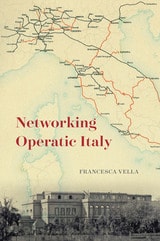
Networking Operatic Italy
Francesca Vella
University of Chicago Press, 2022
Opera’s role in shaping Italian identity has long fascinated both critics and scholars. Whereas the romance of the Risorgimento once spurred analyses of how individual works and styles grew out of and fostered specifically “Italian” sensibilities and modes of address, more recently scholars have discovered the ways in which opera has animated Italians’ social and cultural life in myriad different local contexts.
In Networking Operatic Italy, Francesca Vella reexamines this much-debated topic by exploring how, where, and why opera traveled on the mid-nineteenth-century peninsula, and what this mobility meant for opera, Italian cities, and Italy alike. Focusing on the 1850s to the 1870s, Vella attends to opera’s encounters with new technologies of transportation and communication, as well as its continued dissemination through newspapers, wind bands, and singing human bodies. Ultimately, this book sheds light on the vibrancy and complexity of nineteenth-century Italian operatic cultures, challenging many of our assumptions about an often exoticized country.
Never Make a Spy Out of Me
An Epistolary Story from the Romanian Secret Police Archives (1947-1962)Valentina Glajar
Central European University Press, 2027
New Countries
Capitalism, Revolutions, and Nations in the Americas, 1750–1870John Tutino, editor
Duke University Press, 2016
Contributors. Alfredo Ávila, Roberto Breña, Sarah C. Chambers, Jordana Dym, Carolyn Fick, Erick Langer, Adam Rothman, David Sartorius, Kirsten Schultz, John Tutino
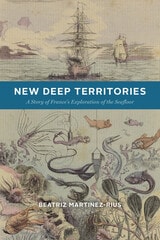
New Deep Territories
A Story of France’s Exploration of the SeafloorBeatriz Martinez-Rius
University of Chicago Press, 2026
Beneath the surface of the seas and oceans lies a territory as important for human societies as the exposed land and the airspace above them: the seafloor. Our daily life is inextricably linked to the seafloor and its resources, from global telecommunications infrastructure to offshore oil and gas extraction to strategic mineral mining.
By focusing on France, a country with an underwater territory seventeen times larger than its emerged lands, New Deep Territories explains how the seafloor emerged as a territory during the second half of the twentieth century. Beatriz Martinez-Rius traces the evolution of the country’s seafloor exploration and the motivations that fueled it from the aftermath of World War I to the late 1970s. In the early 1960s, the seafloor, instead of colonial territories, came to be seen as a source of natural resources. The French government, corporations such as oil companies, and scientists all imagined future uses of the seafloor, and these ever-evolving aspirations drove the development of technologies, techniques, and scientific fields that built up the submerged territory. Government officers and industrial stakeholders massively invested in technoscientific development to prepare for a future reliant on seafloor resources, including oil, gas, and minerals, well before it was technologically possible, economically feasible, and legally acceptable to extract them. The future they envisioned did not arrive, but their investment resulted in an unprecedented understanding of the ocean’s crust. Today, once again, national governments, international organizations, and private stakeholders are turning their attention to the seafloor.
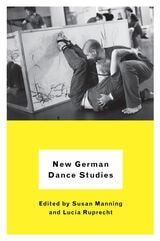
New German Dance Studies
Edited by Susan Manning and Lucia Ruprecht
University of Illinois Press, 2012
New Technologies and Renaissance Studies II
Edited by Tassie Gniady, Kris McAbee, Jessica Murphy
Iter Press, 2014
In the fourth volume of the New Technologies in Medieval and Renaissance Studies series, volume editors Tassie Gniady, Kris McAbee, and Jessica Murphy bring together some of the best work from the New Technologies in Medieval and Renaissance Studies panels at the Renaissance Society of America (RSA) annual meetings for the years 2004–2010. These essays demonstrate a dedication to grounding the use of “newest” practices in the theories of the early modern period. At the same time, the essays are interested in the moment—the needs of scholars then, the theories of media that informed current understanding, and the tools used to conduct studies.
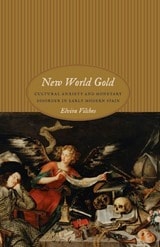
New World Gold
Cultural Anxiety and Monetary Disorder in Early Modern SpainElvira Vilches
University of Chicago Press, 2010
The discovery of the New World was initially a cause for celebration. But the vast amounts of gold that Columbus and other explorers claimed from these lands altered Spanish society. The influx of such wealth contributed to the expansion of the Spanish empire, but also it raised doubts and insecurities about the meaning and function of money, the ideals of court and civility, and the structure of commerce and credit. New World Gold shows that, far from being a stabilizing force, the flow of gold from the Americas created anxieties among Spaniards and shaped a host of distinct behaviors, cultural practices, and intellectual pursuits on both sides of the Atlantic.
Elvira Vilches examines economic treatises, stories of travel and conquest, moralist writings, fiction, poetry, and drama to reveal that New World gold ultimately became a problematic source of power that destabilized Spain’s sense of trust, truth, and worth. These cultural anxieties, she argues, rendered the discovery of gold paradoxically disastrous for Spanish society. Combining economic thought, social history, and literary theory in trans-Atlantic contexts, New World Gold unveils the dark side of Spain’s Golden Age.
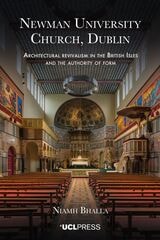
Newman University Church, Dublin
Architectural Revivalism in the British Isles and the Authority of FormNiamh Bhalla
University College London, 2024
Newman University Church, Dublin charts the first ever analysis of University Church’s significance within the history of Victorian revivalist architecture. Author Niamh Bhalla explores the relationship between the church’s context as the first Catholic university in Ireland and the ambiguity of its “early Christian” style, providing an effective lens to understand the architectural revivalism of the nineteenth century, particularly basilican and Byzantine revivalist architectures in the British Isles.
Nightingales in Berlin
Searching for the Perfect SoundDavid Rothenberg
University of Chicago Press, 2019
But have you ever listened closely to a nightingale’s song? It’s a strange and unsettling sort of composition—an eclectic assortment of chirps, whirs, trills, clicks, whistles, twitters, and gurgles. At times it is mellifluous, at others downright guttural. It is a rhythmic assault, always eluding capture. What happens if you decide to join in?
As philosopher and musician David Rothenberg shows in this searching and personal new book, the nightingale’s song is so peculiar in part because it reflects our own cacophony back at us. As vocal learners, nightingales acquire their music through the world around them, singing amidst the sounds of humanity in all its contradictions of noise and beauty, hard machinery and soft melody. Rather than try to capture a sound not made for us to understand, Rothenberg seeks these musical creatures out, clarinet in tow, and makes a new sound with them. He takes us to the urban landscape of Berlin—longtime home to nightingale colonies where the birds sing ever louder in order to be heard—and invites us to listen in on their remarkable collaboration as birds and instruments riff off of each other’s sounds. Through dialogue, travel records, sonograms, tours of Berlin’s city parks, and musings on the place animal music occupies in our collective imagination, Rothenberg takes us on a quest for a new sonic alchemy, a music impossible for any one species to make alone. In the tradition of The Hidden Life of Trees and The Invention of Nature, Rothenberg has written a provocative and accessible book to attune us ever closer to the natural environment around us.
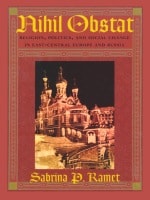
Nihil Obstat
Religion, Politics, and Social Change in East-Central Europe and RussiaSabrina P. Ramet
Duke University Press, 1998
Based on interview research in Germany, Austria, Slovenia, Croatia, Bosnia, Serbia, and Macedonia, and on materials published in German, Italian, Serbo-Croatian, Polish, Czech, Slovak, Russian, and English, Ramet paints a clear picture of the political and religious fragility of former communist states, which are experiencing some aspects of freedom and choice for the first time. With its comprehensive discussion of the largest religious institutions in the area, especially the Catholic and Orthodox Churches, and its extensive survey of nontraditional religious associations that have become active in the region since 1989, this study makes a distinct contribution to growing discussions about the rise of fundamentalism and the inner dilemmas of modernity. With its depth of information and thoughtful exploration of cultural traditions, Nihil Obstat uniquely presents the ramifications and complexities of European religion in a postcommunist world.
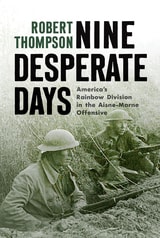
Nine Desperate Days
America's Rainbow Division in the Aisne-Marne OffensiveRobert Thompson
Westholme Publishing, 2022
American forces entered World War I combat in October 1917, but it was not until July 1918 that they went on the offensive for the first time. Among the units selected for this operation was the 42nd Division, or the “Rainbow Division” as it was known popularly. This division, which was composed of National Guard units from twenty-six states, including Joyce Kilmer’s 69th New York Infantry, would spend 164 days in combat, a number exceeded by only two other American divisions. However, it was the nine days from July 25 to August 2, 1918 that were the most terrible and heroic in the division’s history. General of the Army Douglas MacArthur, who served as the division’s chief of staff, later said of the Rainbow Division’s fighting during those pivotal days, “There was neither rest nor mercy.” During those nine days, the Rainbow Division would spearhead the Allied attack in the Aisne-Marne region, the final phase of the Second Battle of the Marne, which saw the last major German offensive on the Western Front defeated. Unfortunately, American leadership proved to be completely unprepared for a dynamic war of maneuver. Basing decisions on wildly inaccurate information about the Germans, senior commanders ordered the men of the Rainbow Division to make ill-advised assaults again and again with little support. Facing an enemy who was determined to hold itspositions, these National Guardsmen fought with courage and determination to gain what was often only yards of ground, and did so at a deadly cost.
In Nine Desperate Days: America’s Rainbow Division in the Aisne-Marne Offensive, historian Robert Thompson chronicles the hardships and tenacity of the men from the 42nd Division during this pivotal campaign. The Americans did not break despite heavy losses, and were able to drive the Germans back from territory they initially gained. The efforts of the Rainbow Division during Aisne-Marne were key to the ultimate Allied victory and are a symbol of American valor and sacrifice during the “war to end all wars.”
No Country for Travellers?
British Visitors to Spain and Portugal, 1760–1820Rosemary Sweet and Richard Ansell
University College London, 2025
Using extensive archival and printed sources left by contemporary travelers, No Country for Travellers? explores the rise and nature of British travel to Spain and Portugal in the late eighteenth and early nineteenth centuries. Not only is it the first book to address the trend of travelers to the Iberian Peninsula during this time, revealing the extent of British interest in Islamic Spain before the Romantic era, but it also brings to light the role of non-combatant travelers to Iberia during the Peninsular War. Beyond uncovering a previously overlooked dimension of the Peninsular War, this history contends with stereotypes of Iberia that were embedded in early modern confessional and civilizational hierarchies.

No Man Is An Island
Community and Commemoration on Norway's UtøyaJørgen Watne Frydnes, translated by Wendy H. Gabrielsen
University of Massachusetts Press, 2025
On July 22, 2011, a white supremacist killed eight people at Oslo’s Government Center in Norway and then terrorized the idyllic island of Utøya, where he executed sixty-nine more people, mostly teenagers. The country had never suffered such a massacre, and in the aftermath, the entire population was reeling.
Utøya, the Norwegian Labor Party’s summer camp for youth, a beloved place where many Norwegians learned about democratic values and processes, made lifelong friendships, and developed a vision for a just society, became mired in grief and discord. When Jørgen Watne Frydnes took on the daunting task of rebuilding the island and charting its future, he had to figure out a compassionate and just way forward. He made a radical decision: he set out to talk with each family of a murdered person, seeking to understand their needs and their hopes so that the future of the island could include their wishes and concerns. This emotionally grueling work, which was never considered in the scholarly literature on commemoration, led to a true renewal of Utøya, resulting in a meaningful memorial to those who were lost as well as beautiful surroundings for campers who come there to study democracy and peace.
Frydnes’s narrative, originally published in Norwegian, is structured around the seasons of the year and the landscape of the island, and tracks one person’s account of learning how to remember, commemorate, and honor the dead, and acknowledge a mass tragedy, and yet also create a nurturing, aspirational space for hope.

No Sacrifice Too Great
The 1st Infantry Division in World War IIGregory Fontenot
University of Missouri Press, 2027
The U.S. 1st Infantry Division (1st ID), familiarly known as the Big Red One, adapted to dynamic battlefield conditions throughout the course of its deployment during World War II by innovating and altering behavior, including tactics, techniques, and procedures. Both the Division’s leaders and soldiers accomplished this by thinking critically about their experiences in combat and wasting little time in putting lessons learned to good use. Simply put, they learned on the job—in battle and after battle—and did so quickly.
In telling the Division’s WWII story, which includes an extensive photographic essay featuring many previously unpublished images, Gregory Fontenot includes the stories of individual members of the Big Red One, from high-ranking officers to enlisted men fresh off the streets of Brooklyn, both during and after the conflict. Colonel Fontenot’s rare ability to combine expert analysis with compelling narrative history makes No Sacrifice Too Great an absorbing read for anyone interested in the military history of the United States.

Noble Volunteers
The British Soldiers Who Fought the American RevolutionDon N. Hagist
Westholme Publishing, 2025
Winner of the 2020 American Revolution Roundtable of Philadelphia Book of the Year
Redcoats. For Americans, the word brings to mind the occupying army that attempted to crush the Revolutionary War. There was more to these soldiers than their red uniforms, but the individuals who formed the ranks are seldom described in any detail in historical literature, leaving unanswered questions. Who were these men? Why did they join the army? Where did they go when the war was over?
In Noble Volunteers: The British Soldiers Who Fought the American Revolution, Don N. Hagist brings life to these soldiers, describing the training, experiences, and outcomes of British soldiers who fought during the Revolution. Drawing on thousands of military records and other primary sources in British, American, and Canadian archives, and the writings of dozens of officers and soldiers, Noble Volunteers shows how a peacetime army responded to the onset of war, how professional soldiers adapted quickly and effectively to become tactically dominant, and what became of the thousands of career soldiers once the war was over.
In this historical tour de force, introduced by Pulitzer Prize winner Rick Atkinson, Hagist dispels long-held myths, revealing how remarkably diverse British soldiers were. They represented a variety of ages, nationalities, and socioeconomic backgrounds, and many had joined the army as a peacetime career, only to find themselves fighting a war on another continent in often brutal conditions. Against the sweeping backdrop of the war, Hagist directs his focus on the small picture, illuminating the moments in an individual soldier’s life—those hours spent nursing a fever while standing sentry in the bitter cold, or writing a letter to a wife back home. What emerges from these vignettes is the understanding that while these were “common” soldiers, each soldier was completely unique, for, as Hagist writes, “There was no ‘typical’ British soldier.”
None a Stranger There
England and/in Europe on the Early Modern StageEdited by Scott Oldenburg and Matteo Pangallo
University of Alabama Press, 2025
Nordic Socialism
The Path Toward a Democratic EconomyPelle Dragsted, Translated by William Banks
University of Wisconsin Press, 2025
In Dragsted’s analysis, Denmark and the rest of the Nordic countries are already socialist, but only in part. The dangers come (and here many conservative Americans will disagree) from the unhealthy encroachment of capitalism. His provocative argument is that capitalism and socialism are not in fact mutually exclusive, and already Nordic economies are hybrids, a mix of decommodified, democratically governed sectors and undemocratic, privately controlled enterprises. The relevant question is the degree to which one dominates the other. Currently, undemocratic forces are ascendant, but it need not be so. Dragsted offers both his diagnosis and his proposed solution, a comprehensive plan for a gradual (re)democratization of the economy and a move to fully and firmly embrace, and redefine, “Nordic socialism.”