Results by title
79 books match the query 'Evolution (Biology)' and 2 start with n
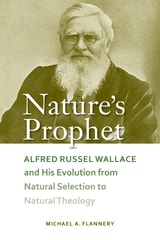
Nature's Prophet
Alfred Russel Wallace and His Evolution from Natural Selection to Natural TheologyMichael A. Flannery
University of Alabama Press, 2018
An astute study of Alfred Russel Wallace’s path to natural theology.
A spiritualist, libertarian socialist, women’s rights advocate, and critic of Victorian social convention, Alfred Russel Wallace was in every sense a rebel who challenged the emergent scientific certainties of Victorian England by arguing for a natural world imbued with purpose and spiritual significance. Nature’s Prophet: Alfred Russel Wallace and His Evolution from Natural Selection to Natural Theology is a critical reassessment of Wallace’s path to natural theology and counters the dismissive narrative that Wallace’s theistic and sociopolitical positions are not to be taken seriously in the history and philosophy of science.
Author Michael A. Flannery provides a cogent and lucid account of a crucial—and often underappreciated—element of Wallace’s evolutionary worldview. As co-discoverer, with Charles Darwin, of the theory of natural selection, Wallace willingly took a backseat to the well-bred, better known scientist. Whereas Darwin held fast to his first published scientific explanations for the development of life on earth, Wallace continued to modify his thinking, refining his argument toward a more controversial metaphysical view which placed him within the highly charged intersection of biology and religion.
Despite considerable research into the naturalist’s life and work, Wallace’s own evolution from natural selection to natural theology has been largely unexplored; yet, as Flannery persuasively shows, it is readily demonstrated in his writings from 1843 until his death in 1913. Nature’s Prophet provides a detailed investigation of Wallace’s ideas, showing how, although he independently discovered the mechanism of natural selection, he at the same time came to hold a very different view of evolution from Darwin.
Ultimately, Flannery shows, Wallace’s reconsideration of the argument for design yields a more nuanced version of creative and purposeful theistic evolution and represents one of the most innovative contributions of its kind in the Victorian and Edwardian eras, profoundly influencing a later generation of scientists and intellectuals.
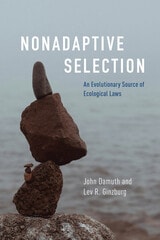
Nonadaptive Selection
An Evolutionary Source of Ecological LawsJohn Damuth and Lev R. Ginzburg
University of Chicago Press, 2025
In this important treatise, ecologists and evolutionary biologists John Damuth and Lev R. Ginzburg identify a specific evolutionary process in biology, which they call nonadaptive selection. The idea is simple, but the implications are profound. Nonadaptive selection, as they use the term, is selection among biological entities (as is natural selection) but is based on the fitness effects of structural properties intrinsic to the entities under selection rather than on interactions between traits and a local shared environment. In other words, features of systems that evolve by nonadaptive selection do not adapt to local environmental conditions; rather, this selective process increases the long-term stability of the focal systems independent of local conditions.
Nonadaptive selection may be of particular value in explaining broad, persistent patterns in multispecies biological units where adaptive evolution may be weak or poorly defined. Examples include Damuth’s Law, the equivalence of energy use among animal species across a wide range of body sizes; the ratio-dependent, or Arditi-Ginzburg, predation conjecture; the consistency of allometric scaling powers; the shortness of trophic chains; and the prevalence of certain types of three-species trophic structures across ecosystems. Damuth and Ginzburg see nonadaptive selection underlying patterns of ecological allometries, community structure, and species interactions, with some implications for macroevolution. Moreover, they find a surprising relationship between these nonadaptive processes and biological laws. They do not advocate the reorientation of any existing research programs but present nonadaptive selection as an additional conceptual framework that may be useful to add to ecology and evolution.