932 books match the query 'Genres & Styles' and 15 start with n
cover of Nabucodonosor: Dramma lirico in Four Parts by Temistocle Solera

Nabucodonosor

Dramma lirico in Four Parts by Temistocle Solera

Giuseppe Verdi

University of Chicago Press, 1988
Nabucodonosor, one of the early Verdi operas, is the third work to be published in The Works of Giuseppe Verdi. Following the strict requirements of the series, the edition is based on Verdi's autograph and other authentic sources, and has been reviewed by a distinguished editorial board—Philip Gossett, Julian Budden, Martin Chusid, Francesco Degrada, Ursula Günther, Giorgio Pestelli, and Pierluigi Petrobelli. Nabucodonosor is available as a two-volume set: a full orchestral score and a critical commentary. The score, which has been beautifully bound and autographed, is printed on high-grade paper in an oversized, 10-1/2 x 14-1/2-inch format. The introduction to the score discusses the work's genesis, sources, and performance history as well as performance practices, instrumentation, and problems of notation. The critical commentary, printed in a smaller format, discusses editorial decisions and identifies the sources of alternate readings of the music and libretto.
[more]
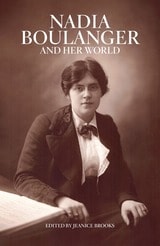
cover of Nadia Boulanger and Her World

Nadia Boulanger and Her World

Edited by Jeanice Brooks

University of Chicago Press, 2020

Nadia Boulanger (1887–1979) was arguably one of the most iconic figures in twentieth-century music, and certainly among the most prominent musicians of her time. For many composers— especially Americans from Aaron Copland to Philip Glass—studying with Boulanger in Paris or Fontainebleau was a formative moment in a creative career.

Composer, performer, conductor, impresario, and charismatic and inspirational teacher, Boulanger engaged in a vast array of activities in a variety of media, from private composition lessons and lecture-recitals to radio broadcasts, recordings, and public performances. But how to define and account for Boulanger’s impact on the music world is still unclear. Nadia Boulanger and Her World takes us from a time in the late nineteenth century, when many careers in music were almost entirely closed to women, to the moment in the late twentieth century when those careers were becoming a reality. Contributors consider Boulanger’s work in the worlds of composition, musical analysis, and pedagogy and explore the geographies of transatlantic and international exchange and disruption within which her career unfolded. Ultimately, this volume takes its title as a topic for exploration—asking what worlds Boulanger belonged to, and in what sense we can consider any of them to be “hers.”
[more]
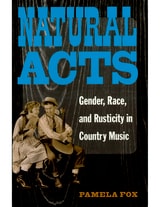
cover of Natural Acts: Gender, Race, and Rusticity in Country Music

Natural Acts

Gender, Race, and Rusticity in Country Music

Pamela Fox

University of Michigan Press, 2009
Whether found in country barn dances, the plaintive twang of Hank Williams, the glitzy glamour of Dolly Parton, or the country-pop sound of Faith Hill, country music has always maintained an allegiance to its own authenticity. Its specific sounds and images have changed over the past century, but country music has consistently been associated with rusticity, a notion connected to the working class and rooted in ideals like unspoiled rural life and values and humble origins. The music suggests not only uncomplicated musical arrangements and old-time instruments such as the banjo and fiddle, but performers who identify with their everyday fans. Natural Acts explores the ways that country musicians -- particularly women artists -- have established a "natural" country identity. Pamela Fox focuses on five revealing moments in country performance: blackface comedy during country music's "Golden Age" of pre-1945 radio and stage programming; the minstrel's "rube" or hillbilly equivalent in the same period; postwar honky-tonk music and culture; the country star memoir or autobiography of the '80s and '90s; and the recent roots phenomenon known as alt.country. "'All I gotta do is act naturally,' Buck Owens sang, and Pamela Fox knows where the acting comes in. From early hillbilly acts to alt.country, Natural Acts lays bare, with wide-ranging scholarship and incisive analysis, the ideologies of authenticity on which country music rests. As engrossing and useful as any book I know on country music." ---Eric Lott, author of Love and Theft: Blackface Minstrelsy and the American Working Class "The first completely mature book of country music historical criticism. It is a deep investigation of country music's power to articulate the displaced pleasures and anxieties of a society wracked by structural change. Historically rigorous, Fox uncovers documents that demonstrate the ongoing power of minstrelsy in barn dance programs across the country past World War II; musically and lyrically astute, she shows how the best honky-tonk music simultaneously critiques the dangers of that setting while seductively luring listeners to those sawdust and alcohol drenched environments; with her ear attuned to the formal complexities of autobiography, Fox directs our attention to the contradictory performance of identity that characterizes the life stories of Reba McEntire, Naomi Judd, Dolly Parton, and others. Natural Acts is provocative, stunning, and engagingly written. Country music studies has come of age." ---Barry Shank, The Ohio State University
[more]
cover of Negotiated Moments: Improvisation, Sound, and Subjectivity

Negotiated Moments

Improvisation, Sound, and Subjectivity

Gillian Siddall and Ellen Waterman, editors

Duke University Press, 2016

The contributors to Negotiated Moments explore how subjectivity is formed and expressed through musical improvisation, tracing the ways the transmission and reception of sound occur within and between bodies in real and virtual time and across memory, history, and space. They place the gendered, sexed, raced, classed, disabled, and technologized body at the center of critical improvisation studies and move beyond the field's tendency toward celebrating improvisation's utopian and democratic ideals by highlighting the improvisation of marginalized subjects. Rejecting a singular theory of improvisational agency, the contributors show how improvisation helps people gain hard-won and highly contingent agency. Essays include analyses of the role of the body and technology in performance, improvisation's ability to disrupt power relations, Pauline Oliveros's ideas about listening, flautist Nicole Mitchell's compositions based on Octavia Butler's science fiction, and an interview with Judith Butler about the relationship between her work and improvisation. The contributors' close attention to improvisation provides a touchstone for examining subjectivities and offers ways to hear the full spectrum of ideas that sound out from and resonate within and across bodies. 

Contributors. George Blake, David Borgo, Judith Butler, Rebecca Caines, Louise Campbell, Illa Carrillo Rodríguez, Berenice Corti, Andrew Raffo Dewar, Nina Eidsheim, Tomie Hahn, Jaclyn Heyen, Christine Sun Kim, Catherine Lee, Andra McCartney, Tracy McMullen, Kevin McNeilly, Leaf Miller, Jovana Milovic, François Mouillot, Pauline Oliveros, Jason Robinson, Neil Rolnick, Simon Rose, Gillian Siddall, Julie Dawn Smith, Jesse Stewart, Clara Tomaz, Sherrie Tucker, Lindsay Vogt, Zachary Wallmark, Ellen Waterman, David Whalen, Pete Williams, Deborah Wong, Mandy-Suzanne Wong
[more]
cover of Negro Soy Yo: Hip Hop and Raced Citizenship in Neoliberal Cuba

Negro Soy Yo

Hip Hop and Raced Citizenship in Neoliberal Cuba

Marc D. Perry

Duke University Press, 2016
In Negro Soy Yo Marc D. Perry explores Cuba’s hip hop movement as a window into the racial complexities of the island’s ongoing transition from revolutionary socialism toward free-market capitalism. Centering on the music and lives of black-identified raperos (rappers), Perry examines the ways these young artists craft notions of black Cuban identity and racial citizenship, along with calls for racial justice, at the fraught confluence of growing Afro-Cuban marginalization and long held perceptions of Cuba as a non-racial nation. Situating hip hop within a long history of Cuban racial politics, Perry discusses the artistic and cultural exchanges between raperos and North American rappers and activists, and their relationships with older Afro-Cuban intellectuals and African American political exiles. He also examines critiques of Cuban patriarchy by female raperos, the competing rise of reggaetón, as well as state efforts to incorporate hip hop into its cultural institutions. At this pivotal moment of Cuban-U.S. relations, Perry's analysis illuminates the evolving dynamics of race, agency, and neoliberal transformation amid a Cuba in historic flux. 
[more]
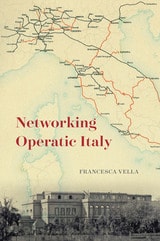
cover of Networking Operatic Italy

Networking Operatic Italy

Francesca Vella

University of Chicago Press, 2022

A study of the networks of opera production and critical discourse that shaped Italian cultural identity during and after Unification.

Opera’s role in shaping Italian identity has long fascinated both critics and scholars. Whereas the romance of the Risorgimento once spurred analyses of how individual works and styles grew out of and fostered specifically “Italian” sensibilities and modes of address, more recently scholars have discovered the ways in which opera has animated Italians’ social and cultural life in myriad different local contexts.

In Networking Operatic Italy, Francesca Vella reexamines this much-debated topic by exploring how, where, and why opera traveled on the mid-nineteenth-century peninsula, and what this mobility meant for opera, Italian cities, and Italy alike. Focusing on the 1850s to the 1870s, Vella attends to opera’s encounters with new technologies of transportation and communication, as well as its continued dissemination through newspapers, wind bands, and singing human bodies. Ultimately, this book sheds light on the vibrancy and complexity of nineteenth-century Italian operatic cultures, challenging many of our assumptions about an often exoticized country.
[more]
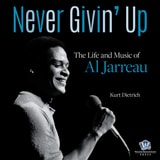
cover of Never Givin' Up: The Life and Music of Al Jarreau

Never Givin' Up

The Life and Music of Al Jarreau

Kurt Dietrich

Wisconsin Historical Society Press, 2023

The inspiring story of an iconic singer from Milwaukee

This is the first biography to chronicle the life and career of one of the most distinguished and beloved musical artists to come out of Wisconsin: Al Jarreau. From his earliest days singing in the 1940s until his death in 2017, Jarreau defied categorization. While his biggest hit, “We’re In This Love Together,” is pure pop, he smashed music industry stereotypes as the first artist to win Grammy Awards in three genres: jazz, pop, and R&B. 

Never Givin’ Up traces Jarreau’s singing career from humble beginnings in his hometown of Milwaukee to international fame. The narrative includes his formative student days at Ripon College and the University of Iowa, as well as the years spent honing his craft at nightspots in Milwaukee, San Francisco, and the Twin Cities. After he was signed by Warner Bros. Records in 1975 at the age of 35, Jarreau achieved stardom with his innovative vocal stylings and electric live performances.

This book includes more than 20 sidebars with bonus information about every Jarreau album and behind-the-scenes stories about the making of the records. Author Kurt Dietrich conducted interviews with dozens of Al's friends, fellow musicians, professional associates, and family members—most notably Al’s sister, Rose Marie Freeman, who was a major contributor to the project. Featuring 54 images spanning Jarreau’s life, from never-before-seen family snapshots to stills from his legendary stage performances, Never Givin’ Up celebrates a Milwaukee hometown hero and global sensation. 

Silver Medal Winner for the 2023 Foreword INDIES Book of the Year Award for Performing Arts and Music 

Finalist for the Association for Recorded Sound Collections’ Award for Best Historical Research in Recorded Jazz 


“Kurt Dietrich has created a masterful book, revealing and depicting a detailed version of my brother, Al Jarreau, through his music and career. In these pages, I see Al’s determination and his admirable goal of ‘Never Givin’ Up’ on his joy of singing. It was my distinct pleasure to work with Kurt Dietrich in the process, establishing what has become a bond of family-like friendship that will endure for a lifetime and beyond.”
—Rose Marie (Jarreau) Freeman

“Dietrich captures Jarreau’s simultaneously gregarious and shy charm while revealing his own affection for this gifted and gracious performer. It’s his love letter to a Milwaukee legend.”
—Bill Milkowski, author of Jaco: The Extraordinary and Tragic Life of Jaco Pastorius and Ode to a Tenor Titan: The Life and Times and Music of Michael Brecker 

"Written in an approachable style and carefully documented, this book will be valuable for fans and researchers of Jarreau’s music. Summing Up: Highly recommended."
—Choice Reviews
 
[more]
cover of Never Givin' Up: The Life and Music of Al Jarreau

Never Givin' Up

The Life and Music of Al Jarreau

Kurt Dietrich

Wisconsin Historical Society Press, 2025

The inspiring story of an iconic singer from Milwaukee

This is the first biography to chronicle the life and career of one of the most distinguished and beloved musical artists to come out of Wisconsin: Al Jarreau. From his earliest days singing in the 1940s until his death in 2017, Jarreau defied categorization. While his biggest hit, “We’re In This Love Together,” is pure pop, he smashed music industry stereotypes as the first artist to win Grammy Awards in three genres: jazz, pop, and R&B. 

Never Givin’ Up traces Jarreau’s singing career from humble beginnings in his hometown of Milwaukee to international fame. The narrative includes his formative student days at Ripon College and the University of Iowa, as well as the years spent honing his craft at nightspots in Milwaukee, San Francisco, and the Twin Cities. After he was signed by Warner Bros. Records in 1975 at the age of 35, Jarreau achieved stardom with his innovative vocal stylings and electric live performances.

This book includes more than 20 sidebars with bonus information about every Jarreau album and behind-the-scenes stories about the making of the records. Author Kurt Dietrich conducted interviews with dozens of Al's friends, fellow musicians, professional associates, and family members—most notably Al’s sister, Rose Marie Freeman, who was a major contributor to the project. Never Givin’ Up celebrates a Milwaukee hometown hero and global sensation. 

Silver Medal Winner for the 2023 Foreword INDIES Book of the Year Award for Performing Arts and Music 

Finalist for the Association for Recorded Sound Collections’ Award for Best Historical Research in Recorded Jazz 


“Kurt Dietrich has created a masterful book, revealing and depicting a detailed version of my brother, Al Jarreau, through his music and career. In these pages, I see Al’s determination and his admirable goal of ‘Never Givin’ Up’ on his joy of singing. It was my distinct pleasure to work with Kurt Dietrich in the process, establishing what has become a bond of family-like friendship that will endure for a lifetime and beyond.”
—Rose Marie (Jarreau) Freeman

“Dietrich captures Jarreau’s simultaneously gregarious and shy charm while revealing his own affection for this gifted and gracious performer. It’s his love letter to a Milwaukee legend.”
—Bill Milkowski, author of Jaco: The Extraordinary and Tragic Life of Jaco Pastorius and Ode to a Tenor Titan: The Life and Times and Music of Michael Brecker 

"Written in an approachable style and carefully documented, this book will be valuable for fans and researchers of Jarreau’s music. Summing Up: Highly recommended."
—Choice Reviews
 
[more]
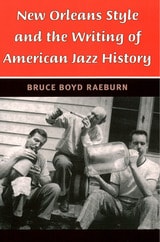
cover of New Orleans Style and the Writing of American Jazz History

New Orleans Style and the Writing of American Jazz History

Bruce Boyd Raeburn

University of Michigan Press, 2009
New Orleans Style tells the tale of the recognition of New Orleans jazz as a discrete style and how that recognition affected the writing of American jazz history. The men and women who participated in the awakening of American jazz scholarship were partisans of a community of "hot" record collectors, whose interest in the origins of jazz was a foregone conclusion. As an international network of these collectors took shape between the 1920s and 1934, they provided a mechanism for the circulation of historical information on jazz, which then became the basis for the emergence of a jazz literati writing for magazines such as Down Beat, Esquire, the New Republic, and Jazz Information. It was not until later that writers like Charles Edward Smith and William Russell, inspired by their love for the music and emphasizing "New Orleans style," explained in works such as Jazzmen (1939) and The Jazz Record Book (1942) that jazz was "born in New Orleans." Raeburn traces the conceptualization of jazz history derived from Jazzmen to jazz's ultimate refuge in New Orleans and its integration into the cultures which it celebrated. The result is an essential work of jazz criticism that will fill a major gap in the field's literature.
[more]
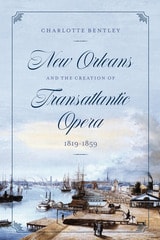
cover of New Orleans and the Creation of Transatlantic Opera, 1819–1859

New Orleans and the Creation of Transatlantic Opera, 1819–1859

Charlotte Bentley

University of Chicago Press, 2022

A history of nineteenth-century New Orleans and the people who made it a vital, if unexpected, part of an emerging operatic world.

New Orleans and the Creation of Transatlantic Opera, 1819–1859 explores the thriving operatic life of New Orleans in the first half of the nineteenth century, drawing out the transatlantic connections that animated it. By focusing on a variety of individuals, their extended webs of human contacts, and the materials that they moved along with them, this book pieces together what it took to bring opera to New Orleans and the ways in which the city’s operatic life shaped contemporary perceptions of global interconnection. The early chapters explore the process of bringing opera to the stage, taking a detailed look at the management of New Orleans’s Francophone theater, the Théâtre d’Orléans, as well as the performers who came to the city and the reception they received. But opera’s significance was not confined to the theater, and later chapters of the book examine how opera permeated everyday life in New Orleans, through popular sheet music, novels, magazines and visual culture, and dancing in its many ballrooms. Just as New Orleans helped to create transatlantic opera, opera in turn helped to create the city of New Orleans.
[more]
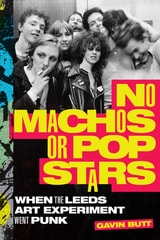
cover of No Machos or Pop Stars: When the Leeds Art Experiment Went Punk

No Machos or Pop Stars

When the Leeds Art Experiment Went Punk

Gavin Butt

Duke University Press, 2022

After punk’s arrival in 1976, many art students in the northern English city of Leeds traded their paintbrushes for guitars and synthesizers. In bands ranging from Gang of Four, Soft Cell, and Delta 5 to the Mekons, Scritti Politti, and Fad Gadget, these artists-turned-musicians challenged the limits of what was deemed possible in rock and pop music. Taking avant-garde ideas to the record-buying public, they created Situationist antirock and art punk, penned deconstructed pop ditties about Jacques Derrida, and took the aesthetics of collage and shock to dark, brooding electro-dance music. In No Machos or Pop Stars Gavin Butt tells the fascinating story of the post-punk scene in Leeds, showing how England’s state-funded education policy brought together art students from different social classes to create a fertile ground for musical experimentation. Drawing on extensive interviews with band members, their associates, and teachers, Butt details the groups who wanted to dismantle both art world and music industry hierarchies by making it possible to dance to their art. Their stories reveal the subversive influence of art school in a regional music scene of lasting international significance.
[more]
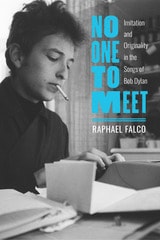
cover of No One to Meet: Imitation and Originality in the Songs of Bob Dylan

No One to Meet

Imitation and Originality in the Songs of Bob Dylan

Raphael Falco

University of Alabama Press, 2022

WINNER OF THE ELIZABETH AGEE PRIZE IN AMERICAN LITERATURE

A groundbreaking appreciation of Dylan as a literary practitioner.

The literary establishment tends to regard Bob Dylan as an intriguing, if baffling, outsider. That changed overnight when Dylan was awarded the 2016 Nobel Prize in Literature, challenging us to think of him as an integral part of our national and international literary heritage. No One to Meet: Imitation and Originality in the Songs of Bob Dylan places Dylan the artist within a long tradition of literary production and offers an innovative way to understand his unique and often controversial methods of composition.

Dylan expert Raphael Falco traces the similarities between the way Dylan borrows, digests, and transforms traditional songs and what Renaissance writers called imitatio. Although Dylan’s lyrical postures may suggest an avant-garde consciousness, No One to Meet shows that Dylan’s creative process creatively expands methods used by classical and Renaissance authors.

Drawing on numerous examples, including Dylan’s previously unseen manuscript excerpts and archival materials, Raphael Falco illuminates how the ancient process of poetic imitation, handed down from Greco-Roman antiquity, allows us to make sense of Dylan’s musical and lyrical technique. By placing Dylan firmly in the context of an age-old poetic practice, No One to Meet deepens our appreciation of Dylan’s songs and allows us to celebrate him as what he truly is: a great writer.
 

[more]
cover of Not without Madness: Perspectives on Opera

Not without Madness

Perspectives on Opera

Fabrizio Della Seta

University of Chicago Press, 2012
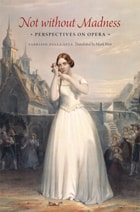
Opera often seems to arouse either irrational enthusiasm or visceral dislike. Such madness, as Goethe wrote, is indispensable in all theater, and yet in practice, sentiment and passion must be balanced by sense and reason. Exploring this tension between madness and reason, Not without Madness presents new analytical approaches to thinking about eighteenth- and nineteenth-century opera through the lenses of its historical and cultural contexts.
 
In these twelve essays, Fabrizio Della Seta explores the concept of opera as a dramatic event and an essential moment in the history of theater. Examining the meaning of opera and the devices that produce and transmit this meaning, he looks at the complex verbal, musical, and scenic mechanisms in parts of La sonnambula, Ernani, Aida, Le nozze di Figaro, Macbeth, and Il trovatore. He argues that approaches to the study of opera must address performance, interpretation, composition, reception, and cultural ramifications. Purely musical analysis does not make sense unless we take into account music’s dramatic function. Containing many essays available for the first time in English, Not without Madness bridges recent divisions in opera studies and will attract musicologists, musicians, and opera lovers alike.
[more]
cover of Notes to Make the Sound Come Right: Four Innovators of Jazz Poetry

Notes to Make the Sound Come Right

Four Innovators of Jazz Poetry

T.J. Anderson III

University of Arkansas Press, 2004
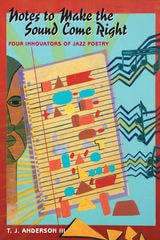
In “When Malindy Sings” the great African American poet Paul Laurence Dunbar writes about the power of African American music, the “notes to make the sound come right.” In this book T. J. Anderson III, son of the brilliant composer, Thomas Anderson Jr., asserts that jazz became in the twentieth century not only a way of revising old musical forms, such as the spiritual and work song, but also a way of examining the African American social and cultural experience. He traces the growing history of jazz poetry and examines the work of four innovative and critically acclaimed African American poets whose work is informed by a jazz aesthetic: Stephen Jonas (1925?–1970) and the unjustly overlooked Bob Kaufman (1925–1986), who have affinities with Beat poetry; Jayne Cortez (1936– ), whose work is rooted in surrealism; and the difficult and demanding Nathaniel Mackey (1947– ), who has links to the language writers. Each fashioned a significant and vibrant body of work that employs several of the key elements of jazz. Anderson shows that through their use of complex musical and narrative weaves these poets incorporate both the tonal and performative structures of jazz and create work that articulates the African journey. From improvisation to polyrhythm, they crafted a unique poetics that expresses a profound debt to African American culture, one that highlights the crucial connection between music and literary production and links them to such contemporary writers as Michael Harper, Amiri Baraka, and Yusef Komunyakaa, as well as young recording artists—United Future Organization, Us3, and Groove Collection—who have successfully merged hip-hop poetry and jazz.
[more]
cover of Now that the audience is assembled

Now that the audience is assembled

David Grubbs

Duke University Press, 2018

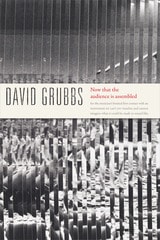
Following his investigation into experimental music and sound recording in Records Ruin the Landscape, David Grubbs turns his attention to the live performance of improvised music with an altogether different form of writing. Now that the audience is assembled is a book-length prose poem that describes a fictional musical performance during which an unnamed musician improvises the construction of a series of invented instruments before an audience that is alternately contemplative, participatory, disputatious, and asleep. Over the course of this phantasmagorical all-night concert, repeated interruptions take the form of in-depth discussions and musical demonstrations. Both a work of literature and a study of music, Now that the audience is assembled explores the categories of improvised music, solo performance, text scores, instrument building, aesthetic deskilling and reskilling, and the odd fate of the composer in experimental music.
[more]