Results by title
715 books match the query 'Higher' and 9 start with n
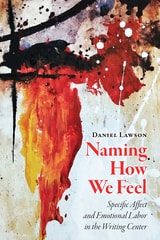
Naming How We Feel
Specific Affect and Emotional Labor In the Writing CenterDaniel Lawson
Utah State University Press, 2026
Writing centers are the locus for a wide range of emotional labor on campus, often serving students beyond the typical educational purpose. Naming How We Feel grapples with the question of how writing center administrators account for, train for, and theorize emotion and affect in the writing center to facilitate better and more ethical practices and considers how writing center administrators might ameliorate the costs of such emotional labor to faculty, tutors, and students.
Beginning with a discussion of how writing center scholars might identify and understand emotional labor, the book then expands to examine richly varied case studies and anecdotes to showcase how tutors tend to experience such labor and consider its relationship and association with emotional intelligence and burnout. Lawson considers how the field might better prepare and train tutors for affect and emotional labor, ultimately advocating for more equitable conditions for emotional labor within writing centers.
Naming How We Feel examines the critical role feelings play in writing and writing center work, offering advice on training tutors for emotional labor and literacy and suggestions for how administrators might engage institutional stakeholders to create and support more equitable conditions for emotional labor within their writing centers.
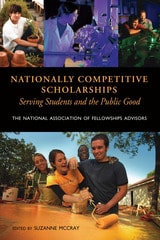
Nationally Competitive Scholarships
Serving Students and the Public GoodSuzanne McCray
University of Arkansas Press, 2007
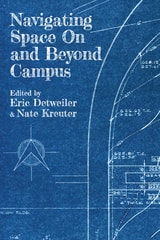
Navigating Space On and Beyond Campus
Eric Detweiler
Utah State University Press, 2026
Offering practical applications of scholarship in spatial theory and rhetorics of space and place, Navigating Space On and Beyond Campus profiles how writing and rhetoric programs across the United States have responded to the spatial challenges and possibilities facing higher education. Exploring how instructors creatively and critically navigate actual, virtual, and inaccessible spaces in the pursuit of effective, ethically informed rhetoric and writing education, this book also reveals how the use of space contributes to the creation and/or denial of equity among students, faculty, and programs.
Contributors document how they have secured and repurposed campus real estate, literally and metaphorically navigated relationships with other campus resources, and responded to austerity measures that have threatened the spaces they have historically called their own. Individual sections focus on the historical pressures that have shaped programs’ locations and resources, developments in the work and design of writing centers, the creation of new labs and centers, and the relationship between writing programs and the broader places and communities with which they are intertwined.
How spaces are allocated, structured, and regulated is a key determinant of access and equity in higher education. Navigating Space On and Beyond Campus offers timely strategies for and reflections on the place of rhetoric and writing on college and university campuses.

Nettl's Elephant
Bruno Nettle
University of Illinois Press, 2010
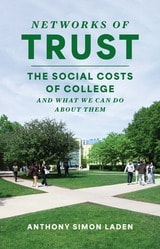
Networks of Trust
The Social Costs of College and What We Can Do about ThemAnthony Simon Laden
University of Chicago Press, 2024
Higher education is a familiar battlefield in today’s culture wars. The right accuses colleges and universities of indoctrinating conservative students with liberal values; the left, with failing to be sufficiently inclusive. The anxieties expressed on both sides of the political spectrum have much in common, however, and they are triggered not by colleges’ failures but by their successes.
So argues philosopher Anthony Simon Laden in Networks of Trust. He highlights how a college education shapes students’ informational trust networks: the complex set of people and institutions they rely on for the information they use to think about and understand the world. While the networks that colleges build for students have great value, learning to inhabit them pulls some students away from their families and communities. If many people distrust institutions of higher education, this is one reason why. Networks of Trust offers a path forward, one that preserves the value while reducing the harms of a college education. It includes concrete suggestions for how colleges and universities can educate students in a manner that inspires and deserves trust: one that bridges rather than deepens our social divides.
Networks of Trust
The Social Costs of College and What We Can Do about ThemAnthony Simon Laden
University of Chicago Press, 2024
An eye-opening look at how parents’ mistrust of colleges has less to do with what their kids are learning than with whom they come to trust.
Higher education is a familiar battlefield in today’s culture wars. The right accuses colleges and universities of indoctrinating conservative students with liberal values; the left, with failing to be sufficiently inclusive. The anxieties expressed on both sides of the political spectrum have much in common, however, and they are triggered not by colleges’ failures but by their successes.
So argues philosopher Anthony Simon Laden in Networks of Trust. He highlights how a college education shapes students’ informational trust networks: the complex set of people and institutions they rely on for the information they use to think about and understand the world. While the networks that colleges build for students have great value, learning to inhabit them pulls some students away from their families and communities. If many people distrust institutions of higher education, this is one reason why. Networks of Trust offers a path forward, one that preserves the value while reducing the harms of a college education. It includes concrete suggestions for how colleges and universities can educate students in a manner that inspires and deserves trust: one that bridges rather than deepens our social divides.
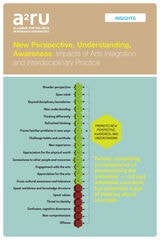
New Perspective, Understanding, Awareness
Impacts of Arts Integration and Interdisciplinary PracticeGabriel Harp
A2RU Intervals, 2019
Learn more online at a2ru.org about A2RU programs, alliance partners, and how to become an A2RU partner. Discover insights and tools to support the arts and design in research universities. You can also search and browse A2RU conference abstracts, working session captures, and a wide array of supporting materials from A2RU and its alliance partnerships.
New Work of Writing Across the Curriculum
Diversity and Inclusion, Collaborative Partnerships, and Faculty DevelopmentStaci M. Perryman-Clark
Utah State University Press, 2023
Many of these initiatives are created in isolation, reinforcing institutional silos that are not used strategically to gain the attention of senior administrators, particularly those working at state-supported public institutions who must manage shrinking institutional budgets. Yet teaching and learning centers and WAC programs gain tremendously from one another by building explicit partnerships on campus-wide diversity initiatives that emphasize cultural competence. In addition, both cultural competence and written proficiency enhance the transferable skills necessary for completing undergraduate education requirements, and this work can be leveraged to draw the attention of senior administrative leadership.
Faculty development and WAC need to make diversity and inclusion initiatives a priority for professional development. The New Work of Writing Across the Curriculum reviews initiatives that point to increased understanding of diversity and inclusion that will be of significance to administrators, WAC specialists, faculty developers, and diversity officers across the spectrum of institutions of higher learning.

Now Don't Try to Reason with Me
Essays and Ironies for a Credulous AgeWayne C. Booth
University of Chicago Press, 1970
“Professor Booth’s earnestness is graced by wit, irony, and generous humor.”—Louis Coxe, New Republic