Results by title
679 books match the query 'Historiography' and 10 start with n
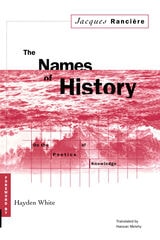
Names Of History
On the Poetics of KnowledgeJacques Ranciere
University of Minnesota Press, 1994
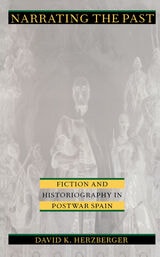
Narrating the Past
Fiction and Historiography in Postwar SpainDavid K. Herzberger
Duke University Press, 1995
The narrative and rhetorical strategies of historical discourse figure in both the fiction and historiography of postwar Spain. Herzberger analyzes these strategies, identifying the structures and vocabularies they use to frame the past and endow it with particular meanings. He shows how Francoist historians sought to affirm the historical necessity of Franco by linking the regime to a heroic and Christian past, while several types of postwar fiction—such as social realism, the novel of memory, and postmodern novels—created a voice of opposition to this practice. Focusing on the concept of writing history that these opposing strategies convey, Herzberger discloses the layering of truth and meaning that lies at the heart of postwar Spanish narrative from the early 1940s to the fall of Franco. His study clearly reveals how the novel in postwar Spain became a crucial form of dissent from the past as it was conceived and used by the State.
Making a decisive intervention in the debate about the ways in which narration determines both the meaning and truth of history and fiction, Narrating the Past will be of special interest to students and scholars of the politics, history, and literature of twentieth-century Spain.
Narratives Unbound
Historical studies in post-communist Eastern EuropePéter Apor
Central European University Press, 2007
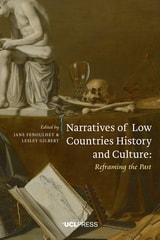
Narratives of Low Countries History and Culture
Reframing the PastEdited by Jane Fenoulhet and Lesley Gilbert
University College London, 2016
New Approaches to Latin American History
Edited by Richard Graham and Peter H. Smith
University of Texas Press, 1974
New Approaches to Latin American History incorporates methods and concepts from the social sciences without abandoning a distinctively historical approach. A collection of original essays by distinguished younger scholars, it proposes original concepts and methods for analyzing crucial problems in Latin American history.
Using as examples such subjects as salvery, dictatorship, immigration, and the relationship between land ownership and political power, the contributors show how approaches and techniques from psychology, political science, economics. and sociology can be applied to historical studies. The papers attempt to explain the thematic and substantive importance of the particular problems at hand; describe and evaluate standard approaches to them; propose original hypotheses; suggest methods for testing the hypotheses; or indicate major methodological or conceptual difficulties that have so far hampered such work.
Despite their diversity of content, the papers show strong underlying unities. First, they all point to the need for placing institutions and actions in a broad societal context. The authurs present an implicit, cumulative argument against the excessive isolation of historical phenomena. Second, they demonstrate the utility of interdisciplinary research. Third, they issue an implicit call for rigorous comparative analysis. The propositions formulated in these essays can best tested and modified in comparative fashion.
Ultimately this book deals with the exposition of a research style: a style based on systematic doubt, an awareness of the need for conceptual rigor, and a willingness to try new methodologies. For this reason it is of interest to historians in every field as well as to students of Latin America.
New Indians, Old Wars
Elizabeth Cook-Lynn
University of Illinois Press, 2006
Addressing Native American Studies' past, present, and future, the essays in New Indians, Old Wars tackle the discipline head-on, presenting a radical revision of the popular view of the American West in the process. Instead of luxuriating in its past glories or accepting the widespread historians' view of the West as a shared place, Elizabeth Cook-Lynn argues that it should be fundamentally understood as stolen.
Firmly grounded in the reality of a painful past, Cook-Lynn understands the story of the American West as teaching the political language of land theft and tyranny. She argues that to remedy this situation, Native American studies must be considered and pursued as its own discipline, rather than as a subset of history or anthropology. She makes an impassioned claim that such a shift, not merely an institutional or theoretical change, could allow Native American studies to play an important role in defending the sovereignty of indigenous nations today.
New Science, New World
Denise Albanese
Duke University Press, 1996
Albanese reads the inaugurators of the scientific revolution against the canonical authors of early modern literature, discussing Galileo’s Dialogue on the Two Chief World Systems and Bacon’s New Atlantis as well as Milton’s Paradise Lost and Shakespeare’s The Tempest. She examines how the newness or “novelty” of investigating nature is expressed through representations of the New World, including the native, the feminine, the body, and the heavens. “New” is therefore shown to be a double sign, referring both to the excitement associated with a knowledge oriented away from past practices, and to the oppression and domination typical of the colonialist enterprise. Exploring the connections between the New World and the New Science, and the simultaneously emerging patterns of thought and forms of writing characteristic of modernity, Albanese insists that science is at its inception a form of power-knowledge, and that the modern and postmodern division of “Two Cultures,” the literary and the scientific, has its antecedents in the early modern world.
New Science, New World makes an important contribution to feminist, new historicist, and cultural materialist debates about the extent to which the culture of seventeenth-century England is proto-modern. It will offer scholars and students from a wide range of fields a new critical model for historical practice.
New Terrains in Southeast Asian History
Abu Talib Ahmad
Ohio University Press, 2003
At a watershed moment in the scholarly approach to the history of this important region, New Terrains in Southeast Asian History captures the richness and diversity of historical discourse among Southeast Asian scholars. Through the perspectives of scholars who live and work within the region, the book offers readers a rare opportunity to enter into the world of Southeast Asian historiography. Individual chapters subject the dominance of national narratives to critical reflection and deconstruction, while others highlight the need to go beyond essentially political narratives to seek out deeper cultural, economic, and social structures by utilizing new sources, methodologies, and concepts. Taken as a whole, the book contends that new terrains in Southeast Asian history may be found “at the interstices and on the margins” where nations, societies, or cultures engage the unending processes of historical change.
The contributors are Abdul Rahman Haji Ismail, Abu Talib Ahmad, Andrew Hardy, Badriyah Haji Salleh, Brenda S. A. Yeoh, C. J. W.-L. Wee, Ni Ni Myint, Dhiravat na Pombejra, Hong Lysa, Huang Jianli, Kobkua Suwannathat-Pian, M. R. Fernando, P. Lim Pui Huen, Paul H. Kratoska, Tan Liok Ee, Thongchai Winichakul, and Yong Mun Cheong.
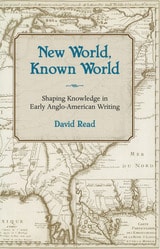
New World, Known World
Shaping Knowledge in Early Anglo-American WritingDavid Read
University of Missouri Press, 2005
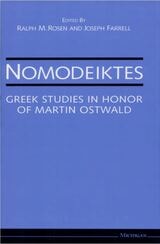
Nomodeiktes
Greek Studies in Honor of Martin OstwaldRalph M. Rosen and Joseph Farrell, Editors
University of Michigan Press, 1994
Nomodeiktes: Greek Studies in Honor of Martin Ostwald offers fascinating discussions of many of these areas, and it helps illuminate ways in which modern perceptions of this complex period are right and are wrong. Important observations are made on Greek historians and historiography, on politics and society, and on Greek philosophy and literature. The analyses of these major areas of investigation will be very useful for all interested in this centrally important period and for those who know the lure of that vivid and compelling city, Athens.