Results by title
405 books match the query 'Human Geography' and 10 start with n
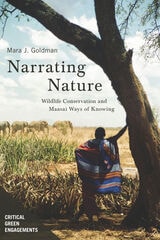
Narrating Nature
Wildlife Conservation and Maasai Ways of KnowingMara J. Goldman
University of Arizona Press, 2020
This book employs different storytelling practices, including a traditional Maasai oral meeting—the enkiguena—to decenter conventional scientific ways of communicating about, knowing, and managing nature. Author Mara J. Goldman draws on more than two decades of deep ethnographic and ecological engagements in the semi-arid rangelands of East Africa—in landscapes inhabited by pastoral and agropastoral Maasai people and heavily utilized by wildlife. These iconic landscapes have continuously been subjected to boundary drawing practices by outsiders, separating out places for people (villages) from places for nature (protected areas). Narrating Nature follows the resulting boundary crossings that regularly occur—of people, wildlife, and knowledge—to expose them not as transgressions but as opportunities to complicate the categories themselves and create ontological openings for knowing and being with nature otherwise.
Narrating Nature opens up dialogue that counters traditional conservation narratives by providing space for local Maasai inhabitants to share their ways of knowing and being with nature. It moves beyond standard community conservation narratives that see local people as beneficiaries or contributors to conservation, to demonstrate how they are essential knowledgeable members of the conservation landscape itself.
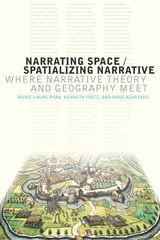
Narrating Space / Spatializing Narrative
Where Narrative Theory and Geography MeetMarie-Laure Ryan, Kenneth Foote, and Maoz Azaryahu
The Ohio State University Press, 2016
Space intersects with narrative in two principal ways: ‘‘Narrating space’’ considers space as an object of representation, while ‘‘spatializing narrative’’ approaches space as the environment in which narrative is physically deployed. The inscription of narrative in real space is illustrated by such forms as technology-supported locative narratives, street names, and historical/heritage site and museum displays. While narratologists are best equipped to deal with the narration of space, geographers can make significant contributions to narratology by drawing attention to the spatialization of narrative. By bringing these two approaches together—and thereby building a bridge between narratology and geography—Narrating Space / Spatializing Narrative yields both a deepened understanding of human spatial experience and greater insight into narrative theory and poetic forms.
Native Space
Geographic Strategies to Unsettle Settler ColonialismNatchee Blu Barnd
Oregon State University Press, 2017
What are the limits and potentials of indigenous acts of spatial production? Native Space argues that control over the notion of “Indianness” still sits at the center of how space is produced in a neocolonial nation, and shows how non-indigenous communities uniquely deploy Native identities in the direct construction of colonial geographies. In short, “the Indian” serves to create White space in concrete ways. Yet, Native geographies effectively reclaim indigenous identities, assert ongoing relations to the land, and refuse the claims of settler colonialism.
Barnd creatively and persuasively uses original cartographic research and demographic data, a series of interrelated stories set in the Midwestern Plains states of Kansas and Oklahoma, an examination of visual art by contemporary indigenous artists, and discussions of several forms of indigenous activism to support his argument. With its highly original, interdisciplinary approach, Native Space makes a significant contribution to the literature in cultural and critical geography, comparative ethnic studies, indigenous studies, cultural studies, American Studies, and related fields.
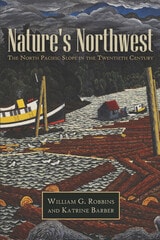
Nature's Northwest
The North Pacific Slope in the Twentieth CenturyWilliam G. Robbins and Katrine Barber
University of Arizona Press, 2011
With an emphasis on the region’s political economy, its environmental history, and its cultural and social heritage, this lively and colorful history of the Pacific Northwest—defined here as Oregon, Washington, Idaho, Montana, and southern British Columbia—places the narrative of this dynamic region within a national and international context.
Embracing both Canadian and American stories in looking at the larger region, renowned historians William Robbins and Katrine Barber offer us a fascinating regional history through the lens of both the environment and society. Understanding the physical landscape of the greater Pacific Northwest—and the watersheds of the Columbia, Fraser, Snake, and Klamath rivers—sets the stage for understanding the development of the area. Examining how this landscape spawned sawmills, fish canneries, railroads, logging camps, agriculture, and shared immigrant and ethnic traditions reveals an intricate portrait of the twentieth-century Northwest.
Impressive in its synthesis of myriad historical facts, this first-rate regional history will be of interest to historians studying the region from a variety of perspectives and an informative read for anyone fascinated by the story of a landscape rich in diversity, natural resources, and Native culture.
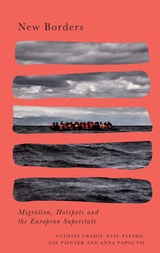
New Borders
Migration, Hotspots and the European SuperstateAntonis Vradis, Evie Papada, Joe Painter, and Anna Papoutsi
Pluto Press, 2018
As borders across Europe have come to symbolize the European Union, this book provides answers to questions of European policy, the securitization of national boundaries, and how legislation determines who is free to belong to a place.
New Lines
Critical GIS and the Trouble of the MapMatthew W. Wilson
University of Minnesota Press, 2017
New Lines takes the pulse of a society increasingly drawn to the power of the digital map, examining the conceptual and technical developments of the field of geographic information science as this work is refracted through a pervasive digital culture. Matthew W. Wilson draws together archival research on the birth of the digital map with a reconsideration of the critical turn in mapping and cartographic thought.
Seeking to bridge a foundational divide within the discipline of geography—between cultural and human geographers and practitioners of Geographic Information Systems (GIS)—Wilson suggests that GIS practitioners may operate within a critical vacuum and may not fully contend with their placement within broader networks, the politics of mapping, the rise of the digital humanities, the activist possibilities of appropriating GIS technologies, and more.
Employing the concept of the drawn and traced line, Wilson treads the theoretical terrain of Deleuze, Guattari, and Gunnar Olsson while grounding their thoughts with the hybrid impulse of the more-than-human thought of Donna Haraway. What results is a series of interventions—fractures in the lines directing everyday life—that provide the reader with an opportunity to consider the renewed urgency of forceful geographic representation. These five fractures are criticality, digitality, movement, attention, and quantification. New Lines examines their traces to find their potential and their necessity in the face of our frenetic digital life.
Nineteenth-Century Geographies
The Transformation of Space from the Victorian Age to the American CenturyThomas, Ronald R
Rutgers University Press, 2002
The nineteenth century was a time of unprecedented discovery and exploration throughout the globe, a period when the “blank spaces” of the earth were systematically investigated, occupied, and exploited by the major imperial powers of Western Europe and the United States. The lived experience of space was also changing in dramatic ways for people as a result of new developments in technology, communication, and transportation. As a result, the century was characterized by a new and intense interest in place, both local and global.
The collection is comprised of seventeen essays from various disciplines organized into four areas of geographic concern. The first, “Time Zones,” examines several ways that place gets expressed as time during the period, how geography becomes history. A second grouping, “Commodities and Exchanges,” explores the role of geographic origin as it was embodied in particular objects, from the souvenir map to imported tea. The set of essays on “Domestic Fronts” moves the discussion from the public to the private sphere by looking at how domestic space became defined in terms of its boundary with the foreign. The final section, “Orientations,” takes up the changing relations of bodies, identities, and the spaces they inhabit and through which they moved. The collection as a whole also traces the development of the discipline of geography with its different institutional and political trajectories in the United States and Great Britain.
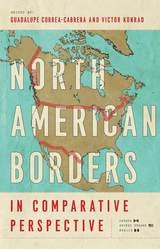
North American Borders in Comparative Perspective
Edited by Guadalupe Correa-Cabrera and Victor Konrad; Foreword by Alan Artibise
University of Arizona Press, 2020
The northern and southern borders and borderlands of the United States should have much in common; instead they offer mirror articulations of the complex relationships and engagements between the United States, Mexico, and Canada. In North American Borders in Comparative Perspectiveleading experts provide a contemporary analysis of how globalization and security imperatives have redefined the shared border regions of these three nations.
This volume offers a comparative perspective on North American borders and reveals the distinctive nature first of the overportrayed Mexico-U.S. border and then of the largely overlooked Canada-U.S. border. The perspectives on either border are rarely compared. Essays in this volume bring North American borders into comparative focus; the contributors advance the understanding of borders in a variety of theoretical and empirical contexts pertaining to North America with an intense sharing of knowledge, ideas, and perspectives.
Adding to the regional analysis of North American borders and borderlands, this book cuts across disciplinary and topical areas to provide a balanced, comparative view of borders. Scholars, policy makers, and practitioners convey perspectives on current research and understanding of the United States’ borders with its immediate neighbors. Developing current border theories, the authors address timely and practical border issues that are significant to our understanding and management of North American borderlands.
The future of borders demands a deep understanding of borderlands and borders. This volume is a major step in that direction.
Contributors
Bruce Agnew
Donald K. Alper
Alan D. Bersin
Christopher Brown
Emmanuel Brunet-Jailly
Irasema Coronado
Guadalupe Correa-Cabrera
Michelle Keck
Victor Konrad
Francisco Lara-Valencia
Tony Payan
Kathleen Staudt
Rick Van Schoik
Christopher Wilson
North of Empire
Essays on the Cultural Technologies of SpaceJody Berland
Duke University Press, 2009
Berland explores how understandings of space and time, empire and margin, embodiment and technology, and nature and culture are shaped by broadly conceived communications technologies including pianos, radio, television, the Web, and satellite imaging. Along the way, she provides a useful overview of the assumptions driving communications research on both sides of the U.S.-Canadian border, and she highlights the distinctive contributions of the Canadian communication theorists Harold Innis and Marshall McLuhan. Berland argues that electronic mediation is central to the construction of social space and therefore to anti-imperialist critique. She illuminates crucial links between how space is traversed, how it is narrated, and how it is used. Making an important contribution to scholarship on globalization, Berland calls for more sophisticated accounts of media and cultural technologies and their complex “geographies of influence.”
Not Yet a Placeless Land
Tracking an Evolving American GeographyWilbur Zelinsky
University of Massachusetts Press, 2011
In this book, cultural geographer Wilbur Zelinsky challenges that nearly universal view and reaches a paradoxical conclusion: that American land and society are becoming more uniform and more diverse at the same time. After recounting the many ways in which modern technologies, an advanced capitalist market system, and a potent central political establishment have standardized the built landscape of the country's vast territory and its burgeoning population over the past two hundred and fifty years, he also considers the vigor of countervailing forces. In a carefully balanced assessment, he documents steady increases in the role of the unpredictable, in the number and variety of arbitrarily located places and activities, and the persistence of basic cultural diversities. Contrary to popular perceptions, place-to-place differences in spoken language, religion, and political behavior have not diminished or disappeared. In fact, Zelinsky shows, novel cultural regions and specialized cities have been emerging even as a latter-day version of regionalism and examples of neo-localism are taking root in many parts of the United States.