Results by title
752 books match the query 'Illinois' and 12 start with n
National Performances
The Politics of Class, Race, and Space in Puerto Rican ChicagoAna Y. Ramos-Zayas
University of Chicago Press, 2003
Drawing on extensive ethnographic research, Ramos-Zayas shows how the performance of Puerto Rican nationalism in Chicago serves as a critique of social inequality, colonialism, and imperialism, allowing barrio residents and others to challenge the notion that upward social mobility is equally available to all Americans—or all Puerto Ricans. Paradoxically, however, these activists' efforts also promote upward social mobility, overturning previous notions that resentment and marginalization are the main results of nationalist strategies.
Ramos-Zayas's groundbreaking work allows her here to offer one of the most original and complex analyses of contemporary nationalism and Latino identity in the United States.

Natural Landscape Amenities and Suburban Growth
Metropolitan Chicago, 1970-1980Christopher Mueller-Wille
University of Chicago Press, 1990
Nauvoo Polygamy
"…but we called it celestial marriage"George D. Smith
Signature Books, 2011
“Nauvoo Polygamy is s a thorough investigation of sexual politics in the City of the Saints, the 1840s Mormon headquarters in the U.S. State of Illinois. Written with precision, clarity, and ease, it is a major contribution to Mormon history, groundbreaking in identifying the other polygamists who followed the lead of their prophet, Joseph Smith, in taking multiple partners.” —Klaus J. Hansen, Professor Emeritus of History, Queen’s University, Ontario
“If for no other reason, the inclusion of chapter 6 makes this book worth its price. The chapter quotes liberally from those like Elizabeth Ann Whitney and Bathsheba Smith who accepted polygamy rather easily, those like Jane Richards who accepted it only reluctantly, and those like Patty Sessions who found plural marriage almost unbearable. A bonus is chapter 9 which provides a concise historical overview of polygamous societies in Reformation Europe, touches on similar societies in America, and offers an extended discussion of Orson Pratt’s 1852 defense of plural marriage.” —Thomas G. Alexander, Professor Emeritus of History, Brigham Young University
“George Smith shows how many of the prophet’s followers embraced plural marriage during a period when the LDS Church was emphatically denying the practice … [and he tells this in] a lucid writing style.” —Daniel Walker Howe, Pulitzer Prize winning author of What Hath God Wrought: The Transformation of America, 1815-1848.
“An extremely important contribution to the history of polygamy … that allows us to see how Joseph Smith’s marriages fit into the context of his daily life.” —Todd M. Compton, author of In Sacred loneliness: The Plural Wives of Joseph Smith
Nearly Neighbors
Jane Addams, Johnny Powers, and the Progressive Political ImaginationTerrence J. McDonald
University of Chicago Press, 2026
Jane Addams was full of courage and goodwill when she opened Hull House in Chicago’s Nineteenth Ward in 1889. However, she failed to understand that her immigrant neighbors had been well-organized around mostly Catholic churches and schools for decades before her arrival. Her ultimate political rival, Johnny Powers, grew up in this culture but was no ethnic hero or deep political thinker. Nearly Neighbors is the first book to provide a contextualized history of their encounter, embedding it in the social and political culture and structures of Chicago and the Nineteenth Ward in the 1890s.
Terrence J. McDonald provides a crucial analysis of two pivotal figures in Chicago’s political history, in part by providing the first detailed assessment of Powers’s life and practices, but also by demonstrating Addams’s misconception of him and her neighbors—and why it matters for understanding her Progressive work overall. In both her political work and writings, Addams saw her ethnic neighbors as bundles of economic need, rather than bearers of ethnic culture. At the same time, she was recruited by elite allies into causes that appeared to be opposed by her neighbors. These views and practices permitted Powers to win in their climactic political battle in 1898 simply by claiming to be the neighborhood defender against Addams and her “downtown” allies. Nearly Neighbors offers a new way of understanding Addams and the complicated legacy of her famous political work and writings.
Negotiating Latinidad
Intralatina/o Lives in ChicagoFrances R. Aparicio
University of Illinois Press, 2019
Neoliberal Chicago
Edited by Larry Bennett, Roberta Garner, and Euan Hague
University of Illinois Press, 2017
Newcomers to Old Towns
Suburbanization of the HeartlandSonya Salamon
University of Chicago Press, 2003
Although the death of the small town has been predicted for decades, during the 1990s the population of rural America actually increased by more than three million people. In this book, Sonya Salamon explores these rural newcomers and the impact they have on the social relationships, public spaces, and community resources of small town America.
Salamon draws on richly detailed ethnographic studies of six small towns in central Illinois, including a town with upscale subdivisions that lured wealthy professionals as well as towns whose agribusinesses drew working-class Mexicano migrants and immigrants. She finds that regardless of the class or ethnicity of the newcomers, if their social status differs relative to that of oldtimers, their effect on a town has been the same: suburbanization that erodes the close-knit small town community, with especially severe consequences for small town youth. To successfully combat the homogenization of the heartland, Salamon argues, newcomers must work with oldtimers so that together they sustain the vital aspects of community life and identity that first drew them to small towns.
An illustration of the recent revitalization of interest in the small town, Salamon's work provides a significant addition to the growing literature on the subject. Social scientists, sociologists, policymakers, and urban planners will appreciate this important contribution to the ongoing discussion of social capital and the transformation in the study and definition of communities.
Newcomers
Gentrification and Its DiscontentsMatthew L. Schuerman
University of Chicago Press, 2019
In Newcomers, journalist Matthew L. Schuerman explains how a phenomenon that began with good intentions has turned into one of the most vexing social problems of our time. He builds a national story using focused histories of northwest Brooklyn, San Francisco’s Mission District, and the onetime site of Chicago’s Cabrini-Green housing project, revealing both the commonalities among all three and the place-specific drivers of change. Schuerman argues that gentrification has become a too-easy flashpoint for all kinds of quasi-populist rage and pro-growth boosterism. In Newcomers, he doesn’t condemn gentrifiers as a whole, but rather articulates what it is they actually do, showing not only how community development can turn foul, but also instances when a “better” neighborhood truly results from changes that are good. Schuerman draws no easy conclusions, using his keen reportorial eye to create sharp, but fair, portraits of the people caught up in gentrification, the people who cause it, and its effects on the lives of everyone who calls a city home.
No One Was Killed
The Democratic National Convention, August 1968John Schultz
University of Chicago Press, 2009
While other writers contemplated the events of the 1968 Chicago riots from the safety of their hotel rooms, John Schultz was in the city streets, being threatened by police, choking on tear gas, and listening to all the rage, fear, and confusion around him. The result, No One Was Killed, is his account of the contradictions and chaos of convention week, the adrenalin, the sense of drama and history, and how the mainstream press was getting it all wrong.
"A more valuable factual record of events than the city’s white paper, the Walker Report, and Theodore B. White’s Making of a President combined."—Book Week
"As a reporter making distinctions between Yippie, hippie, New Leftist, McCarthyite, police, and National Guard, Schultz is perceptive; he excels in describing such diverse personalities as Julian Bond and Eugene McCarthy."—Library Journal
"High on my short list of true, lasting, inspired evocations of those whacked-out days when the country was fighting a phantasmagorical war (with real corpses), and police under orders were beating up demonstrators who looked at them funny."—Todd Gitlin, from the foreword
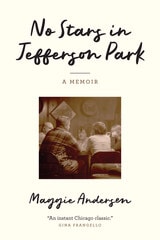
No Stars in Jefferson Park
A MemoirMaggie Andersen
Northwestern University Press, 2026
A Chicagoan’s coming-of-age memoir finds courage in the face of immense loss
In her early twenties, Maggie Andersen was a founding ensemble member of Chicago’s storied Gift Theatre with her then-boyfriend, Michael Patrick Thornton. But after a series of spinal strokes left Thornton paralyzed, Andersen made the heart-wrenching decision to leave him, along with their growing company and, later, her beloved city. No Stars in Jefferson Park alternates between two narratives: the energy and excitement of making art in Chicago’s thriving storefront theater scene and the devastating day-to-day realities of rehabilitation and rebuilding—and somewhere in the middle finding the courage to choose yourself.
Over the past twenty-plus years, the Gift—now performing in the working-class neighborhood of Portage Park—has become one of the most vital storefront theaters in Chicago, with Thornton’s career taking him to Hollywood and Broadway. But Andersen’s story has brought her back home. No Stars in Jefferson Park is a testament to lifelong friendship, a love letter to Chicago, and a profound coming-of-age story about the pain and necessity of putting yourself first.
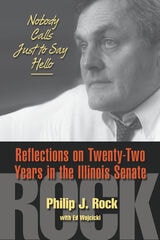
Nobody Calls Just to Say Hello
Reflections on Twenty-Two Years in the Illinois SenatePhilip J. Rock, with Ed Wojcicki
Southern Illinois University Press, 2011
A native of Chicago's West Side, Rock became one of the most influential politicians in Illinois during the 1970s and 1980s. As a senator in the 1970s and senate president from 1979 to 1993, he sponsored historic legislation to assist abused and neglected children and victims of domestic violence, ushered the state through difficult income tax increases and economic development decisions, shepherded an unruly and fragmented Democratic senate caucus, and always was fair to his Republican counterparts. Covering in great detail a critical period in Illinois political history for the first time, Rock explains how making life better for others drove his decisions in office, while also espousing the seven principles he advocates for effective leadership and providing context for how he applied those principles to the legislative battles of the era.
Unlike many Illinois politicians, Rock, a former seminarian, was known for having a greater interest in issues than in partisan politics. Considered a true statesman, he also was known as a skilled orator who could silence a busy floor of legislators with his commentary on important issues and as a devoted public servant who handled tens of thousands of bills and sponsored nearly five hundred of them himself.
Nobody Calls Just to Say Hello, which takes its title from the volume of calls and visits to elected officials from constituents in need of help, perfectly captures Rock's profound reverence for the institutions of government, his respect for other government offices, and his reputation as a problem solver who, despite his ardent Democratic beliefs, disavowed political self-preservation to cross party lines and make government work for the people. Taking readers through his legislative successes, bipartisan efforts, and political defeats-including a heartbreaking loss in the U.S. Senate primary to Paul Simon in 1984-Rock passionately articulates his belief that government's primary role is to help people, offering an antidote to the current political climate with the simple legislative advice, "Just try to be fair, give everyone a chance, and everything else comes after that."
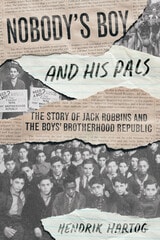
Nobody's Boy and His Pals
The Story of Jack Robbins and the Boys’ Brotherhood RepublicHendrik Hartog
University of Chicago Press, 2024
In 1914, social reformer Jack Robbins and a group of adolescent boys in Chicago founded the Boys’ Brotherhood Republic, an unconventional and unusual institution. During a moral panic about delinquent boys, Robbins did not seek to rehabilitate and/or punish wayward youths. Instead, the boys governed themselves, democratically and with compassion for one another, and lived by their mantra “So long as there are boys in trouble, we too are in trouble.” For nearly thirty years, Robbins was their “supervisor,” and the will he drafted in the late 1950s suggests that he continued to care about forgotten boys, even as the political and legal contexts that shaped children’s lives changed dramatically.
Nobody’s Boy and His Pals is a lively investigation that challenges our ideas about the history of American childhood and the law. Scouring the archives for traces of the elusive Jack Robbins, Hendrik Hartog examines the legal histories of Progressive reform, childhood, criminality, repression, and free speech. The curiosity of Robbins’s story is compounded by the legal challenges to his will, which wound up establishing the extent to which last wishes must conform to dominant social values. Filled with persistent mysteries and surprising connections, Nobody’s Boy and His Pals illuminates themes of childhood and adolescence, race and ethnicity, sexuality, wealth and poverty, and civil liberties, across the American Century.