Results by title
67 books match the query 'Imagination' and 3 start with n

National Megalomania and Imagination of the Ancient World
Jie-Hyun Lim
Central European University Press, 2027
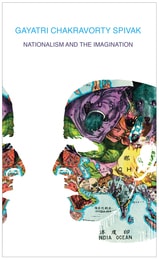
Nationalism and the Imagination
Gayatri Chakravorty Spivak
Seagull Books, 2010
Gayatri Chakravorty Spivak has distinguished herself as one of the foremost scholars of contemporary literary and postcolonial theory and feminist thought. Known for her translation of Derrida’s On Grammatology and her groundbreaking essay, “Can the Subaltern Speak?,” Spivak has often focused on subaltern, marginalized women and the role of essentialism in feminist thought to unite women from divergent cultural backgrounds. In Nationalism and the Imagination, Spivak expands upon her previous postcolonial scholarship, employing a cultural lens to examine the rhetorical underpinnings of the idea of the nation-state.
In this gripping and intellectually rigorous work, Spivak specifically analyzes the creation of Indian sovereignty in 1947 and the tone of Indian nationalism, bound up with class and religion, that arose in its wake. Spivak was five years old when independence was declared, and she vividly writes: “These are my earliest memories: Famine and blood on the streets.” As well, she recollects the songs and folklore stories that were prevalent at the time in order to examine the role of the mother tongue and the relationship between language and feelings of national identity. She concludes that nationalism colludes with the private sphere of the imagination in order to command the public sphere.
Originally given as an address at the University of Sofia in Bulgaria, Nationalism and the Imagination provides powerful insight into the historical narrative of India as well as compelling ideas that speak to nationalist concerns around the world. Also included in this book is the discussion with Spivak that followed the speech, making this an essential and informative work for scholars of post-colonialism.
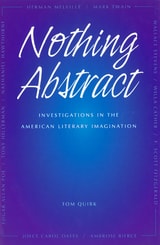
Nothing Abstract
Investigations in the American Literary ImaginationTom Quirk
University of Missouri Press, 2001
Written by one of the leading scholars in the field, Nothing Abstract is a collection of essays gathered over the past twenty years--all of which, in some fashion, have to do with a genetic approach to literary study. In previous books, the author has traced the compositional histories of certain literary works, the course of individual careers, and the genesis of literary movements. In this book, Tom Quirk resists the direction taken by contemporary theory in favor of an approach to literature through source and influence study, the evolution of a writer's achievement, the establishment of biographical or other contexts, and the transition from one literary era to another.
All of the essays that Quirk has chosen for this collection illustrate a scholarly method. The first two essays, somewhat general in their concerns, constitute a defense for the genetic method, and subsequent essays serve as evidence for the usefulness of genetic inquiry. The entire volume challenges poststructuralist theory not through active confrontation, but merely by being what it is and doing what it does. More important though is that all of the chosen essays are intrinsically interesting. They tell fascinating stories—stories about literary genesis, biographical circumstances, and artistic ambitions and achievement.
Authors discussed at length are Edgar Allan Poe, Tony Hillerman, Nathaniel Hawthorne, Herman Melville, Mark Twain, Ambrose Bierce, Wallace Stevens, Willa Cather, F. Scott Fitzgerald, and Joyce Carol Oates. Quirk also touches on Flannery O'Connor, Richard Wright, Robert Frost, Jack London, Stephen Crane, William Faulkner, and others. Nothing Abstract makes a great contribution to the study of important American writers and will be welcomed by all students and scholars of American studies and American literature.