Results by title
102 books match the query 'Indians' and 5 start with n
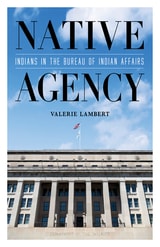
Native Agency
Indians in the Bureau of Indian AffairsValerie Lambert
University of Minnesota Press, 2022
What happens when American Indians take over an institution designed to eliminate them?
The Bureau of Indian Affairs was hatched in the U.S. Department of War to subjugate and eliminate American Indians. Yet beginning in the 1970s, American Indians and Alaska Natives took over and now run the agency. Choctaw anthropologist Valerie Lambert argues that, instead of fulfilling settler-colonial goals, the Indians in the BIA have been leveraging federal power to fight settler colonialism, battle white supremacy, and serve the interests of their people.
Although the missteps and occasional blunders of the Indians in the BIA have at times damaged the federal–Indian relationship and fueled the ire of their people, and although the BIA is massively underfunded, Indians began crafting the BIA into a Native agency by reformulating the meanings of concepts that lay at its heart—concepts such as tribal sovereignty, treaties, the trust responsibility, and Indian land. At the same time, they pursued actions to strengthen and bolster tribes, to foster healing, to fight the many injustices Indians face, and to restore the Indian land base.
This work provides an essential national-level look at an intriguing and impactful form of Indigenous resistance. It describes, in great detail, the continuing assaults made on Native peoples and tribal sovereignty in the United States during the twenty-first century, and it sketches the visions of the future that Indians at the BIA and in Indian Country have been crafting for themselves.
Native American Language Ideologies
Beliefs, Practices, and Struggles in Indian CountryEdited by Paul V. Kroskrity and Margaret C. Field
University of Arizona Press, 2009
These studies take up such active issues as "insiderness" in Cherokee language ideologies, contradictions of space-time for the Northern Arapaho, language socialization and Paiute identity, and orthography choices and language renewal among the Kiowa. The authors--including members of indigenous speech communities who participate in language renewal efforts--discuss not only Native Americans' conscious language ideologies but also the often-revealing relationship between these beliefs and other more implicit realizations of language use as embedded in community practice.
The chapters discuss the impact of contemporary language issues related to grammar, language use, the relation between language and social identity, and emergent language ideologies themselves in Native American speech communities. And although they portray obvious variation in attitudes toward language across communities, they also reveal commonalities--notably the emergent ideological process of iconization between a language and various national, ethnic, and tribal identities.
As fewer Native Americans continue to speak their own language, this timely volume provides valuable grounded studies of language ideologies in action--those indigenous to Native communities as well as those imposed by outside institutions or language researchers. It considers the emergent interaction of indigenous and imported ideologies and the resulting effect on language beliefs, practices, and struggles in today's Indian Country as it demonstrates the practical implications of recognizing a multiplicity of indigenous language ideologies and their impact on heritage language maintenance and renewal.
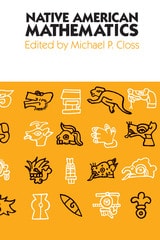
Native American Mathematics
By Michael P. Closs
University of Texas Press, 1996
There is no question that native cultures in the New World exhibit many forms of mathematical development. This Native American mathematics can best be described by considering the nature of the concepts found in a variety of individual New World cultures. Unlike modern mathematics in which numbers and concepts are expressed in a universal mathematical notation, the numbers and concepts found in native cultures occur and are expressed in many distinctive ways. Native American Mathematics, edited by Michael P. Closs, is the first book to focus on mathematical development indigenous to the New World.
Spanning time from the prehistoric to the present, the thirteen essays in this volume attest to the variety of mathematical development present in the Americas. The data are drawn from cultures as diverse as the Ojibway, the Inuit (Eskimo), and the Nootka in the north; the Chumash of Southern California; the Aztec and the Maya in Mesoamerica; and the Inca and Jibaro of South America. Among the strengths of this collection are this diversity and the multidisciplinary approaches employed to extract different kinds of information. The distinguished contributors include mathematicians, linguists, psychologists, anthropologists, and archaeologists.

Nature and Antiquities
The Making of Archaeology in the AmericasEdited by Philip L. Kohl, Irina Podgorny, and Stefanie Gänger
University of Arizona Press, 2014
The volume breaks new ground by entreating archaeologists to acknowledge the importance of ways of knowing that resulted from the study of nature in the history of archaeology. Some of the contributions to this volume trace the part conventions, practices, and concepts from natural history and the natural sciences played in the history and making of the discipline. Others set out to uncover, reassemble, or adjust our vision of collections that research historians of archaeology have disregarded or misrepresented—because their nineteenth-century makers would refuse to comply with today’s disciplinary borders and study natural specimens and antiquities in conjunction, under the rubric of the territorial, the curious or the universal. Other contributions trace the sociopolitical implications of studying nature in conjunction with “indigenous peoples” in the Americas—inquiring into what it meant and entailed to comprehend the inhabitants of the American continent in and through a state of nature.
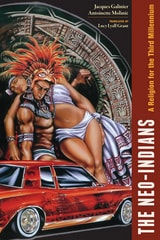
Neo-Indians
A Religion for the Third MilleniumJacques Galinier
University Press of Colorado, 2013
There is no full-time neo-Indian. Both indigenous and non-indigenous practitioners assume Indian identities only when deemed spiritually significant. In their daily lives, they are average members of modern society, dressing in Western clothing, working at middle-class jobs, and retaining their traditional religious identities. As a result of this part-time status the neo-Indians are often overlooked as a subject of study, making this book the first anthropological analysis of the movement.
Galinier and Molinié present and analyze four decades of ethnographic research focusing on Mexico and Peru, the two major areas of the movement’s genesis. They examine the use of public space, describe the neo-Indian ceremonies, provide analysis of the ceremonies’ symbolism, and explore the close relationship between the neo-Indian religion and tourism. The Neo-Indians will be of great interest to ethnographers, anthropologists, and scholars of Latin American history, religion, and cultural studies.