Results by title
936 books match the query 'LGBTQ+ Studies' and 22 start with n

Napoleonic Friendship
Military Fraternity, Intimacy, and Sexuality in Nineteenth-Century FranceBrian Joseph Martin
University of New Hampshire Press, 2011
Winner of the Laurence Wylie Prize in French Cultural Studies
One of the first books on “Gays in the Military” published following the historic repeal of “Don't Ask Don't Tell” in 2011, Napoleonic Friendship examines the history of male intimacy in the French military, from Napoleon to the First World War. Echoing the historical record of gay soldiers in the United States, Napoleonic Friendship is the first book-length study on the origin of queer soldiers in modern France. Based on extensive archival research in France, the book traces the development of affectionate friendships in the French Army from 1789 to 1916.
Following the French Revolution, radical military reforms created conditions for new physical and emotional intimacy between soldiers, establishing a model of fraternal affection during the Revolutionary and Napoleonic Wars that would persist amid the ravages of the Franco-Prussian War and World War I. Through readings of Napoleonic military memoirs (and other non-fiction archival material) and French military fiction (from Hugo and Balzac to Zola and Proust), Martin examines a broad range of emotional and erotic relationships, from combat buddies to soldier lovers. He argues that the French Revolution's emphasis on military fraternity evolved into an unprecedented sense of camaraderie in the armies of Napoleon. For many soldiers, the hardships of combat led to intimate friendships. For some, the homosociality of military life inspired mutual affection, lifelong commitment, and homoerotic desire.
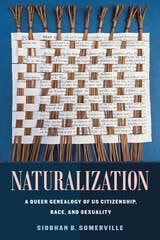
Naturalization
A Queer Genealogy of US Citizenship, Race, and SexualitySiobhan B. Somerville
Duke University Press, 2026
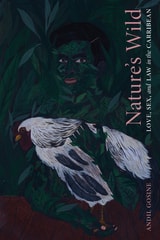
Nature's Wild
Love, Sex, and Law in the CaribbeanAndil Gosine
Duke University Press, 2021
Duke University Press Scholars of Color First Book Award recipient
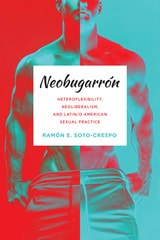
Neobugarrón
Heteroflexibility, Neoliberalism, and Latin/o American Sexual PracticeRamón E. Soto-Crespo
The Ohio State University Press, 2023
How should we understand the bugarrón, a man who has sex with other men while regarding himself as heterosexual? Reaching beyond queer and gay studies, Ramón E. Soto-Crespo’s research suggests that this paradoxical figure mutated into what he calls the “neobugarrón,” a neoliberal market-oriented actor who used the traditional sexual practice as an optimizing strategy for manipulating the forces of globalization during the 1990s. In Neobugarrón: Heteroflexibility, Neoliberalism, and Latin/o American Sexual Practice, Soto-Crespo chronicles the cultural modifications of bugarrón, a distinct male-male sexual practice in Latin/o America and the Caribbean, during the twentieth and twenty-first centuries. Working with and against Foucault and Kinsey to examine diverse works from anthropology, literature, cinema, and social media, he investigates a wide array of bugarrón sources, ranging from previously underexamined multimedia to ethnographies, fiction, films, and beyond. These works constitute a neobugarrón archive and attest to a sexual practice currently metamorphosing on the cusp of extinction. Soto-Crespo’s analysis challenges conventional understandings of “heteroflexible” sex between men and reveals a hitherto unnoticed transformation in neoliberal ecologies of bugarrón sexual practice.
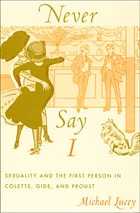
Never Say I
Sexuality and the First Person in Colette, Gide, and ProustMichael Lucey
Duke University Press, 2006
Considering novels along with journalism, theatrical performances, correspondences, and face-to-face encounters, Lucey focuses on the interlocking social and formal dimensions of using the first person. He argues for understanding the first person not just as a grammatical category but also as a collectively produced social artifact, demonstrating that Proust’s, Gide’s, and Colette’s use of the first person involved a social process of assuming the authority to speak about certain issues, or on behalf of certain people. Lucey reveals these three writers as both practitioners and theorists of the first person; he traces how, when they figured themselves or other first persons in certain statements regarding same-sex identity, they self-consciously called attention to the creative effort involved in doing so.

New Maricón Cinema
Outing Latin American FilmBy Vinodh Venkatesh
University of Texas Press, 2016
Recent critically and commercially acclaimed Latin American films such as XXY, Contracorriente, and Plan B create an affective and bodily connection with viewers that elicits in them an emotive and empathic relationship with queer identities. Referring to these films as New Maricón Cinema, Vinodh Venkatesh argues that they represent a distinct break from what he terms Maricón Cinema, or a cinema that deals with sex and gender difference through an ethically and visually disaffected position, exemplified in films such as Fresa y chocolate, No se lo digas a nadie, and El lugar sin límites.
Covering feature films from Argentina, Chile, Cuba, Ecuador, Mexico, Peru, the United States, and Venezuela, New Maricón Cinema is the first study to contextualize and analyze recent homo-/trans-/intersexed-themed cinema in Latin America within a broader historical and aesthetic genealogy. Working with theories of affect, circulation, and orientations, Venkatesh examines key scenes in the work of auteurs such as Marco Berger, Javier Fuentes-León, and Julia Solomonoff and in films including Antes que anochezca and Y tu mamá también to show how their use of an affective poetics situates and regenerates viewers in an ethically productive cinematic space. He further demonstrates that New Maricón Cinema has encouraged the production of “gay friendly” commercial films for popular audiences, which reflects wider sociocultural changes regarding gender difference and civil rights that are occurring in Latin America.
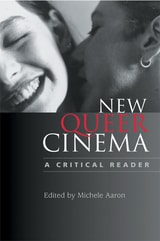
New Queer Cinema
A Critical ReaderAaron, Michele
Rutgers University Press, 2004
Coined in the early 1990s to describe a burgeoning film movement, “New Queer Cinema” has turned the attention of film theorists, students, and audiences to the proliferation of intelligent, stylish, and daring work by lesbian and gay filmmakers within independent cinema and to the infiltration of “queer” images and themes into the mainstream. Why did this shift take place? Was it political gains, cultural momentum, or market forces that energized the evolution and transformation of this cinematic genre?
New Queer Cinema: A Critical Reader provides a definitive and highly readable guide to the development of this important and controversial film movement. The volume is divided into four sections: defining “new queer cinema,” assessing its filmmakers, examining geographic and national differences, and theorizing spectatorship. Chapters address the work of pivotal directors (such as Todd Haynes and Gregg Araki) and salient films (including Paris is Burning and Boys Don’t Cry), as well as unconventional and non-Anglo-American work (experimental filmmaking and third world cinema).
With a critical eye to its uneasy relationship to the mainstream, New Queer Cinema explores the aesthetic, sociocultural, political, and, necessarily, commercial investments of the movement. It is the first full-length study of recent developments in queer cinema that combines indispensable discussions of central issues with exciting new work by key writers.
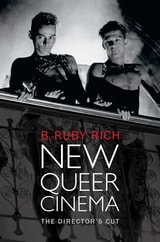
New Queer Cinema
The Director's CutB. Ruby Rich
Duke University Press, 2013
As a critic, curator, journalist, and scholar, Rich has been inextricably linked to the New Queer Cinema from its inception. This volume presents her new thoughts on the topic, as well as bringing together the best of her writing on the NQC. She follows this cinematic movement from its origins in the mid-1980s all the way to the present in essays and articles directed at a range of audiences, from readers of academic journals to popular glossies and weekly newspapers. She presents her insights into such NQC pioneers as Derek Jarman and Isaac Julien and investigates such celebrated films as Go Fish, Brokeback Mountain, Itty Bitty Titty Committee, and Milk. In addition to exploring less-known films and international cinemas (including Latin American and French films and videos), she documents the more recent incarnations of the NQC on screen, on the web, and in art galleries.

New Queer Television
From Marginalization to MainstreamificationEdited by Thomas Brassington, Debra Ferreday, and Dany Girard
Intellect Books, 2024
Though queer critics and queer theory tend to frame queer identities as marginal, this edited volume draws attention to a dynamic field in which a wide variety of queer identities can be put on display and consumed by audiences. Cementing a foundational understanding of queerness that is at odds with current shifts in media production, contributors present a broad variety of queer identities from across a range of televisual shows and genres to reconsider the marginalization of queerness in the twenty-first century. Doing so challenges preexisting notions that such “mainstreamification” necessitates being subsumed by the cisheteropatriarchy. This project argues the opposite, showing that heteronormative assumptions are outdated and that new queer representations lay the groundwork for filling gaps that queer criticism has left open.
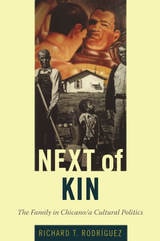
Next of Kin
The Family in Chicano/a Cultural PoliticsRichard T. Rodríguez
Duke University Press, 2009
Describing how la familia came to be adopted as an organizing strategy for communitarian politics, Rodríguez looks at foundational texts including Rodolfo Gonzales’s well-known poem “I Am Joaquín,” the Chicano Liberation Youth Conference’s manifesto El Plan Espiritual de Aztlán, and José Armas’s La Familia de La Raza. Rodríguez analyzes representations of the family in the films I Am Joaquín, Yo Soy Chicano, and Chicana; the Los Angeles public affairs television series ¡Ahora!; the experimental videos of the artist-activist Harry Gamboa Jr.; and the work of hip-hop artists such as Kid Frost and Chicano Brotherhood. He reflects on homophobia in Chicano nationalist thought, and examines how Chicano gay men have responded to it in works including Al Lujan’s video S&M in the Hood, the paintings of Eugene Rodríguez, and a poem by the late activist Rodrigo Reyes. Next of Kin is both a wide-ranging assessment of la familia’s symbolic power and a hopeful call for a more inclusive cultural politics.
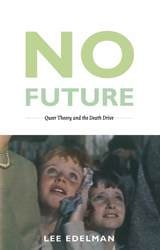
No Future
Queer Theory and the Death DriveLee Edelman
Duke University Press, 2004
Closely engaging with literary texts, Edelman makes a compelling case for imagining Scrooge without Tiny Tim and Silas Marner without little Eppie. Looking to Alfred Hitchcock’s films, he embraces two of the director’s most notorious creations: the sadistic Leonard of North by Northwest, who steps on the hand that holds the couple precariously above the abyss, and the terrifying title figures of The Birds, with their predilection for children. Edelman enlarges the reach of contemporary psychoanalytic theory as he brings it to bear not only on works of literature and film but also on such current political flashpoints as gay marriage and gay parenting. Throwing down the theoretical gauntlet, No Future reimagines queerness with a passion certain to spark an equally impassioned debate among its readers.
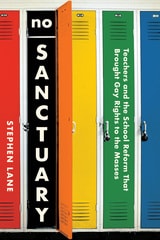
No Sanctuary
Teachers and the School Reform That Brought Gay Rights to the MassesStephen Lane
University Press of New England, 2018

No Tea, No Shade
New Writings in Black Queer StudiesE. Patrick Johnson, editor
Duke University Press, 2016
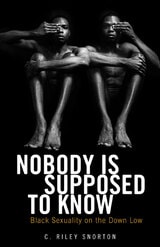
Nobody Is Supposed to Know
Black Sexuality on the Down LowC. Riley Snorton
University of Minnesota Press, 2014
Since the early 2000s, the phenomenon of the “down low”—black men who have sex with men as well as women and do not identify as gay, queer, or bisexual—has exploded in news media and popular culture, from the Oprah Winfrey Show to R & B singer R. Kelly’s hip hopera Trapped in the Closet. Most down-low stories are morality tales in which black men are either predators who risk infecting their unsuspecting female partners with HIV or victims of a pathological black culture that repudiates openly gay identities. In both cases, down-low narratives depict black men as sexually dangerous, duplicitous, promiscuous, and contaminated.
In Nobody Is Supposed to Know, C. Riley Snorton traces the emergence and circulation of the down low in contemporary media and popular culture to show how these portrayals reinforce troubling perceptions of black sexuality. Reworking Eve Sedgwick’s notion of the “glass closet,” Snorton advances a new theory of such representations in which black sexuality is marked by hypervisibility and confinement, spectacle and speculation. Through close readings of news, music, movies, television, and gossip blogs, Nobody Is Supposed to Know explores the contemporary genealogy, meaning, and functions of the down low.
Snorton examines how the down low links blackness and queerness in the popular imagination and how the down low is just one example of how media and popular culture surveil and police black sexuality. Looking at figures such as Ma Rainey, Bishop Eddie L. Long, J. L. King, and Will Smith, he ultimately contends that down-low narratives reveal the limits of current understandings of black sexuality.
None Like Us
Blackness, Belonging, Aesthetic LifeStephen Best
Duke University Press, 2018
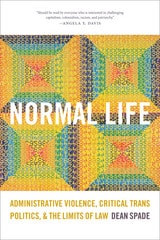
Normal Life
Administrative Violence, Critical Trans Politics, and the Limits of LawDean Spade
Duke University Press, 2015
Wait—what's wrong with rights? It is usually assumed that trans and gender nonconforming people should follow the civil rights and "equality" strategies of lesbian and gay rights organizations by agitating for legal reforms that would ostensibly guarantee nondiscrimination and equal protection under the law. This approach assumes that the best way to address the poverty and criminalization that plague trans populations is to gain legal recognition and inclusion in the state's institutions. But is this strategy effective?
In Normal Life Dean Spade presents revelatory critiques of the legal equality framework for social change, and points to examples of transformative grassroots trans activism that is raising demands that go beyond traditional civil rights reforms. Spade explodes assumptions about what legal rights can do for marginalized populations, and describes transformative resistance processes and formations that address the root causes of harm and violence.
In the new afterword to this revised and expanded edition, Spade notes the rapid mainstreaming of trans politics and finds that his predictions that gaining legal recognition will fail to benefit trans populations are coming to fruition. Spade examines recent efforts by the Obama administration and trans equality advocates to "pinkwash" state violence by articulating the US military and prison systems as sites for trans inclusion reforms. In the context of recent increased mainstream visibility of trans people and trans politics, Spade continues to advocate for the dismantling of systems of state violence that shorten the lives of trans people. Now more than ever, Normal Life is an urgent call for justice and trans liberation, and the radical transformations it will require.

Normal Life
Administrative Violence, Critical Trans Politics, and the Limits of LawDean Spade
Duke University Press, 2011
Wait—what's wrong with rights? It is usually assumed that trans and gender nonconforming people should follow the civil rights and “equality” strategies of lesbian and gay rights organizations by agitating for legal reforms that would ostensibly guarantee equal access, nondiscrimination, and equal protection under the law. This approach assumes that the best way to address the poverty and criminalization that plague trans populations is to get recognized by law and included in the state's institutions. But does changing what the law says about a targeted and marginalized population bring material relief? And what if many of the problems that shorten trans people's lives stem from the ordinary, banal ways that gender norm categories are administered by virtually every state and private institution?
In Normal Life Dean Spade presents revelatory critiques of the legal equality framework for social change and points to examples of transformative grassroots trans activism that is raising demands that go beyond traditional civil rights reforms. Spade explodes the assumptions about what legal rights can do for marginalized populations and describes transformative resistance processes and formations that address the root causes of harm and violence. Setting forth a politic that goes beyond the quest for mere legal inclusion, Normal Life is an urgent call for justice and trans liberation, and the radical transformations it will require.
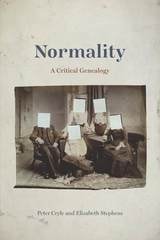
Normality
A Critical GenealogyPeter Cryle and Elizabeth Stephens
University of Chicago Press, 2017
In Normality, Peter Cryle and Elizabeth Stephens offer an intellectual and cultural history of what it means to be normal. They explore the history of how communities settle on any one definition of the norm, along the way analyzing a fascinating series of case studies in fields as remote as anatomy, statistics, criminal anthropology, sociology, and eugenics. Cryle and Stephens argue that since the idea of normality is so central to contemporary disability, gender, race, and sexuality studies, scholars in these fields must first have a better understanding of the context for normality. This pioneering book moves beyond binaries to explore for the first time what it does—and doesn’t—mean to be normal.
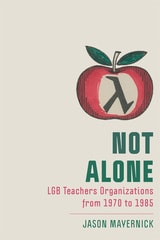
Not Alone
LGB Teachers Organizations from 1970 to 1985Jason Mayernick
Rutgers University Press, 2024
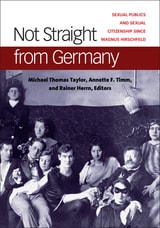
Not Straight from Germany
Sexual Publics and Sexual Citizenship since Magnus HirschfeldMichael Thomas Taylor, Annette F. Timm, and Rainer Herrn, Editors
University of Michigan Press, 2017
Two visual sourcebooks and catalog essays on an exhibition of contemporary artists’ responses to the Hirschfeld historical materials interrogate the modes of visual representation that Hirschfeld employed by re-imagining the public visibility of his institute from a contemporary perspective. The archival material includes stunning, never-before-published images from Hirschfeld’s institute that challenge many received ideas, while the scholarly and art catalog essays explore collaboration and dialogue as methods of research and activism that resonate beyond the academy to pressing issues of public concern.
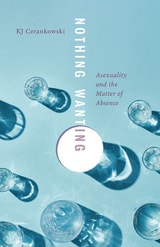
Nothing Wanting
Asexuality and the Matter of AbsenceKJ Cerankowski
University of Minnesota Press, 2025
Advancing asexuality studies in new, queer directions—beyond identity and beyond the human
We’ve all seen the page that states “this page intentionally left blank” or heard an authority figure declare “nothing to see here, folks,” and yet the so-called blank page has writing on it, and folks definitely have something to see. From the entry point of these and other paradoxical declarations of absence, KJ Cerankowski applies the aesthetics of asexuality to theorize silences, nothings, and emptiness. In the process, he explores new ways of making meaning out of the supposedly meaningless.
Throughout this investigation into absences, Cerankowski moves intuitively and idiosyncratically, taking readers along a series of waypoints that include Border, the acclaimed horror film about a customs officer who can smell fear; Jenny Hval’s discomfiting novel Paradise Rot; and disabled artist Finnegan Shannon’s iconic benches. Experimental in form as well as content, Nothing Wanting offers an innovative and mischievous reading experience that plays with structural elements like redaction, erasure, supertext, and repetition. With a deeply anticapitalist, anticolonial motivating ideology, it pushes to the limits of language, subverting commonplace notions of books, knowledge, and what it is to be human.
Moving beyond identity and representation, Nothing Wanting is playful, fascinating, and provocative as it conceives asexuality as additive and expansive rather than lacking. As it reveals the vibrant lifeworlds that hum in silences and thrum in stillnesses, Nothing Wanting pivots from the imposition of wanting nothing to the craving of nothing wanting: satisfied, yet always yearning for more worlds of thriving—for everything and everyone.
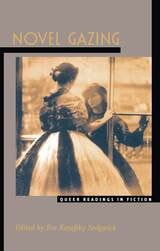
Novel Gazing
Queer Readings in FictionEve Kosofsky Sedgwick, ed.
Duke University Press, 1997
Through discussions of a diverse array of British, French, and American novels—including major canonical novels, best-sellers, children’s fiction, and science fiction—these essays explore queer worlds of taste, texture, joy, and ennui, focusing on such subjects as flogging, wizardry, exorcism, dance, Zionist desire, and Internet sexuality. Interpreting the works of authors as diverse as Benjamin Constant, Toni Morrison, T. H. White, and William Gibson, along with canonical queer modernists such as James, Proust, Woolf, and Cather, contributors reveal the wealth of ways in which selves and communities succeed in extracting sustenance from the objects of a culture whose avowed desire has often been not to sustain them. The dramatic reframing that these essays perform will make the significance of Novel Gazing extend beyond the scope of queer studies to literary criticism in general.
Contributors. Stephen Barber, Renu Bora, Anne Chandler, James Creech, Tyler Curtain, Jonathan Goldberg, Joseph Litvak, Michael Lucey, Jeff Nunokawa, Cindy Patton, Jacob Press, Robert F. Reid-Pharr, Eve Kosofsky Sedgwick, Melissa Solomon, Kathryn Bond Stockton, John Vincent, Maurice Wallace, Barry Weller