Results by title
112 books match the query 'Languages' and 6 start with n
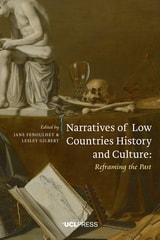
Narratives of Low Countries History and Culture
Reframing the PastEdited by Jane Fenoulhet and Lesley Gilbert
University College London, 2016
This edited collection explores the ways in which our understanding of the past in Dutch history and culture can be rethought to consider not only how it forms part of the present but how it can relate also to the future. Divided into three parts – The Uses of Myth and History, The Past as Illumination of Cultural Context, and Historiography in Focus – this book seeks to demonstrate the importance of the past by investigating the transmission of culture and its transformations. It reflects on the history of historiography and looks critically at the products of the historiographic process, such as Dutch and Afrikaans literary history. The chapters cover a range of disciplines and approaches: some authors offer a broad view of a particular period, such as Jonathan Israel's contribution on myth and history in the ideological politics of the Dutch Golden Age, while others zoom in on specific genres, texts or historical moments, such as Benjamin Schmidt’s study of the doolhof, a word that today means ‘labyrinth’ but once described a 17th-century educational amusement park. This volume, enlightening and home to multiple paths of enquiry leading in different directions, is an excellent example of what a past-present doolhof might look like.
[more]
Native American Language Ideologies
Beliefs, Practices, and Struggles in Indian CountryEdited by Paul V. Kroskrity and Margaret C. Field
University of Arizona Press, 2009
Beliefs and feelings about language vary dramatically within and across Native American cultural groups and are an acknowledged part of the processes of language shift and language death. This volume samples the language ideologies of a wide range of Native American communities--from the Canadian Yukon to Guatemala--to show their role in sociocultural transformation.
These studies take up such active issues as "insiderness" in Cherokee language ideologies, contradictions of space-time for the Northern Arapaho, language socialization and Paiute identity, and orthography choices and language renewal among the Kiowa. The authors--including members of indigenous speech communities who participate in language renewal efforts--discuss not only Native Americans' conscious language ideologies but also the often-revealing relationship between these beliefs and other more implicit realizations of language use as embedded in community practice.
The chapters discuss the impact of contemporary language issues related to grammar, language use, the relation between language and social identity, and emergent language ideologies themselves in Native American speech communities. And although they portray obvious variation in attitudes toward language across communities, they also reveal commonalities--notably the emergent ideological process of iconization between a language and various national, ethnic, and tribal identities.
As fewer Native Americans continue to speak their own language, this timely volume provides valuable grounded studies of language ideologies in action--those indigenous to Native communities as well as those imposed by outside institutions or language researchers. It considers the emergent interaction of indigenous and imported ideologies and the resulting effect on language beliefs, practices, and struggles in today's Indian Country as it demonstrates the practical implications of recognizing a multiplicity of indigenous language ideologies and their impact on heritage language maintenance and renewal.
[more]
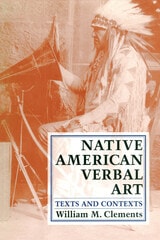
Native American Verbal Art
Texts and ContextsWilliam M. Clements
University of Arizona Press, 1996
For more than four centuries, Europeans and Euroamericans have been making written records of the spoken words of American Indians. While some commentators have assumed that these records provide absolutely reliable information about the nature of Native American oral expression, even its aesthetic qualities, others have dismissed them as inherently unreliable. In Native American Verbal Art: Texts and Contexts, William Clements offers a comprehensive treatment of the intellectual and cultural constructs that have colored the textualization of Native American verbal art. Clements presents six case studies of important moments, individuals, and movements in this history. He recounts the work of the Jesuits who missionized in New France during the seventeenth and eighteenth centuries and textualized and theorized about the verbal expressions of the Iroquoians and Algonquians to whom they were spreading Christianity.
He examines in depth Henry Timberlake’s 1765 translation of a Cherokee war song that was probably the first printed English rendering of a Native American "poem." He discusses early-nineteenth-century textualizers and translators who saw in Native American verbal art a literature manqué that they could transform into a fully realized literature, with particular attention to the work of Henry Rowe Schoolcraft, an Indian agent and pioneer field collector who developed this approach to its fullest. He discusses the "scientific" textualizers of the late nineteenth century who viewed Native American discourse as a data source for historical, ethnographic, and linguistic information, and he examines the work of Natalie Curtis, whose field research among the Hopis helped to launch a wave of interest in Native Americans and their verbal art that continues to the present.
In addition, Clements addresses theoretical issues in the textualization, translation, and anthologizing of American Indian oral expression. In many cases the past records of Native American expression represent all we have left of an entire verbal heritage; in most cases they are all that we have of a particular heritage at a particular point in history. Covering a broad range of materials and their historical contexts, Native American Verbal Art identifies the agendas that have informed these records and helps the reader to determine what remains useful in them. It will be a welcome addition to the fields of Native American studies and folklore.
[more]
New Perspectives on Language Variety in the South
Historical and Contemporary ApproachesMichael D. Picone
University of Alabama Press, 2015
The third installment in the landmark LAVIS (Language Variety in the South) series, New Perspectives on Language Variety in the South: Historical and Contemporary Approaches brings together essays devoted to the careful examination and elucidation of the rich linguistic diversity of the American South, updating and broadening the work of the earlier volumes by more fully capturing the multifaceted configuration of languages and dialects in the South.
Beginning with an introduction to American Indian languages of the Southeast, five fascinating essays discuss indigenous languages, including Caddo, Ofo, and Timucua, and evidence for the connection between the Pre-Columbian Southeast and the Caribbean.
Five essays explore the earlier Englishes of the South, covering topics such as the eighteenth century as the key period in the differentiation of Southern American English and the use of new quantitative methods to trace the transfer of linguistic features from England to America. They examine a range of linguistic resources, such as plantation overseers’ writings, modern blues lyrics, linguistic databases, and lexical and locutional compilations that reveal the region’s distinctive dialectal traditions.
New Perspectives on Language Variety in the South: Historical and Contemporary Approaches widens the scope of inquiry into the linguistic influences of the African diaspora as evidenced in primary sources and records. A comprehensive essay redefines the varieties of French in Louisiana, tracing the pathway from Colonial Louisiana to the emergence of Plantation Society French in a diglossic relationship with Louisiana Creole. A further essay maps the shift from French to English in family documents.
An assortment of essays on English in the contemporary South touch on an array of compelling topics from discourse strategies to dialectal emblems of identity to stereotypes in popular perception.
Essays about recent Latino immigrants to the South bring the collection into the twenty-first century, taking into account the dramatic increase in the population of Spanish speakers and illuminating the purported role of “Spanglish,” the bilingual lives of Spanish-speaking Latinos in Mississippi, and the existence of regional Spanish dialectal diversity.
[more]
Northern Paiute–Bannock Dictionary
Compiled by Sven Liljeblad, Catherine S. Fowler, and Glenda Powell
University of Utah Press, 2011
Based on extensive fieldwork that spanned more than 50 years, this comprehensive dictionary is a monumental achievement and will help to preserve this American Indian language that is nearing extinction.
[more]
Northwest Voices
Language and Culture in the Pacific NorthwestKristin Denham
Oregon State University Press, 2019
The Pacific Northwest has long been a linguistically rich region, yet there are few books devoted its unique linguistic heritage. The essays collected in Northwest Voices examine the historical background of the Pacific Northwest, the contributions of indigenous languages, the regional legacy of English, and the relationship between our perceptions of people and the languages they speak.
Although not often considered a bastion of diversity, linguistic or otherwise, in fact the Pacific Northwest has had a surprising number of influences on the English language, and a great number of other languages have left their mark on the region in a variety of ways. Individual essays examine the region's linguistic diversity, explore the origins and use of place names, and detail efforts to revive indigenous languages.
Written for both general readers and language scholars, Northwest Voices brings together research and perspectives from linguistics, history, and cultural studies to help readers understand how and why the language of our region is of utmost importance to our pasts, presents, and futures.
CONTRIBUTORS
Edwin Battistella
Kara Becker
Kathy Cole
Kristin Denham
Betsy Evans
Russell Hugo
Danica Sterud Miller
David Pippin
Allan Richardson
Jordan B. Sandoval
Alicia Beckford Wassink
Henry Zenk
[more]