Results by title
998 books match the query 'Life' and 22 start with n
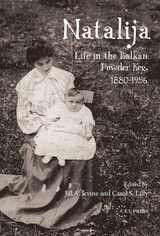
Natalija
Life in the Balkan Powder Keg, 1880-1956Natalija Matic-Zrnic
Central European University Press, 2009
Nathan Hale
The Life and Death of America's First SpyM. William Phelps
University Press of New England, 2015
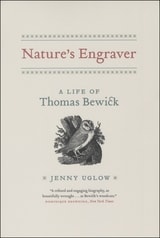
Nature's Engraver
A Life of Thomas BewickJenny Uglow
University of Chicago Press, 2009
Thomas Bewick’s (1753–1828) History of British Birds was the first field guide for ordinary people, illustrated with woodcuts of astonishing accuracy and beauty. In Nature’s Engraver, Jenny Uglow tells the story of the farmer’s son from Tyneside who became one of Britain’s greatest and most popular engravers. It is a story of violent change, radical politics, lost ways of life, and the beauty of the wild—a journey to the beginning of our lasting obsession with the natural world.
“A refined and engaging biography, as beautifully wrought, in its way, as Bewick’s woodcuts.”—New York Times
“Uglow’s clear prose sparkles like Bewick’s River Tyne.”—Los Angeles Times
“This is a lovely book, not just in the quality and sympathy of the writing but in the care of its design and illustration. [Uglow] has turned a rich but undramatic life into a vignette as full of interest and details as one of Bewick’s own woodcuts.”—Sunday Telegraph
“A splendid biography. But it becomes an endearing one by the scattered presence of so many of Bewick’s woodcuts.”—Washington Post
“Another triumph for England’s most innovative biographer, and a marvelous treat for fans of Bewick’s beguiling work.”—Kirkus Reviews

Near Human
Border Zones of Species, Life, and BelongingMette N. Svendsen
Rutgers University Press, 2022
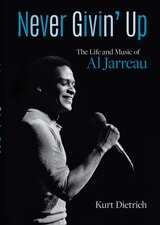
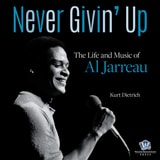
Never Givin' Up
The Life and Music of Al JarreauKurt Dietrich
Wisconsin Historical Society Press, 2023
This is the first biography to chronicle the life and career of one of the most distinguished and beloved musical artists to come out of Wisconsin: Al Jarreau. From his earliest days singing in the 1940s until his death in 2017, Jarreau defied categorization. While his biggest hit, “We’re In This Love Together,” is pure pop, he smashed music industry stereotypes as the first artist to win Grammy Awards in three genres: jazz, pop, and R&B.
Never Givin’ Up traces Jarreau’s singing career from humble beginnings in his hometown of Milwaukee to international fame. The narrative includes his formative student days at Ripon College and the University of Iowa, as well as the years spent honing his craft at nightspots in Milwaukee, San Francisco, and the Twin Cities. After he was signed by Warner Bros. Records in 1975 at the age of 35, Jarreau achieved stardom with his innovative vocal stylings and electric live performances.
This book includes more than 20 sidebars with bonus information about every Jarreau album and behind-the-scenes stories about the making of the records. Author Kurt Dietrich conducted interviews with dozens of Al's friends, fellow musicians, professional associates, and family members—most notably Al’s sister, Rose Marie Freeman, who was a major contributor to the project. Featuring 54 images spanning Jarreau’s life, from never-before-seen family snapshots to stills from his legendary stage performances, Never Givin’ Up celebrates a Milwaukee hometown hero and global sensation.
Silver Medal Winner for the 2023 Foreword INDIES Book of the Year Award for Performing Arts and Music
Finalist for the Association for Recorded Sound Collections’ Award for Best Historical Research in Recorded Jazz
“Kurt Dietrich has created a masterful book, revealing and depicting a detailed version of my brother, Al Jarreau, through his music and career. In these pages, I see Al’s determination and his admirable goal of ‘Never Givin’ Up’ on his joy of singing. It was my distinct pleasure to work with Kurt Dietrich in the process, establishing what has become a bond of family-like friendship that will endure for a lifetime and beyond.”
—Rose Marie (Jarreau) Freeman
“Dietrich captures Jarreau’s simultaneously gregarious and shy charm while revealing his own affection for this gifted and gracious performer. It’s his love letter to a Milwaukee legend.”
—Bill Milkowski, author of Jaco: The Extraordinary and Tragic Life of Jaco Pastorius and Ode to a Tenor Titan: The Life and Times and Music of Michael Brecker
"Written in an approachable style and carefully documented, this book will be valuable for fans and researchers of Jarreau’s music. Summing Up: Highly recommended."
—Choice Reviews
Never Givin' Up
The Life and Music of Al JarreauKurt Dietrich
Wisconsin Historical Society Press, 2025
This is the first biography to chronicle the life and career of one of the most distinguished and beloved musical artists to come out of Wisconsin: Al Jarreau. From his earliest days singing in the 1940s until his death in 2017, Jarreau defied categorization. While his biggest hit, “We’re In This Love Together,” is pure pop, he smashed music industry stereotypes as the first artist to win Grammy Awards in three genres: jazz, pop, and R&B.
Never Givin’ Up traces Jarreau’s singing career from humble beginnings in his hometown of Milwaukee to international fame. The narrative includes his formative student days at Ripon College and the University of Iowa, as well as the years spent honing his craft at nightspots in Milwaukee, San Francisco, and the Twin Cities. After he was signed by Warner Bros. Records in 1975 at the age of 35, Jarreau achieved stardom with his innovative vocal stylings and electric live performances.
This book includes more than 20 sidebars with bonus information about every Jarreau album and behind-the-scenes stories about the making of the records. Author Kurt Dietrich conducted interviews with dozens of Al's friends, fellow musicians, professional associates, and family members—most notably Al’s sister, Rose Marie Freeman, who was a major contributor to the project. Never Givin’ Up celebrates a Milwaukee hometown hero and global sensation.
Silver Medal Winner for the 2023 Foreword INDIES Book of the Year Award for Performing Arts and Music
Finalist for the Association for Recorded Sound Collections’ Award for Best Historical Research in Recorded Jazz
“Kurt Dietrich has created a masterful book, revealing and depicting a detailed version of my brother, Al Jarreau, through his music and career. In these pages, I see Al’s determination and his admirable goal of ‘Never Givin’ Up’ on his joy of singing. It was my distinct pleasure to work with Kurt Dietrich in the process, establishing what has become a bond of family-like friendship that will endure for a lifetime and beyond.”
—Rose Marie (Jarreau) Freeman
“Dietrich captures Jarreau’s simultaneously gregarious and shy charm while revealing his own affection for this gifted and gracious performer. It’s his love letter to a Milwaukee legend.”
—Bill Milkowski, author of Jaco: The Extraordinary and Tragic Life of Jaco Pastorius and Ode to a Tenor Titan: The Life and Times and Music of Michael Brecker
"Written in an approachable style and carefully documented, this book will be valuable for fans and researchers of Jarreau’s music. Summing Up: Highly recommended."
—Choice Reviews
New Perspectives on the Life and Art of Richard Crashaw
Edited by John R. Roberts
University of Missouri Press, 1990
Richard Crashaw (1612/13-1649) has been one of the most neglected, misunderstood, misread, and unappreciated of the so-called major metaphysical poets. Critics have long labeled Crashaw’s poetry “foreign,” “grotesque,: “deficient in judgment and taste,” and even “sexually perverse.” In recent years, however, Crashaw’s role in providing an understanding and appreciation of seventeenth century poetic theory and aesthetics has become increasingly more evident to literary scholars and critics. They now generally agree that his poetry occupies a permanent and significant position in the intellectual, religious, and literary history of his time.
This collection of ten original critical and historical essays on the life and art of Crashaw will serve as a further impetus to the renewed interest in Crashaw. In the introduction, John R. Roberts and Lorraine M. Roberts survey past Crashavian criticism, giving the reader an overall view of the critical response to Crashaw and his work. The introduction also signals new directions for future scholarship. Scholars, critics, and students of metaphysical, baroque, and religious poetry will find these essays engaging and insightful.

Newport In Rockies
Life & Good Times OfMarshall Sprague
Ohio University Press, 1988
In the town's early years, rich easterners and Englishmen came seeking adventure, romance, and gentility. But when gold was discovered at nearby Cripple Creek in 1900, Colorado Springs became an instant boom town. A second major boom came several decades later, when local boosters persuaded the Army to choose Colorado Springs as the site for Fort Carson, a training center for 30,000 troops. Other military projects followed, including Peterson Field, Ent Air Force Base, the underground North American Air Defense Command Combat Operations Center, and in 1954, the U.S. Air Force Academy. More recent projects, discussed in a new final chapter, include the Olympic Training Center and the Olympic Hall of Fame, as well as high-tech industries and advances in culture, education, and recreation.
As the city sprawls eastward onto the prairie, it bears little resemblance to General Palmer's 1871 village. Yet the general's dream of a quality town in a quality environment has continued to inspire generations of administrators and boosters who have made Colorado Springs a model of urban prosperity.
Newspaperwoman of the Ozarks
The Life and Times of Lucile Morris UptonSusan Croce Kelly
University of Arkansas Press, 2023
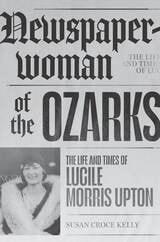
Lucile Morris Upton landed her first newspaper job out West in the early 1920s, then returned home to spend half a century reporting on the Ozarks world she knew best. Having come of age just as women gained the right to vote, she took advantage of opportunities that presented themselves in a changing world. During her years as a journalist, Upton rubbed shoulders with presidents, flew with aviation pioneer Wiley Post, covered the worst single killing of US police officers in the twentieth century, wrote an acclaimed book on the vigilante group known as the Bald Knobbers, charted the growth of tourism in the Ozarks, and spearheaded a movement to preserve iconic sites of regional history. Following retirement from her newspaper job, she put her experience to good use as a member of the Springfield City Council and community activist.
Told largely through Upton’s own words, this insightful biography captures the excitement of being on the front lines of newsgathering in the days when the whole world depended on newspapers to find out what was happening.
Winner, 2024 Missouri Literary Award
First Place, 2024 Missouri Professional Communicators Communications Contest
Finalist, Society of Midland Authors Book Award

No Color Is My Kind
The Life of Eldrewey Stearns and the Integration of HoustonBy Thomas R. Cole
University of Texas Press, 1997
No Man's Land
The Life and Art of Mary Riter HamiltonKathryn A. Young
University of Manitoba Press, 2017
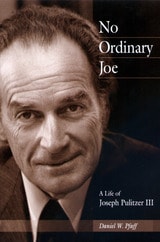
No Ordinary Joe
A Life of Joseph Pulitzer IIIDaniel W. Pfaff
University of Missouri Press, 2005

No Place for a Woman
A Life of Senator Margaret Chase SmithSherman, Janann
Rutgers University Press, 1999
No Place for a Woman is the first biography to analyze Margaret Chase Smith’s life and times by using politics and gender as the lens through which we can understand this Maine senator’s impact on American politics and American women. Sherman’s research is based upon more than one hundred hours of personal interviews with Senator Smith, and extensive research in primary and government documents, including those from the holdings of the Margaret Chase Smith Library.
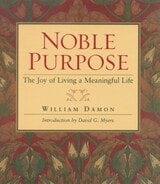
Noble Purpose
Joy Of Living A Meaningful LifeWilliam Bill Damon
Templeton Press, 2003
This book describes the personal and spiritual benefits of living life in a way that matters, with an awareness that one's life can reflect a sense of higher purpose no matter what the circumstances. The book draws upon religious, philosophical, and literary writings to show how humans in many cultures and historical epochs have pursued noble purposes by answering God's call as each hears it.
Noble purpose can be pursued both in heroic acts and in everyday behavior. The book shows how ordinary people—teachers, business professionals, parents, citizens—can ennoble what they do by being mindful of its deepest meaning. It also points out that humility is a necessary virtue for those who pursue a noble purpose. Great heroes are bold, courageous, and sometimes audacious in their determination to succeed; but they are also humble in their awareness of their own limitations. Moreover, a person must never violate basic moral laws while pursuing a noble purpose—the means must be as moral as the ends.
Purpose brings coherence and satisfaction to people's lives, producing joy in good times and resilience in hard times. It also presents a paradox: hard work in service of noble purpose that transcends personal gain is a surer path to happiness than the self-indulgent pursuit of happiness for its own sake. The closer we come to God's purpose for us, the more satisfied our lives become.
From the inspiration and examples conveyed in this book, we learn that all individuals have the capacity to discover their own God-given abilities, to learn the world's need for the services they can provide, and to experience joy in serving society and God in their special ways. As theologian Frederick Buechner writes, "The place God calls you to is the place where your deep gladness and the world's deep hunger meet."
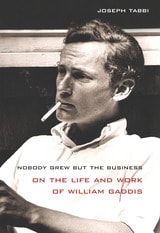
Nobody Grew but the Business
On the Life and Work of William GaddisJoseph Tabbi
Northwestern University Press, 2015
Finalist, 2016 Society for Midland Authors Award for Biography & Memoir
During his lifetime, William Gaddis (1922–1998) evaded biographical questions, never read from his work publicly, and didn’t allow his photograph to appear on his books. Before his novel J R (1975) won Gaddis the National Book Award and some measure of renown, he had given up the bohemian world of 1950s Greenwich Village for a series of corporate jobs that both paid the bills and provided an inside view of the encroachment of market values into every corner of American culture.
By illustrating the interconnectedness of Gaddis’s life and work, Tabbi, among his foremost interpreters, demystifies the “difficult author” and shows a writer who was as attuned as any to the way Americans talk, and who sensitively chronicled the gradual commodification of artistic endeavor. Illuminating, heartbreaking, and masterful, Tabbi’s book gives us the most subtly drawn portrait to date of one of the twentieth century’s seminal novelists.

North American Icelandic
The Life of a LanguageBirna Arnbjornsdottir
University of Manitoba Press, 2006

Northern White-Cedar
The Tree of LifeGerald L. Storm
Michigan State University Press, 2022
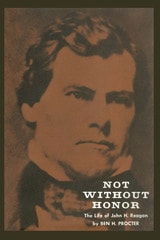
Not Without Honor
The Life of John H. ReaganBy Ben H. Procter
University of Texas Press, 1961
John H. Reagan was one of the most important figures in Texas history; this was the first biography of him to be published. Reagan, who was born in Sevier County, Tennessee, in 1818, came to Texas twenty-one years later—while Texas was still a republic—and stayed to play many major roles in its later economic and political development.
In this excellent biography, Ben H. Procter not only re-creates for us the character of the man, with his forthright integrity and his boundless desire for knowledge, but also places him against the background of the time in which he lived. In vivid language Procter portrays the violence and vigor of pioneer life, the excitement of frontier politics, the dedication, devotion, enthusiasm, and—ultimately—despair of the Civil War, and the bitterness of the struggle with the railroad tycoons and their gargantuan monopolies. Spanning as it does the Republic of Texas, early statehood, the Confederacy, Reconstruction, and the era of the "robber barons," the story of John H. Reagan encompasses a panoramic sweep of mid- to late-nineteenth-century United States history.
Throughout his long life, respect came to Reagan almost as a matter of course. The forceful strength of his personality made an impression few people could ignore. From the day when Colonel Durst hired the young Reagan as a tutor for his children, exclaiming, "This man is a scholar," until the day some fifty years later when Governor Hogg persuaded him to leave the U.S. Senate to become chairman of the new Railroad Commission because the Commission "must be above reproach," his extraordinary character and ability were recognized. In fact, the perceptive intelligence that made him examine all aspects of a situation, and the sturdy integrity and courage that made it impossible for him to abandon a position he believed to be right simply because it was for the moment unpopular, frequently gave him the appearance of a prophet. Although this "prophetic gift" occasionally led to interludes of public disfavor, Reagan was accorded honor, even in his own land—and in later years veneration—that any prophet might envy.

Not at All What One Is Used To
The Life and Times of Isabella GardnerMarian Janssen
University of Missouri Press, 2026
Born in 1915 to one of New England’s elite wealthy families, Isabella Gardner was expected to follow a certain path in life—one that would take her from marriageable debutante to proper society lady. But that plan was derailed when at age eighteen, Isabella caused a drunk-driving accident. Her family, to shield her from disgrace, sent her to Europe for acting studies, not foreseeing how life abroad would fan the romantic longings and artistic impulses that would define the rest of Isabella’s years. In Not at All What One Is Used To, author Marian Janssen tells the story of this passionate, troubled woman, whose career as a poet was in constant compromise with her wayward love life and her impulsive and reckless character.
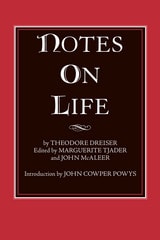
Notes on Life
Theodore Dreiser
University of Alabama Press, 1974
Exploring human nature, society, and destiny through the lens of American naturalism.
In Notes on Life, Theodore Dreiser—best known for his landmark novels Sister Carrie and An American Tragedy—reveals himself as an incisive thinker grappling with the forces that shape human existence. This compelling collection of essays brings together Dreiser’s reflections on society, ambition, morality, and the often-unseen pressures that guide individual lives. Written during a period of rapid cultural and industrial transformation in the United States, these essays offer a deeply engaged response to the uncertainties and contradictions of modern life.
At the heart of Notes on Life lies Dreiser’s enduring commitment to the principles of literary naturalism: the belief that human behavior is influenced—if not determined—by environment, heredity, and social conditions. Yet these essays go beyond literary theory. They present a searching, often personal inquiry into what it means to live meaningfully in a world shaped by inequality, chance, and desire. Dreiser examines the tension between individual aspiration and societal constraint, probing the psychological and moral dimensions of success, failure, and identity.
What distinguishes this collection is its accessibility and range. Dreiser writes with a directness that invites readers into complex philosophical questions without sacrificing intellectual depth. Whether considering the nature of happiness, the role of material success, or the ethical dilemmas of modern society, he offers insights that remain strikingly relevant. His voice—by turns analytical, reflective, and quietly provocative—bridges the gap between literature and philosophy, making these essays as engaging for general readers as they are valuable for students and scholars.
For those interested in American literature, Notes on Life provides essential context for understanding Dreiser’s fiction and the broader movement of realism and naturalism in the early twentieth century. For contemporary readers, it offers a timeless meditation on the forces that continue to shape human experience: ambition, circumstance, and the search for meaning in an ever-changing world.
Both a work of literary significance and a volume of enduring philosophical reflection, Notes on Life stands as a testament to Dreiser’s intellectual breadth and his unwavering commitment to exploring the complexities of human life.

Novelist to a Generation
The Life and Thought of Winston ChurchillUniversity of Wisconsin Press, 1976
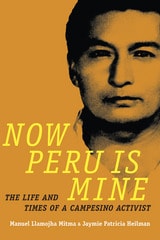
Now Peru Is Mine
The Life and Times of a Campesino ActivistManuel Llamojha Mitma and Jaymie Patricia Heilman
Duke University Press, 2016