Results by title
70 books match the query 'Mexican American authors' and 3 start with n
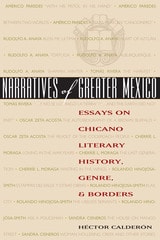
Narratives of Greater Mexico
Essays on Chicano Literary History, Genre, and BordersBy Héctor Calderón
University of Texas Press, 2005
Once relegated to the borders of literature—neither Mexican nor truly American—Chicana/o writers have always been in the vanguard of change, articulating the multicultural ethnicities, shifting identities, border realities, and even postmodern anxieties and hostilities that already characterize the twenty-first century. Indeed, it is Chicana/o writers' very in-between-ness that makes them authentic spokespersons for an America that is becoming increasingly Mexican/Latin American and for a Mexico that is ever more Americanized.
In this pioneering study, Héctor Calderón looks at seven Chicana and Chicano writers whose narratives constitute what he terms an American Mexican literature. Drawing on the concept of "Greater Mexican" culture first articulated by Américo Paredes, Calderón explores how the works of Paredes, Rudolfo Anaya, Tomás Rivera, Oscar Zeta Acosta, Cherríe Moraga, Rolando Hinojosa, and Sandra Cisneros derive from Mexican literary traditions and genres that reach all the way back to the colonial era. His readings cover a wide span of time (1892-2001), from the invention of the Spanish Southwest in the nineteenth century to the América Mexicana that is currently emerging on both sides of the border. In addition to his own readings of the works, Calderón also includes the writers' perspectives on their place in American/Mexican literature through excerpts from their personal papers and interviews, correspondence, and e-mail exchanges he conducted with most of them.
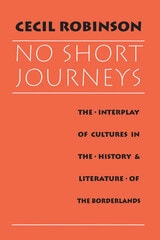
No Short Journeys
The Interplay of Cultures in the History and Literature of the BorderlandsCecil Robinson
University of Arizona Press, 1992
"In graceful prose, the longtime English professor leads readers on a leisurely stroll through the literary landscape of the Southwest."—Journal of Arizona History
"Does more for reconstructing American literature than any of the contemporary American literature anthologies that are on the market today. . . . Strongly recommended."—Choice
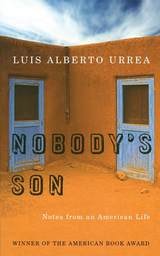
Nobody's Son
Notes from an American LifeLuis Alberto Urrea
University of Arizona Press, 1998
. . . I'm not saying it's our story. I'm not saying it isn't. It might be yours. "How do you tell a story that cannot be told?" writes Luis Alberto Urrea in this potent memoir of a childhood divided. Born in Tijuana to a Mexican father and an Anglo mother from Staten Island, Urrea moved to San Diego when he was three. His childhood was a mix of opposites, a clash of cultures and languages. In prose that seethes with energy and crackles with dark humor, Urrea tells a story that is both troubling and wildly entertaining. Urrea endured violence and fear in the black and Mexican barrio of his youth. But the true battlefield was inside his home, where his parents waged daily war over their son's ethnicity. "You are not a Mexican!" his mother once screamed at him. "Why can't you be called Louis instead of Luis?" He suffers disease and abuse and he learns brutal lessons about machismo. But there are gentler moments as well: a simple interlude with his father, sitting on the back of a bakery truck; witnessing the ultimate gesture of tenderness between the godparents who taught him the magical power of love. "I am nobody's son. I am everybody's brother," writes Urrea. His story is unique, but it is not unlike thousands of other stories being played out across the United States, stories of other Americans who have waged war—both in the political arena and in their own homes—to claim their own personal and cultural identity. It is a story of what it means to belong to a nation that is sometimes painfully multicultural, where even the language both separates and unites us. Brutally honest and deeply moving, Nobody's Son is a testament to the borders that divide us all.