Results by title
77 books match the query 'Nietzsche, Friedrich Wilhelm' and 32 start with n

Nietzsche
Lou Salomé
University of Illinois Press, 1988
Published in 1894 as its subject languished in madness, Salomé's book rode the crest of a surge of interest in Nietzsche's iconoclastic philosophy. She discusses his writings and such biographical events as his break with Wagner, attempting to ferret out the man in the midst of his works.
Salomé's provocative conclusion -- that Nietzsche's madness was the inevitable result of his philosophical views -- generated considerable controversy. Nietzsche's sister, Elisabeth Förster-Nietzsche, dismissed the book as a work of fantasy. Yet the philosopher's longtime acquaintance Erwin Rohde wrote, "Nothing better or more deeply experienced or perceived has ever been written about Nietzsche."
Siegfried Mandel's extensive introduction examines the circumstances that brought Lou Salomé and Nietzsche together and the ideological conflicts that drove them apart.
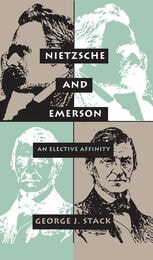
Nietzsche & Emerson
An Elective AffinityGeorge J. Stack
Ohio University Press, 1993
George J. Stack traces the sources of ideas and theories that have long been considered the exclusive province of Friedrich Nietzsche to the surprisingly radical writings of the American essayist and poet, Ralph Waldo Emerson.
Nietzsche and Emerson makes us see Emerson’s writings in a new, more intensified light and presents a new perspective on Nietzsche’s philosophy. Stack traces how the rich theoretical ideas and literary images of Emerson entered directly into the existential dimension of Nietzsche’s thought and hence into the stream of what has been considered a distinctively European intellectual movement.
Nietzsche Pursued
Toward a Philosophy for the FutureRichard Schacht
University of Chicago Press, 2024
Nietzsche advocated for a post-theistic “philosophy of the future”—a new approach to human reality that would bend Western thought away from nihilism in a life-affirming, value-creative direction. His early demise left this endeavor only just begun. In Nietzsche Pursued, Richard Schacht examines Nietzsche’s revisionist approach to familiar philosophical topics, exploring how some may be further pursued in Nietzschean ways.
Each chapter focuses on one topic that is central to Nietzsche's vision of what philosophy can and should be and do. Among them: his kind of naturalism, humanity, perspectivism, morality, and music. Building on his analysis in Nietzsche’s Kind of Philosophy, Schacht invites readers to see with new appreciation the ongoing significance of Nietzsche’s thought for philosophy’s future.
Nietzsche and Asian Thought
Edited by Graham Parkes
University of Chicago Press, 1991
The contributors are Roger T. Ames, Johann Figl, Chen Guying, Michel Hulin, Arifuku Kogaku, David A. Kelly, Glen T. Martin, Sonoda Muneto, Graham Parkes, okochi Ryogi, Eberhard Scheiffele, Mervyn Sprung, and Joan Stambaugh.
"Exemplary. Its comparative approach is incisive yet accessible. I consider it a 'must read'"—Kathleen Marie Higgins, Philosophy East and West
"An excellent introduction to the broad ranging reception of Nietzsche among Asian thinkers."—James R. Watson, Canadian Philosophical Review
"The essays in this welcome collection are invariably thought-provoking and genuinely cross-disciplinary."—Kenneth Surin, Religious Studies Review
"A worthy and undogmatic introduction to several fascinating questions concerning the relations between Nietzschean thought and certain traditions of thought in India, China, and Japan."—Don Miller, Asian Studies Review
Nietzsche and Dostoevsky
Philosophy, Morality, TragedyEdited by Jeff Love and Jeffrey Metzger
Northwestern University Press, 2016
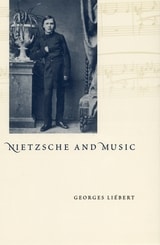
Nietzsche and Music
Georges Liébert
University of Chicago Press, 2003
In his youth, Friedrich Nietzsche yearned to become a great composer and wrote many pieces of music. He later claimed to be "the most musical of all philosophers." Yet most books on Nietzsche fail to explore the importance of music for his thought.
Nietzsche and Music provides the first in-depth examination of the fundamental significance of music for Nietzsche's life and work. Nietzsche's views on music are essential for understanding his philosophy as a whole. Part biography and part critical examination, Georges Liébert brilliantly demonstrates that despite failed attempts at a professional career as composer, Nietzsche never fully removed himself from the world of music, but instead, became a composer of philosophy, utilizing the musical form as a template for his own writings and creative thought. Liébert's study surveys Nietzsche's opinions about particular composers and compositions, as well as his more theoretical writings on music and its relation to the other arts. He also explores Nietzsche's listening habits, his playing and style of composition, and his many contacts in the musical world, including his controversial and contentious relationship with Richard Wagner. For Nietzsche, music gave access to a realm of wisdom that transcended thought. Music was Nietzsche's great solace; in his last years, it was his refuge from madness.
A virtuoso exploration of this little-known but crucial aspect of Nietzsche's life and work, this volume will be of enormous value to scholars of philosophy, music, aesthetics, and literature.
Nietzsche and Race
Marc de Launay
University of Chicago Press, 2023
The caricature of Friedrich Nietzsche as a proto-Nazi is still with us, having originated with his own Nazi sister, Elisabeth Förster, who curated Nietzsche’s disparate texts to suit her own purposes. In Nietzsche and Race, Marc de Launay deftly counters this persistent narrative in a series of concise and highly accessible reflections on the concept of race in Nietzsche’s publications, notebooks, and correspondence. Through a fresh reading of Nietzsche’s core philosophical project, de Launay articulates a new understanding of race in Nietzsche’s body of work free from the misunderstanding of his detractors.
Nietzsche and the Problem of Sovereignty
Richard J. White
University of Illinois Press, 1997
nature of the individual. Richard White shows how Nietzsche was inspired
and guided by the question of personal "sovereignty" and how
through his writings he sought to provoke the very sovereignty he described.
White argues that Nietzsche is a philosopher our contemporary age must
therefore come to understand if we are ever to secure a genuinely meaningful
direction for the future. Profoundly relevant to our era, Nietzsche's
philosophy addresses a version of individuality that allows us to move
beyond the self-dispossession of mass society and the alternative of selfish
individualism--to fully understand how one becomes what one is.
A volume in the International Nietzsche Studies series, edited by
Richard Schacht

Nietzsche and the Shadow of God
Didier Franck; Translated from the French by Bettina Bergo and Philippe Farah
Northwestern University Press, 2011
Bergo and Farah’s clear translation introduces this work to an English-speaking audience for the first time.
Nietzsche and the Transcendental Tradition
Michael Steven Green
University of Illinois Press, 2002
In recent years, both analytic thinkers and postmodern theorists have looked at Friedrich Nietzsche's epistemology from the perspectives of their philosophical traditions. Michael Steven Green's penetrating study tries instead to do justice to Nietzsche's views on truth and knowledge by looking at them from the perspective of his contemporaries, particularly the Neo-Kantian philosopher Afrikan Spir, whose ideas exerted a tremendous influence on Nietzsche's thought.
Despite his generally naturalist outlook, Nietzsche was committed to an antinaturalist theory of cognition inherited from Kant and Spir. Green shows how this fundamental tension in Nietzsche's thought led him to present not only the antirealism that has commonly been attributed to him in the past, but two other epistemological positions. These are a denial of the possibility of human thought entirely, and an error theory–-the argument that all of our judgments are false–-that has strong parallels in Spir's thought and Kant's antinomies.
Viewing Nietzsche's error theory in light of Kantian transcendental idealism, Green makes sense of arguments that have previously confounded Nietzsche interpreters. Green also provides the first English translations of many passages from Spir's writings and Nietzsche's notebooks.
In examining Nietzsche's thought through the lens of the philosophical influences upon him–-the philosophers that Nietzsche himself read–-Green establishes a significant new foundation from which to assess Nietzsche's place in modern philosophy and culture.
Nietzsche and the Vicious Circle
Pierre Klossowski
University of Chicago Press, 1997
Long recognized as a masterpiece of Nietzsche scholarship, Nietzsche and the Vicious Circle is made available here for the first time in English. Taking a structuralist approach to the relation between Nietzsche's thought and his life, Klossowski emphasizes the centrality of the notion of Eternal Return (a cyclical notion of time and history) for understanding Nietzsche's propensities for self-denial, self-reputation, and self-consumption.
Nietzsche's ideas did not stem from personal pathology, according to Klossowski. Rather, he made a pathological use of his best ideas, anchoring them in his own fluctuating bodily and mental conditions. Thus Nietzsche's belief that questions of truth and morality are at base questions of power and fitness resonates dynamically and intellectually with his alternating lucidity and delirium.
Nietzsche on Language, Consciousness, and the Body
Christian J. Emden
University of Illinois Press, 2005
Emden situates Nietzsche’s writings on language and rhetoric within their wider historical context. He demonstrates that Nietzsche is not as radical in his thinking as has been often supposed, and that a number of problems with Nietzsche disappear when Nietzsche’s works are compared to works on the same subjects by writers of the 18th and 19th centuries. Further, the relevance of rhetoric and the history of rhetoric to philosophy and the history of philosophy is reasserted, in consonance with Nietzsche’s own statements and practices. Important in this regard are the role of fictions, descriptions, and metaphor.

Nietzsche's Corps/e
Aesthetics, Politics, Prophecy, or, the Spectacular Technoculture of Everyday LifeGeoff Waite
Duke University Press, 1996
Waite advances his argument by bringing Marxist—especially Gramscian and Althusserian—theories to bear on the concept of Nietzsche/anism. But he also goes beyond ideological convictions to explore the vast Nietzschean influence that proliferates throughout the marketplace of contemporary philosophy, political and literary theory, and cultural and technocultural criticism. In light of a philological reconstruction of Nietzsche’s published and unpublished texts, Nietzsche’s Corps/e shuttles between philosophy and everyday popular culture and shows them to be equally significant in their having been influenced by Nietzsche—in however distorted a form and in a way that compromises all of our best interests.
Controversial in its “decelebration” of Nietzsche, this remarkable study asks whether the postcontemporary age already upon us will continue to be dominated and oriented by the haunting spectre of Nietzsche’s corps/e. Philosophers, intellectual historians, literary theorists, and those interested in western Marxism, popular culture, Friedrich Nietzsche, and the intersection of French and German thought will find this book both appealing and challenging.

Nietzsche's Earth
Great Events, Great PoliticsGary Shapiro
University of Chicago Press, 2016
Shapiro explores Nietzsche’s rejection of historical inevitability and its idea of the end of history. He highlights Nietzsche’s prescient vision of today’s massive human mobility and his criticism of the nation state’s desperate efforts to sustain its exclusive rule by declaring emergencies and states of exception. Shapiro then explores Nietzsche’s vision of a transformed garden earth and the ways it sketches an aesthetic of the Anthropocene. He concludes with an explanation of the deep political structure of Nietzsche’s “philosophy of the Antichrist,” by relating it to traditional political theology. By triangulating Nietzsche between his time and ours, between Bismarck’s Germany and post-9/11 America, Nietzsche’s Earth invites readers to rethink not just the philosopher himself but the very direction of human history.
Nietzsche's Earthbound Wisdom
The Philosopher, the Poet, and the SageKeith Ansell-Pearson
University of Chicago Press, 2025
Today, Nietzsche is justly celebrated for his rich, philosophical naturalism, but Keith Ansell-Pearson warns that we must not overlook the visionary dimension of his thinking and his focus on the need to cultivate a new care of the self and care of life. In Nietzsche’s Earthbound Wisdom, Ansell-Pearson recovers Nietzsche’s love for a philosophy that guides us through our passions, one that opens us more fully to the possibilities of life and the joy of knowledge.
Ansell-Pearson offers close readings of Nietzsche’s texts in conversation with philosophical and literary figures including Augustine, Baudelaire, Carlyle, Dostoevsky, Emerson, Flaubert, Stendhal, and more. Throughout, Ansell-Pearson examines Nietzsche’s sophisticated critique of literary naturalism and his alternative conception of the poet as a seer who has a deep longing for a new earth.
Nietzsche's Enlightenment
The Free-Spirit Trilogy of the Middle PeriodPaul Franco
University of Chicago Press, 2011
Nietzsche's Final Teaching
Michael Allen Gillespie
University of Chicago Press, 2017
Cutting against the grain of most current Nietzsche scholarship, Michael Allen Gillespie presents the thought of the late Nietzsche as Nietzsche himself intended, drawing not only on his published works but on the plans for the works he was unable to complete, which can be found throughout his notes and correspondence. Gillespie argues that the idea of the eternal recurrence transformed Nietzsche’s thinking from 1881 to 1889. It provided both the basis for his rejection of traditional metaphysics and the grounding for the new logic, ontology, theology, and anthropology he intended to create with the aim of a fundamental transformation of European civilization, a “revaluation of all values.” Nietzsche first broached the idea of the eternal recurrence in Thus Spoke Zarathustra, but its failure to gain attention or public acceptance led him to present the idea again through a series of works intended to culminate in a never-completed magnum opus. Nietzsche believed this idea would enable the redemption of humanity. At the same time, he recognized its terrifying, apocalyptic consequences, since it would also produce wars of unprecedented ferocity and destruction.
Through his careful analysis, Gillespie reveals a more radical and more dangerous Nietzsche than the humanistic or democratic Nietzsche we commonly think of today, but also a Nietzsche who was deeply at odds with the Nietzsche imagined to be the forefather of Fascism. Gillespie’s essays examine Nietzsche’s final teaching—its components and its political, philosophical, and theological significance. The book concludes with a critical examination and a reflection on its meaning for us today.
Nietzsche's Journey to Sorrento
Genesis of the Philosophy of the Free SpiritPaolo D'Iorio
University of Chicago Press, 2016
Nietzsche first voyaged to the south in the autumn of 1876, upon the invitation of his friend, Malwida von Meysenbug. The trip was an immediate success, reviving Nietzsche’s joyful and trusting sociability and fertilizing his creative spirit. Walking up and down the winding pathways of Sorrento and drawing on Nietzsche’s personal notebooks, D’Iorio tells the compelling story of Nietzsche’s metamorphosis beneath the Italian skies. It was here, D’Iorio shows, that Nietzsche broke intellectually with Wagner, where he decided to leave his post at Bâle, and where he drafted his first work of aphorisms, Human, All Too Human, which ushered in his mature era. A sun-soaked account of a philosopher with a notoriously overcast disposition, this book is a surprising travelogue through southern Italy and the history of philosophy alike.
Nietzsche's Kind of Philosophy
Finding His WayRichard Schacht
University of Chicago Press, 2023
In Nietzsche’s Kind of Philosophy, Richard Schacht provides a holistic interpretation of Friedrich Nietzsche’s distinctive thinking, developed over decades of engagement with the philosopher’s work. For Schacht, Nietzsche’s overarching project is to envision a “philosophy of the future” attuned to new challenges facing Western humanity after the “death of God,” when monotheism no longer anchors our understanding of ourselves and our world. Schacht traces the developmental arc of Nietzsche’s philosophical efforts across Human, All Too Human, Daybreak, Joyful Knowing (The Gay Science), Thus Spoke Zarathustra, Beyond Good and Evil, and On the Genealogy of Morality. He then shows how familiar labels for Nietzsche—nihilist, existentialist, individualist, free spirit, and naturalist—prove insufficient individually but fruitful if refined and taken together. The result is an expansive account of Nietzsche’s kind of philosophy.
Nietzsche's Kisses
A NovelLance Olsen
University of Alabama Press, 2006
Nietzsche's Legacy
"Ecce Homo" and "The Antichrist," Two Books on Nature and PoliticsHeinrich Meier
University of Chicago Press, 2024
A reappraisal of Ecce Homo and The Antichrist within Nietzsche’s oeuvre.
Nietzsche's Legacy takes on the most challenging and misunderstood works in Nietzsche’s oeuvre to illuminate his view of what a philosopher is and what constitutes a philosophic life. Interpreting Ecce Homo and The Antichrist as twin books meant to replace the abandoned Will to Power project, Heinrich Meier recovers them from the stigma of Nietzsche’s late mental collapse, showing that these works are, above all, a lucid self-assessment. The carefully written pair contains both the highest affirmation—the Yes of the “revaluation of all values”—and the most resolute negation—the No to Christianity. How the Yes and the No go together, how the relation between nature and politics is to be determined, how Nietzsche’s intention is governing the political-philosophical double-face: this is the subject of Nietzsche’s Legacy, which opens up a new understanding of Nietzsche’s philosophy as a whole.
Nietzsche's New Seas
Explorations in Philosophy, Aesthetics, and PoliticsEdited by Michael Allen Gillespie and Tracy B. Strong
University of Chicago Press, 1988
Nietzsche's Perspectivism
Steven Hales and Rex Welshon
University of Illinois Press, 2000
Hales and Welshon present Nietzsche's treatment of perspectivism as both more complex and more fruitful than the common view of it as a doctrine that truth is not objective. Neither a metaphor nor a methodology, perspectivism emerges as a protean concept akin to a unifying theme; an alternative to the absolutism that recurs in science, philosophy, and religion; and a technique for revealing the unimagined possibilities open to every individual.

Nietzsche's Philosophical Context
An Intellectual BiographyThomas Brobjer
University of Illinois Press, 2007
Nietzsche's Posthumanism
Edgar Landgraf
University of Minnesota Press, 2023
A timely and trenchant commentary on the centrality of Nietzsche’s thought for our time
While many posthumanists claim Nietzsche as one of their own, rarely do they engage his philosophy in any real depth. Nietzsche’s Posthumanism addresses this need by exploring the continuities and disagreements between Nietzsche’s philosophy and contemporary posthumanism. Focusing specifically on Nietzsche’s reception of the life sciences of his day and his reflections on technology—research areas as central to Nietzsche’s work as they are to posthumanism—Edgar Landgraf provides fresh readings of Nietzsche and a critique of post- and transhumanist philosophies.
Through Landgraf’s inquiry, lesser-known aspects of Nietzsche’s writings emerge, including the neurophysiological basis of his epistemology (which anticipates contemporary debates on embodiment), his concerns with insects and the emergent social properties they exhibit, and his reflections on the hominization and cultivation effects of technology. In the process, Landgraf challenges major commonplaces about Nietzsche’s philosophy, including the idea that his social theory asserts the rights of “the strong” over “the weak.” The ethos of critical posthumanism also offers a new perspective on key ethical and political contentions of Nietzsche’s writings.
Nietzsche’s Posthumanism presents a uniquely framed introduction to tenets of Nietzsche’s thought and major trends in posthumanism, making it an essential exploration for anyone invested in Nietzsche and his contemporary relevance, and in posthumanism and its genealogy.
Retail e-book files for this title are screen-reader friendly.
Nietzsche's Revaluation of Values
A STUDY IN STRATEGIESE. E. Sleinis
University of Illinois Press, 1994
Nietzsche's Sister and the Will to Power
A Biography of Elisabeth Förster-NietzscheCarol Diethe
University of Illinois Press, 2002
In 1901, a year after her brother Friedrich's death, Elisabeth Förster-Nietzsche published The Will to Power, a hasty compilation of writings he had never intended for print. In Nietzsche's Sister and the Will to Power, Carol Diethe contends that Förster-Nietzsche's own will to power and her desire to place herself--not her brother--at the center of cultural life in Germany are centrally responsible for Nietzsche's reputation as a belligerent and proto-Fascist thinker.
Offering a new look at Nietzsche's sister from a feminist perspective, this spirited and erudite biography examines why Elisabeth Förster-Nietzsche recklessly consorted with anti-Semites, from her own husband to Hitler himself, out of convenience and a desire for revenge against a brother whose love for her waned after she caused the collapse of his friendship with Lou Salomé. The book also examines their family dynamics, Nietzsche's dismissal of his sister's early writing career, and the effects of limited education on intelligent women. Diethe concludes by detailing Förster-Nietzsche's brief marriage and her subsequent colonial venture in Paraguay, maintaining that her sporadic anti-Semitism was, like most things in her life, an expedient tool for cultivating personal success and status.
A volume in the series International Nietzsche Studies, edited by Richard Schacht
Nietzsche, Heidegger, and the Transition to Postmodernity
Gregory Bruce Smith
University of Chicago Press, 1995
Smith argues that, while much of postmodern thought is rooted in Nietzsche and Heidegger, it has ironically attempted, whether unwittingly or by design, to deflect their philosophy back onto a modern path. Other alternative paths emanating from both Nietzschean and Heideggerian thought that might more powerfully speak to postmodern culture have been ignored. Nietzsche and Heidegger, Smith suggests, have made possible a far more revolutionary critique of modernity then even their most ardent postmodern admirers have realized.
Smith contends that the influences on the postmodern in the thought of Nietzsche and Heidegger are founded in a new vision of praxis liberated from theory. Ultimately, these philosophers do transcend the nihilism often found in the guise of postmodernism. Their thought is, moreover, consistent with the possibility of limited constitutional government and the rule of law. Smith's book takes the first step toward recovering these possibilities and posing the fundamental questions of politics and ethics in ways that have heretofore been closed off by late-modern thought.
Nietzsche, Psychology, and First Philosophy
Robert B. Pippin
University of Chicago Press, 2010
Friedrich Nietzsche is one of the most elusive thinkers in the philosophical tradition. His highly unusual style and insistence on what remains hidden or unsaid in his writing make pinning him to a particular position tricky. Nonetheless, certain readings of his work have become standard and influential. In this major new interpretation of Nietzsche’s work, Robert B. Pippin challenges various traditional views of Nietzsche, taking him at his word when he says that his writing can best be understood as a kind of psychology.
Pippin traces this idea of Nietzsche as a psychologist to his admiration for the French moralists: La Rochefoucauld, Pascal, Stendhal, and especially Montaigne. In distinction from philosophers, Pippin shows, these writers avoided grand metaphysical theories in favor of reflections on life as lived and experienced. Aligning himself with this project, Nietzsche sought to make psychology “the queen of the sciences” and the “path to the fundamental problems.” Pippin contends that Nietzsche’s singular prose was an essential part of this goal, and so he organizes the book around four of Nietzsche’s most important images and metaphors: that truth could be a woman, that a science could be gay, that God could have died, and that an agent is as much one with his act as lightning is with its flash.
Expanded from a series of lectures Pippin delivered at the Collège de France, Nietzsche, Psychology, and First Philosophy offers a brilliant, novel, and accessible reading of this seminal thinker.
Nietzsche
Attempt at a MythologyErnst Bertram. Translated and with an Introduction by Robert E. Norton
University of Illinois Press, 2008
The only English translation of a crucial interpretation of Nietzsche
First published in 1918, Ernst Bertram's Nietzsche: Attempt at a Mythology substantially shaped the image of Nietzsche for the generation between the wars. It won the Nietzsche Society's first prize and was admired by luminous contemporaries including André Gide, Hermann Hesse, Gottfried Benn, and Thomas Mann. Although translated into French in 1932, the book was never translated into English following the decline of Nietzsche's and Bertram's reputations after 1945. Now, with Nietzsche's importance for twentieth-century thought undisputed, the work by one of his most influential interpreters can at last be read in English.Employing a perspectival technique inspired by Nietzsche himself, Bertram constructs a densely layered portrait of the thinker that shows him riven by deep and ultimately irresolvable cultural, historical, and psychological conflicts. At once lyrical and intensely probing, richly complex yet thematically coherent, Bertram's book is a masterpiece in a forgotten tradition of intellectual biography.
Nietzsche
His Philosophy of Contradictions and the Contradictions of His PhilosophyWolfgang Muller-Lauter
University of Illinois Press, 1999
Müller-Lauter has remained at the forefront of German Nietzsche studies throughout the quarter century since this book first appeared. This long-awaited translation, containing two substantial subsequent essays, is a major addition to the English-language Nietzsche literature
Nihilism Before Nietzsche
Michael Allen Gillespie
University of Chicago Press, 1994
Reconstructing nihilism's intellectual and spiritual origins before it was given its determinitive definition by Nietzsche, Gillespie focuses on the crucial turning points in the development of nihilism, from Ockham and the nominalist revolution to Descartes, Fichte, the German Romantics, the Russian nihilists and Nietzsche himself. His analysis shows that nihilism is not the result of the death of God, as Nietzsche believed; but the consequence of a new idea of God as a God of will who overturns all eternal standards of truth and justice. To understand nihilism, one has to understand how this notion of God came to inform a new notion of man and nature, one that puts will in place of reason, and freedom in place of necessity and order.