Results by title
337 books match the query 'North America' and 15 start with n

NAFTA and Labor in North America
Norman Caulfield
University of Illinois Press, 2010
Native American DNA
Tribal Belonging and the False Promise of Genetic ScienceKim TallBear
University of Minnesota Press, 2013
Who is a Native American? And who gets to decide? From genealogists searching online for their ancestors to fortune hunters hoping for a slice of casino profits from wealthy tribes, the answers to these seemingly straightforward questions have profound ramifications. The rise of DNA testing has further complicated the issues and raised the stakes.
In Native American DNA, Kim TallBear shows how DNA testing is a powerful—and problematic—scientific process that is useful in determining close biological relatives. But tribal membership is a legal category that has developed in dependence on certain social understandings and historical contexts, a set of concepts that entangles genetic information in a web of family relations, reservation histories, tribal rules, and government regulations. At a larger level, TallBear asserts, the “markers” that are identified and applied to specific groups such as Native American tribes bear the imprints of the cultural, racial, ethnic, national, and even tribal misinterpretations of the humans who study them.
TallBear notes that ideas about racial science, which informed white definitions of tribes in the nineteenth century, are unfortunately being revived in twenty-first-century laboratories. Because today’s science seems so compelling, increasing numbers of Native Americans have begun to believe their own metaphors: “in our blood” is giving way to “in our DNA.” This rhetorical drift, she argues, has significant consequences, and ultimately she shows how Native American claims to land, resources, and sovereignty that have taken generations to ratify may be seriously—and permanently—undermined.

Native American Folklore in Nineteenth-Century Periodicals
William M. Clements
Ohio University Press, 1986
Though study of American Indian cultures had been fostered for several centuries by missionaries and explorers, it was not until he nineteenth century that a disciplined and systematic approach to the study of New World cultures began to emerge. With Schoolcraft, Powell, Boas, and others, an adventurers’ avocation first became a profession, and it is to these early scholars that we owe the major theoretical perspectives and insights which provided a grounding for American anthropology and folklore studies.
In these twenty-one essays, many of which originally appeared in such now obscure periodicals as Southern Literary Messenger, American Whig Review, and DeLestry’s Western Magazine, Clements presents representative works by most of the major early figures in the field. The collection includes early statements and applications of most of the theoretical approaches to folklore employed in the nineteenth century, and it encompasses each of the major folklore genres studied by nineteenth-century researchers.
Extensive headnotes to each essay provide information about the author, discussion of the theoretical context of each essay, and direction to more contemporary treatments of the theories and materials involved, and the problems addressed. These together with a brief introduction tracing the genesis of American folklore studies, and chronological arrangement of the articles themselves, make Native American Folklore a convenient introduction to and survey of the major ideas and figures of American folklore studies in its formative period.
Native American Oral Traditions
Collaboration and InterpretationLarry Evers
Utah State University Press, 2001
This collection provides a benchmark that helps secure the position of collaboration between Native American and non-Native American scholars in the forefront of study of Native oral traditions. Seven sets of intercultural authors present Native American oral texts with commentary, exploring dimensions of perspective, discovery, and meaning that emerge through collaborative translation and interpretation. The texts studied all come from the American West but include a rich variety of material, since their tribal sources range from the Yupik in the Arctic to the Yaqui in the Sonoran Desert.
This presentation of jointly authored work is timely: it addresses increasing interest in, calls for, and movement toward reflexivity in the relationships between scholars and the Native communities they study, and it responds to the renewed commitment in those communities to asserting more control over representations of their traditions. Although Native and academic communities have long tried to work together in the study of culture and literature, the relationship has been awkward and imbalanced toward the academics. In many cases, the contributions of Native assistants, informants, translators, and field workers to the work of professional ethnographers has been inadequately credited, ignored, or only recently uncovered. Native Americans usually have not participated in planning and writing such projects. Native American Oral Traditions provides models for overcoming such obstacles to interpreting and understanding Native oral literature in relation to the communities and cultures from which it comes.
Native American Performance and Representation
Edited by S. E. Wilmer
University of Arizona Press, 2009
This volume examines Native performance using a variety of lenses, such as feminism, literary and film theory, and postcolonial discourse. Through the many unique voices of the contributors, major themes are explored, such as indigenous self-representations in performance, representations by nonindigenous people, cultural authenticity in performance and representation, and cross-fertilization between cultures. Authors introduce important, though sometimes controversial, issues as they consider the effects of miscegenation on traditional customs, racial discrimination, Native women’s position in a multicultural society, and the relationship between authenticity and hybridity in Native performance.
An important addition to the new and growing field of Native performance, Wilmer’s book cuts across disciplines and areas of study in a way no other book in the field does. It will appeal not only to those interested in Native American studies but also to those concerned with women’s and gender studies, literary and film studies, and cultural studies.
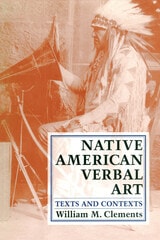
Native American Verbal Art
Texts and ContextsWilliam M. Clements
University of Arizona Press, 1996
He examines in depth Henry Timberlake’s 1765 translation of a Cherokee war song that was probably the first printed English rendering of a Native American "poem." He discusses early-nineteenth-century textualizers and translators who saw in Native American verbal art a literature manqué that they could transform into a fully realized literature, with particular attention to the work of Henry Rowe Schoolcraft, an Indian agent and pioneer field collector who developed this approach to its fullest. He discusses the "scientific" textualizers of the late nineteenth century who viewed Native American discourse as a data source for historical, ethnographic, and linguistic information, and he examines the work of Natalie Curtis, whose field research among the Hopis helped to launch a wave of interest in Native Americans and their verbal art that continues to the present.
In addition, Clements addresses theoretical issues in the textualization, translation, and anthologizing of American Indian oral expression. In many cases the past records of Native American expression represent all we have left of an entire verbal heritage; in most cases they are all that we have of a particular heritage at a particular point in history. Covering a broad range of materials and their historical contexts, Native American Verbal Art identifies the agendas that have informed these records and helps the reader to determine what remains useful in them. It will be a welcome addition to the fields of Native American studies and folklore.
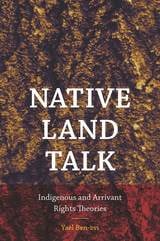
Native Land Talk
Indigenous and Arrivant Rights TheoriesYael Ben-zvi
Dartmouth College Press, 2018
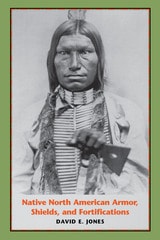
Native North American Armor, Shields, and Fortifications
By David E. Jones
University of Texas Press, 2004
From the Chickasaw fighting the Choctaw in the Southeast to the Sioux battling the Cheyenne on the Great Plains, warfare was endemic among the North American Indians when Europeans first arrived on this continent. An impressive array of offensive weaponry and battle tactics gave rise to an equally impressive range of defensive technology. Native Americans constructed very effective armor and shields using wood, bone, and leather. Their fortifications ranged from simple refuges to walled and moated stockades to multiple stockades linked in strategic defensive networks.
In this book, David E. Jones offers the first systematic comparative study of the defensive armor and fortifications of aboriginal Native Americans. Drawing data from ethnohistorical accounts and archaeological evidence, he surveys the use of armor, shields, and fortifications both before European contact and during the historic period by American Indians from the Southeast to the Northwest Coast, from the Northeast Woodlands to the desert Southwest, and from the Sub-Arctic to the Great Plains. Jones also demonstrates the sociocultural factors that affected warfare and shaped the development of different types of armor and fortifications. Extensive eyewitness descriptions of warfare, armor, and fortifications, as well as photos and sketches of Indian armor from museum collections, add a visual dimension to the text.
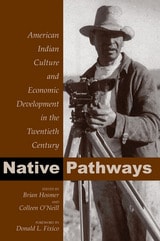
Native Pathways
American Indian Culture and Economic Development in the Twentieth CenturyBrian Hosmer
University Press of Colorado, 2004
Native Studies Keywords
Edited by Stephanie Nohelani Teves, Andrea Smith, and Michelle Raheja
University of Arizona Press, 2015
Take sovereignty, for example. The word has served as the battle cry for social justice in Indian Country. But what is the meaning of sovereignty? Native peoples with diverse political beliefs all might say they support sovereignty—without understanding fully the meaning and implications packed in the word.
The field of Native studies is filled with many such words whose meanings are presumed, rather than articulated or debated. Consequently, the foundational terms within Native studies always have multiple and conflicting meanings. These terms carry the colonial baggage that has accrued from centuries of contested words.
Native Studies Keywords is a genealogical project that looks at the history of words that claim to have no history. It is the first book to examine the foundational concepts of Native American studies, offering multiple perspectives and opening a critical new conversation.
Nineteenth-Century Rhetoric in North America
Nan Johnson
Southern Illinois University Press, 1991
Johnson argues that nineteenth-century rhetoric was primarily synthetic, derived from the combination of classical elements and eighteenth-century belletristic and epistemological approaches to theory and practice. She reveals that nineteenth-century rhetoric supported several rhetorical arts, each conceived systematically from a similar theoretical foundation.
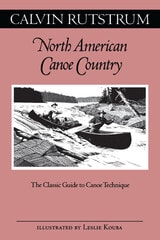
North American Canoe Country
The Classic Guide to Canoe TechniqueCalvin Rutstrum
University of Minnesota Press, 2000
The essential resource on how to canoe, now back in print.
Calvin Rutstrum’s fans have long known about his nuts-and-bolts approach to wilderness living. With this reissue of North American Canoe Country, a new generation of readers has the opportunity to learn time-tested secrets of a safe canoe adventure from a master outdoorsman.
First published in 1964, North American Canoe Country is a complete treatise on the art of canoeing. Written as a guide for travelers who want to embark on self-sufficient trips deep into the wilderness, this book offers readers all the information they need to plan and undertake a canoe trip. Rutstrum gives the essentials on canoes, comparing birch-bark, wood, wood-and-canvas, and aluminum crafts. His paddling techniques are timeless-he describes strategies for rough waters and rapids, for boating alone or in tandem, including stroke diagrams. Portaging, safety procedures, direction finding, towing, and much more are systematically explained.
North American Icelandic
The Life of a LanguageBirna Arnbjornsdottir
University of Manitoba Press, 2006
North American Indigenous Warfare and Ritual Violence
Edited by Richard J. Chacon and Rubén G. Mendoza
University of Arizona Press, 2007
The editors argue that a failure to acknowledge the roles of warfare and violence in the lives of indigenous North Americans is itself a vestige of colonial repression—depriving native warriors of their history of armed resistance. These essays document specific acts of Native American violence across the North American continent. Including contributions from anthropologists, archaeologists, historians, and ethnographers, they argue not only that violence existed but also that it was an important and frequently celebrated component of Amerindian life.
CONTENTS
Acknowledgments
Introduction
Richard J. Chacon and Rubén G. Mendoza
1. Traditional Native Warfare in Western Alaska
Ernest S. Burch Jr.
2. Barbarism and Ardour of War from the Tenderest Years”: Cree-Inuit Warfare in the Hudson Bay Region
Charles A. Bishop and Victor P. Lytwyn
3. Aboriginal Warfare on the Northwest Coast: Did the Potlatch Replace Warfare?
Joan A. Lovisek
4. Ethnohistoric Descriptions of Chumash Warfare
John R. Johnson
5. Documenting Conflict in the Prehistoric Pueblo Southwest
Polly Schaafsma
6. Cahokia and the Evidence for Late Pre-Columbian War in the North American Midcontinent
Thomas E. Emerson
7. Iroquois-Huron Warfare
Dean R. Snow
8. Desecrating the Sacred Ancestor Temples: Chiefly Conflict and Violence in the American Southeast
David H. Dye and Adam King
9. Warfare, Population, and Food Production in Prehistoric Eastern North America
George R. Milner
10. The Osteological Evidence for Indigenous Warfare in North America
Patricia M. Lambert
11. Ethical Considerations and Conclusions Regarding Indigenous Warfare and Violence in North America
Richard J. Chacon and Rubén G. Mendoza
References
About the Contributors
Index
North American Monsters
A Contemporary Legend CasebookDavid J. Puglia
Utah State University Press, 2021
A diverse cast of scholars contemplate these alluring creatures, feared and beloved by the communities that host them—the Jersey Devil gliding over the Pine Barrens, Lieby wriggling through Lake Lieberman, Char-Man stalking the Ojai Valley, and many, many more. Embracing local stories, beliefs, and traditions while neither promoting nor debunking, North American Monsters aspires to revive scholarly interest in local legendary monsters and creatures and to encourage folkloristic monster legend sleuthing.