Results by title
111 books match the query 'Personal narratives, American' and 4 start with n
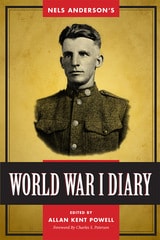
Nels Anderson’s World War I Diary
Allan Kent Powell
University of Utah Press, 2013
Nels Anderson’s World War I Diary provides a rare glimpse into the wartime experiences of one of the most well-respected sociologists of the twentieth century, the renowned author of The Hobo (1920) and Desert Saints: The Mormon Frontier in Utah (1942). Anderson, a keen observer of people, places, and events his entire life, joined the U.S. Army in 1918 at the age of 29 and was sent to Europe to fight as part of the Allied Expeditionary Force (AEF) under General Pershing. Because keeping a journal was strongly discouraged among American forces during WWI, particularly among the rank-and-file soldiers, Anderson’s diary stands as a rare gem. Furthermore, it is the only known account of war service during WWI by a member of the LDS Church. Anderson joined the Mormon faith after accepting the hospitality of an extended Mormon ranching family during his travels throughout the American West as a working hobo.
Anderson’s accounts of the St. Mihiel and Meuse-Argonne offensives are particularly remarkable given the challenges of keeping a detailed journal amidst the chaos and suffering of the war’s Western Front. His insights into the depravity and callousness of war are buttressed with intimate human portraits of those to whom he was closest. The war years provided many formative experiences that would prove to have a lasting influence on Anderson’s views regarding the working poor, authority, and human values; this would come to bear heavily on his later work as a pioneering sociologist at the University of Chicago, where he helped establish participant observation as a research method. The many introspective entries contained in this volume will be of reat interest to military historians and history buffs as well as to those in the social sciences looking to find the intellectual origins of Anderson’s later work in the burgeoning field of sociology.
Winner of the Army Historical Foundation Distinguished Writing Award for Journals, Memoirs, and Letters.
Nightmare on Iwo Jima
A Marine in CombatPatrick F. Caruso, with a foreword by David G. Rathgeber
University of Alabama Press, 2007

Normandy to the Bulge
An American GI in Europe During World War IIRichard Courtney
Southern Illinois University Press, 1997
Basing this compelling war memoir on his original World War II diary, Pfc. Richard D. Courtney tells what it was like to be a combat infantryman in the greatest and most destructive war in history.
Not Without Honor
The Nazi POW Journal of Steve Carano; With Accounts by John C. Bitzer and Bill BlackmonKay Sloan
University of Arkansas Press, 2008