Results by title
50 books match the query 'Philosophy of nature' and 5 start with n
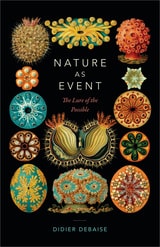
Nature as Event
The Lure of the PossibleDidier Debaise
Duke University Press, 2017
We have entered a new era of nature. What remains of the frontiers of modern thought that divided the living from the inert, subjectivity from objectivity, the apparent from the real, value from fact, and the human from the nonhuman? Can the great oppositions that presided over the modern invention of nature still claim any cogency? In Nature as Event, Didier Debaise shows how new narratives and cosmologies are necessary to rearticulate that which until now had been separated. Following William James and Alfred North Whitehead, Debaise presents a pluralistic approach to nature. What would happen if we attributed subjectivity and potential to all beings, human and nonhuman? Why should we not consider aesthetics and affect as the fabric that binds all existence? And what if the senses of importance and value were no longer understood to be exclusively limited to the human?
[more]
Nature in American Philosophy (Studies in Philosophy and the History of Philosophy, Volume 42)
Jean De Groot
Catholic University of America Press, 2004
With its focus on philosophy of nature, this book fills a gap in the ongoing reassessment of nineteenth-century American philosophy, and it opens the way to further study of the role played by reflection on nature in the emergence of the American mind.
[more]
Nature
Course Notes from the College de FranceMaurice Merleau-Ponty
Northwestern University Press, 2000
Collected here are the written traces of courses on the concept of nature given by Maurice Merleau-Ponty at the Collège de France in the 1950s-notes that provide a window on the thinking of one of the most influential philosophers of the twentieth century. In two courses distilled by a student and in a third composed of Merleau-Ponty's own notes, the ideas that animated the philosopher's lectures and that informed his later publications emerge in an early, fluid form in the process of being elaborated, negotiated, critiqued, and reconsidered.
Merleau-Ponty's project in these courses is an interrogation of nature, a task at the center of his investigation of perception, truth, and subjectivity. The first course, a survey of the historical elements in our concept of nature, examines first the Cartesian concept of nature and then historical and contemporary responses to Descartes, all with an eye toward developing a vision of nature more consistent with the findings of contemporary science.
In the second course, Merleau-Ponty takes up the problem of the relation of nature to ontology in general. Here, the key question is how the animal finds itself in its world. Because the human body is ultimately "an animal of movements and perceptions," humanity is intertwined with animality.
In the third course, "Nature and Logos: The Human Body," Merleau-Ponty assesses his previous findings and examines the emergence of the human body at the intersection of nature and Logos. This course, contemporaneous with the working notes for <i>The Visible and the Invisible<i>, allows us to observe the evolution of that work as well as to revisit the research he had begun in <i>Primacy of Perception</i>.
In these traces: a new reading of Descartes; a measured appreciation of Schelling; an assessment of recent developments in the sciences (both physical and biological) that leads to the notion of the body as a "system of equivalencies"; and an examination of the phenomenon of life. We have a wealth of material that allows us to reconsider Merleau-Ponty's thinking and to engage his philosophical project anew.
Before his death in 1961, Maurice Merleau-Ponty was chair in philosophy at the Collège de France.
Robert Vallier is completing his doctoral work on Merleau-Ponty and Schelling at DePaul University. He has also taught at the Universite de Paris-X (Nanterre) and at the College Internationale de Philosophie.
[more]
New Philosophy of Human Nature
Neither Known to Nor Attained by the Great Ancient Philosophers, Which Will Improve Human Life and HelathOliva Sabuco de Nantes Barrera
University of Illinois Press, 2006
This volume is a critical edition of the 1587 treatise by Oliva Sabuco, New Philosophy of Human Nature, written during the Spanish Inquisition. Puzzled by medicine’s abject failure to find a cure for the plague, Sabuco developed a new theory of human nature as the foundation for her remarkably modern holistic philosophy of medicine.
Fifty years before Descartes, Sabuco posited a dualism that accounted for mind/body interaction. She was first among the moderns to argue that the brain--not the heart--controls the body. Her account also anticipates the role of cerebrospinal fluid, the relationship between mental and physical health, and the absorption of nutrients through digestion. This extensively annotated translation features an ample introduction demonstrating the work’s importance to the history of science, philosophy of medicine, and women’s studies.
Fifty years before Descartes, Sabuco posited a dualism that accounted for mind/body interaction. She was first among the moderns to argue that the brain--not the heart--controls the body. Her account also anticipates the role of cerebrospinal fluid, the relationship between mental and physical health, and the absorption of nutrients through digestion. This extensively annotated translation features an ample introduction demonstrating the work’s importance to the history of science, philosophy of medicine, and women’s studies.
[more]
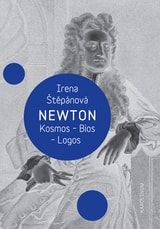
Newton
Kosmos - Bios - LogosIrena Stepánová
Karolinum Press, 2014
In 1936, following the sale of Newton’s unpublished manuscripts at auction, the scientific world was shocked: it turned out that Newton’s writings in physics and mathematics, often considered the foundations of modern science, were only a fragment of his writings, most of which were focused on theology and alchemy. In this study of Newton’s work and thought, Irena Štepánová argues for a Newton who was not the man of cold reason we know, but a “priest-scientist” with the life-long intention of carrying out an examination of God himself, as he revealed himself in both the world and in scriptural writings.
[more]