Results by title
119 books match the query 'Power (Social sciences)' and 2 start with n
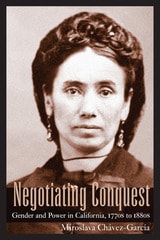
Negotiating Conquest
Gender and Power in California, 1770s to 1880sMiroslava Chávez-García
University of Arizona Press, 2004
Conquest usually has a negative impact on the vanquished, but it can also provide the disenfranchised in conquered societies with new tools for advancement within their families and communities. This study examines the ways in which Mexican and Native women challenged the patriarchal traditional culture of the Spanish, Mexican, and early American eras in California, tracing the shifting contingencies surrounding their lives from the imposition of Spanish Catholic colonial rule in the 1770s to the ascendancy of Euro-American Protestant capitalist society in the 1880s.
Negotiating Conquest begins with an examination of how gender and ethnicity shaped the policies and practices of the Spanish conquest, showing that Hispanic women, marriage, and the family played a central role in producing a stable society on Mexico’s northernmost frontier. It then examines how gender, law, property, and ethnicity shaped social and class relations among Mexicans and native peoples, focusing particularly on how women dealt with the gender-, class-, and ethnic-based hierarchies that gave Mexican men patriarchal authority. With the American takeover in 1846, the text’s focus shifts to how the imposition of foreign legal, economic, linguistic, and cultural norms affected the status of Mexican women, male-female relations, and the family. Addressing such issues as divorce, legitimacy, and inheritance, it describes the manner in which the conquest weakened the economic position of both Mexican women and men while at the same time increasing the leverage of Mexican women in their personal and social relationships with men.
Drawing on archival materials—including dozens of legal cases—that have been largely ignored by other scholars, Chávez-García examines federal, state, and municipal laws across many periods in order to reveal how women used changing laws, institutions, and norms governing property, marriage and sexuality, and family relations to assert and protect their rights. By showing that mexicanas contested the limits of male rule and insisted that patriarchal relationships be based on reciprocity, Negotiating Conquest expands our knowledge of how patriarchy functioned and evolved as it reveals the ways in which conquest can transform social relationships in both family and community.
[more]
Networks of Power
Political Relations in the Late Postclassic Naco ValleyEdward Schortman
University Press of Colorado, 2011
Little is known about how Late Postclassic populations in southeast Mesoamerica organized their political relations. Networks of Power fills gaps in the knowledge of this little-studied area, reconstructing the course of political history in the Naco Valley from the fourteenth through early sixteenth centuries.
Describing the material and behavioral patterns pertaining to the Late Postclassic period using components of three settlements in the Naco Valley of northwestern Honduras, the book focuses on how contests for power shaped political structures. Power-seeking individuals, including but not restricted to ruling elites, depended on networks of allies to support their political objectives. Ongoing and partially successful competitions waged within networks led to the incorporation of exotic ideas and imported items into the daily practices of all Naco Valley occupants. The result was a fragile hierarchical structure forever vulnerable to the initiatives of agents operating on local and distant stages.
Networks of Power describes who was involved in these competitions and in which networks they participated; what resources were mustered within these webs; which projects were fueled by these assets; and how, and to what extent, they contributed to the achievement of political aims.
[more]