598 books match the query 'Religious' and 10 start with n
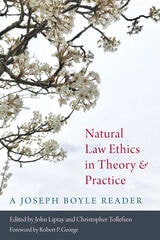
cover of Natural Law Ethics in Theory and Practic: A Joseph Boyle Reader

Natural Law Ethics in Theory and Practic

A Joseph Boyle Reader

Joseph Boyle

Catholic University of America Press, 2020

Natural Law Ethics in Theory and Practice brings together a selection of essays of the late Joseph Boyle. Boyle was, with Germain Grisez and John Finnis, a founder and developer of the New Classical Natural Law Theory, arguably the most important development in Catholic moral philosophy of the twentieth century. While this theory is indebted to the work of St. Thomas Aquinas, it incorporates an understanding and assessment of that work that is different from that found in other statements of natural law. Boyle made crucial contributions to a wide variety of aspects of this theory, and the volume is divided into two parts.

Part One: Articulating a Theory of Natural Law contains three sections in which Boyle defends the reality of free choice and the view that the basic reasons for action, or first principles of natural law, are incommensurable in goodness. Boyle identifies the basic moral standard for choice and action, and develops an account of human action that elucidates the important role played by intention and double effect in their moral evaluation.

The essays in Part Two: Natural Law Theory and Contemporary Moral Problems demonstrate the strength and scope of Boyle’s natural law account, as he brings it to bear upon just war theory, property and welfare rights, and issues in bioethics. The essays in bioethics address the difficult question of whether it is appropriate to tube-feed patients in persistent vegetative state, and include an unpublished essay, “Against Assisted Death,” which he delivered as the Anscombe Lecture at The Anscombe Bioethics Centre in Oxford about a year before he died.

This volume also includes a Foreword by Princeton’s Robert P. George; an Introduction by the editors that highlights Boyle’s contribution to the development of the new classical natural law theory; and a bibliography of Boyle’s publications.
[more]
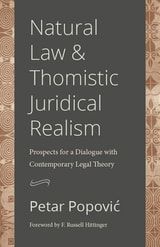
cover of Natural Law and Thomistic Juridical Realism: Prospects for a Dialogue with Contemporary Legal Theory

Natural Law and Thomistic Juridical Realism

Prospects for a Dialogue with Contemporary Legal Theory

Petar Popovic

Catholic University of America Press, 2022
This book proposes a rather novel legal-philosophical approach to understanding the intersection between law and morality. It does so by analyzing the conditions for the existence of a juridical domain of natural law from the perspective of the tradition of Thomistic juridical realism. In order to highlight the need to reconnect with this tradition in the context of contemporary legal philosophy, the book presents various other recent jurisprudential positions regarding the overlap between law and morality. While most authors either exclude a conceptual necessity for the inclusion of moral principles in the nature of law or refer to the purely moral status of natural law at the foundations of the legal phenomenon, the book seeks to elucidate the essential properties of the juridical status of natural law. In order to establish the juridicity of natural law, the book explores the relevant arguments of Thomas Aquinas and some of his main commentators on this issue, above all Michel Villey and Javier Hervada. It establishes that Thomistic juridical realism observes the juridical phenomenon not only from the perspective of legal norms or subjective individual rights, but also from the perspective of the primary meaning of the concept of right (ius), namely, the just thing itself as the object of justice. In this perspective, natural rights already possess a fully juridical status and can be described as natural juridical goods. In addition, from the viewpoint of Thomistic juridical realism, we can identify certain natural norms or principles of justice as the juridical title of these rights or goods. The book includes an assessment of the prospective points of dialogue with the other trends in Thomistic legal philosophy as well as with various accounts of the nature of law in contemporary legal theory.
[more]
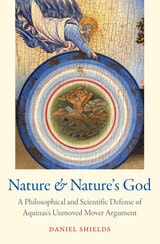
cover of Nature and Nature's God: A Philosophical and Scientific Defense of Aquinas' Unmoved Mover Argument

Nature and Nature's God

A Philosophical and Scientific Defense of Aquinas' Unmoved Mover Argument

Daniel Shields

Catholic University of America Press, 2023
Aquinas’ first proof for God’s existence is usually interpreted as a metaphysical argument immune to any objections coming from empirical science. Connections to Aquinas’ own historical understanding of physics and cosmology are ignored or downplayed. Nature and Nature's God proposes a natural philosophical interpretation of Aquinas’ argument more sensitive to the broader context of Aquinas’ work and yielding a more historically accurate account of the argument. Paradoxically, the book also shows that, on such an interpretation, Aquinas’ argument is not only consistent with modern science, but actually confirmed by the history of science, from classical mechanics through 19th century thermodynamics to contemporary cosmology. The first part of the book considers Aquinas’ argument in its historical context, exploring the key principles that everything in motion is moved by something else and that an infinite regress of causes is impossible. The structure of the First Way is analyzed and the argument is connected both with Aquinas’ Third Way—a new interpretation of which is also proposed—and Aquinas’ second proof from motion in the Summa contra Gentiles. To complete the account of what natural philosophy—prior to metaphysics—can demonstrate about God, a chapter on Aquinas’ teleological argument (the Fifth Way) is also included. The second part of the book tracks the history of modern science from Copernicus to today, showing how Aquinas’ argument fared at each major turn. The first chapter shows how Newton’s understanding of inertia and conservation of momentum supports the idea that motion cannot continue forever without God’s causality, and integrates a modern understanding of inertia and gravity with the principles of Thomistic natural philosophy. The second chapter considers the first and second laws of thermodynamics, showing how they too support Aquinas’ contention that motion cannot continue forever without God’s causality. This chapter also discusses statistical mechanics and contemporary cosmology, demonstrating that science continues to support Aquinas’ unmoved mover argument. The final chapter turns to modern biology as well as cosmological fine-tuning to show that modern science also continues to support Aquinas’ teleological argument. The result is not only a satisfying defense of Aquinas’ natural philosophical proofs for God’s existence, but a primer on the broader project of integrating Thomistic natural philosophy with modern science.
[more]
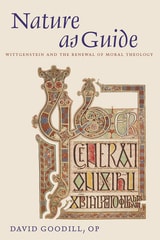
cover of Nature as Guide: Wittgenstein and the Renewal of Moral Theology

Nature as Guide

Wittgenstein and the Renewal of Moral Theology

David Goodill, OP

Catholic University of America Press, 2022
Wittgenstein influenced a generation of philosophers and theologians, with works such as Fergus Kerr’s Theology After Wittgenstein showing the relevance of Wittgenstein’s philosophy for contemporary questions in theology. Nature as Guide follows many of the insights of this earlier generation of Wittgenstein influenced scholars, to bring Wittgenstein into conversation with contemporary Catholic moral theology. The first four chapters of the book provides a reading of key themes in Wittgenstein’s philosophy, and draw among others on G.E.M. Anscombe to situate Wittgenstein in relation to the Platonic tradition. Understanding the relationship between grammar, metaphysics and nature is central to this tradition and these themes are examined through an account of Wittgenstein’s philosophical development. These four chapters also provides a critical perspective on Wittgenstein’s thought, engaging with the criticisms of Wittgenstein offered by philosophers such as Rhees Rush and William Charlton. Chapter five lays the groundwork for a dialogue between Wittgenstein and moral theology. Firstly, by examining how open Wittgenstein’s philosophy is to dialogue with theology, and secondly through proposing the use of Servais Pinckaers’ definition of moral theology to structure the conversation developed in subsequent chapters. Pinckaers’ definition is based upon St Thomas Aquinas’ presentation of the principles of human acts in the Prima Secundae of the Summa Theologiae and the final three chapters focus on the question of human acts and their basis in human nature. The reading of Wittgenstein developed in the first part of the book is brought into dialogue with the tradition of Catholic moral theology represented by Pinckaers and other students of St Thomas, such as Anscombe, Josef Pieper, Herbert McCabe, Jean Porter and Alasdair MacIntyre. The book finishes with McCabe’s account of the transformation of human nature through God’s Word, showing how Wittgenstein’s understanding of human practices can shed light on the life of grace.
[more]
cover of Navajo Tradition, Mormon Life: The Autobiography and Teachings of Jim Dandy

Navajo Tradition, Mormon Life

The Autobiography and Teachings of Jim Dandy

Robert S. McPherson

University of Utah Press, 2012

Born in the early 1940s in northern Arizona’s high country desert, Jim Dandy began life imbued with the traditions of the Navajo people. Raised by his father and grandfather—both medicine men—and a grandmother steeped in Navajo practices, he embraced their teachings and followed in their footsteps. But attending the LDS Placement program in northern Utah changed his life’s course when he became a member of the Mormon Church. Following graduation from high school, Jim served an LDS mission among his people, obtained a bachelor’s degree, and entered the work force in southeastern Utah as a career counselor, teacher, and community advocate who improved educational opportunities on the Navajo Reservation.

Jim has led a life of service and teaching. He maintains the traditional philosophy with which he was raised and the Mormon beliefs that he learned and continues to follow; his life reflects the values inherent in these two different worlds. Readers interested in Navajo philosophy will find his blend of these two distinct views fascinating, while others will better understand the effects of the controversial placement program on the life of one individual. However, this is primarily the warm story of a man’s life among his people and his love for them and their culture.
 

[more]
cover of Navigator of the Flood

Navigator of the Flood

Mario Brelich

Northwestern University Press, 1991
Mario Brelich, a Hungarian author writing in Italian, was a superb ironist. In his three novels, of which this is the first, he explored central episodes of the Old and New Testaments with unsparing wit and intelligence. In Navigator of the Flood, Brelich's Noah is a man laboring under a burden of responsibility by a Lord who appears from time to time to "correct"--at man's expense--His own foreknowledge and omniscience. If Noah finds God's commands at times cruel or incomprehensible, if he still sees beauty in a life now under threat of extinction, and wonders why he and his family should be chosen to survive while all others are condemned to perish, he remains the dutiful and upright patriarch who submits to the role assigned to him.
[more]
cover of Newman University Church, Dublin: Architectural Revivalism in the British Isles and the Authority of Form

Newman University Church, Dublin

Architectural Revivalism in the British Isles and the Authority of Form

Niamh Bhalla

University College London, 2024

The first-ever account of the historic relationship between the church and early architecture in Dublin.

Newman University Church, Dublin charts the first ever analysis of University Church’s significance within the history of Victorian revivalist architecture. Author Niamh Bhalla explores the relationship between the church’s context as the first Catholic university in Ireland and the ambiguity of its “early Christian” style, providing an effective lens to understand the architectural revivalism of the nineteenth century, particularly basilican and Byzantine revivalist architectures in the British Isles.
[more]
cover of Nicholas of Cusa's <i>On Learned Ignorance</i>: A Commentary on <i>De docta ignorantia</i>

Nicholas of Cusa's <i>On Learned Ignorance</i>

A Commentary on <i>De docta ignorantia</i>

Karsten Harries

Catholic University of America Press, 2024
This is the first commentary to have been written on Nicholas of Cusa's most famous work, On Learned Ignorance. This fact testifies to the difficulty of what has long been recognized to be the most significant philosophical text produced by the Renaissance. While there are many passages in the work that can be cited in support of Cassirer's celebration of Cusanus as the first modern philosopher, that judgment is challenged by the way his work is rooted in a faith and a tradition likely to strike us as thoroughly medieval. This commentary shows how closely the two are linked. Despite the many ways in which what the cardinal has to say belongs to a past that the progress of reason would seem to have left irrecoverably behind, it yet provides us with a continuing challenge. Key to On Learned Ignorance is the incommensurability of the infinite and the finite, of God and creation. Cusanus lets us recognize the essential transcendence of reality, so different from the ontology implied by Descartes' insistence on clear and distinct understanding, which has presided over the progress of science and has helped shape our world. What makes Cusanus’ thought important is not the way it anticipates modernity, but the way it challenges often taken-for-granted presuppositions of our worldview, most importantly a distinctly modern self-assertion or self-elevation that has made our human reason the measure of reality. If it is impossible to deny the countless ways in which our science and technology have given us ever deeper insights into the mysteries of nature and improved our lives, it is equally impossible to deny that this very progress today endangers this fragile earth and the quality of our lives. Cusanus can help us preserve our humanity.
[more]
cover of Nicholas of Cusa: A Sketch for a Biography

Nicholas of Cusa

A Sketch for a Biography

Erich Meuthen

Catholic University of America Press, 2010
This translation of Erich Meuthen's well-known biography of Nicholas of Cusa presents the foremost summary of Cusanus's life and thought. F
[more]
cover of Nots

Nots

Mark C. Taylor

University of Chicago Press, 1993

Nots is a virtuoso exploration of negation and negativity in theology, philosophy, art, architecture, postmodern culture, and medicine. In nine essays that range from nihility in Buddhism to the embodiment of negativity in disease, Mark C. Taylor looks at the surprising ways in which contrasting concepts of negativity intersect.

In the first section of this book, Taylor discusses the question of the "not" in the religious thought of Anselm, Hegel, Derrida, and Nishitani. In the second part, he analyzes artistic efforts "to figure not" in the work of artists Arakawa and Madeline Gins, architect Daniel Libeskind, pop artist David Sallee, and pop icon Madonna. The final section consists of a deeply personal and scientifically informed chapter that discusses the workings of negativity in immunology and illness.

Taylor's essays work toward a sense of the not as unnameable as it is irrepressible—an "unthinkable third" that falls between being and nonbeing. Bringing together concerns that span Taylor's early investigations of Hegel and Kierkegaard and recent studies of art and architecture, Nots is an important contribution by one of the most original and distinctive voices now writing on the American scene.

Religion and Postmodernism series
[more]