Results by title

10 books match the query 'Implications'
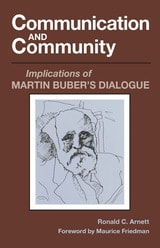
cover of Communication and Community: Implications of Martin Buber's Dialogue

Communication and Community

Implications of Martin Buber's Dialogue

Ronald C. Arnett. Foreword by Maurice Friedman

Southern Illinois University Press, 1986

Martin Buber’s work suggests that real life begins with two individ­uals engaged in dialogue, not just taking care of one’s own needs as described in social Darwinism.

Arnett argues that the end of the age of abundance demands that we give up the communica­tive strategies of the past and seek to work together in the midst of limited resources and an uncertain future. Today’s situa­tion calls for an unwavering commitment to Buber’s “narrow ridge” concern for both self and community.

Arnett illustrates the narrow ridge definition of interpersonal communication with rich ex­amples. His vignettes demon­strate effective and ineffective approaches to human communi­ty. An effective approach, he makes clear, incorporates not only openness to others’ points of view but also a willingness to be persuaded.

[more]
cover of Diversity in Language: Perspectives and Implications

Diversity in Language

Perspectives and Implications

Edited by Yoshiko Matsumoto, David Oshima, Orrin Robinson, and Peter Sells

CSLI, 2007

What does linguistic diversity tell us about the human mind? In the comprehensive volume Diversity in Language, a renowned team of contributorsassess the intricacies of linguistic variation. From historical perspectives on Indonesian to apparent time change in Smith Island verbs, from unplanned spoken Russian to argument structure in the Pacific Northwest, these essays render the full spectrum of linguistic possibility.


[more]
cover of Liberalism After Communism: The Implications of the 1993 Elections to the Federal Assembly

Liberalism After Communism

The Implications of the 1993 Elections to the Federal Assembly

Jerzy Szacki

Central European University Press, 1995
This study is devoted to recent developments in Central European (especially Polish) political thought, and concentrates on the emergence of liberal ideas, a subject largely neglected by Western observers. It provides a clear account of protoliberal and liberal thinking in Central Europe both before and after 1989, a critical appraisal of the democratic opposition to communism, and an analysis of economic liberalism as its rival orientation. The author examines the changes which occur in classical liberal ideas when they are implemented in a region with practically no liberal tradition and no socioeconomic infrastructure, and shows how liberal ideas in Central Europe are becoming constructivist, functioning as the ideological justification for a new kind of Utopian social engineering that aims at constructing capitalism.
[more]
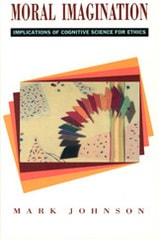
cover of Moral Imagination: Implications of Cognitive Science for Ethics

Moral Imagination

Implications of Cognitive Science for Ethics

Mark Johnson

University of Chicago Press, 1993

Using path-breaking discoveries of cognitive science, Mark Johnson argues that humans are fundamentally imaginative moral animals, challenging the view that morality is simply a system of universal laws dictated by reason. According to the Western moral tradition, we make ethical decisions by applying universal laws to concrete situations. But Johnson shows how research in cognitive science undermines this view and reveals that imagination has an essential role in ethical deliberation.

Expanding his innovative studies of human reason in Metaphors We Live By and The Body in the Mind, Johnson provides the tools for more practical, realistic, and constructive moral reflection.
[more]
cover of NanoCulture: Implications of the New Technoscience

NanoCulture

Implications of the New Technoscience

Edited by N. Katherine Hayles

Intellect Books, 2004

"Nano" denotes a billionth; a nanometer is a billionth of a meter. New instrumentation and techniques have for the first time made possible materials research and engineering at this level, the scale of individual molecules and atoms.
Extraordinary visions of material abundance, unprecedented materials, and powerful engineering capabilities have marked the arrival of nanotechnology, as well as dystopian scenarios of self-replicating devices running amok and causing global catastrophe. Largely a future possibility rather than present actuality, nanotechnology has become a potent cultural signifier.

NanoCulture explores the ways in which nanotechnology interacts with, and itself becomes, a cultural construction. Topics include the co-construction of nanoscience and science fiction; the influence of risk assessment and nanotechnology on the shapes of narratives; intersections between nanoscience as a writing practice and experimental literature at the limits of fabrication; the Alice-in-Wonderland metaphor for nanotechnology; and the effects of mediation on nanotechnology and electronic literature.

NanoCulture is produced in collaboration with the nano art exhibit at the Los Angeles County Museum of Art (December 2003-September 2004), created by an interdisciplinary team led by media artist Victoria Vesna and nanoscientist James Gimzewski. NanoCulture is richly illustrated with images from the nano exhibit, which also provides the basis for an ethnographic analysis of collaborative process and an exploration of changing concepts of museum space.

The dynamic uniting these diverse perspectives is boundary crossing: between art, science, and literature; cultural imaginaries, scientific facts, and technological possibilities; actual. virtual, and hybrid spaces; the science of fictions and the fictions of science; and utopian dreams, material constraints, and dystopian nightmares.

The first book-length study focus on cultural implications of nanotechnology, NanoCulture breaks new ground in showing the importance of the new technoscience to contemporary culture and of culture to the development, interpretation, and future of this technoscience.
[more]
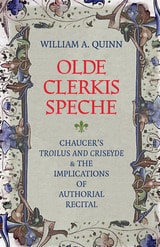
cover of Olde Clerkis Speche: Chaucer's Troilus and Criseyde and the Implications of Authorial Recital

Olde Clerkis Speche

Chaucer's Troilus and Criseyde and the Implications of Authorial Recital

William A. Quinn

Catholic University of America Press, 2013

Olde Clerkis Speche affirms both the historical legitimacy and the interpretive benefits of reading Troilus and Criseyde as if the text were initially composed for Chaucer’s own recital before a familiar audience. Proposing a qualification rather than contradiction of the "persona" as a reading premise, Quinn revitalizes the interpretive context of Chaucer’s original performance milieu. The central five chapters offer a "close hearing" of the possible tonal strategies of each book of Troilus and Criseyde during actual recital. Particular attention is given to expressions now normally overlooked, phrasing that does not advance the modern reader’s appreciation of plot or character development or theme; such "filler" did, however, once offer Chaucer's own "reader response" (or ennaratio) during the recital event. These five chapters simultaneously evaluate the probability that Chaucer himself revised each recital installment for subsequent manuscript circulation. All together, these chapters provide a sustained case study of the interplay between the author's anticipations of recital presence and textual absence. Although this study does not pretend to detail an inaugural staging of Troilus and Criseyde , it does attend to the histrionic potential of Chaucer's own "speche/ In poetrie" (T&C V. 1854-5). The final chapter discusses how such a recital premise impacts several current controversies among Chaucerians, including the dating of Chaucer's individual acts of composition, the underlying assumptions regarding the "publication" of each text, the editorial imposition of punctuation on the manuscript record, and the poet’s increasing anxiety regarding his future absence from the reading event. Olde Clerkis Speche will be of interest to all readers of Chaucer as well as everyone interested in performance theory and the history of reading.
[more]
cover of The Pinochet Case: Origins, Progress and Implications

The Pinochet Case

Origins, Progress and Implications

Edited by Madeleine Davis

University of London Press, 2003

The 1998 arrest of Senator Augusto Pinochet in London, on the orders of a Spanish judge seeking his extradition for human rights crimes, made headlines all over the world. Part of a wider, ongoing attempt by human rights activists and lawyers to prosecute the crimes of Latin American military regimes, the case has important implications for national and international law and for politics, diplomacy, and democracy. This book brings together political scientists and lawyers from Latin America, the United States, Spain, and the UK to analyze the political and historical context of the case, its progress through the courts in the UK and Chile, its handling by national governments, and its political and legal implications, both national and international. Contributors include Alan Angell (St Antony's College, Oxford, UK), Alexandra Barahona de Brito (Instituto de Estudos Estrategicos e Internacionais and Universidade Moderna, Lisbon, Portugal), Francisco Bravo Lopez (Chilean Interior Ministry), Juan E.
Garces (1999 recipient of the Right Livelihood Award for his work in preparing the Pinochet case), Carlos Huneeus (CERC, Chile and Pontificia Universidad Catolica de Chile), Brian Loveman (San Diego State University, USA), Carlos Malamud (Real Instituto Elcano de Estudios Internacionales y Estrategicos, Madrid, Spain), Antonio Remiro Brotons (Universidad Autonoma de Madrid, Spain), Naomi Roht-Arriaza (University of California, Hastings College of Law, USA), and Diana Woodhouse (Oxford Brookes University, UK).

[more]
cover of The Rise of AI: Implications and Applications of Artificial Intelligence in Academic Libraries

The Rise of AI

Implications and Applications of Artificial Intelligence in Academic Libraries

Sandy Hervieux

Assoc of College & Research Libraries, 2022

Librarians are uniquely positioned to rise to the challenge that artificial intelligence (AI) presents to the field. Libraries and their like have existed for millennia; they progress with society, altering and adapting their services to meet the information needs of their communities.

The Rise of AI collects projects, collaborations, and future uses from academic librarians who have begun to embrace AI in their work. In three parts—User Services, Collections and Discovery, and Toward Future Applications—it explores:
  • machine translation
  • creating incubation spaces
  • robotics
  • combining information literacy initiatives with AI literacy
  • fostering partnerships with other on-campus groups
  • integrating AI technology into collections to enhance discoverability
  • using AI to refine metadata for images, articles, and theses
  • machine learning
 
The Rise of AI introduces implications and applications of artificial intelligence in academic libraries and hopes to provoke conversations and inspire new ways of engaging with the technology. As the discussion surrounding ethics, bias, and privacy in AI continues to grow, librarians will be called to make informed decisions and position themselves as leaders in this discourse.
 
[more]
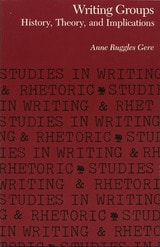
cover of Writing Groups: History, Theory, and Implications

Writing Groups

History, Theory, and Implications

Anne Ruggles Gere

Southern Illinois University Press, 1987

Drawing upon previously unpublished archival materials as well as historical accounts, Gere traces the history of writing groups in America, from their origins over a century ago to their recent reappearance in the works of Macrorie, Elbow, Murray, and others.

From this historical perspective Gere examines the theoretical foundations of writing groups, challenging the traditional concept of writing as an individual performance. She offers instead a broader view of authorship that includes both individual and social dimensions, with implications not only for the teaching of composition but also for theories of rhetoric and literacy.

[more]
cover of Writing as a Human Activity: Implications and Applications of the Work of Charles Bazerman

Writing as a Human Activity

Implications and Applications of the Work of Charles Bazerman

Paul M. Rogers

University Press of Colorado, 2023

Writing As a Human Activity offers a collection of original essays that attempt to account for Charles Bazerman’s shaping influence on the field of writing studies. Through scholarly engagement with his ideas, the 16 chapters—written by authors from Asia, Europe, North America, and South America—address Bazerman’s foundational scholarship on academic and scientific writing, genre theory, activity theory, writing research, writing across the curriculum, writing pedagogy, the sociology of knowledge, new media and technology, and international aspects of writing. Collectively, the authors use Bazerman’s work as a touchstone to consider contemporary contexts of writing as a human activity.
 
[more]