Results by title
546 books match the query 'Semiotics & Theory' and 21 start with n
Names Of History
On the Poetics of KnowledgeJacques Ranciere
University of Minnesota Press, 1994
Narrating Demons, Transformative Texts
Rereading Genius in Mid-Century Modern Fictional MemoirDaniel T. O’Hara
The Ohio State University Press, 2012
Narrating the Past
Fiction and Historiography in Postwar SpainDavid K. Herzberger
Duke University Press, 1995
The narrative and rhetorical strategies of historical discourse figure in both the fiction and historiography of postwar Spain. Herzberger analyzes these strategies, identifying the structures and vocabularies they use to frame the past and endow it with particular meanings. He shows how Francoist historians sought to affirm the historical necessity of Franco by linking the regime to a heroic and Christian past, while several types of postwar fiction—such as social realism, the novel of memory, and postmodern novels—created a voice of opposition to this practice. Focusing on the concept of writing history that these opposing strategies convey, Herzberger discloses the layering of truth and meaning that lies at the heart of postwar Spanish narrative from the early 1940s to the fall of Franco. His study clearly reveals how the novel in postwar Spain became a crucial form of dissent from the past as it was conceived and used by the State.
Making a decisive intervention in the debate about the ways in which narration determines both the meaning and truth of history and fiction, Narrating the Past will be of special interest to students and scholars of the politics, history, and literature of twentieth-century Spain.
Narrative Bonds
Multiple Narrators in the Victorian NovelAlexandra Valint
The Ohio State University Press, 2021
Narrative Co-Construction
Author-Audience Interactions and Their ContextsEdited by Malcah Effron, Margarida McMurry, and Virginia Pignagnoli
The Ohio State University Press, 2026
Advances a new, inclusive, and varied framework for understanding narrative as a product of interplay between authors, audiences, and texts.
In centering the interplay between authors and audiences as the foundation for the narrative act, the innovative and varied collection Narrative Co-Construction makes a resounding argument for the importance of making space for attending to world-building both within the world of the story and out in the world of the audience. Drawing from a range of theoretical orientations, contributors advance a framework that allows multiple points of entry to a given story and welcomes intersectional approaches, both in terms of the embodied identities of its critics and in terms of the theoretical tools they use to identify the methodologies currently active within narrative theory.
Analyzing texts by Jane Austen, André Gide, Mark Z. Danielewski, Ruth Ozeki, Ocean Vuong, and others, as well as interviews and digital (epi)texts, contributors put co-construction in dialogue with digital media studies, empirical studies, cognitive theories, literary history, literary geography, narrative criminology, and more. This inclusive approach puts different viewpoints, identities, and intellectual allegiances in conversation and asserts the value of making context and intersectionality explicit when examining narrative. By highlighting the author-audience collaboration at the heart of narrative vitality, Narrative Co-Construction deepens our understanding of narrative’s world-building power and celebrates how fictions engage readers.
Contributors:
Helen H. Davis, Malcah Effron, Erika Gotfredson, Lindsay Holmgren, Isabell Klaiber, Margaret Love, Margarida McMurry, Rae Muhlstock, Virginia Pignagnoli, Lois Presser, Alexander Scherr, Siim Sorokin, Martha Swift, Anna Torvaldsen, Katherine Weese
Narrative Policy Analysis
Theory and PracticeEmery Roe
Duke University Press, 1994
Assuming no prior knowledge of literary theory, Roe introduces the theoretical concepts and terminology from literary analysis through an examination of the budget crises of national governments. With a focus on several particularly intractable issues in the areas of the environment, science, and technology, he then develops the methodology of narrative policy analysis by showing how conflicting policy "stories" often tell a more policy-relevant meta-narrative. He shows the advantage of this approach to reading and analyzing stories by examining the ways in which the views of participants unfold and are told in representative case studies involving the California Medfly crisis, toxic irrigation in the San Joaquin Valley, global warming, animal rights, the controversy over the burial remains of Native Americans, and Third World development strategies.
Presenting a bold innovation in the interdisciplinary methodology of the policy sciences, Narrative Policy Analysis brings the social sciences and humanities together to better address real-world problems of public policy—particularly those issues characterized by extreme uncertainty, complexity, and polarization—which, if not more effectively managed now, will plague us well into the next century.
Narrative Theory Unbound
Queer and Feminist InterventionsEdited by Robyn Warhol and Susan S. Lanser
The Ohio State University Press, 2015
Through twenty-one essays prefaced by a cogent history of the field, Narrative Theory Unbound offers new perspectives on narrative discourse and its constituent elements; on intersectional approaches that recognize race, religion, and national culture as integral to understanding sexuality and gender; on queer temporalities; on cognitive research; and on lifewriting in graphic, print, and digital constellations. Exploring genres ranging from reality TV to fairy tales to classical fiction, contributors explore the thorny, contested relationships between feminist and queer theory, on the one hand, and between feminist/queer theory and contemporary narratologies, on the other. Rather than aiming for cohesiveness or conclusiveness, the collection stages open-ended debates designed to unbind the assumptions that have kept gender and sexuality on the periphery of narrative theory.
Narrative in the Anthropocene
Erin James
The Ohio State University Press, 2022
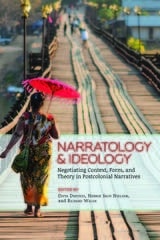
Narratology and Ideology
Negotiating Context, Form, and Theory in Postcolonial NarrativesDivya Dwivedi
The Ohio State University Press, 2018
The thirteen essays in Narratology and Ideology offer compelling readings of individual novels, with a focus upon South Asian literature, that provide a cumulative case study on the value of postcolonial narratology. The essays show not only how narrative theory can be productively applied in service of postcolonial criticism but also how such attention to postcolonial fictions can challenge and refine our theoretical understanding of narrative.
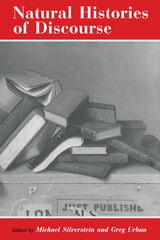
Natural Histories of Discourse
Edited by Michael Silverstein and Greg Urban
University of Chicago Press, 1996
Eleven original essays of "natural history" range in focus from nuptial poetry of insult among Wolof griots to case-based teaching methods in first-year law-school classrooms. Stage by stage, they give an idea of the cultural processes of "entextualization" and "contextualization" of discourse that they so richly illustrate. The contributors' varied backgrounds include anthropology, psychiatry, education, literary criticism, and law, making this collection invaluable not only to anthropologists and linguists, but to all analysts of culture.

Negative Life
The Cinema of ExtinctionSteven Swarbrick and Jean-Thomas Tremblay
Northwestern University Press, 2024
How films help us understand the inevitable death of Earth and humanity
Negative Life: The Cinema of Extinction brings cinema studies, queer theory, and psychoanalysis into novel configuration around the concept of negative life, a sundering of human and nonhuman relations. Engaging a philosophical and cinematic corpus that rejects the pastoralism of “entanglement” or “enmeshment,” Steven Swarbrick and Jean-Thomas Tremblay counter ecocritical pieties and cut a new path for theory. They examine films by Julian Pölsler, Kelly Reichardt, Lee Isaac Chung, Mahesh Mathai, Paul Schrader, and others that exemplify the existential contradictions currently intensifying amid the sixth mass extinction. Each case study testifies formally and thematically to negative life as a structural condition of thought and film. Together, the cases reveal the unlivable dimension of life and art, where form, desire, and nonbelonging tarry with the future-oriented promise of ecostudies—where all that lives connects. Negative Life militates against this promise, showing that faith in connection is a dead end.
Never on Time, Always in Time
Narrative Form and the Queer SensoriumKate McCullough
The Ohio State University Press, 2024
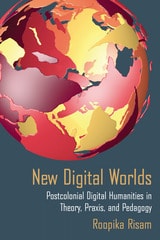
New Digital Worlds
Postcolonial Digital Humanities in Theory, Praxis, and PedagogyRoopika Risam
Northwestern University Press, 2019
New Digital Worlds traces the formation of postcolonial studies and digital humanities as fields, identifying how they can intervene in knowledge production in the digital age. Roopika Risam examines the role of colonial violence in the development of digital archives and the possibilities of postcolonial digital archives for resisting this violence. Offering a reading of the colonialist dimensions of global organizations for digital humanities research, she explores efforts to decenter these institutions by emphasizing the local practices that subtend global formations and pedagogical approaches that support this decentering. Last, Risam attends to human futures in new digital worlds, evaluating both how algorithms and natural language processing software used in digital humanities projects produce universalist notions of the "human" and also how to resist this phenomenon.
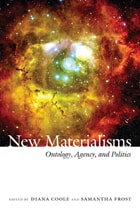
New Materialisms
Ontology, Agency, and PoliticsDiana Coole and Samantha Frost, eds.
Duke University Press, 2010
Coole and Frost argue that contemporary economic, environmental, geopolitical, and technological developments demand new accounts of nature, agency, and social and political relationships; modes of inquiry that privilege consciousness and subjectivity are not adequate to the task. New materialist philosophies are needed to do justice to the complexities of twenty-first-century biopolitics and political economy, because they raise fundamental questions about the place of embodied humans in a material world and the ways that we produce, reproduce, and consume our material environment.
Contributors
Sara Ahmed
Jane Bennett
Rosi Braidotti
Pheng Cheah
Rey Chow
William E. Connolly
Diana Coole
Jason Edwards
Samantha Frost
Elizabeth Grosz
Sonia Kruks
Melissa A. Orlie

New World Maker
Radical Poetics, Black Internationalism, and the Translations of Langston HughesRyan James Kernan, foreword by Robin D. G. Kelley
Northwestern University Press, 2022
Through original research and close readings alert to the foreign prosody underlying Hughes’s work, New World Maker recuperates his political writing, which had been widely maligned by Cold War detractors and adherents of New Criticism, and affirms his place as a progenitor of African diasporic literature and within the pantheon of US modernists. Demonstrating the integral part translation played in Hughes’s creative process, this book challenges a number of common assumptions about this canonical thinker and offers important insights for scholars of African diasporic literature, comparative literature, and American, Caribbean, and translation studies.
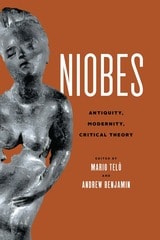
Niobes
Antiquity, Modernity, Critical TheoryEdited by Mario Telò and Andrew Benjamin
The Ohio State University Press, 2024
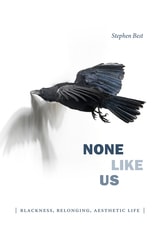
None Like Us
Blackness, Belonging, Aesthetic LifeStephen Best
Duke University Press, 2018
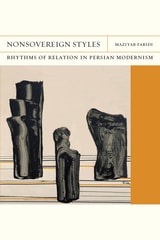
Nonsovereign Styles
Rhythms of Relation in Persian ModernismMaziyar Faridi
Northwestern University Press, 2027
Exploring motifs in modern Persian literature and Iranian film that demand new forms of relationality from politics
Assembling an understudied corpus of literary and filmic texts at the intersection of Persian and global modernism, Maziyar Faridi traces a constellation of aesthetic motifs that resist colonially imported constructs of political relationality in order to argue for an intermedial poetics of nonsovereignty. Moving from the poetry of Nima Yushij and Ahmad Shamlou to the ciné-poems of Férydoun Rahnéma and Forugh Farrokhzad, Nonsovereign Styles charts the transformation of poetic language through its exposure to minor ethnic languages and the rhetorics of English, French, and Spanish modernist poetry and alternative film. Faridi centers two key motifs: ezterāb, a trembling rhythm in which the self encounters itself as difference, and mehr, an aporetic mode of relation beyond identity, community, and sovereignty. Against the state’s project of ethnonationalism, these motifs form a poetics that is both transhistorical and transnational, producing a translational link between Iranian and internationalist poets, such as Langston Hughes and Paul Éluard. By situating Persian modernism within the broader map of global modernism, this book invites us to consider what reading these texts can teach us today about styles of relating to the world and the very sense of the political.

Novalis, Spinoza, and the Limits of Romantic Materialism
Siarhei Biareishyk
Northwestern University Press, 2026
Offering an innovative and illuminating new reading of Spinoza and Novalis
This rigorously researched study reframes our understanding of the intellectual currents in Germany around 1800 through a careful reinterpretation of its key thinker, Novalis, in conversation with Spinoza’s philosophy. Siarhei Biareishyk presents an alternative to the standard narrative that resolutely links emergent modernity and secularization to philosophical “idealism” by showing how Spinozan materialism informs the scientific experiments, metaphysical inquiries, and political debates of Novalis and his contemporaries. Shifting our focus away from the historical interpretation of Novalis as a mystic and theorist of subjectivity, Biareishyk elaborates on the Spinozan materialist strain in Novalis in three key domains: ontology and the conception of nature, theories of singularity and individuation, and the concept of the political. He brings current romanticist scholarship into conversation with contemporary discussions of Spinoza in continental philosophy, in the Marxist tradition particularly, demonstrating that the Spinoza–Novalis encounter provides a viable alternative—in its articulation of causality, dialectics, and the political—to the dominant conceptual apparatuses of both Kant and Hegel.
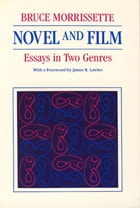
Novel and Film
Essays in Two GenresBruce Morrissette
University of Chicago Press, 1985
The influential essays collected in Novel and Film display a wide range of critical and analytic approaches to the narrative aspects of the two genres. For all the variety of their subjects, from constructional forms such as interior duplication and game play to intertextual parallels with mathematics and topology, these essays together define a unified critical perspective, one that has brought fresh precision to the analysis of narrative techniques and that continues to raise questions of prime importance to contemporary fiction. Included is a complete bibliography of Morrissette's scholarly works.
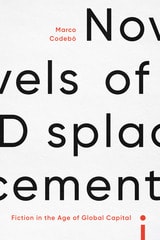
Novels of Displacement
Fiction in the Age of Global CapitalMarco Codebò
The Ohio State University Press, 2020
Using four works as case studies—Bernardo Carvalho’s Nove noites, Daniel Sada’s Porque parece mentira la verdad nunca se sabe, Zadie Smith’s White Teeth, and Mathias Énard’s Zone—Codebò investigates how globalization, displacement, and technology inform our understanding of subjectivity and one’s place in the world. Coming from different literary traditions––Brazilian-Portuguese, Spanish, English, and French–– Novels of Displacement traces the development of displacement caused by organized crime, migration, and war. Ultimately what emerges from this study is evidence of how cultures of untruth damage but do not destroy human agency.