Results by title
96 books match the query 'Shadow' and 2 start with n

Nietzsche and the Shadow of God
Didier Franck; Translated from the French by Bettina Bergo and Philippe Farah
Northwestern University Press, 2011
In Nietzsche and the Shadow of God (Nietzsche et l’ombre de Dieu), his study of Nietzsche’s integral philosophical corpus, Franck revisits the fundamental concepts of Nietzsche’s thought, from the death of God and the will to power, to the body as the seat of thinking and valuing, and finally to his conception of a post-Christian justice. The work engages Heidegger’s interpretation of Nietzsche’s destruction of the Platonic-Christian worldview, showing how Heidegger’s hermeneutic overlooked Nietzsche’s powerful confrontation with revelation and justice by working through the Christian body, as set forth in the Epistles of Saint Paul and reread both by Martin Luther and by German Idealism. Franck shows systematically how Nietzsche “transvalued” the metaphysical tenets of the Christian body of believers. In so doing, he provides an unparalleled demonstration of the coherence of Nietzsche’s project and the ways in which the revaluation of values, amor fati, and the trials of eternal recurrence reshape the living self toward a creative existence beyond original sin—indeed, beyond an ethics of “good” versus “evil.”
Bergo and Farah’s clear translation introduces this work to an English-speaking audience for the first time.
Bergo and Farah’s clear translation introduces this work to an English-speaking audience for the first time.
[more]
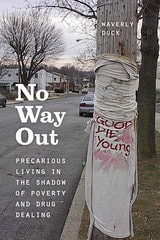
No Way Out
Precarious Living in the Shadow of Poverty and Drug DealingWaverly Duck
University of Chicago Press, 2015
In 2005 Waverly Duck was called to a town he calls Bristol Hill to serve as an expert witness in the sentencing of drug dealer Jonathan Wilson. Convicted as an accessory to the murder of a federal witness and that of a fellow drug dealer, Jonathan faced the death penalty, and Duck was there to provide evidence that the environment in which Jonathan had grown up mitigated the seriousness of his alleged crimes. Duck’s exploration led him to Jonathan’s church, his elementary, middle, and high schools, the juvenile facility where he had previously been incarcerated, his family and friends, other drug dealers, and residents who knew him or knew of him. After extensive ethnographic observations, Duck found himself seriously troubled and uncertain: Are Jonathan and others like him a danger to society? Or is it the converse—is society a danger to them?
Duck’s short stay in Bristol Hill quickly transformed into a long-term study—one that forms the core of No Way Out. This landmark book challenges the common misconception of urban ghettoes as chaotic places where drug dealing, street crime, and random violence make daily life dangerous for their residents. Through close observations of daily life in these neighborhoods, Duck shows how the prevailing social order ensures that residents can go about their lives in relative safety, despite the risks that are embedded in living amid the drug trade. In a neighborhood plagued by failing schools, chronic unemployment, punitive law enforcement, and high rates of incarceration, residents are knit together by long-term ties of kinship and friendship, and they base their actions on a profound sense of community fairness and accountability. Duck presents powerful case studies of individuals whose difficulties flow not from their values, or a lack thereof, but rather from the multiple obstacles they encounter on a daily basis.
No Way Out explores how ordinary people make sense of their lives within severe constraints and how they choose among unrewarding prospects, rather than freely acting upon their own values. What emerges is an important and revelatory new perspective on the culture of the urban poor.
[more]