Results by title
279 books match the query 'Slavery' and 8 start with n
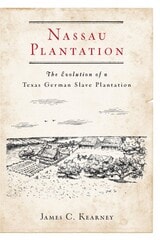
Nassau Plantation
The Evolution of a Texas-German Slave PlantationJames C. Kearney
University of North Texas Press, 2010

Negro Slavery in Arkansas
Orville Taylor
University of Arkansas Press, 2000
Long out of print and found only in rare-book stores, it is now available to a contemporary audience with this new paperback edition.
When slavery was abolished by the Emancipation Proclamation, there were slaves in every county of the state, and almost half the population was directly involved in slavery as either a slave, a slaveowner, or a member of an owner’s family. Orville Taylor traces the growth of slavery from John Law’s colony in the early eighteenth century through the French and Spanish colonial period, territorial and statehood days, to the beginning of the Civil War. He describes the various facets of the institution, including the slave trade, work and overseers, health and medical treatment, food, clothing, housing, marriage, discipline, and free blacks and manumission.
While drawing on unpublished material as appropriate, the book is, to a great extent, based on original, often previously unpublished, sources. Valuable to libraries, historians in several areas of concentration, and the general reader, it gives due recognition to the signficant place slavery occupied in the life and economy of antebellum Arkansas.
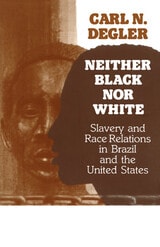
Neither Black Nor White
Slavery and Race Relations in Brazil and the United StatesCarl Degler
University of Wisconsin Press, 1986
Carl Degler’s 1971 Pulitzer-Prize-winning study of comparative slavery in Brazil and the United States is reissued in the Wisconsin paperback edition, making it accessible for all students of American and Latin American history and sociology.
Until Degler’s groundbreaking work, scholars were puzzled by the differing courses of slavery and race relations in the two countries. Brazil never developed a system of rigid segregation, such as appeared in the United States, and blacks in Brazil were able to gain economically and retain far more of their African culture. Rejecting the theory of Giberto Freyre and Frank Tannenbaum—that Brazilian slavery was more humane—Degler instead points to a combination of demographic, economic, and cultural factors as the real reason for the differences.
“In the early 1970s when studies in social history were beginning to blossom on the North American scene, Carl Degler’s prize-winning contribution was a thoughtful provocative essay in comparative history. Its thoughtfulness has not diminished with the years. Indeed, it is as topical today as when it was first published. The Brazilian experience with rapid industrialization and its attempt to restore democratic government indicates that the issues which Degler treated in the early 1970s are more pertinent than ever today.”—Franklin W. Knight, Department of History, Johns Hopkins University.

No Limits to Their Sway
Cartagena's Privateers and the Masterless Caribbean in the Age of RevolutionsEdgardo Pérez Morales
Vanderbilt University Press, 2018
Most of Cartagena's privateers were people of color and descendants of slaves who benefited from the relative freedom and flexibility of life at sea, but also faced kidnapping, enslavement, and brutality. Many came from Haiti and Guadeloupe; some had been directly involved in the Haitian Revolution. While their manpower proved crucial in the early Anti-Spanish struggles, Afro-Caribbean privateers were also perceived as a threat, suspected of holding questionable loyalties, disorderly tendencies, and too strong a commitment to political and social privileges for people of color. Based on handwritten and printed sources in Spanish, English, and French, this book tells the story of Cartagena's multinational and multicultural seafarers, revealing the Trans-Atlantic and maritime dimensions of South American independence.
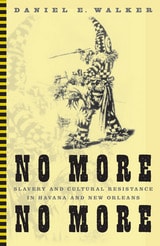
No More, No More
Slavery And Cultural Resistance In Havana And New OrleansDaniel E. Walker
University of Minnesota Press, 2004
An illuminating look at the festival performances of slaves in Havana and New Orleans
However urban slave societies might have differed from their rural counterparts, they still relied on a concerted assault on the psychological, social, and cultural identity of their African-descended inhabitants to maintain power and control. This ambitious book looks at how people of African descent in two such societies—Havana and New Orleans in the nineteenth century—created and maintained their own forms of cultural resistance to the slave regime’s assault and, in the process, put forth autonomous views of self and the social landscape.
In Havana’s annual Día de Reyes festival and in the weekly activities that took place at New Orleans’s Congo Square, author Daniel Walker identifies specific cultural beliefs and activities that Africans brought to the New World and modified in order to withstand and contest the dehumanizing effects of oppression. No More, No More crosses disciplinary boundaries as well, elucidating the economic, social, cultural, and demographic operations at work in two cities and the wide-scale efforts at cultural resistance embodied in public performances.
No State Shall Abridge
The Fourteenth Amendment and the Bill of RightsMichael Kent Curtis
Duke University Press, 1990
“Curtis effectively settles a serious legal debate: whether the framers of the 14th Amendment intended to incorporate the Bill of Rights guarantees and thereby inhibit state action. Taking on a formidable array of constitutional scholars, . . . he rebuts their argument with vigor and effectiveness, conclusively demonstrating the legitimacy of the incorporation thesis. . . . A bold, forcefully argued, important study.”—Library Journal
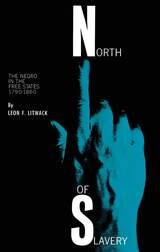
North of Slavery
The Negro in the Free StatesLeon F. Litwack
University of Chicago Press, 1965
This book was a landmark when it was published in 1965, and it has remained a crucial source for our understanding of American history ever since.

Novel Bondage
Slavery, Marriage, and Freedom in Nineteenth-Century AmericaTess Chakkalakal
University of Illinois Press, 2013